




Ventilation stopped completely. Occupancy was doing more air exchange than you realised — every door opening, every window, every use of the room.
And check the drains. A P-trap in an unused en-suite loses its water seal by evaporation. A sewer note that was not there on Friday is a plumbing job, not an odour.
2. Because occupancy was also ventilation, and you never counted it. Every time you walked through that door you exchanged some air. You opened a window in the morning. You went in and out. A used room is being continuously, accidentally ventilated. Shut it for sixty hours and it sits at the absolute floor of its range — around 0.2 air changes an hour, and often less with the door closed against a still flat.
3. Because a closed room gets hot, and heat speeds everything up. Sun on a west wall or a top-floor slab, a shut window, no fan, no air conditioning. The temperature climbs through each afternoon, and evaporation and release from every material in the room climb with it. This is the part that surprises people: emission actually rises while removal is at zero, which is why an empty room can greet you worse than a used one.
4. Because a drain nobody ran may have lost its water seal. A P-trap holds a small plug of water that blocks sewer gas. If nobody runs the shower, the basin or the floor drain in an en-suite, that water evaporates — faster in a hot closed room. A sharp sewer note that was not there on Friday is almost always this, and it is a plumbing matter, not an odour problem. Run every tap and flush every toilet before you do anything else.
5. And the fragrance step comes after the return routine. Open everything, run the water, throw the bed open, and then a reed diffuser or a Sukoon puts the character back. Scent laid over a dry trap or an unaired room gives you both at once.
Made in India, composed by an ISIPCA Versailles-trained perfumer — and a portion of every order supports girl-child education through Nanhi Kali.
Why an empty room can smell worse than a used one
The intuition behind the question is that a room smells because of what is happening in it, so a room where nothing is happening should be clean. That is half right. Nothing new went in over the weekend — but a bedroom is not a container of air, it is a container of absorbent material, and every one of those materials had a week's worth of your household in it before you left. Sorption works in both directions: fabric takes odour molecules in when the concentration in the air is high, and releases them back when it drops. Closing the door on a loaded bedroom is closing the door on a slow, steady emitter. The weekend was not a pause. It was three days of quiet unloading with the exit shut.
The second half is the part almost nobody accounts for: the ventilation you were providing without knowing it. A room in daily use gets its door opened perhaps twenty times, its window opened in the morning, a fan run, a wardrobe opened and closed. Not one of those looks like ventilating, but together they are a meaningful amount of air exchange in a small room. Take the occupant out and all of it stops at once. Add the heat — a shut room with sun on the wall and no fan runs warmer through each afternoon than the same room in use, and higher temperature raises the rate at which every material in it releases what it holds. So you have emission going up and removal going down over the same sixty hours. That is the whole mechanism, and it explains why the empty room greets you more strongly than the occupied one ever did.
The three things that happen in a shut room, and one that catches everybody
 Step fourFrom ₹749The mattress and pillow are the largest absorbent objects in the flat and they had a full week of skin lipids, body moisture and everything the room encountered before you left. Curtains, the rug, the inside of the wardrobe and any clothes left hanging do the same on a smaller scale. All of them release slowly over days. In a room being aired daily you never notice, because removal keeps pace. In a room shut for a weekend there is nothing to keep pace with it, so the concentration climbs quietly the whole time. Strip the bed before you leave if the trip is more than a couple of nights — an unmade, uncovered mattress in an empty room is a mattress that dries out.
Symptom to cause: what you walked back into
The useful thing about coming home is that you have a genuinely reset nose for about ten minutes. Use them. Walk in, stand still, and place the smell before you start opening bags.
| What you notice | Most likely cause | How to confirm it | What actually fixes it |
|---|---|---|---|
| Flat, closed and familiar — clears within ten minutes of opening up ★ | Ordinary accumulation: fabric emitting into a room with no air exchange | Open window and door together and re-enter after fifteen minutes | Air on return; leave the bedroom door open next time you go away |
| Sharp sewer or drain note that was not there on Friday | A dry P-trap in an unused drain — a plumbing matter, not an odour | Run every tap and shower, flush every toilet, water down each floor drain, wait an hour | Refill the traps; if it returns within days, get the seal checked. Never fragrance this. |
| Hot, heavy air and a smell that is strongest in the afternoon | Solar gain in a sealed room raising the release rate of every material in it | Compare the room on a cloudy return with a bright one | Curtains drawn against sun while away; door left open; purge hard on return |
| Strongly of your own diffuser, with something flat underneath it | A reed diffuser running hot in a sealed room with nothing carrying it away | Take the reeds out, air the room for fifteen minutes and judge again | Drop to one or two reeds before a long trip; replace clogged reeds at each refill |
| Musty, earthy smell after a monsoon absence, possibly with marks on a wall | Damp or mould in a closed humid room — a health issue, not an odour | Check behind the headboard, under the window sill and inside the wardrobe in daylight | Find the moisture source and remove the growth before anything else. |
| Warm dusty or plasticky smell the moment you switch the AC on | Dust settled on a damp evaporator coil and filter over an idle weekend | Run the unit on fan-only and see whether the note appears without cooling | Wash the filter; have the coil and drain cleaned if it persists |
| If none of these fit: open the flat completely, walk out for half an hour, and come back in. Your nose is reset only once per outing, and this is the best reading you will get all week. | |||
Reeds · always-on roomsFrom ₹749Shop →  Sukoon · when you want a switch₹1,899Shop →
  Hotel Collection · the scentFrom ₹299Shop →
The return routine, and the leaving routine
The return routine, before you unpack. Open the bedroom window and the bedroom door together, and something on the far side of the flat as well, so air can cross rather than sit. Fifteen minutes is right after a weekend — more than the usual ten, because you are clearing three days rather than one night. While that is running, do the water: every tap and shower for thirty seconds, every toilet flushed, and a mug of water down any floor drain or utility drain. That refills the P-traps and rules out the single most common cause of a smell that appears only when a home has been left. Then throw the bed fully open and put the ceiling fan over it for an hour, because a mattress that has sat sealed for a weekend wants moving air more than it wants anything else.
The leaving routine, which is where most of the benefit is. Before you go: strip the bed if the trip is more than a couple of nights, or at minimum leave the duvet thrown fully back rather than making it. Take the bin out. Get damp towels onto the balcony rail or into the wash. Run water down every drain in the flat so the traps start full. Draw the curtains against afternoon sun, which is the cheapest way to keep the room from baking. Leave the bedroom door open so the room shares air with the rest of the flat instead of sitting in its own for sixty hours, and leave the wardrobe door ajar for the same reason. In monsoon, this all matters more: a warm, closed, humid room with no air movement is the exact condition in which musty growth starts, and that is a health question rather than a fragrance one.
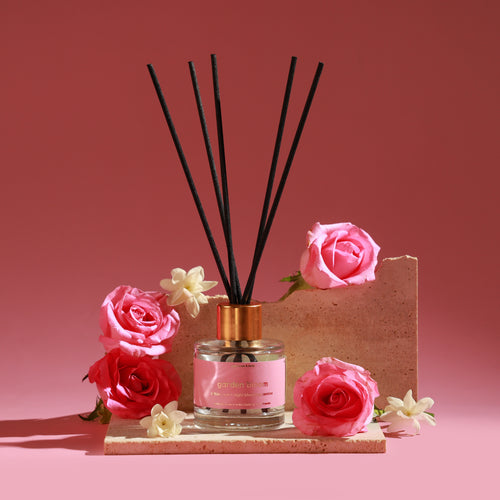
And the honest note about my own product. A reed diffuser is a passive evaporative system driven by temperature and airflow, so a hot sealed room makes it run faster, not slower. Leave a full bottle on six reeds in a closed bedroom through a hot week and you will come back to a room that smells emphatically of your own fragrance with something flat underneath it, and a bottle noticeably lower than you expected. Before a trip of more than a few days in summer, take it down to one or two reeds, or lift the reeds out and lay them on a saucer. On return, put the full number back once the room has been aired. In a bedroom the normal setting is three or four reeds anyway — reed count is the volume control, and a reed diffuser from ₹749 wants the lowest setting in the smallest room. If you would rather nothing ran at all while you were away, that is an argument for the Sukoon at ₹1,899 with a Hotel Collection scent from ₹299, which simply stays off. The two liquids are not interchangeable.
What to do, in order
Almost all of this is free and most of it happens in the fifteen minutes after you drop your bags. The purchase is fourth, and going away is one of the few times you should turn it down rather than up.
| Step | What to do | When | Cost |
|---|---|---|---|
| 1. Remove the source | Run every tap and shower, flush every toilet, water down every floor drain — before you judge anything else | Before anything else | ₹0 |
| 2. Move the air | Window and bedroom door open together for fifteen minutes, with something open across the flat | Daily, five to ten minutes | ₹0 |
| 3. Deal with what holds it | Bed thrown fully open with the fan over it; strip the bed before long trips; curtains drawn while away | Weekly to monthly | ₹0 |
| 4. Then the always-on layer ★ | A SOSA reed diffuser — a steady background once the room is aired — take it down to one or two reeds before a long summer trip | 50ml 6-8 weeks · 130ml 14-18 | from ₹749 |
| 5. Or the on-demand layer | Sukoon with a Hotel Collection scent — scent that simply stays off while you are away and comes back on when you do | Run it when you want it | ₹1,899 |
Versailles
The single most common message I get after a long weekend is some version of "the flat smells wrong and I have not even been in it". It is such a reliable pattern that I now answer with a question rather than a product: did anyone run the shower in the guest bathroom this week? About half the time, that is the whole thing — a dry trap, thirty seconds of water, problem gone, and nothing bought.
The rest is usually the fabric quietly unloading into a room nobody opened. It helps to think of a bedroom as having been charged up over the previous week and then sealed. It was always going to release; the only question was whether anything was carrying it away, and for sixty hours the answer was no. Leaving the bedroom door open when you go away costs nothing and changes that.
And I will say the unhelpful thing about my own bottles, because it is true: a reed diffuser left on six reeds in a hot shut room runs hard and gets you nowhere, since the room is not exchanging anything. Fewer reeds before a trip. Full number when you are home and the window has been open. A portion of every order funds a girl's classroom through Nanhi Kali.
Frequently asked questions
- The guest bathroom nobody uses — the same dry-trap mechanism, one room over.
- Fine at night, weird by morning — the eight-hour accumulation curve.
- Window open versus window closed — the same room at two air-change rates.
- Pillow, duvet and mattress — the reservoir that keeps emitting when you leave.
- Brand: the SOSA founder story.
SOSA products & prices (verified August 2026): Hotel Collection water-based ultrasonic diffuser fragrance 15ml ₹299 · 100ml ₹999 · 300ml ₹1,799 · Pack of 7 (15ml, all fragrances) ₹1,799; refills 100ml from ₹999. Seven scents: The Ritz-Carlton-inspired (white tea · bergamot · cedar), Westin-inspired (white tea · aloe · cedar), 1 Hotels-inspired (cedarwood · vetiver · green leaves), The St. Regis-inspired (amber · violet · woods), Shangri-La-inspired (jasmine · green tea · white tea), Four Seasons-inspired (citrus · floral · sandalwood), W Hotels-inspired (citrus · pepper · amber). Diffusers: Boond 300ml ₹899 · Sukoon 500ml ₹1,899 · Megh 6L ₹3,499. Water-based, phthalate-free, composed to IFRA standards for home diffusion; 3–6 drops per tank. Made in India, Pune. The Hotel Collection scents are SOSA's own interpretations inspired by the world's finest hotels; all hotel names are trademarks of their respective owners and are used only to describe the scent style — SOSA is an independent Indian fragrance house, not affiliated with or endorsed by any hotel brand. Prices and availability subject to change — see the live product pages.