
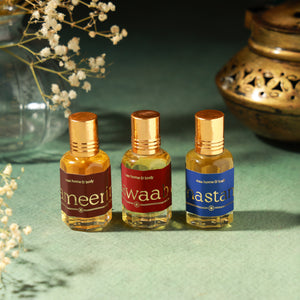
- The direct answer
- What actually makes a floral attar read contemporary
- The three decisions this comes down to
- Matching your sense of 'contemporary' to the right SOSA attar
- How much to put on, and how often
- What to buy first, and what to add later
- A note from Sonal
- Questions about contemporary versus traditional florals
2. No rose and no oudh is the specific thing that sets it apart in this range. Ameeri and Mastani both build on rose paired with oudh, which is the oldest and most recognisable attar structure there is. Adaa is the one attar here that steps outside that pairing entirely.
3. A single clean white flower reads differently from a rose-and-spice bouquet. Jasmine sambac alone, without a second competing floral note, is a simpler, more linear structure — closer to how a lot of contemporary niche and designer florals are built around one clear idea rather than a layered traditional bouquet.
4. White musk as a base, rather than oudh or sandalwood, is a genuinely different finish. A musk base keeps a floral close to skin and quiet as it dries down, where an oudh or sandalwood base gives a fragrance more weight and a more traditional, incense-adjacent trail.
5. This isn't a verdict against Ameeri or Mastani — it's a different, equally deliberate choice. Rose-and-oudh is a structure with real history behind it, built on purpose, not a fragrance that failed to modernise. Adaa simply answers a different brief.
If 'contemporary' is the specific thing you're listening for, it's in Adaa's structure — citrus, one flower, musk — not in a fresher-smelling version of rose and oudh.
What actually makes a floral attar read contemporary
'Contemporary' gets used loosely in fragrance conversation, usually to mean 'fresher' or 'less intense,' but the more precise version of the word points to structure — how many notes are doing the work, and which families they come from. A traditional attar structure, the one this range's rose attars are built on, layers a floral centre over a resinous or woody base: rose paired with oudh, or rose and jasmine paired with oudh, is the oldest and most recognisable attar architecture there is, and it's a structure that has stayed current for centuries because it genuinely works, not because attar has failed to move past it.
A more contemporary structure tends to do less at once: a single bright opening note, one clear floral idea rather than a bouquet, and a clean base rather than a resinous one. That's the shape Adaa takes — bergamot opens it, jasmine sambac carries the middle alone, and white musk finishes it, with green cardamom adding spice-green lift rather than a second competing note. No rose, no oudh, no sandalwood. It's a simpler equation, and that simplicity, more than any particular note, is what reads as current. A lot of the fragrances launched in the last decade, across designer and niche alike, have moved toward exactly this kind of arithmetic — fewer named materials, a cleaner base, less reliance on a dense accord to carry the whole composition. Adaa isn't chasing that trend on purpose; it simply happens to land in the same structural family because the same logic — one idea, done clearly — produces the same kind of result whether it's built for an alcohol spray or an oil.
None of this makes Ameeri or Mastani lesser attars, and it would be dishonest to imply otherwise. Rose and oudh together is a deliberate, historically grounded pairing, chosen because it produces a specific kind of warmth and depth that a lighter structure can't reach. Calling it 'dated' would be mistaking intention for age — Ameeri and Mastani are traditional on purpose, built to sit in a lineage rather than to escape one, and that's a legitimate answer to a different question than the one this post is answering.
The three decisions this comes down to
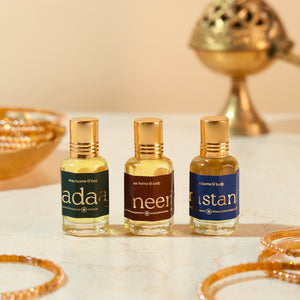
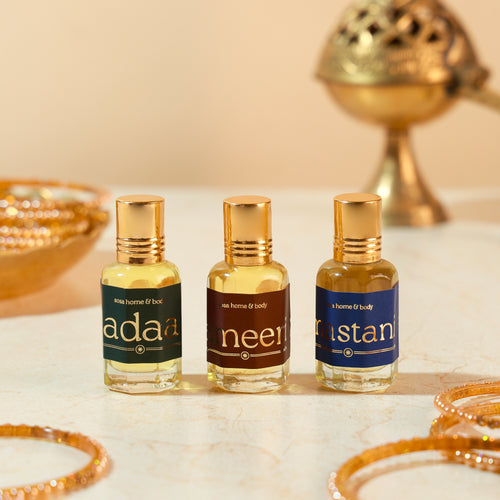
 Adaa₹379A citrus-opening, single-white-flower, musk-based structure is what actually reads contemporary — Adaa fits that description on its note list alone, not because of how it's marketed.
Matching your sense of 'contemporary' to the right SOSA attar
Different readers mean different things by 'contemporary.' This lines up the actual structural reasons against each attar, so the word means something specific rather than a vague preference.
| If 'contemporary' means… | The attar | Why it fits | The structural reason |
| No rose, no oudh, one clear floral idea | Adaa | Bergamot, green cardamom, jasmine sambac, white musk | A citrus-opening, single-white-flower, clean-musk-base structure — the shape a great deal of current perfumery uses |
| Fresher, but still rose-forward | Ameeri | Taif rose, Indian sandalwood, Persian saffron, soft oudh | Still a traditional rose-and-oudh structure underneath, just a lighter oudh treatment than Mastani's |
| Deep and layered, worn for the atmosphere it builds | Mastani | Night-blooming jasmine, Damask rose, oudh | The most classically layered structure in this range — floral centre over a full oudh base, built for depth on purpose |
| You're genuinely unsure which structure you actually prefer | Adaa and Ameeri, one of each | A direct side-by-side of the contemporary and traditional structures, without committing to the full range at once | ₹764 for both at 3 ml |
| Nawaab's white royal oud and Mysore sandalwood sit outside the floral comparison entirely | It's a traditional woody-oud structure, not a floral one — worth knowing before it's read as either a contemporary or a traditional floral answer |
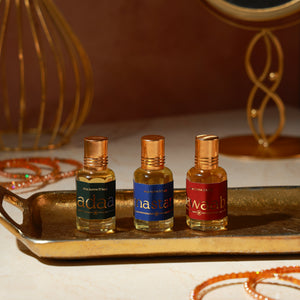
Adaa · contemporary structure₹379Shop → 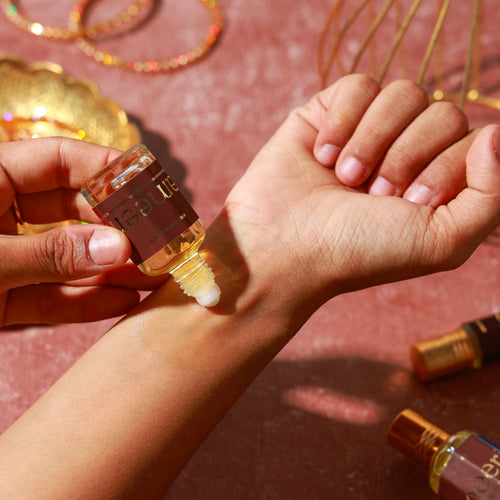 Ameeri · traditional, lighter oudh₹385Shop →
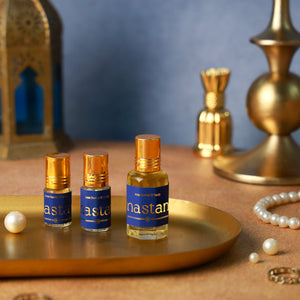
 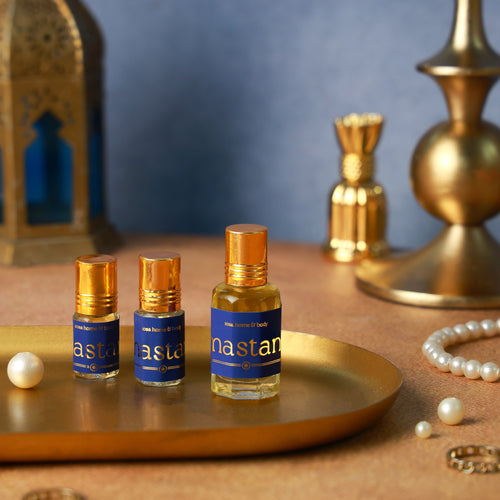 Mastani · traditional, full depth₹389Shop →
How much to put on, and how often
Never judge Adaa's contemporary structure against Ameeri or Mastani's traditional one by sillage or how far either carries — an oil isn't competing on projection, and the comparison worth making is about the shape of the fragrance, not how loudly it announces itself.
Sometimes it helps to wear Adaa on one wrist and either traditional attar on the other for a single day, simply to feel the structural difference — one note idea against a layered one — directly on skin rather than from a description.
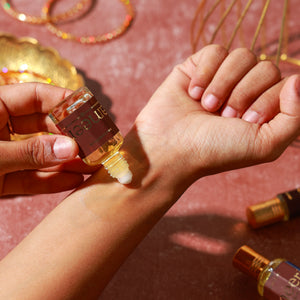
Usually, one light pass at the wrist and one at the inner elbow from a 3 ml roll-on is enough to spend a full day deciding which structure actually suits you — no more is needed for a first, honest comparison.
What to buy first, and what to add later
Matched to which structure — simple and citrus-led, or layered and rose-and-oudh — you suspect you actually want.
| Route | Best for | Why | What it costs |
| Adaa, 3 ml | A first, honest test of the contemporary structure | Low-risk way to learn whether a citrus-and-single-white-flower shape suits you before committing further | ₹379 |
| Adaa, 6 ml or 12 ml | Once the 3 ml has confirmed it | The same bergamot, cardamom, jasmine sambac and white musk structure, sized for daily wear | ₹669 / ₹1,149 |
| Ameeri, 3 ml | A traditional structure with a lighter oudh treatment | Taif rose and Indian sandalwood carried by soft oudh rather than a full one | ₹385 |
| Mastani, 3 ml | The most fully traditional, layered structure in this range | Night-blooming jasmine and Damask rose over oudh, built for depth on purpose | ₹389 |
| The Attar Trio | Genuinely undecided and ready to compare a traditional range at once | Ameeri, Nawaab and Mastani together, cheaper than three single bottles, though it doesn't include Adaa | ₹1,055 |
I trained in a house that treats structure as the whole conversation, and I still think most 'contemporary versus traditional' debates skip past the actual reason a fragrance reads one way or the other. It's rarely about how new a note is — orange blossom and rose are both centuries old. It's about how many ideas a formula is carrying and how they're layered.
Adaa is genuinely the simplest structure in this range: one opening, one floral idea, one base. That's what makes it read current, not a decision to avoid tradition. Ameeri and Mastani are built the opposite way on purpose — rose and jasmine given real weight by oudh, because that weight is the entire point of a traditional attar and I wasn't going to build a thinner version of it just to chase a trend. I've watched other perfumers thin out a rose-and-oudh formula to make it feel 'younger,' and the result usually reads as an apology for the structure rather than a confident version of something else — that's not a trap I wanted Ameeri or Mastani to fall into.
What I'd ask a reader chasing 'contemporary' to sit with is whether they actually want the simpler structure, or whether they've absorbed the idea that traditional automatically means old-fashioned. Those aren't the same question, and Adaa and Ameeri, worn back to back at 3 ml each, answer it far better than any description I could write here. I'd rather someone try both and choose the traditional structure on purpose than assume, without smelling it, that contemporary must be the better answer for them.
Questions about contemporary versus traditional florals
- Which Perfume Oil Should I Buy If I Like Modern Floral Fragrances? — a closer look at what 'modern' means for this range's florals.
- I Love Rose Perfumes but Don't Want Traditional Rose Attar — What Should I Choose? — the same contemporary-versus-traditional question, asked from rose specifically.
- Should a Floral-Perfume Lover Choose Floral Musk or Floral Woods in Attar Form? — the structural choice between Adaa's musk base and Ameeri's wood base.
- Which SOSA Attar Should a Floral-Perfume Lover Try? — this series's direct wrap-up for the same reader.
- Brand: the SOSA founder story.
SOSA attars & prices (verified September 2026): All four are alcohol-free roll-on attars in 3 ml, 6 ml and 12 ml. Adaa (bergamot, green cardamom, jasmine sambac, white musk) ₹379 · ₹669 · ₹1,149. Ameeri (Taif rose, Indian sandalwood, Persian saffron, soft oudh) ₹385 · ₹679 · ₹1,165. Mastani (night-blooming jasmine, Damask rose, oudh) ₹389 · ₹685 · ₹1,179. Nawaab (white royal oud, Mysore sandalwood, Kashmir saffron) ₹399 · ₹699 · ₹1,199. The Ameeri + Nawaab + Mastani trio is ₹1,055 · ₹1,859 · ₹3,189. Prices are the live store prices at the time of writing.