

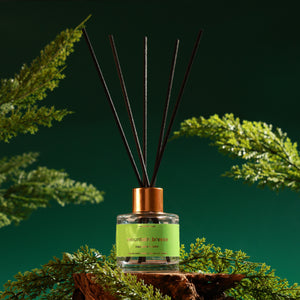
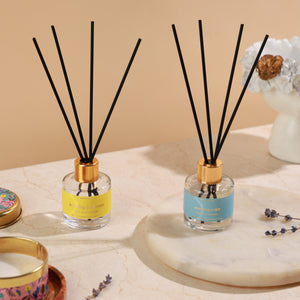
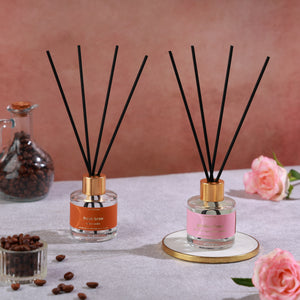
The bottle: a Garden Bloom 130ml at ₹1,299 on four reeds for a genuine foyer with a console; a 50ml at ₹799 on three reeds for a small entrance lobby.
No real foyer? Most 1BHK and 2BHK entrances are just the near edge of the living room. Stand the living-room bottle on that side rather than buying a second one — this bottle is additional spend on top of the whole-flat kits already documented in this cluster (1BHK ₹2,847 · 2BHK ₹3,696 · 3BHK ₹4,445 · 4BHK ₹5,244), not part of them.
2. Two to three metres in from the front door, never beside it. A bottle right at the door sits in the blast of every opening and swing, and loses half its output to the stairwell or corridor outside, which is not your air to scent.
3. On the side people actually pause on. That is the shoe side or the key-drop side — wherever a visitor is stationary, even briefly, rather than mid-stride toward the living room.
4. Never on the floor. It is the one place people genuinely put a foyer diffuser, usually because it is the only free surface by the shoe rack, and it puts the fragrance below the meeting zone and directly in the path of shoes and mopping.
5. Never under a ceiling fan or AC vent, and never in the direct sun of a glazed door. Both strip the top notes early and shorten a bottle that should run three to four months into one that fades by week six.
Alcohol-free, IFRA-compliant, composed by an ISIPCA Versailles-trained perfumer and handmade in small batches in Pune — and every purchase funds a girl's education through Nanhi Kali.

Why a foyer is not a corridor
This cluster's rule for passages is blunt and has stayed blunt across every post that reaches it: nothing in a corridor, because transit air holds nothing. A corridor is a length of floor with no still air anywhere in it and nothing at either end that belongs to it — people cross it, the air crosses with them, and a bottle standing in the middle of that flow is asked to fragrance a wind tunnel. That rule does not soften for a foyer just because a foyer sits at the front of the flat instead of in the middle of it.
But a foyer is built differently, and the difference is structural, not decorative. It has a threshold — the exact line where outside stops and inside starts. It has a stopping point: the spot where shoes come off, keys go down, a person waits half a second before someone opens the inner door. It has a door of its own that opens and shuts, rather than staying permanently ajar the way a passage archway does. And critically, it has still air in its corners even while the centre of the room keeps moving — a console against a side wall sits outside the direct path of anyone walking through, the same way a doorway alcove sits outside a draught even in a room with the window open. A corridor has none of this. It is transit with nothing at either end that belongs to it. A foyer has a stop in it.
Which is the whole resolution: a foyer can hold a fragrance, but only if the bottle lives in the still part of the room and not the moving part. Put it in the centre of the floor or hard against the door and you have recreated a corridor inside a room built to avoid one. Put it on the console, off to the side, at the point where a person actually pauses, and you have used the one structural feature that separates a foyer from a passage. The same logic scales — a much larger entrance hall in a big house follows an identical rule about which edge of the room is still; see where to place reed diffusers in a large home for how it plays out at that scale.
The three decisions for a foyer bottle
 Garden Bloom 130ml₹1,299The test is not square footage, it is behaviour. Does anyone stand still in this space for even three seconds — taking off shoes, putting down a bag, greeting someone at the door? If yes, it is a foyer and it can take a bottle. If the honest answer is that people simply walk through it at the same pace they walk through everywhere else, with no shoe-off point and no console, it is a corridor that happens to sit near the front door, and the passage rule applies: nothing there. A genuine foyer usually has a console, a shoe cabinet or at minimum a narrow shelf — furniture is often the tell, because nobody puts furniture in a space they only ever move through.
The foyer-by-foyer plan
Not every entrance is the same room wearing a different name, so the table below sorts by what the space actually is rather than by carpet area. Reed counts and positions assume a flip every three to five days and no direct sun or fan draught; a bottle answering to both will underperform every figure quoted here regardless of size.
| Foyer type | Bottle | Reeds | Position | Verdict |
|---|---|---|---|---|
| Genuine foyer, console or shoe cabinet ★ | Garden Bloom 130ml | Four | On the console, 2–3m in, pause side, ~1m up | ₹1,299 — the default buy |
| Small entrance lobby, narrow shelf only | Garden Bloom 50ml | Three | Same rules, scaled to the smaller surface | ₹799 — right-sized, not a downgrade |
| Foyer with a glazed door, catches direct sun | Garden Bloom 50ml | Three | Shaded side of the console, away from the glass | ₹799 — move it, don't skip it |
| Foyer sitting under a ceiling fan or AC vent | Garden Bloom 130ml | Four | Same console, shifted clear of the airflow | ₹1,299 — a position problem, not a bottle problem |
| Narrow builder passage under a metre deep, no shoe-off point | None | — | Treat it as the corridor it actually is | ₹0 — skip it |
| No separate foyer — entrance is the near edge of the living room | None | — | Stand the living-room bottle on the entrance side of the room | ₹0 — no extra bottle needed |
| Note: this is a single bottle in a single room. For context, the whole-flat kits documented elsewhere in this cluster run ₹2,847 for a 1BHK, ₹3,696 for a 2BHK, ₹4,445 for a 3BHK and ₹5,244 for a 4BHK — the foyer bottle above sits on top of those totals, not inside them. | ||||
Garden Bloom · the console130ml ₹1,299Shop → Garden Bloom · the small lobby50ml ₹799Shop → 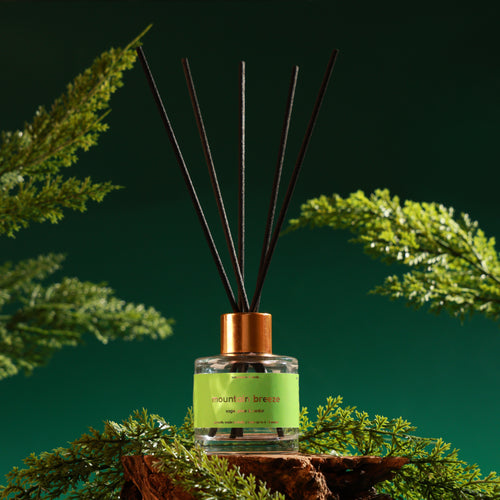 Mountain Breeze · the woody alt50ml ₹849Shop →
Reeds, flipping and the exact spot
Start at the reed count you intend to keep rather than the full six the bottle ships with. Fibre reeds saturate within a day and a half, so a foyer that has been over-dosed for a week takes several days to settle back down even after reeds come out. Four in a 130ml on a genuine console, three in a 50ml on a smaller shelf, and give it seventy-two hours before judging the strength — the first evening is not representative, because the reeds are still drawing oil up the fibre and the room has not reached a steady state.
Flip the reeds saturated-end up every three to five days, exactly as everywhere else in the flat. This is the only maintenance a foyer bottle needs, and skipping it is why a diffuser that felt strong on day one goes quiet by week three. A Sunday flip, done at the same time as the rest of the house, keeps the entrance at a steady level rather than swinging between too much and nothing at all.
Placement is worth doing precisely because it costs nothing extra. Console or shoe cabinet, about a metre off the floor — high enough to sit above the meeting zone, low enough that it is not competing with a mirror or artwork above it. Two to three metres in from the door, never against the frame. On the shoe side or the key-drop side, whichever one people actually stand at. Never on the floor, where it sits below where anyone's face is and in the direct path of shoes, umbrellas and the weekly mop. Never under a ceiling fan or an AC vent, both of which strip the top notes off within days and leave a thinner, flatter base note behind. Never in the direct sun of a glazed door, which heats the oil and fades it on the same schedule as a windowsill bottle in a bedroom. And as with every reed diffuser in the house, it is oil sitting open in a glass vessel — keep it above the reach of children and pets, and off any surface a spill would mark.
What a foyer reed diffuser actually costs
This is one bottle, not a flat's worth of bottles, so the arithmetic is short. The only running cost is the refill, since the reeds and the glass are both reused.
| Setup | Bottle & reeds | Best for | Cost |
|---|---|---|---|
| The small lobby | Garden Bloom 50ml, three reeds | A narrow entrance shelf or shoe rack, no full console | ₹799 |
| The genuine foyer ★ | Garden Bloom 130ml, four reeds | A proper console with a shoe-off point | ₹1,299 |
| The woody alternative | Mountain Breeze 50ml, three reeds | Dark wood, leather shoe racks, a more formal entrance | ₹849 |
| No real foyer | Reuse the living-room bottle, no separate purchase | 1BHK and 2BHK entrances that are just the near edge of the living room | ₹0 |
| Running cost | A 300ml refill ₹2,399, or 500ml ₹3,499 (₹7/ml) | 500ml is ten 50ml fills — roughly ₹350 a fill | from ₹2,399 |
Versailles
People ask me about the foyer more anxiously than almost any other room, because they have correctly absorbed the idea that passages get nothing and then panicked about where that leaves the entrance. It leaves it exactly where it should be — the one exception to the passage rule, and the only one, because a foyer is the one piece of transit space with a stop built into it.
The mistake I see most is dosage, not placement. Homeowners who have got the console right, got the distance from the door right, then load it with all six reeds because the entrance is supposed to make the biggest impression in the flat. It makes the opposite impression on a fresh nose. Four reeds on a genuine console reads as considered. Six reads as trying.
And if there is no real foyer — which is most 1BHK and a good number of 2BHK flats — the right answer costs nothing. Stand the living-room bottle on the door side of the room and let it do both jobs. Every purchase funds a girl's education through Nanhi Kali — not a percentage, not a quarterly cheque. Every one.
Frequently asked questions
- Is a reed diffuser good for a home entrance? — the case for and against, settled.
- Reed diffuser near your front door — how close is too close, in real terms.
- Foyer vs living room: which gets the strongest bottle? — the two rooms compared head-on.
- The complete SOSA entrance, foyer and hallway guide — every scenario in one place.
- Brand: the SOSA founder story.
SOSA reed diffusers & prices (verified August 2026): Morning Freshness (Malabar lemon · peppermint · eucalyptus) 50ml ₹749 · 130ml ₹1,249 · Evening Calm (lavender · chamomile) 50ml ₹799 · 130ml ₹1,299 · Garden Bloom (British rose · night-blooming jasmine) 50ml ₹799 · 130ml ₹1,299 · Fresh Brew (Coorg coffee · Kerala vanilla) 50ml ₹849 · 130ml ₹1,349 · Mountain Breeze (Himalayan pine · sage · cedar) 50ml ₹849 · 130ml ₹1,349. Duo sets: Day & Night 2 × 50ml ₹1,498 · 2 × 130ml ₹2,498; Fresh & Grounded 2 × 50ml ₹1,548 · 2 × 130ml ₹2,548; Warmth & Bloom 2 × 50ml ₹1,598 · 2 × 130ml ₹2,598. Refills 300ml ₹2,399 · 500ml ₹3,499. Six fibre reeds included with every bottle; refillable glass. 50ml suits rooms up to 150 sq ft and lasts 6–8 weeks; 130ml suits rooms above 150 sq ft and lasts 14–18 weeks. Fractionated coconut oil (CCT) carrier, alcohol-free, phthalate-free, paraben-free, IFRA-compliant, low VOC; tested through 45°C heat and 85% monsoon humidity. Composed and handmade in small batches in Pune. Ultrasonic machines quoted for comparison: Boond ₹899 · Sukoon ₹1,899 · Megh ₹3,499, which run the separate water-based Hotel Collection fragrances (15ml ₹299 · 100ml ₹999 · 300ml ₹1,799) — the two lines are not interchangeable. Every purchase funds a girl's education through Nanhi Kali. Prices and availability subject to change — see the live product pages.