Where Should You Place Two Sukoons in a 3BHK?

Where Should You Place Two Sukoons in a 3BHK?

★ Home scenting for Indian 3BHKs · four rooms, three machines, or one VaayuSukoon ₹1,899 · Vaayu ₹11,999 · Aangan ₹25,999 · Hotel Collection from ₹299A portion funds girl-child education
★ SOSA Sukoon × Hotel Collection
Four enclosed rooms is the point where you stop counting diffusers and start choosing between three of them and one of something else
★ ★ ★ ★ ★
★★★★★
"Three Sukoons covered the bedrooms perfectly and the living-dining still felt thin. That's when the Vaayu conversation made sense."
Sanjay R. 3BHK, Whitefield
3 × Sukoon → Vaayu
★★★★★
"We did two first — master and living. Second bedroom got the third one six weeks later. Buying in stages worked well."
Pooja V. 3BHK, Mumbai
Staged to 3
★★★★★
"Five fragrances across three machines. Sounds excessive, costs less than one mid-range candle habit, and the house is unrecognisable."
Arvind N. 3BHK, Chennai
5-scent wardrobe
★★★★★
"Open living-dining in a 3BHK is one big volume — one Sukoon was never going to do it. The Vaayu at ₹11,999 did, and it's silent."
Ruchi T. 3BHK, Gurgaon
Vaayu · living-dining
★★★★★
"Refilling three tanks was the bit I underestimated. The 300ml bottles and a Sunday routine sorted it."
Deepak M. 3BHK, Pune
300ml refills
★★★★★
"Priority order was living room, master, then guest room. Told me to buy two and live with it before the third. I never needed a fourth."
Sneha K. 3BHK, Hyderabad
Priority buying
★★★★★
"Three Sukoons covered the bedrooms perfectly and the living-dining still felt thin. That's when the Vaayu conversation made sense."
Sanjay R. 3BHK, Whitefield
3 × Sukoon → Vaayu
★★★★★
"We did two first — master and living. Second bedroom got the third one six weeks later. Buying in stages worked well."
Pooja V. 3BHK, Mumbai
Staged to 3
★★★★★
"Five fragrances across three machines. Sounds excessive, costs less than one mid-range candle habit, and the house is unrecognisable."
Arvind N. 3BHK, Chennai
5-scent wardrobe
★★★★★
"Open living-dining in a 3BHK is one big volume — one Sukoon was never going to do it. The Vaayu at ₹11,999 did, and it's silent."
Ruchi T. 3BHK, Gurgaon
Vaayu · living-dining
★★★★★
"Refilling three tanks was the bit I underestimated. The 300ml bottles and a Sunday routine sorted it."
Deepak M. 3BHK, Pune
300ml refills
★★★★★
"Priority order was living room, master, then guest room. Told me to buy two and live with it before the third. I never needed a fourth."
Sneha K. 3BHK, Hyderabad
Priority buying
One Sukoon per enclosed room · 270–320 sq ft each · from ₹1,899 Or one waterless Vaayu for up to 1000m³ of connected space · ₹11,999 Made in India · a portion of every order funds girl-child education


Founder Diaries · Home Fragrance · 3BHK Homes
By Sonal Sahani · ISIPCA Versailles 10 min read Updated August 2026
Two Sukoons in a 3BHK will either cover two rooms properly or one and a half rooms badly, and what decides which is where they stand rather than what they cost. The living/dining and the master bedroom, one machine each, and never both units breathing into the same air. That is the whole answer. It needs an article because a four-room flat offers more ways to get this wrong than any smaller home, and the commonest error costs ₹1,899 without ever looking like a mistake.
Quick answers — read this first
The two rooms: the 350–500 sq ft living/dining and the 140–180 sq ft master bedroom.

Each unit: 90–120cm up, hard surface, roughly central to its own room and on the line the flat's air already takes.

Never: two machines in one open living-dining, two machines in the two bedrooms with the living room left out, or a machine in the corridor.
The short answer
Short answer: put one Sukoon in the 350–500 sq ft living/dining and one in the 140–180 sq ft master bedroom. Each covers 270–320 sq ft of connected air, so the two machines must sit in two different enclosed rooms — a 3BHK holds four of them, and a closed door stops fragrance completely rather than diluting it.
The pick: the living/dining unit on a console or sideboard 90–120cm up, roughly central to the volume rather than against an end wall and clear of the kitchen zone; the master bedroom unit on a chest of drawers across the room from the pillow, at least 1.5m away, on low with the 2H timer. The corridor gets nothing, and the two remaining bedrooms get a reed duo set at ₹1,598 until the third machine arrives at ₹1,899.
Shop: the Sukoon (₹1,899), the Hotel Collection from ₹299, reed diffusers from ₹749 and the Boond (₹899) for a bathroom.
Straight answer
Where should you place two Sukoons in a 3BHK?
1. One in the living/dining, one in the master bedroom. Those two rooms hold almost every conscious hour in an ordinary week, and they are the only pair in a 3BHK where two machines are certainly not duplicating each other. Each Sukoon covers 270–320 sq ft of connected air.

2. Waist height or above, on something hard. Cool mist is denser than room air and descends as it disperses, so a unit at 90–120cm on a console, sideboard or chest of drawers reaches far more of a room than one on the floor beside a socket. Stand it on glass, stone, laminate or sealed wood, because a fine haze settles within about a foot.

3. On the line the air already takes. Front door to balcony, or the loop the air conditioner makes on its way back. Placed on that line the room distributes the fragrance for you. Placed in a dead corner behind a wardrobe it will scent that corner beautifully and nothing else.

4. Never let the two machines serve the same air. Both units in one open living-dining is ₹3,798 spent on a single room with a heavier middle and no extra reach at the ends. Two units in the two bedrooms, with the living room left out, is the same error with better manners.

5. The corridor does not get a machine. It is a passage that borrows from the rooms either side of it, and nobody stands in it long enough to notice. The same is true of the kitchen while you cook; a bathroom is a Boond at ₹899 rather than a 500ml unit.

A portion of every order supports girl-child education through Nanhi Kali.

TL;DR: one machine in the living/dining, one in the master bedroom, each at 90–120cm on a hard surface and on the flat's airflow line. Never two units in the same open plan, never both in bedrooms with the living room left out, and never one in the corridor.
Two Sukoons
The honest starting point
Two Sukoons ₹3,798
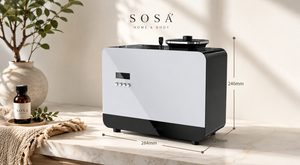
A 3BHK holds four enclosed air masses — a 350–500 sq ft living/dining, a 140–180 sq ft master bedroom, a 110–140 sq ft second bedroom and a 100–130 sq ft third bedroom. One Sukoon covers 270–320 sq ft, which is one of them. Two machines at ₹3,798 take the living/dining and the master bedroom, and because every Sukoon ships with three 15ml Hotel Collection scents you land with six bottles between them. In a four-room home this is the floor rather than the answer.

The three placement rules for a pair

A Sukoon puts out 30–50 ml/h of 2.4MHz cool mist from a 500ml tank, and whether that becomes a scented room or a damp patch on a side table is settled entirely by where it stands. The first two rules below apply to any diffuser in any home and cost nothing to follow. The third only exists once you own two machines, and in a four-room flat it is the rule that decides whether the second ₹1,899 did any work at all.

1
RULE ONE
Height and surface, for both machines
Cool mist is denser than the air around it and descends as it spreads, so a unit started at ankle level — usually because that is where the socket is — pools in the lowest third of the room. The flat then smells of very little standing up and rather a lot sitting down, which is the commonest reason people conclude a diffuser is weak. Get both machines to 90–120cm on a console, sideboard or chest of drawers, and stand them on glass, stone, laminate or sealed wood rather than a rug or unsealed timber, because a fine haze settles within about a foot of the unit. Raising a diffuser by a metre changes its coverage more than any button on it. In hard-water cities use filtered or RO water — white mineral dust on the sideboard is a water problem rather than a machine problem.
2
RULE TWO
Find the line the air already takes, in each room separately
Every flat has one — front door to balcony, living room to the bedroom window, or the loop the air conditioner makes on its way back to the unit. Placed anywhere along that line, the room distributes the fragrance without being asked. The 3BHK difference is that you do this exercise twice, in two rooms that have nothing to do with each other, because the machines are not cooperating — each is solving its own volume. In a 350–500 sq ft living/dining that usually means somewhere central rather than against an end wall, because this is the one room in the flat at or above the top of a single machine's rating.
The bedroom exception: in a 140–180 sq ft master bedroom, place the machine across the room from the pillow and at least 1.5m away, then run it on low with the 2H timer. You want ambience across the room rather than output at arm's length, and the room is comfortably inside the rating either way.
3
RULE THREE
Two machines must never serve the same air — and two bedrooms is the wrong pair
This rule only exists at two units and it is broken constantly, in two different ways. The first is both machines in the living-dining, one by the television and one near the dining table, because that is where the sockets and the surfaces are. Two Sukoons pointed into the same volume do not add their coverage together; they overlap it, so you get a heavier middle, no more reach at the ends and a master bedroom that is still silent. The second version is subtler: a machine in each of two bedrooms, with the living/dining left out. It sounds fair, and it means the largest room in the flat — the one the front door opens into, the one every guest meets, the one holding most of your waking hours — is the one room nobody scented. The second machine's entire value is that it stands behind a different door from the first, and the first door should always be the one at the front.

Where each machine goes, room by room

A 3BHK offers a small set of recognisable positions and two of them get a machine. Find the room on the left, put the unit where the third column says, then read the reason — the reasons travel to other flats and the exact positions do not.

Placement by room
Two machines, four rooms, and the right spot for each
Room Typical size Where it goes Why
Living / dining ★ 350–500 sq ft Console or sideboard 90–120cm up, roughly central to the volume, clear of the kitchen zone The largest air mass in the flat and the top of one machine's rating — central placement is how it reaches the ends
Master bedroom 140–180 sq ft Chest of drawers or dresser, across the room from the pillow, at least 1.5m away Ambience across a room that sits well inside the rating; low setting and the 2H timer
Second bedroom 110–140 sq ft No machine yet — a reed diffuser from ₹749 on the chest of drawers The third Sukoon at ₹1,899 belongs here the week somebody starts using the room
Third / guest bedroom 100–130 sq ft Nothing, or a candle from ₹379 on the evening somebody stays The least air and the least traffic in the flat — the last room to earn hardware
Corridor A passage No machine, ever It borrows from the rooms either side of it, and nobody stands in it long enough to register a fragrance
Kitchen and bathrooms Air pockets Extractor first; a Boond at ₹899 in a bathroom Fragrance layers on top of clean air rather than replacing it, and a 500ml unit is absurd in a bathroom
Shop this guide
Two machines placed properly, and something for the rooms that wait
The SOSA principle
Two machines can cover two rooms, or one room twice.
Nothing else about the pair matters as much as that sentence — not the setting, not the scent, and certainly not the price you paid.

The corridor, the open plan and the rooms you did not choose

The corridor is the question I get asked most about this size of home, and the answer is that it is not a room. A 3BHK corridor is a metre and a half wide, has no door of its own and is somewhere you spend perhaps four minutes a day in total. It has no air of its own either — it borrows from whichever rooms have their doors open, which is why it smells faintly of the living room in the evening and of nothing at all at midnight. Putting a machine there scents a passage nobody occupies while doing very little for the rooms on either side, because the fragrance has to travel through the same doorways in reverse. Place the living/dining unit on the flat's airflow line instead and the corridor takes care of itself for free. The one thing worth putting in a corridor is something that needs no socket and asks nothing of you — a reed diffuser from ₹749 on a console — and that is decoration rather than coverage.

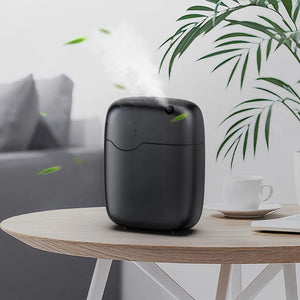
The open living-dining is the harder problem, and it is the one genuine sizing issue in a 3BHK. At 350–500 sq ft, running into the entrance and often into the corridor with no door anywhere in it, this room starts at the top of a 270–320 sq ft rating and goes upwards from there. Exhaust placement before you spend anything: get the machine to 90–120cm rather than the floor, move it away from the end wall to somewhere central to the whole volume, and put it on the line between the front door and the balcony. In a 350–400 sq ft space that is reliably enough, and I would far rather you moved a machine a metre than spent another rupee. What placement cannot do is make one unit behave like two — and adding a second Sukoon at the far end of the same open space overlaps in the middle without reaching further at the ends. If a genuinely open 450–500 sq ft plan still thins out after you have done everything above, that room — and only that room — is where a waterless Vaayu at ₹11,999 becomes a real conversation, with Sukoons staying in the bedrooms because a nebuliser does not open a door either.

Then there are the two bedrooms you did not choose, which in a 3BHK is the part people underestimate. Stopping at two machines means naming two rooms you are leaving out rather than one, and the honest fix is not to shuttle a machine between them. A 500ml tank is heavy when full and needs emptying before it travels, so the rota survives about a fortnight of enthusiasm, becomes conditional in the third week, and by the second month the unit lives permanently wherever it was last put down. Give the waiting rooms something that does not ask for a routine: a reed diffuser duo set at ₹1,598 covers both for less than a single machine, scents a corner rather than a room, needs no socket in bedrooms where the sockets are behind the bed, and reads as looked-after rather than shut up. Two Sukoons and a reed duo set is ₹5,396 and gives all four rooms something — then buy the third machine at ₹1,899 the week one of those rooms gains a person.

Both machines in the living-dining is ₹3,798 spent on one room. Both machines in the bedrooms is the same mistake with better manners.
— Sonal Sahani, SOSA

The SOSA 3BHK edit

Placement is free, so this list is about what comes after it. The order below assumes the two machines are already standing in the right two rooms, because nothing further down the table compensates for a unit on the floor in a dead corner.

The SOSA 3BHK edit
Two machines placed properly, and what follows
Buy What it does When it earns its place Price
1. Two Sukoons Living/dining and master bedroom, 270–320 sq ft each, both at 90–120cm on the airflow line — six 15ml scents between them Now. These are the two rooms that hold most of an ordinary day ₹3,798
2. Reed duo set Both waiting bedrooms given a quiet presence — no socket, no routine, no tank The same week. ₹5,396 in total gives every room in the flat something ₹1,598
3. A third Sukoon The bedroom that gains a person; nine 15ml scents across the flat The week somebody starts sleeping, studying or working in there ₹1,899
4. 300ml refill Your everyday scent across both tanks at roughly ₹6 per ml After a month, once one of the six included bottles has won ₹1,799
5. Boond 300ml / candle A bathroom at the right scale; light as well as fragrance on the evening a guest stays Only once the rooms you live in are handled ₹899 / from ₹379
Not this: a machine in the corridor A 500ml unit scenting a passage nobody stands in Never. The corridor borrows from the rooms either side of it ₹1,899
Honest notes for buyers: the Sukoon covers 270–320 sq ft, which is why a studio needs exactly one and a 3BHK needs three or a Vaayu instead. Ultrasonic diffusers are water-based and add a little humidity to the room, which is a benefit in an AC-dry home and a consideration in a damp coastal one; they run SOSA's own water-based Hotel Collection fragrance and nothing else, because thicker essential and carrier oils clog the 2.4MHz misting plate. The Vaayu and the HVAC systems are waterless nebulisers running undiluted oil — a different technology, not a bigger Sukoon, and the better choice for long daily runs across connected space. Fragrance layers on top of clean air; it does not replace an extractor fan, an open window or a bin that gets emptied. The Hotel Collection scents are SOSA's own interpretations inspired by the world's finest hotels; SOSA is an independent Indian fragrance house, not affiliated with or endorsed by any hotel brand. A portion of every order supports girl-child education through Nanhi Kali.
SOSA reed diffusers
For the rooms that are still waiting
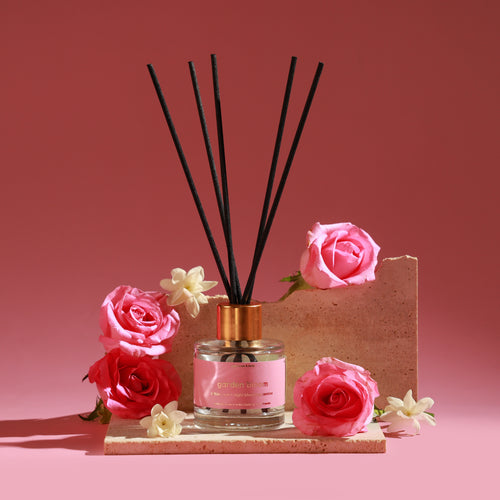
SOSA reed diffusers from ₹749
Alcohol-free reeds for the bedrooms that have not got a machine yet. They scent a corner rather than a room, they cannot be timed or turned down, and in a 100–140 sq ft guest bedroom that limitation reads as restraint — a 130ml bottle at ₹1,299 on the chest of drawers is a quiet presence rather than an event. The duo set is ₹1,598, which covers two waiting bedrooms for less than a single Sukoon and a good deal less than two.
SS
ISIPCA
Versailles
A note from Sonal

I have watched this go wrong in enough homes to know it is never a knowledge problem. People place diffusers where the sockets are, because that is what a socket is for, and in a 3BHK the sockets cluster in the living room. So both machines end up eight feet apart, the flat has one very scented room and three quiet ones, and the household concludes that two machines were not enough when in fact two machines were never used.

The rule I would tattoo on the box is that a second machine only earns its money by standing behind a different door. Living/dining and master bedroom, every time, unless somebody in your home is awake in a bedroom more hours than you are in the sitting room — and then swap the master for that room rather than adding a third to the living-dining. Everything else is small print: waist height, hard surface, the line the air already takes, and the honest admission that the corridor was never going to be a room. Get those right and two machines feel like a scented flat. Get them wrong and no amount of fragrance repairs it.

Everything is made and supported from Pune, and a part of every order funds girl-child education through Nanhi Kali. You get a home that smells like somewhere you chose; a girl gets a classroom. That equation has always felt right to me.

Frequently asked questions

Where should you place two Sukoons in a 3BHK?
One in the 350–500 sq ft living/dining and one in the 140–180 sq ft master bedroom. Each Sukoon covers 270–320 sq ft of connected air, so the two machines belong in two different enclosed rooms — the living/dining unit central and 90–120cm up, the bedroom unit across the room from the pillow on low with the 2H timer.
Can I put both Sukoons in the living-dining if it is large?
No. Two machines in one air mass overlap in the middle rather than adding their coverage together, so you get a heavier centre and no more reach at the ends. Move one behind a bedroom door, and if a genuinely open 450–500 sq ft plan still thins out, that room is a Vaayu question at ₹11,999 rather than a second Sukoon question.
Should the two machines go in the two bedrooms instead?
Only if your household is genuinely asleep or working behind those doors for most of its hours. Otherwise it leaves the living/dining — the largest volume, the room the front door opens into and the room with the most waking hours — as the one space nobody scented.
Does the corridor in a 3BHK need its own diffuser?
No. A corridor has no door of its own and borrows air from the rooms either side of it, so it smells of the living room while doors are open and of nothing when they are shut. Place the living/dining machine on the flat's airflow line and the corridor is handled; a reed diffuser from ₹749 on a console is decoration rather than coverage.
How high should a Sukoon be placed?
90–120cm, on a hard surface. Cool mist is denser than room air and descends as it disperses, so a unit on the floor scents the lowest third of the room. Glass, stone, laminate or sealed wood is best, because a fine haze settles within about a foot of the machine.
Two rooms, placed properly
Two Sukoons, ₹3,798 — and the second one only works behind a different door
Each machine covers 270–320 sq ft and arrives with three 15ml Hotel Collection fragrances of your choice. Living/dining and master bedroom, both at 90–120cm on the flat's airflow line, with a reed duo set at ₹1,598 for the two rooms still waiting. A portion of every order supports girl-child education through Nanhi Kali.
See the SOSA Sukoon → Reed diffusers from ₹749
Continue the read
More from SOSA
Editorial standards & sources
About this guide: Written by Sonal Sahani, ISIPCA Versailles-trained founder and perfumer at SOSA Home & Body, on where a pair of ultrasonic diffusers belongs in a four-room Indian flat — height, airflow, the two rooms that win, and the placement errors that quietly waste the second machine.

Facts verified August 2026: SOSA Sukoon — 500ml tank, 2.4MHz ultrasonic cool mist, 270–320 sq ft coverage, 16–18 hours runtime on low and 9–12 on high, 30–50 ml/h mist output, 7-colour LED, remote and steady/2H/4H timers, BPA-free ABS with auto shut-off and overheat protection, ~17cm high — ₹1,899, including three 15ml Hotel Collection fragrances of your choice. Boond 300ml ₹899; Megh 6-litre ₹3,499. Hotel Collection water-based fragrance 15ml ₹299, 100ml ₹999, 300ml ₹1,799, Pack of 7 × 15ml ₹1,799; 100ml and 300ml refills from ₹999. Seven scents: The Ritz-Carlton-inspired (white tea, bergamot, cedar), Westin-inspired (white tea, aloe, cedar), 1 Hotels-inspired (cedarwood, vetiver, green leaves), The St. Regis-inspired (amber, violet, woods), Shangri-La-inspired (jasmine, green tea, white tea), Four Seasons-inspired (citrus, floral, sandalwood), W Hotels-inspired (citrus, pepper, amber). Waterless systems for larger and connected spaces: Vaayu ₹11,999 (up to 1000m³), Aangan ₹25,999 (8,000–10,000 sq ft), Meenar ₹38,500 (12,000–18,000 sq ft). The Hotel Collection scents are SOSA's own interpretations; SOSA is not affiliated with or endorsed by any hotel brand. Prices subject to change — see the live product pages.
Back to blog