


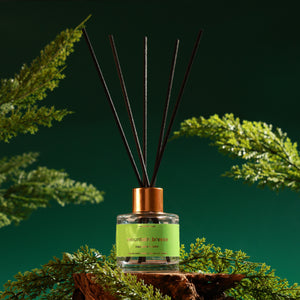
Where the fragrance goes: the entrance and lobby carry the signal, because nobody stands in a threshold for three hours. Corridors and the reception approach carry it more faintly. The members’ lounge sits deliberately below the level anyone could name.
Where it does not go: dining rooms, private dining, bar counters, spa treatment rooms, gym floors, boardrooms and a heritage library. Naming those is what makes the rest of the scheme credible to a chef, a sommelier and a long-standing member.
The machine: waterless cold-air nebulising. Vaayu at ₹11,999 covers up to 1000 m³ per unit; Aangan at ₹25,999 covers up to 3,000 m³ when it is connected to the air system.
The honest gap: SOSA publishes no leather, tobacco or smoky fragrance for any diffuser, and no purchasable refill oil is listed for the waterless commercial machines — the fragrance itself is specified and quoted per property through the contact page.
2. The door is allowed to be legible. Nothing else is. A member arrives from outside with a fresh nose and meets the building for the first time in about fifteen seconds. That is the one moment a club may be unambiguous. Everywhere a member sits, the level must fall until it is below what anyone would think to name — because the person who can still name it after an hour is being told, every minute, that somebody is managing their experience.
3. One identity, several intensities — never two fragrances. Members do not experience a club as a set of rooms; they experience it as a walk. Two different fragrances along one corridor produce a seam, and a seam is the thing that reads as cheap. The same composition at three different settings reads as one building.
4. Decide the unscented rooms first, out loud, at committee. Dining rooms, private dining and bar counters stay neutral. So do spa treatment rooms, which carry their own therapy oils, and gym floors, which need air change rather than perfume. So does a boardroom, where guests are captive for two hours and did not choose the smell. So does a library whose paper-and-timber character is a genuine asset. A scheme that names its exclusions is believed; a scheme that scents everything is not.
5. Buy the transport, not the strength. The reason a club lobby smells like a club lobby is that fragrance is introduced into moving air rather than released from an object on a console. Waterless cold-air nebulising — Vaayu ₹11,999 for a zone, Aangan ₹25,999 on the air handling — shatters undiluted oil into a dry nano-mist with no water, no added humidity and no residue. Alcohol-free, phthalate-free, IFRA-compliant, composed in Pune. A portion of every order supports girl-child education through Nanhi Kali.

The sequence: arrival, dwell, and the rooms you leave alone
Think about what a member actually does. They park, they walk in, they hand something to a person at a desk, they go somewhere and stay there. Those three activities have completely different olfactory requirements, and the commonest failure in club scenting is applying one setting to all three because the machine has one setting. The gradient is the scheme. Everything below is the same identity at a different level, chosen by how long a human being remains in the volume.
 Vaayu₹11,999The threshold and the lobby are a transit volume. Nobody stands in them, which means nobody adapts to them, which means they are the one part of the property where the fragrance may be plainly perceptible without anybody finding it intrusive. Treat the vestibule and the lobby as two volumes rather than one if there is a set of doors between them, and place the machine in the airflow path rather than in the sightline. Behind a reception desk is the worst position in the building: it is where the staff are, it is usually out of the moving air, and it guarantees the one group who cannot smell it will be the group standing closest to it.
Aangan₹25,999A members’ lounge is the hardest room in the building precisely because it is the room the club is proudest of. Somebody sits in it from two o’clock until six. If the level is set so that the room is pleasant when they walk in, it will be heavy by the second hour and oppressive by the fourth — and they will not say “this is too strong”, they will say the club feels stuffy, which is worse because you cannot act on it. Dose down, not up. A long-dwell room should sit below the level at which a member would think to remark on it. The corridor outside may carry slightly more, so that the walk in still registers as a change; the nose reports change far better than it reports a steady state, which is why a member notices a fragrance walking past a doorway and stops noticing it once seated.
Vaayu₹11,999The threshold and the lobby are a transit volume. Nobody stands in them, which means nobody adapts to them, which means they are the one part of the property where the fragrance may be plainly perceptible without anybody finding it intrusive. Treat the vestibule and the lobby as two volumes rather than one if there is a set of doors between them, and place the machine in the airflow path rather than in the sightline. Behind a reception desk is the worst position in the building: it is where the staff are, it is usually out of the moving air, and it guarantees the one group who cannot smell it will be the group standing closest to it.
Aangan₹25,999A members’ lounge is the hardest room in the building precisely because it is the room the club is proudest of. Somebody sits in it from two o’clock until six. If the level is set so that the room is pleasant when they walk in, it will be heavy by the second hour and oppressive by the fourth — and they will not say “this is too strong”, they will say the club feels stuffy, which is worse because you cannot act on it. Dose down, not up. A long-dwell room should sit below the level at which a member would think to remark on it. The corridor outside may carry slightly more, so that the walk in still registers as a change; the nose reports change far better than it reports a steady state, which is why a member notices a fragrance walking past a doorway and stops noticing it once seated.
 Mountain Breeze₹849Dining rooms, private dining and bar counters stay neutral. Ambient fragrance competes with the kitchen’s work, flattens wine, and is the one intervention a chef and a sommelier will both object to in the same meeting. Spa treatment rooms already carry therapy oils chosen by the therapist. Gym floors need air change rather than perfume; fragrance laid over exertion is a mixture, not a correction, and it smells like one. Boardrooms and private meeting rooms are small closed volumes holding people who did not choose to be there for two hours — default to unscented and let the corridor outside carry the identity. And in an older club, the library or card room that smells of paper, timber and old leather is not a problem to solve; that smell is a large part of what the membership fee buys.
Before any of this: musty is a building problem, not a fragrance problem
More than half the clubs that write to us are not asking for an identity at all. They are asking, politely, for something to be done about a smell — a heavy, closed, faintly sour note that hangs in the lounge on a Tuesday morning and in the card room all year. Fragrance will not fix it. Fragrance laid over musty does not produce fragrance; it produces musty-and-fragrance, and that mixture reads as cheaper than the musty did on its own, because now the building smells as though something is being covered up. Members detect this immediately and they raise it at committee, by name.
The cause is almost always the same set of things: moisture, low air change, and a great deal of absorbent mass. A club is full of carpet and underlay, heavy curtains, upholstered wing chairs, timber panelling and leather that has taken up humidity over decades — and a number of its rooms are used two evenings a week and shut the rest of the time. Add a monsoon and an air system that stops at midnight, and the building holds the last three years of itself. The order is fixed: find the source, deal with the moisture, get the air changing, clean the absorbent surfaces, and only then think about fragrance. A club that runs its air handling on full fresh air for an hour before opening, dries its carpets properly, services its drain traps so they do not dry out overnight and gets its relative humidity down will smell noticeably better before a single machine is bought.
I say that knowing it delays the sale, because it is the part of this subject where a supplier’s interests and a club’s interests genuinely diverge. To be exact about what we do and do not claim: SOSA sells no air purifier and no dehumidifier, and a diffuser makes no health, air-quality or mould claim of any kind. Fragrance adds fragrance. That is the whole of it. The value of the machine appears only once the building underneath it is in order, and if you install one before that you will have spent ₹11,999 to make a real problem harder to diagnose.
The whole club, room by room
This is the table I would put in front of a house committee. It is deliberately organised by how long a member stays in the volume, because that single variable decides more than the room’s function does. The last three rows are the rooms I would ask you to leave alone, and they are in the table for the same reason the others are — a scheme that only lists what it wants to sell you is a proposal, not advice.
| Space | How long a member stays | Register | Intensity | What serves it |
|---|---|---|---|---|
| Entrance, vestibule, main lobby ★ | Seconds to two minutes, fresh nose | Dry woods, white tea, a thread of citrus | Clearly perceptible — the signal | Vaayu in the airflow path, or an HVAC return |
| Reception and the desk approach | Half a minute, standing | Same identity, no change of scent | One step below the lobby | The lobby machine, positioned away from the desk |
| Corridors and stair halls | Passing through, repeatedly | Same identity | Light, but continuous | Often the best value in the whole scheme |
| Members’ lounge, reading corners | Two to four hours, seated | Same identity, drier still | Below the level anyone would name | Aangan on the air system, or a zone unit set low |
| Cloakrooms and washrooms | A few minutes | Clean and bright rather than woody | Light | Reeds are genuinely appropriate at this scale |
| Wellness reception, changing-room lobby | Minutes, in transit | Clean, cool, non-gourmand | Very light | A zone unit shared with the corridor |
| Dining rooms, private dining, bar counter | An hour or more, eating | None — neutral | Unscented | Nothing. The kitchen is the fragrance |
| Gym floor, spa treatment rooms | Thirty to ninety minutes | None | Unscented | Air change on the gym; the therapist’s own oils in treatment |
| Boardroom, private meeting rooms, library | One to three hours, captive | None, or the lowest setting at most | Unscented by default | Carry the identity in the corridor outside instead |
Zone · Vaayu₹11,999See it → Air system · Aangan₹25,999See it → Larger property · Meenar₹38,500See it →
What is actually specifiable, and what is quoted
There are three mechanisms available and they are not variations on one another; they are different physical systems with different jobs. A reed diffuser is a passive capillary device — oil climbs six fibre reeds and evaporates, with no energy used and no air moved. That makes it a fragrant zone, about two metres across, rather than a fragranced room. In a cloakroom or on a small console it is exactly right. In a 4,000 sq ft members’ lounge it is not underperforming, it is doing precisely what a passive device does, and adding nine more bottles gives you ten small zones rather than one large one. An ultrasonic machine — Sukoon ₹1,899 at 270–320 sq ft, Boond ₹899 at up to about 150 sq ft — throws a mixture of water and oil as a wet mist. It covers a real room, but it adds humidity and can leave a fine white mineral deposit on dark surfaces, and in an Indian club humidity is usually the enemy rather than the tool.
Waterless cold-air nebulising is the commercial answer. Pressurised air shatters undiluted oil into a dry nano-mist that the room’s own airflow carries; there is no water, no dilution, no added humidity and no residue. That is also the reason a member can never find the diffuser in a well-scented building: the fragrance is introduced into the moving air rather than released from an object on a table, so there is no gradient to walk up and no source to locate. Vaayu is the zone machine at ₹11,999, rated to up to 1000 m³, controlled from a Bluetooth app or the onboard buttons, with run windows of 1h, 4h, 8h or 24h, a choice of days, adjustable intensity, auto-stop and a key-lock. Aangan at ₹25,999 is the building machine, rated to up to 3,000 m³ when it is connected to the HVAC or air handling unit, with an 800ml reservoir, a metal body of 3.9 kg at 284 × 125 × 246 mm, under 42 dB, and a programmable board with work and pause cycles and daily schedules. Meenar at ₹38,500 is the larger-property option and is specified on enquiry.
Two clarifications that save a great deal of time in a specification meeting. First, the connection to an air handling unit is a mechanical integration and a real one — the machine introduces its mist into the air the building is already moving. It is not a digital integration, and none is offered: there is no building-management interface, no automation protocol and no smart-home connection on any SOSA machine, and I would rather state that in the first meeting than have it surface at commissioning. Second, on sizing: coverage is stated in volume rather than floor area, and in a club that distinction does real work. A double-height entrance hall or a galleried staircase consumes coverage that a square-foot figure hides entirely. A closed door is a boundary and an open plan is one volume, so two small rooms with doors are two zones however modest their area. I will not publish a machine count as a formula, because the honest number depends on connected volume, ceiling height, where the doors are, whether the property sits on one air system or several, and how many hours each zone is genuinely occupied. Send those five things to the contact page and the answer becomes specific.
The scheme in buying order — and the two gaps
If a club asked me to write the purchase order, this is the sequence I would write it in, and the first line is not a machine. There are also two things this range does not contain, and both of them come up in almost every first conversation, so they belong in the table rather than in a footnote.
| Step | What it is | Why it comes here in the order | Cost |
|---|---|---|---|
| 1. Fix the building first ★ | Moisture, air change, drain traps, carpet drying, a morning purge before opening | Because fragrance over musty reads as a cover-up, and members say so | No purchase |
| 2. Decide the unscented rooms | Dining, bar counter, gym floor, spa treatment, boardroom, library | Naming the exclusions is what makes the rest of the scheme credible | No purchase |
| 3. Vaayu at the arrival zone | Up to 1000 m³, in the airflow path or an HVAC return, key-locked after setting | The threshold carries the whole signal, so it is the first machine and sometimes the only one | ₹11,999 |
| 4. Aangan if the club is one air system | Up to 3,000 m³ on HVAC, 800ml, programmable cycles and daily schedules | Only worth it where the air handling genuinely serves the zones you want scented | ₹25,999 |
| 5. Reeds where a zone is what you want | Mountain Breeze and the rest, 50ml or 130ml, six fibre reeds | Cloakrooms, consoles, a secretary’s office — small volumes where two metres is the brief | ₹749–₹1,349 |
| No leather, and no listed commercial refill: the honest gaps | SOSA publishes no leather, tobacco or smoky fragrance for any diffuser. No purchasable refill oil is listed for the waterless machines either — that fragrance is specified and quoted per property | Said plainly, because a committee will check both and because quoted fragrance is the norm in commercial scenting rather than an evasion | Quoted |
Versailles
The first club I walked through with a general manager had ten reed diffusers in the members’ lounge and a complaint file about the smell. Nobody had done anything foolish. They had simply bought a passive device ten times over and expected it to behave like an active one, and what they had produced was ten pleasant pockets of fragrance with nothing in between them and a lounge that still smelled of thirty years of carpet.
What changed the building was not a bigger machine. It was running the air handling on fresh air for an hour before opening, drying the carpets properly after the monsoon, and then putting one zone unit at the threshold and nothing at all in the lounge for the first month. Members started describing the club as fresh. Not fragranced — fresh. That word is the one you are actually chasing, and it comes mostly from air, not from oil.
The other thing I would say to a committee is this. Whoever sets the intensity will be a member of staff who has been in the building since seven in the morning and stopped registering the fragrance before the first member arrived. Receptors adapt to a constant stimulus within minutes; the signal still arrives, the brain simply stops reporting it. So do not let the person who is in it all day be the person who judges it. Set it once, turn the key-lock, write the setting down, and check it only by walking in from outside — and take a member with you, because a visitor is a better instrument than any of us. Everything we make is composed in Pune, and a part of every order funds a girl’s classroom through Nanhi Kali.
Frequently asked questions
- The signature fragrance question — why a signature is a decision held for a decade rather than a bottle.
- Making a club smell expensive — half of it is the absence of stale air.
- The business club register and woody, leathery, fresh or hotel-like — the two direction pages.
- How strong it should be and avoiding the perfume-store effect — dose, and the gradient across a property.
- Should a club have one at all, how to choose it, and how it becomes an identity.
- Brand: the SOSA founder story.
SOSA commercial scenting — facts verified August 2026: Vaayu ₹11,999, waterless cold-air nebulising, coverage up to 1000 m³ ≈ 2,000–3,000 sq ft, 400ml refillable sealed tank lasting up to about 90+ days depending on intensity and hours, Bluetooth app plus onboard buttons, run windows of 1h / 4h / 8h / 24h, day selection, adjustable intensity, auto-stop and key-lock, under 38 dB, freestanding, wall-mounted or HVAC-return mounting, DC 12V / 1A at 5W, CE, RoHS and SGS, black and white. Aangan ₹25,999, HVAC or AHU connection or standalone wall-mount or lay-flat, coverage up to 3,000 m³ ≈ 8,000–10,000 sq ft, 800ml reservoir, under 42 dB, DC 12V at 14W, intelligent PCB with programmable work and pause cycles and daily schedules, metal body 3.9 kg at 284 × 125 × 246 mm, black or white, one-year warranty, imported; it has no app and no Bluetooth, and no certifications are published for it. Meenar ₹38,500 is the larger-property option and is specified on enquiry; no coverage figure is published for it here. Ultrasonic machines: Sukoon ₹1,899 at 270–320 sq ft, Boond ₹899 at up to about 150 sq ft, Megh ₹3,499 with a six-litre tank and around 100 hours of runtime but only about 215 sq ft of coverage. Reed diffusers ₹749–₹849 for 50ml lasting 6–8 weeks and ₹1,249–₹1,349 for 130ml lasting 14–18 weeks, six fibre reeds, alcohol-free, phthalate-free, paraben-free, IFRA-compliant, 0 ppm formaldehyde, heat-stable CCT carrier, refillable glass bottle, tested at 45°C and 85% RH, composed in Pune. The Hotel Collection fragrance oils are water-based and ultrasonic-only at 15ml ₹299, 100ml ₹999 and 300ml ₹1,799; they are not for reed diffusers and not for the waterless commercial machines. No purchasable refill oil is listed for the waterless commercial machines — that fragrance is specified and quoted per property. SOSA publishes no leather fragrance in any format and no tobacco or smoky fragrance for any diffuser. SOSA sells no air purifier, no dehumidifier and no room spray for interiors, and makes no health, air-quality, VOC or mould claim. No dealer programme, reseller margin, trade price, territory or service contract is published. Free shipping above ₹499. A portion of every order supports girl-child education through Nanhi Kali. SOSA is an independent Indian fragrance house; the Hotel Collection scents are SOSA’s own interpretations inspired by the world’s finest hotels, and SOSA is not affiliated with or endorsed by any hotel brand. Prices subject to change — see the live product pages.