

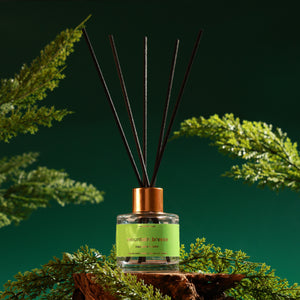
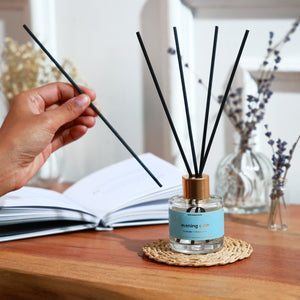
The level: below naming. If a member can describe the fragrance without being prompted, the lounge is set too high. Arrival may be unambiguous because nobody stands in a threshold; a lounge may not, because somebody stands in it all afternoon.
Why it is the hardest room in the club: it combines the longest dwell, the most absorbent soft furnishing, the most opinionated occupants and the worst available judge. The person who sets the intensity is a member of staff who has been in the building since seven and stopped perceiving the fragrance before the doors opened.
The honest gap: SOSA publishes no leather fragrance in any format, and no tobacco or smoky fragrance for any diffuser, so a lounge that wants a leather register cannot buy one here. It also does not need one — the leather is in the room already. And no adaptation time in minutes, no throw figure and no concentration threshold is published for any SOSA machine, so the level is set by walking in from outside rather than read off a chart.
2. The level belongs below naming. There is a threshold above which a person becomes able to say “this room is fragranced” and below which they can only say the room feels pleasant. The lounge belongs under that line and the entrance hall may sit above it. That is not timidity; it is the difference between a club and a lobby-scented shopping centre, and restraint is the only luxury signal that costs nothing to buy.
3. Design for the fourth hour and for the late arrival. Two people must be satisfied simultaneously: the member who has been in the chair since two o’clock and cannot smell anything at all, and their guest who arrives at five and can smell everything. If you set the level so the first person is aware of it, the second will find the room oppressive. Design for the second and the first will be comfortable without noticing why.
4. Get the building right before buying a machine. A lounge is the most absorbent room in a club — carpet and underlay, heavy curtain, upholstered wing chairs, timber panelling, leather that has taken up humidity — and a room used two evenings a week in a monsoon will smell closed however good the fragrance is. The order never changes: source, moisture, ventilation and air change, cleaning, and only then fragrance. Fragrance over a stale room produces stale-and-fragrance, and members read that mixture as a cover-up within a week.
5. Use one identity everywhere and vary only the level. The club’s signature belongs in the lounge as much as in the hall; what changes between them is intensity, not composition. Everything SOSA makes is alcohol-free, phthalate-free, paraben-free, IFRA-compliant and 0 ppm formaldehyde, composed in Pune, and a portion of every order supports girl-child education through Nanhi Kali.

Why the members’ lounge is the hardest room in the club
Clubs generally expect the entrance to be the difficult decision, because it is the visible one and the one a committee argues about. In practice the entrance is the easy room: it is a transit volume, it is opened and closed all day so its air turns over constantly, and nobody is in it long enough to develop an opinion. The lounge is where every one of those helpful conditions is reversed. Three things stack, and they are worth separating because each one has a different remedy.
 Mountain Breeze₹849Receptors adapt to a constant stimulus within minutes: the signal still arrives, the brain stops reporting it. In a lounge that is true of everybody in the room, and most true of the staff who have been in the building since seven in the morning. So the question “can you still smell it?” is being asked of the worst instrument available. Almost every over-scented club I have walked into got there honestly, one small increase at a time, each one made by somebody who genuinely could not smell the fragrance and reasonably concluded it had stopped working. It had not stopped working. They had stopped noticing, which is a completely different fact with a completely different remedy.
 Aangan₹25,999Everything that makes a lounge comfortable also makes it retentive. Carpet and underlay, heavy lined curtains, deep upholstery, leather that has taken up humidity through a monsoon, timber panelling, books. That soft mass takes up whatever the room has held — cooking carry-over from a service corridor, cigarette smoke from a decade ago, damp from a closed fortnight — and releases it slowly for hours afterwards. A room like that does not have a fragrance problem, it has a materials and air-change problem, and adding fragrance to it produces a mixture rather than a replacement. The mixture is the thing members complain about at committee, and they are right to: a covered smell reads as cheaper than the original smell did, because now something is evidently being hidden.
 Evening Calm₹799A hotel guest who dislikes a lobby fragrance leaves in two days. A member who dislikes the lounge has paid to sit in it and will raise it at the next general meeting, in writing, with support. The lounge is also where members bring guests, wear their own fragrance and conduct conversations that matter to them, so the room is competing with perfume somebody chose that morning and with an occasion somebody cares about. The practical consequence is that a lounge fragrance has to be one nobody dislikes rather than one most people like, and those are different briefs. A dry woody-green register is chosen for exactly that reason: it has very few enemies. Gourmands, big florals and heavy ambers all have enthusiastic admirers and equally strong objectors.
The long-stay register, material by material
When I am asked what a lounge should smell of, the useful answer is not a list of notes but a description of behaviour over time. A long-dwell composition has to be interesting enough to be worth having and dull enough to be endured for four hours, and most of the materials that make a fragrance immediately impressive are precisely the ones that fail the second test. Dry woods work because they are almost linear — cedar at hour four smells much as cedar smelled at minute ten, so the room does not drift under the occupants. Vetiver works for the same reason, with the added benefit of an earthy, slightly bitter edge that keeps the whole thing from becoming comfortable in a sugary way. Tea, particularly white and green tea accords, contributes the quality a lounge is really after: a clean, faintly astringent air that reads as a well-kept room rather than as a perfume.
What fails is easier to describe. Sweetness fails, because sugar accumulates in perception and because the human nose treats sweet smells as food, which makes them inappropriate near a bar and actively wrong near dining. Large white florals fail, because indole and the heavier floral materials become animalic as the day warms — the same chemistry that makes jasmine smell alive in the evening makes it smell dirty at thirty-five degrees. Heavy amber and resin fail in the specific case of a lounge that is already panelled in dark wood and furnished in leather, because the room is supplying warmth already and the fragrance then doubles it into something stuffy. And anything at all fails if it is set high, which is the failure I see most: a good composition at the wrong dose flattens into one sweet or sharp impression, and that impression is exactly what people mean when they say a place smells like air freshener. The difference between expensive and cheap, in a room, is nearly always concentration rather than composition.
One more property is worth naming because it is invisible in a note list and decisive in an Indian club. A long-dwell room is usually air-conditioned for eight or ten hours a day, and recirculating air in a closed room distributes a fragrance evenly — which is helpful — while drying that air speeds evaporation, which shortens everything. In monsoon the opposite happens: saturated air carries fragrance less readily, so projection shortens and the scent hangs close to its source. Neither of these is a reason to change the composition. Both are reasons to set the level once, in the conditions the room actually runs in, and to check it again when the season has turned, rather than adjusting it on a Tuesday because it seemed quiet.
Every register, judged for a four-hour room
The directions clubs propose to me for a lounge, and how each behaves when somebody has to sit in it all afternoon. The last two rows are the ones I argue against most often, and the final row is a direction SOSA cannot supply at all.
| Direction | At minute five | At hour four | Verdict for a lounge |
|---|---|---|---|
| Dry woods — cedar, vetiver ★ | Quiet, composed, barely there | Almost unchanged; nearly linear | The default. Very few enemies |
| Tea and clean citrus | Bright, airy, reads as a kept room | Softens rather than accumulates | Excellent, especially in a hot climate |
| Herbal and green | Fresh, slightly bitter, alert | Holds well; can thin out by evening | Good as a lift inside a woody base |
| Soft lavender and chamomile | Calm, low, unobtrusive | Still calm; the gentlest option | Defensible in a quiet reading lounge |
| Large florals | Impressive, generous | Turns heavy and can go animalic in heat | Wrong room. Keep florals for an entrance |
| Gourmand — coffee, vanilla, caramel | Warm and welcoming | Cloying, and it reads as food near a bar | No. Lovely at home, wrong in a club lounge |
| Leather or tobacco accords | The thing most clubs ask for first | Competes with the real leather in the room | SOSA publishes no leather, tobacco or smoky fragrance for any diffuser |
The lounge zone · Vaayu₹11,999See it → A whole floor · Aangan₹25,999See it → 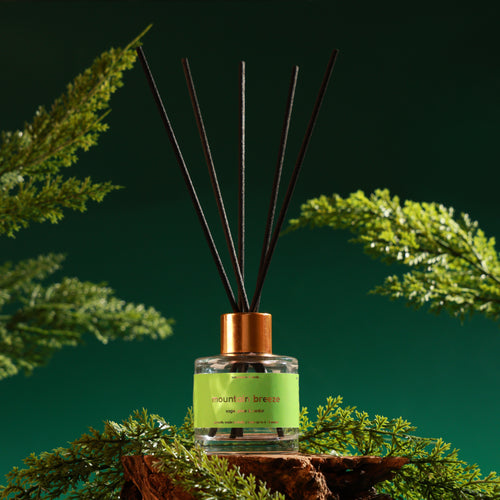 The dry-wood register · reeds₹849See it →
Setting the level, and deciding who is allowed to touch it
Everything above is a composition argument. The part that actually determines whether a club’s lounge smells good in three years’ time is procedural, and it is usually neglected because it is not interesting. The setting must be made once, by somebody unadapted, written down, and then physically prevented from drifting. That is why the key-lock on Vaayu is, in a club, worth more than any headline coverage figure. A lounge machine sits in a room staffed by people who have adapted to it, and a dial within reach of an adapted person moves in one direction only. Lock it, record the setting in the operations file against a named person, and review it on a calendar rather than on a feeling.
The second procedural decision is the schedule rather than the strength, and this is where most clubs have a free improvement available to them. A lounge that runs at a low continuous level through the service day behaves quite differently from one that runs hard in bursts, even where the total oil consumed is similar: bursts produce peaks that people notice as peaks, and a member who walks in during one will describe the club as too strong regardless of what the average was. Vaayu offers run windows of 1h / 4h / 8h / 24h with a choice of days and adjustable intensity; Aangan is set through an intelligent PCB with programmable work and pause cycles and daily schedules rather than through an app. Use that granularity to make the room even across the day instead of using intensity to make it louder.
The third decision is where the source goes, and in a lounge it is nearly always wrong on the first attempt. Fragrance needs the room’s own airflow to travel; a passive source in a still corner scents that corner and nothing else, and two passive sources make two concentration peaks with a valley between them, because neither moves air — the midpoint is the farthest point from both. That is the whole reason a reed diffuser cannot scent a large lounge: a reed is a fragrant zone, not a fragranced room, and ten bottles distributed round a members’ lounge give you ten small zones rather than one large one. This is not a failure of the product; it is the mechanism doing exactly what a passive capillary device does. Reeds belong in a club in cloakrooms, a secretary’s office, a small card room, a lift lobby — anywhere small enough that two metres around the bottle is most of the space.
The lounge edit — and the honest gaps
The decisions in the order a house committee should take them. Four of the first five cost nothing, which is the usual shape of this work: the building and the procedure matter more than the purchase, and the purchase is the last thing to decide rather than the first.
| Decision | What it is | Why it matters in a lounge | Cost |
|---|---|---|---|
| 1. Fix the building first ★ | Source, moisture, air change, cleaning — before any fragrance decision | A soft-furnished room holds odour; fragrance on top of it makes a mixture, not a replacement | No purchase |
| 2. Choose a dry register | Cedar, vetiver, tea, a green or citrus lift, no sweetness | Near-linear materials behave the same at hour four as at minute five | No extra |
| 3. Set the level from outside | Fifteen minutes out of the building, then walk in and judge once | Everyone inside the room has adapted and will ask for more | No purchase |
| 4. Write the setting down and lock it | A named owner, a recorded intensity, and the key-lock engaged | An unlocked dial in an adapted room only ever moves upward | No purchase |
| 5. Buy for the connected volume | Vaayu up to 1000 m³ ≈ 2,000–3,000 sq ft, with a DC 12V / 1A 5W point at the mounting position | A closed door is a boundary; an open plan is one volume, including the gallery above it | ₹11,999 |
| 6. Or put the source in the air system | Aangan on a mechanical HVAC or AHU connection, up to 3,000 m³ ≈ 8,000–10,000 sq ft | Removes the object from a room where members look at everything | ₹25,999 |
| Do not buy: more reed diffusers | A reed is a passive capillary device scenting roughly two metres around itself | Ten bottles in a lounge are ten small zones, not one large one. Keep reeds for cloakrooms and small rooms | Saves money |
| The honest gaps: what is not published | SOSA publishes no leather fragrance in any format and no tobacco or smoky fragrance for any diffuser. No adaptation time in minutes, no throw or falloff figure and no machine count as a formula is published either. No purchasable refill oil is listed for the waterless commercial machines; that fragrance is specified and quoted per property | Named rather than invented, because a club will check | Quoted |
Versailles
The first time I was asked to look at a members’ lounge, the committee had prepared for the wrong meeting. They had a shortlist of fragrances, a strong preference among them, and a view about which one felt most like the club. What they had not done was sit in the room for three hours, which is what I did instead, and by the end of it the fragrance question had answered itself. The room was warm, deeply upholstered, and carrying a faint closed smell from a fortnight of monsoon with the air system off overnight. Anything we put on top of that would have been the second thing you smelled, not the first.
What I have come to believe about lounges is that they are the one room where the fragrance brief is genuinely different in kind from every other room in the building. Elsewhere you are composing for an impression. Here you are composing for endurance, and endurance rewards dull materials — cedar, vetiver, tea, a dry green lift — over interesting ones. It is the same discipline as writing something a person will read every day for a decade. You take out the clever parts.
And I would say the thing clubs least want to hear, which is that the measure of success in a lounge is silence. If members are complimenting the fragrance, it is too high, and it will be higher next year, because whoever is adjusting it has stopped being able to smell it. The club you want is one where nobody has ever mentioned the smell and every one of them would notice within a minute if you switched it off. Everything we make is composed in Pune, and a part of every order funds a girl’s classroom through Nanhi Kali.
Frequently asked questions
- The business lounge — quiet, dry and nothing that reads as food.
- Two to four hours and whether the lounge should differ from the lobby.
- Leather and wood and modern minimal interiors.
- All-day consistency and continuous low versus bursts.
- Nose-blind staff and how to stop the level climbing.
- Brand: the SOSA founder story.
SOSA commercial scenting — facts verified August 2026: Vaayu ₹11,999, waterless cold-air nebulising, up to 1000 m³ ≈ 2,000–3,000 sq ft, 400ml refillable sealed tank lasting up to about 90+ days depending on intensity and hours, Bluetooth app plus onboard buttons, run windows of 1h / 4h / 8h / 24h, day selection, adjustable intensity, auto-stop and key-lock, under 38 dB, freestanding, wall-mounted or HVAC-return, DC 12V / 1A at 5W, CE, RoHS and SGS, black and white. Aangan ₹25,999, HVAC or AHU connection or standalone wall-mount or lay-flat, up to 3,000 m³ ≈ 8,000–10,000 sq ft, 800ml reservoir giving weeks between refills on business-hours schedules, under 42 dB, DC 12V at 14W, intelligent PCB with programmable work and pause cycles and daily schedules, metal body 3.9 kg at 284 × 125 × 246 mm, black or white, one-year warranty, imported; it is not app-controlled, has no Bluetooth, and no certifications are published for it. Meenar ₹38,500 is the larger-property option, specified on enquiry; no coverage figure is published for it here, and it should not be assumed to reach further than Aangan. Ultrasonic machines: Sukoon ₹1,899 at 270–320 sq ft with a 500ml tank and 16–18 hours on low, Boond ₹899 with a 300ml tank at up to about 150 sq ft, Megh ₹3,499 with a six-litre tank and around 100 hours of runtime but only about 215 sq ft of coverage. Hotel Collection fragrance oils are water-based and ultrasonic-only at 15ml ₹299, 100ml ₹999 and 300ml ₹1,799; they are not for reed diffusers and not for the waterless commercial machines. No purchasable refill oil is listed for the waterless commercial machines; that fragrance is specified and quoted per property. SOSA publishes no leather fragrance in any format and no tobacco or smoky fragrance for any diffuser. SOSA sells no air purifier and no dehumidifier, and every SOSA spray is a car perfume rather than an interior product. No SOSA machine offers Wi-Fi, Alexa, Google Assistant, KNX, Crestron, Control4, Modbus, BACnet or any building-management integration; the Aangan HVAC connection is mechanical. Reed diffusers 50ml ₹749–₹849 lasting 6–8 weeks and 130ml ₹1,249–₹1,349 lasting 14–18 weeks, six fibre reeds, alcohol-free, phthalate-free, paraben-free, IFRA-compliant, 0 ppm formaldehyde, heat-stable CCT carrier, refillable glass bottle, tested at 45°C and 85% RH, composed in Pune. No dealer programme, reseller margin, trade price, territory or service contract is published. Free shipping above ₹499. A portion of every order supports girl-child education through Nanhi Kali. SOSA is an independent Indian fragrance house; the Hotel Collection scents are SOSA’s own interpretations inspired by the world’s finest hotels, and SOSA is not affiliated with or endorsed by any hotel brand. Prices subject to change — see the live product pages.