


The one exception: a guest room you want to announce itself on arrival, where you are consciously trading the room's own scent strength for a strong first impression at the threshold.
Master bedroom above 150 sq ft? The 130ml at ₹1,299, still on three reeds — the bigger bottle buys months, not a longer reach toward the door.
2. The first cost is leakage. Every time the door opens, the air nearest it is the air that moves. A bottle sited there is preferentially exported to a passage nobody stands in, on a doctrine this whole cluster keeps to: nothing in a corridor, ever.
3. The second cost is the clash. A bedroom scent and whatever the passage has borrowed from the living zone meet in a band roughly a metre wide at the threshold, several times an hour. This is the commonest cause of a home that smells muddled without the owner being able to point to why.
4. The third cost is a false reading. A door-adjacent bottle smells strongest exactly where you stand when you walk in and judge it. You conclude the room is well scented, while the far side of the bed — where you actually sleep — smells of nothing.
5. If six feet will not fit, use the hinge, not the swing. Stand the bottle on the same wall the door is set into, beside the hinge side, so the opening door sweeps air past it rather than pulling air straight through it toward the passage.
Composed by an ISIPCA Versailles-trained perfumer, alcohol-free and IFRA-compliant, handmade in small batches in Pune — and every purchase funds a girl's education through Nanhi Kali.
Why a doorway is a hole, not a wall
Treat a room as a sealed box for a moment. Fragrance molecules leaving a reed's wet end diffuse outward until they meet a boundary — a wall, a window, a closed door — and then they simply accumulate, thinning slowly as the room's own air exchanges with the world outside at whatever rate the building allows. A closed bedroom door is one of the best boundaries in a home: doctrine point two in this whole cluster is to count the doors you shut, because a shut door is an absolute barrier. But an open door, or a door being opened and closed several times an hour, is not a boundary at all. It is a controlled breach, and for the moment it is open, the room's air and the passage's air are one body of air with a pressure difference pushing through it. Whatever is nearest that breach goes first.
A reed diffuser has no fan pushing scent toward you, which is precisely why siting matters more for reeds than for an ultrasonic machine. There is no reserve of projected mist to fall back on — there is only the still cloud sitting immediately around the bottle. Put that cloud six feet from the door and an opening door barely touches it; the air it exchanges is air from the far side of the room, largely unscented anyway. Put the same cloud eighteen inches from the door and the opening door draws directly through the one pocket of air actually carrying fragrance, and carries a meaningful fraction of it out with each swing. Over a day of a dozen openings, that is not a rounding error. It is the difference between a bottle lasting its rated eight weeks at strength and one that seems to fade within three.
This also explains a complaint I hear often and almost never trace correctly: "my bedroom and living room scents fight each other near the door." They are not really fighting inside the bedroom. They are meeting in the doorway itself, in a band perhaps a metre wide, where corridor air carrying a trace of the living-room scent meets bedroom air carrying the bedroom scent, several times an hour, and neither fully wins. Pull the bedroom bottle back from that band and the clash mostly disappears, because there is far less bedroom scent left in the doorway air to begin with. I go through the wider question of running separate scents for a bedroom and a living room, and why the pairing matters more than either scent alone, in a companion guide — read it if your two rooms are the ones clashing.
The three failures of a door-adjacent bottle
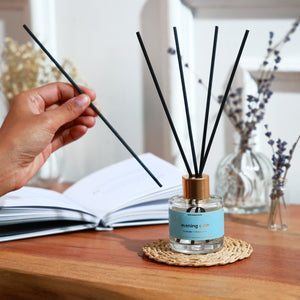
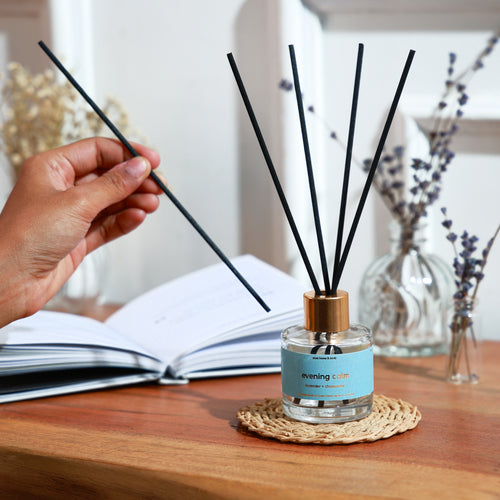
 Evening Calm 50ml₹799A door in daily use opens and closes many times between waking and sleeping — checking on a child, fetching something, letting a pet in or out, simply passing through. Each time, the room briefly connects to the corridor and the air nearest the opening is preferentially exchanged. A bottle standing in that zone is not scenting the room evenly; it is topping up the corridor's air at the room's expense, over and over, in a way a bottle six feet back never experiences.
Position against the door, mapped
The table below runs a bedroom bottle through six positions relative to the door, from worst to best, plus the one legitimate exception. "Six feet" is a working rule, not a ruler measurement — the point is to get the bottle clear of the metre-wide swing-and-clash zone the door creates, wherever that lands in your particular room.
| Position relative to the door | What happens | Verdict | Reeds |
|---|---|---|---|
| Within 2 ft, in the direct swing | Maximum leakage on every opening; strongest false reading right at the threshold | Avoid | — |
| 2–6 ft, facing the opening arc | Meaningful export each opening; sits inside the clash band with corridor air | Marginal | Three |
| On the door's own wall, beside the hinge | Swept past by the opening door rather than pulled through; the small-room fix | Acceptable | Three |
| 6 ft or more, bedside or dresser ★ | Normal steady state, minimal clash, an honest reading from the bed itself | Best | Three |
| Directly opposite the door, in sightline | Reads strongly on arrival for a guest; weakest at the far side of the bed | Show-home only | Two |
| In the corridor outside the door | Transit air holds nothing worth paying for — the doctrine that runs across this whole guide | Never | — |
| Note: the "show-home only" row is a real, legitimate choice for a room shown to visitors rather than slept in — a guest bedroom, a model flat. It is a deliberate trade of the room's own strength for a stronger first impression at the door, and it should be named as that trade, not mistaken for the general rule. | |||
Evening Calm · bedside, standard room50ml ₹799Shop → Evening Calm · master, above 150 sq ft130ml ₹1,299Shop →  Reed refills · running costfrom ₹2,399Shop →
Reeds, flipping and the hinge-side fix
A bedroom bottle runs on three reeds, never six — half the projection of a living-room bottle, which is correct for a small sealed room you spend eight hours a night inside rather than passing through. Distance from the door does not change the reed count; it changes where the same three-reed cloud actually sits relative to the air that stays in the room. Flip the reeds saturated-end up every three to five days regardless of placement — this is the entire maintenance routine, and a door-adjacent bottle that seems to fade fast is often simply losing more of each flip's strength to the corridor rather than needing a flip more often.
If the room genuinely has no wall six feet from the door — a small bedroom, a box room, a door set into the only free stretch of wall — the fix is not a bigger bottle, it is a different spot on the same short list of walls. Stand the bottle on the wall the door itself is hinged into, as close to the hinge as the furniture allows, rather than on the wall the door swings open toward. A door pivots around its hinge; the air near the hinge side moves the least as it swings, while the air in the arc the door sweeps through moves the most. A bottle beside the hinge gets brushed by the door's motion rather than pulled through it, which recovers most of the six-foot effect in a room too small to actually offer six feet.
Everywhere else, the standard placement advice still applies: about a metre off the floor, clear air on at least two sides, out of the path of a ceiling fan or split AC, off the windowsill and out of direct sun. A bedside table or a dresser almost always satisfies both the distance rule and the general placement rule at once, which is why it remains the default answer rather than a compromise. And because this is oil in an open bottle, keep it above the reach of children and pets and off any surface a spill would mark, wherever in the room it ends up standing.
What to buy instead
This is a one-room decision, not a flat-wide one — the numbers below are a single bottle and a reed count, not a multi-room kit. For context, the full-flat totals cited across this cluster are 1BHK ₹2,847 · 2BHK ₹3,696 · 3BHK ₹4,445 · 4BHK ₹5,244, and this bedroom bottle is one line inside whichever of those you are building toward.
| Setup | What you get | Best for | Total |
|---|---|---|---|
| The standard bedroom ★ | Evening Calm 50ml, three reeds, bedside or dresser, six feet from the door | Rooms up to 150 sq ft | ₹799 |
| The small or shared room | Same Evening Calm 50ml, dialled to two reeds | A tight room where even three reeds reads strong | ₹799 |
| The master bedroom | Evening Calm 130ml, still three reeds — never six | Rooms above 150 sq ft | ₹1,299 |
| The show-home exception | Evening Calm 50ml, two reeds, sited deliberately by the door | A guest room shown to visitors, not slept in | ₹799 |
| Running cost | A 300ml refill ₹2,399, or 500ml ₹3,499 (₹7/ml) | 500ml is ten 50ml fills — roughly ₹350 a fill | from ₹2,399 |
Versailles
Almost every bedroom I have walked into with a "weak" reed diffuser had the bottle within arm's reach of the door — on the shelf you pass on the way out, on the shoe cabinet just inside, on the console that happened to be the first flat surface available. It always felt like a reasonable choice, because it was the first surface at hand, and it always underperformed for the same reason: a doorway is not a place, it is a hole, and a bottle beside a hole spends its evenings feeding a corridor nobody stands in.
The fix costs nothing. It is not a bigger bottle, not more reeds, not a stronger scent — it is six feet of distance, or the hinge side of the same wall if the room will not give you six feet. I have watched people move a bottle from a doorside shelf to a bedside table and describe the change as if they had bought a new product. They had not. They had simply stopped paying a corridor for a scent meant for a bed.
The one time I tell people to leave it by the door is when the door is the point — a guest room meant to announce itself the moment it is opened, a show flat, a room nobody actually sleeps in. That is a legitimate brief, and it deserves an honest answer rather than a blanket rule. For every other bedroom, move it back. Every purchase funds a girl's education through Nanhi Kali — not a percentage, not a quarterly cheque. Every one.
Frequently asked questions
- Reed diffuser on your bedside table — the placement that solves the door problem by default.
- Reed diffuser near a window — the other surface that looks convenient and is not.
- Reed diffuser in an air-conditioned bedroom — draught does to a bottle what a door does, only continuously.
- How many reeds should you use for a bedroom? — the volume knob, separate from placement.
- Brand: the SOSA founder story.
SOSA reed diffusers & prices (verified August 2026): Morning Freshness (Malabar lemon · peppermint · eucalyptus) 50ml ₹749 · 130ml ₹1,249 · Evening Calm (lavender · chamomile) 50ml ₹799 · 130ml ₹1,299 · Garden Bloom (British rose · night-blooming jasmine) 50ml ₹799 · 130ml ₹1,299 · Fresh Brew (Coorg coffee · Kerala vanilla) 50ml ₹849 · 130ml ₹1,349 · Mountain Breeze (Himalayan pine · sage · cedar) 50ml ₹849 · 130ml ₹1,349. Duo sets: Day & Night 2 × 50ml ₹1,498 · 2 × 130ml ₹2,498; Fresh & Grounded 2 × 50ml ₹1,548 · 2 × 130ml ₹2,548; Warmth & Bloom 2 × 50ml ₹1,598 · 2 × 130ml ₹2,598. Refills 300ml ₹2,399 · 500ml ₹3,499. Six fibre reeds included with every bottle; refillable glass. 50ml suits rooms up to 150 sq ft and lasts 6–8 weeks; 130ml suits rooms above 150 sq ft and lasts 14–18 weeks. Fractionated coconut oil (CCT) carrier, alcohol-free, phthalate-free, paraben-free, IFRA-compliant, low VOC; tested through 45°C heat and 85% monsoon humidity. Composed and handmade in small batches in Pune. Ultrasonic machines quoted for comparison: Boond ₹899 · Sukoon ₹1,899 · Megh ₹3,499, which run the separate water-based Hotel Collection fragrances (15ml ₹299 · 100ml ₹999 · 300ml ₹1,799) — the two lines are not interchangeable. Every purchase funds a girl's education through Nanhi Kali. Prices and availability subject to change — see the live product pages.