



Reason one — height: a playing child’s breathing zone is 0.8–1.2 m from the floor against an adult’s 1.5–1.7 m, and often lower still on a mat.
Reason two — contact: everything here is held, chewed and dropped. It is a contact zone before it is an air space.
Reason three — materials: plush toys, foam mats and cushions absorb what you run and give it back at face distance.
2. Children play lower than any equipment is ever installed. An adult’s breathing zone sits at roughly 1.5–1.7 m. A standing child’s sits at roughly 0.8–1.2 m. A child on a play mat sits lower still. Every ambient scenting product on the market is designed around the adult figure, because that is the occupant of the hotel lobby it was built for. The consequence in a clinic is straightforward: a unit at desk or console height sits directly in the child’s zone, so the smallest occupant of the room receives the strongest dose while the adult standing beside them receives less.
3. A play area is a contact zone, not just an air space. This is the argument that does not apply anywhere else in the clinic. In a reception, fragrance is purely an airborne question. In a play corner, everything is picked up, held against the face, chewed, dropped on the floor and picked up again, often by a different child ten minutes later. Nebulised or evaporated fragrance settles on surfaces as well as travelling in air. Introducing that into the one zone where objects are routinely mouthed makes the housekeeping harder for no benefit anyone can articulate.
4. The materials in the zone are the worst possible ones. A play corner is almost entirely soft: plush toys, foam interlocking mats, bean bags, fabric-covered blocks, a rug, cushions. Every one of those absorbs airborne fragrance and re-releases it slowly, and almost none of them is ever washed. So a play area does not experience the level you set — it experiences an accumulating baseline held in the exact objects children press to their faces. The zone with the most absorbent contents is the zone you least want to load.
5. And there is no gain on the other side of the ledger. The commercial argument for scenting a reception is that a parent forms an impression in the first few seconds. Nobody forms an impression of a clinic from the smell of the play corner; parents judge that zone on whether the toys look clean, whether the mat is wiped and whether anything is broken. So the play area is a rare case where the case against is substantial and the case for is essentially empty. That is what makes the answer flat rather than balanced.
Made in India, composed by an ISIPCA Versailles-trained perfumer — and a portion of every order supports girl-child education through Nanhi Kali.
Why the floor changes the whole calculation
Ambient scenting inherits its assumptions from rooms designed around standing adults, and the most consequential of those assumptions is vertical. Concentration is not uniform in a room: it is highest near the emitter and falls with distance, and the vertical dimension of that gradient is invisible on any floor plan. Put a unit on a reception counter at roughly a metre and the highest concentration in the room sits at the height of a five-year-old’s face. The occupant you would most want to protect is the one standing in the strongest part of the field, and no coverage figure printed by any supplier describes this, because coverage is quoted as an area and the problem is a height.
The second thing the floor changes is contact. Everywhere else in a clinic, ambient fragrance is a question about air. In a play corner it also becomes a question about surfaces, because the surfaces are in constant contact with hands and mouths and are shared between children across a whole day. Anything airborne eventually settles, and a play area gives it the largest and most absorbent surface area in the building to settle onto — plush fur, open-cell foam, loose-weave fabric. Housekeeping in a paediatric clinic is already working hard on that zone; loading it with an additional substance makes that work harder and delivers nothing a parent will ever notice or credit.
The three reasons, in the order they carry weight
 Desk, not cornerFrom ₹749Kneel down in your own play corner and put your head where a four-year-old’s head goes. That is the breathing zone you are actually designing for — roughly 0.8–1.2 m standing, and lower on a mat. Now look at where the diffuser is. In most clinics it is on a counter or a side table at about the same height or slightly above, which puts the child in the strongest part of the field and the parent above it. If anything is running in that room at all, it belongs high on a wall, aimed away from both the seating and the play zone.
Zone by zone, with the play corner broken out
The play corner appears here as its own line rather than as part of the waiting area, because it behaves differently from the seating three metres away from it.
| Area of the clinic | Scented? | Why | What we would use |
|---|---|---|---|
| Children’s play corner ★ | No — neutral | Floor-level breathing zone, everything handled and mouthed, and the most absorbent contents in the building | Nothing, and no equipment in the zone |
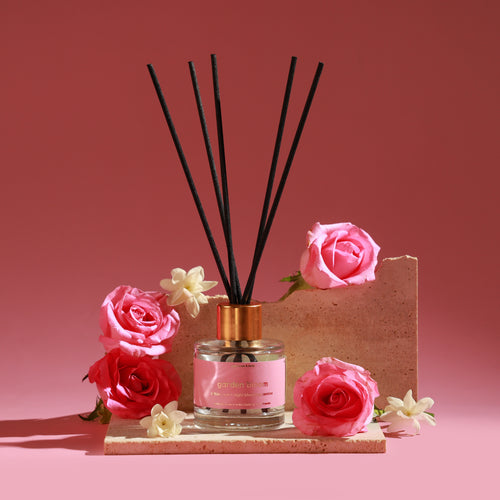
| Reception desk and entrance | Yes, low | Short dwell and arriving noses — but the level is capped by whatever the play corner can tolerate | Three reeds from ₹749, sited away from the play zone |
| Waiting seating | Minimum only | Thirty to sixty minutes of seated occupancy, largely by children | Drift from the reception source, never a separate unit |
| Consultation and examination rooms | No | Clinicians rely on their own sense of smell and a seated child cannot move away | Nothing |
| Vaccination, injection and procedure rooms | No | A distinctive scent repeatedly paired with an unpleasant procedure becomes associated with it | Nothing |
| Nebulisation, asthma, neonatal and isolation waiting | Never | Respiratory patients, newborns and infectious waiting — no added airborne load at all | Nothing |
| Before any of this: a play corner’s smell is produced by its toys, its mat and its bin, not by its air. A washing cadence, a wipeable-toy policy and a lidded bin will change that zone more than any diffuser could, and they remove odour rather than adding to it. | |||
Small reception · no power neededFrom ₹749Shop →  Mid reception · has an off switch₹1,899Shop →
  Large lobby · timed, dialable₹11,999Shop →
If reception is scented, how to keep the play zone genuinely neutral
Separate it physically as far as the floor plan allows. Put the greatest possible distance between the source and the play corner, then check the airflow rather than the geometry — stand at the diffuser and work out where the air actually goes. A split unit discharging across reception can carry fragrance to a corner that looks well away from the source on plan, while a corner two metres nearer but behind the airflow receives far less. Where the play zone is downstream of the discharge, either move the play zone or drop the reception source to nothing; those are the only two honest options.
Set the reception level from the play corner, not from the desk. Judge the room by kneeling in the play zone with a nose that has been outside for thirty minutes, and set the reception source so that position reads as neutral. That inversion is the whole method: the conservative zone governs, not the commercial one. On a reed diffuser that usually means three reeds; on a Sukoon, three drops in intermittent mode; on a Vaayu, the shortest on-time available, mounted high and aimed away. If none of those gets the corner to neutral, the room is telling you to install nothing.
Then fix what actually makes a play corner smell. It is never the absence of fragrance. It is the mat that has not been lifted since it was laid, the plush toys that have never been through a wash, the bin that takes tissues and nappies without a lid, and the fact that the zone is in constant use for nine hours with no air movement through it. A rotating toy box with half the toys out for cleaning at any time, wipeable toys chosen over plush ones, mats lifted and cleaned underneath weekly, and a lidded bin emptied twice a day will transform that corner. None of that is a fragrance purchase.
What we would actually install
Every option here is for the reception desk. Nothing on this table goes into a play corner, which is why the bottom row is the one that applies to the zone this article is about.
| Option | Suits | Control you get | Price |
|---|---|---|---|
| Reed diffuser ★ | A small reception desk — a reception desk sited well away from the play corner, on three reeds, with the bottle behind the counter | Reed count only — no switch, no timer | from ₹749 |
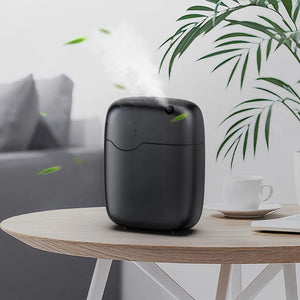
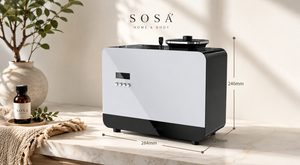
| Sukoon 500ml | A reception up to ~320 sq ft — a larger reception with a genuine off switch, at three drops, provided the play zone reads neutral | On/off, intermittent mode, you control the drops | ₹1,899 |
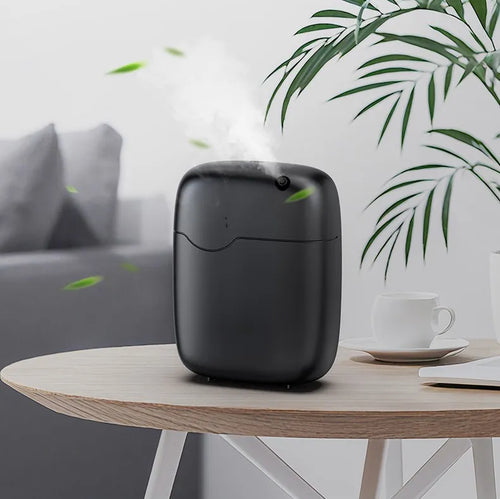
| Vaayu | A large lobby or a zoned duct — a large lobby where the unit can be mounted high and aimed away from both seating and play | Duty cycle in seconds, timer, app scheduling | ₹11,999 |
| Aangan | Whole-facility HVAC — a zoned facility where the play area and clinical rooms are excluded at the duct, not merely by a wall | Zone-level control, but only if the ducting is zoned | ₹25,999 |
| Nothing at all | The play corner itself, always — and any clinic where reception and play share one open air space with no distance between them | Complete — and the correct answer more often than the trade admits | ₹0 |
Versailles
This is the one question in the cluster where I do not think there is a considered middle position. A play corner should be neutral. I would not put a diffuser in one even switched off, because a cable, a socket and a bottle of oil inside reach of a four-year-old is a bad idea before you get anywhere near the fragrance question.
When clinics push back, it is usually because reception and the play corner are the same room and they want to know how to have both. My answer is that the corner wins. Set the reception level by kneeling in the play zone and judging what you find there, and if the only setting that keeps the corner neutral is off, then off is the setting. A clinic loses nothing by a reception that smells of clean air.
What genuinely improves a play corner is unglamorous and I would rather sell it to you than a machine: wipeable toys instead of plush, a rotation box so half of them are out being cleaned at any time, the mat lifted and cleaned underneath, and a lidded bin emptied twice a day. Beyond that, take the decision through your own clinical governance, infection-control and housekeeping leads rather than through a fragrance supplier. A portion of every order funds a girl’s classroom through Nanhi Kali.
Frequently asked questions
- Play zone fragrance-free with a scented reception? — yes, and how to achieve it.
- How far from the play area? — distance, airflow and height.
- Keeping the machine out of reach — mounting, cables and tamper-resistance.
- Do toys and cushions hold odours? — yes — and what a laundry cadence looks like.
- Brand: the SOSA founder story.
SOSA products & prices (verified August 2026): Hotel Collection water-based ultrasonic diffuser fragrance 15ml ₹299 · 100ml ₹999 · 300ml ₹1,799 · Pack of 7 (15ml, all fragrances) ₹1,799; refills 100ml from ₹999. Seven scents: The Ritz-Carlton-inspired (white tea · bergamot · cedar), Westin-inspired (white tea · aloe · cedar), 1 Hotels-inspired (cedarwood · vetiver · green leaves), The St. Regis-inspired (amber · violet · woods), Shangri-La-inspired (jasmine · green tea · white tea), Four Seasons-inspired (citrus · floral · sandalwood), W Hotels-inspired (citrus · pepper · amber). Diffusers: Boond 300ml ₹899 · Sukoon 500ml ₹1,899 · Megh 6L ₹3,499. Water-based, phthalate-free, composed to IFRA standards for home diffusion; 3–6 drops per tank. Made in India, Pune. The Hotel Collection scents are SOSA's own interpretations inspired by the world's finest hotels; all hotel names are trademarks of their respective owners and are used only to describe the scent style — SOSA is an independent Indian fragrance house, not affiliated with or endorsed by any hotel brand. Prices and availability subject to change — see the live product pages.