
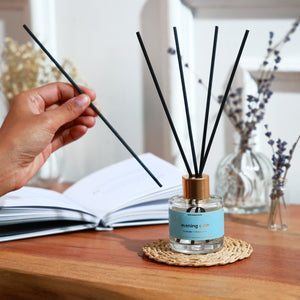

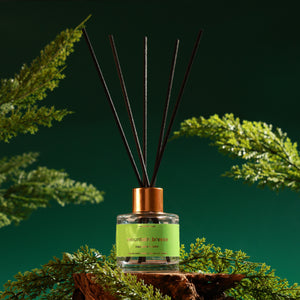


The honest caveat: a Sukoon is a cool-mist ultrasonic — it adds water vapour to air already close to saturated for a third of the year. In a closed AC bedroom, run it on the 2H timer, not continuously. That is a setting question, not a flaw.
Most 2BHK owners here end up with both: reeds in the bedrooms, Sukoon in the living room.
2. Sukoon wins for one specific room: an open living-dining zone of 270–320 sq ft. That is beyond what a 50ml reed's 150 sq ft ceiling is built to reach, and it is also the room where scent-on-a-schedule — steady, 2H or 4H timer, set from the remote before you're home — earns the ₹1,899.
3. Through the four-month monsoon, drop the reed to three reeds, not six. Humidity does not stop the oil from working; it changes how much you need. Three reeds stretches a 50ml bottle from 6–8 weeks to 10–14, which roughly halves the running cost in the wettest months.
4. In a closed AC bedroom, run the Sukoon on the 2H timer, not continuously. Adding water vapour to air that is already near-saturated for a third of the year disperses less readily than the same mist in a ventilated room. That is an honest setting question, not a fault in the machine.
5. Most 2BHK owners in this city end up buying both. Reeds for the bedrooms, Sukoon for the living room — that combination, not either product trying to do the whole flat, is what actually holds up through a Mumbai year.
Alcohol-free, IFRA-compliant reed oil composed by an ISIPCA Versailles-trained perfumer, tested through 45°C heat and 85% humidity, handmade in small batches in Pune — and every purchase funds a girl's education through Nanhi Kali.
Why humidity changes the answer, and changes it differently for each product
A Sukoon is a cool-mist ultrasonic diffuser: a small transducer plate vibrates fast enough to shear water in its 500ml tank into a fine vapour, and that vapour carries dissolved fragrance out into the room. The mechanism depends entirely on the vapour finding somewhere to go — air that has room to absorb more moisture. Mumbai air at 80–85% relative humidity, which is normal for four months of the year, is already close to that ceiling. Push more water vapour into air that is nearly saturated and it has less capacity to take it up: the mist disperses more slowly, tends to hang rather than spread, and in a small sealed room can read as dampness rather than fragrance by the next morning. This is not a defect in the Sukoon. It is physics acting on any ultrasonic diffuser, in any brand, in this climate — and the honest, practical answer is to run it on the 2H timer in a closed AC bedroom through monsoon rather than leaving it on steady.
A reed diffuser has no equivalent problem, because it has no equivalent mechanism. The carrier in SOSA's reed oil is alcohol-free fractionated coconut oil (CCT), not water and not alcohol, and it does not evaporate the way either of those does. Scent moves off the exposed ends of the reeds by capillary wicking and slow evaporation of the oil itself, a process governed by the oil's own vapour pressure rather than by how much moisture the surrounding air can still hold. That is why SOSA's reed oil is tested through 85% humidity and 45°C heat and performs to spec at both — humidity does not stop the mechanism the way it slows an ultrasonic mist. What humidity does change is dosage: three reeds instead of six through monsoon, because the same bottle simply reads heavier when the air is already saturated with moisture and the scent has less headroom to lift off and disperse.
Fairness matters here, because it is easy to make this sound like the Sukoon is the flawed product and the reed is the clever one — it is not that simple. Give a Sukoon real air volume and real air movement — an open 300 sq ft living-dining zone with a fan running and a door in regular use — and the same mist that struggles in a shut 150 sq ft bedroom disperses perfectly well, because there is far more air for the vapour to move into and more turnover to carry it. The humidity argument is not "reed good, Sukoon bad." It is "match the mechanism to the room": an oil-based reed for small, closed, humid rooms where a mist has nowhere to go, and an ultrasonic machine for a large, more open room where a reed's soft radius was never going to reach in the first place.
The three things that actually decide it
 Sukoon₹1,899A 50ml reed is sized for rooms up to 150 sq ft; a 130ml goes above that and runs 14–18 weeks, but neither is built or tested the way the Sukoon is for a genuinely large open zone. The Sukoon's 270–320 sq ft rating exists precisely because Mumbai living-dining rooms of that size are common and a reed's soft radius, however many reeds you add, was never designed to fill one. Between roughly 150 and 270 sq ft is the honest grey zone — a 130ml reed can hold a moderately sized closed room there, but an open-plan living area of that size is the Sukoon's territory.
Reed vs Sukoon for Mumbai, side by side
The table below compares both on the factors that actually change in this climate — not on generic specifications. Figures assume the reed diffuser's monsoon dosage (three reeds) and the Sukoon on its low setting, which is the realistic way both run for a third of the year here.
| Factor | Reed diffuser | Sukoon |
|---|---|---|
| Room size | 50ml to 150 sq ft (6–8 wks); 130ml above 150 sq ft (14–18 wks) | 270–320 sq ft, purpose-built for open living-dining zones |
| Humidity behaviour | Oil carrier unaffected by 80–85% RH; only dosage changes — three reeds, not six, in monsoon | Cool mist into near-saturated air disperses more slowly; run on 2H timer, not steady, in a closed AC room |
| Power & water needs | None — no plug, no water, nothing to fill | Mains power plus a 500ml water tank, refilled roughly every 16–18 hrs on low |
| Maintenance | Flip reeds saturated-end up every 3–5 days | Top up and rinse the water tank between fills; wipe dry before refilling |
| What it costs to run | Roughly ₹86–₹98 a week on fresh 50ml bottles, or about ₹46 a week on the 300ml refill | Roughly ₹35–₹56 a week after the one-time ₹1,899, depending on Hotel Collection top-up size |
| Away for a week | Keeps going unattended; the room is exactly as scented when you return | Tank runs dry within about a day on low; sits switched off for the rest of the week unless topped up |
| Note: the humidity behaviour row is the whole comparison in miniature — one product is unaffected by the mechanism that slows the other down. Reed oil and the water-based Hotel Collection used in the Sukoon are different formulations and are never interchangeable between the two. | ||
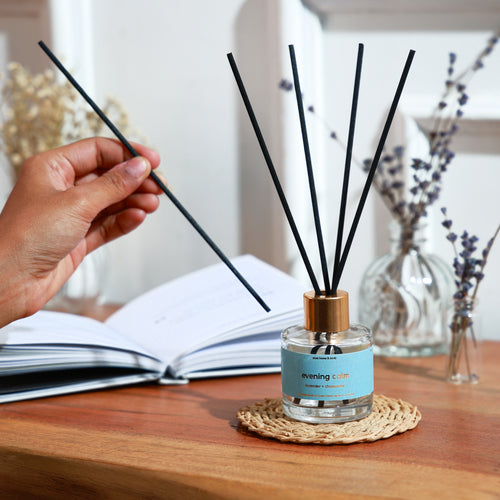
Evening Calm · the bedroom50ml ₹799Shop →  Sukoon · the living room₹1,899Shop →
 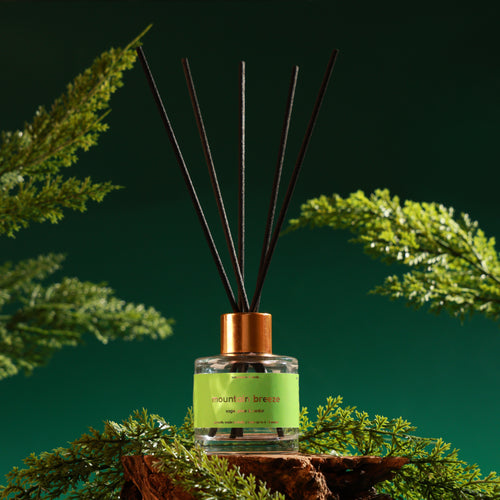 Mountain Breeze · dry woods50ml ₹849Shop →
Reed count, timer settings and placement for a Mumbai monsoon
Through the four monsoon months, pull three reeds out of every reed diffuser in the flat and leave three in, not six. This is not a compromise — it is the correct setting for the air you actually have. Humid air already carries a great deal of moisture, so the same six-reed dose reads heavier and can tip from pleasant into cloying, particularly with sweeter or gourmand registers, while drier woods and citrus stay legible for longer. Three reeds also roughly halves the running cost through the wettest months, because a bottle that would last 6–8 weeks on six reeds stretches to 10–14 weeks on three. Move back to five or six once the air dries out from October.
For the Sukoon, the setting that matters most is the timer, not the fragrance. In a closed, air-conditioned bedroom during monsoon, the steady/continuous setting is where the near-saturated-air problem shows up — use the 2H timer instead, which gives the room bursts of scent with recovery time between them rather than a constant mist fighting air that has nowhere to put it. In a genuinely open living-dining room with a fan running and normal foot traffic, steady or the 4H timer works fine, because there is more air volume and more turnover for the vapour to disperse into. The remote is worth using deliberately here: set it running fifteen to twenty minutes before you expect to walk in, rather than leaving it on all day.
Placement carries as much weight as either setting. Keep a reed diffuser out of the direct path of an AC vent or a ceiling fan on high — both strip the top notes fast and empty the bottle faster, humidity or not — but also away from a balcony door left open to monsoon rain, where the incoming damp air competes with rather than complements the fragrance. Keep a Sukoon on a hard, level surface away from curtains, upholstery or wooden furniture the mist could dampen over time, and never in the direct path of the AC's return-air intake, which will simply pull the scent away before it reaches the room.
What it costs over a year
The arithmetic in full, both ways, with nothing rounded to make one product look better. A Mumbai year splits roughly into eight non-monsoon months (about 35 weeks) and four monsoon months (about 17 weeks); at six reeds a bottle lasts 6–8 weeks (call it 7), and at three reeds through monsoon it lasts 10–14 weeks (call it 12) — which works out to about five bottles across the dry months and one more through monsoon, six bottles a year for one reed diffuser running continuously.
| Route | What it involves | Year one | Per week |
|---|---|---|---|
| Reed, fresh bottles | About six 50ml bottles a year at ₹749–₹849, buying a new one each time it runs out | ₹4,494–₹5,094 | ₹86–₹98 |
| Reed, refilled ★ | One 50ml bottle (₹749–₹849) to get the glass, then a 300ml refill at ₹2,399 as needed | ₹3,148–₹3,248 | ₹61–₹62 |
| Sukoon, light top-up | Sukoon ₹1,899 (ships with three 15ml fragrances) plus one 100ml Hotel Collection top-up ₹999, for mostly 2H-timer use in one bedroom-sized closed room | ₹2,898 | ₹56 |
| Sukoon, steady use | Sukoon ₹1,899 plus one 300ml Hotel Collection top-up ₹1,799, for steady/4H use in an open 270–320 sq ft living room | ₹3,698 | ₹71 |
| The combination ★ | Two bedrooms on the refilled-reed route, one living room on the light-top-up Sukoon route — what most 2BHK owners here land on | ₹9,294 | ₹179 |
Versailles
This question comes up more in Mumbai than in any other city we ship to, and it usually arrives with an unspoken assumption that one of the two products must simply be better. Neither is. I formulated the reed oil to be indifferent to humidity because that was the honest engineering problem in front of me — an oil-based carrier that does not care what the air outside is doing. I did not formulate the Sukoon's physics; water vapour and near-saturated air behave the way they behave, in any ultrasonic diffuser from any brand, and pretending otherwise would not survive a single July in this city.
What I would want a reader to take from this piece is not "buy the reed" or "buy the Sukoon" but the room-size test itself: 150 sq ft and a door you shut is a reed's job, 270–320 sq ft and open is the Sukoon's, and almost everything in between is a judgement call rather than a rule. The one setting I will insist on, because I have had this exact complaint often enough to trust it: the 2H timer, not steady, in a closed AC bedroom through monsoon. It is a five-second change and it fixes the complaint completely.
And if the budget and the flat allow it, buy both — not because two products beat one, but because a bedroom and a living-dining room are genuinely different jobs in this climate, and the combination is simply the correct tool for each. Every purchase, whichever route you take, funds a girl's education through Nanhi Kali. Not a percentage. Every one.
Frequently asked questions
- I have a 150 sq ft AC bedroom in Mumbai — reed diffuser or Sukoon? — the single-room version of this decision.
- What home fragrance actually lasts in Mumbai's humidity? — the mechanism, in more depth.
- How many reeds should I use in a 150 sq ft bedroom during Mumbai monsoon? — the dosage question on its own.
- Why does my reed diffuser stop smelling after a few days in Mumbai? — nose-blindness, top notes and the two-hour test.
- Brand: the SOSA founder story.
SOSA products & prices (verified August 2026): Reed diffusers — Morning Freshness 50ml ₹749 · 130ml ₹1,249, Evening Calm 50ml ₹799 · 130ml ₹1,299, Garden Bloom 50ml ₹799 · 130ml ₹1,299, Fresh Brew 50ml ₹849 · 130ml ₹1,349, Mountain Breeze 50ml ₹849 · 130ml ₹1,349; six fibre reeds and refillable glass with every bottle, alcohol-free fractionated-coconut (CCT) carrier tested through 45°C heat and 85% monsoon humidity, 50ml lasts 6–8 weeks at six reeds and 10–14 at three, 130ml lasts 14–18 weeks. Refills 300ml ₹2,399 · 500ml ₹3,499. Ultrasonic diffusers: Boond ₹899 (300ml, USB-powered, to 150 sq ft) · Sukoon ₹1,899 (500ml, 270–320 sq ft, 16–18 hrs on low, remote, steady/2H/4H timer, ships with three 15ml Hotel Collection fragrances) · Megh ₹3,499. Hotel Collection water-based fragrance 15ml ₹299 · 100ml ₹999 · 300ml ₹1,799 — a fragrance for a machine, not a standalone product, and never interchangeable with reed oil. Phthalate-free, paraben-free, IFRA-compliant, low VOC; composed and handmade in small batches in Pune. Every purchase funds a girl's education through Nanhi Kali. Prices and availability subject to change — see the live product pages.