



This is one of the most common messages I get, and almost every time the answer is the same: nothing is wrong. Two ordinary things are happening at once — the reeds are settling from their loud first day into their normal, quieter working life, and your own nose is quietly adapting to a smell it now lives inside.
Quick answer
Two normal things → Fresh dry reeds soak fast and throw hardest on day one, then settle to a steady level. Meanwhile your nose adapts to a constant scent.
How to check → Step outside for 15–20 minutes and walk back in. If it greets you again, the reed is fine — your nose had adjusted.
Only if you want the burst on demand → that is a method question, and an active SOSA Safar ₹3,999 gives a renewable walk-in hit.
In one paragraph
Short answer: A day-one burst that settles after a few days is exactly how a healthy reed diffuser behaves — the reeds throw hardest when they are fresh and dry, then find a steady lower level. Add the ordinary way your nose stops registering a constant smell, and the "drop" is two normal effects, not a defect.
The pick: keep the reed you have — try a 50ml from ₹749 and flip it weekly. Only if you genuinely want an on-demand burst, look at active diffusion like SOSA Safar ₹3,999.
Shop: Reed diffusers · All home scenting
The day-one burst is real — and so is the settle
Let me start with the part almost nobody explains, because it matters. When you first stand the reeds in a brand-new bottle, they are bone dry. Dry reed fibres are thirsty — they wick oil up fast, saturate their full length in the first several hours, and evaporate it off their tips at the highest rate they will ever manage. That is your day one: a genuine, physical peak. The room really is at its most fragrant, and you are not imagining it.
Then the reeds reach saturation. Once the whole stick is soaked, wicking slows to match evaporation, and the diffuser settles into its steady working rate — the level it will hold, more or less, for the life of the bottle. So the drop you notice on day three or four is the difference between a fresh reed's opening surge and its normal cruising speed. It is not the diffuser dying. It is the diffuser finding its pace. Every good reed does this; a reed that didn't soften a little after the first day would be the odd one out.
"Day one is the reed's loudest day, not its normal day. The settle you notice afterwards is the fragrance finding the level it will actually keep."
And your nose is doing its own quiet thing
Now layer the second effect on top, because it usually does most of the work. Olfactory habituation — nose-blindness, in plain English — is your brain deciding that a constant, unchanging smell is no longer news. It happens with everything: the particular smell of your own home that you stop noticing until you come back from a trip, the perfume you can't smell on yourself by afternoon, the coffee shop that seems to lose its aroma ten minutes after you sit down. Your receptors don't switch off; your brain simply stops flagging the signal so it can pay attention to new ones.
A reed diffuser is the perfect trigger for this. It runs constantly, at a steady, unchanging strength, in a room you spend hours in. By day three you have breathed that exact scent thousands of times, and your brain has filed it under "background." The fragrance in the air hasn't dropped nearly as much as your perception of it has. This is why your guest walks in and says "oh, lovely, what's that?" while you're standing there wondering what they mean.
The fifteen-minute test
Here is the honest way to separate the two. Leave the room for fifteen to twenty minutes — better still, step outside onto the balcony or into the lane where the air is completely different. Let your nose reset on other smells. Then walk back in. If the fragrance greets you at the door again, your reed is perfectly fine and habituation was the whole story. If the room is genuinely faint even on a fresh return, then it's worth checking the reeds and the bottle.
If it really is faint on a fresh return
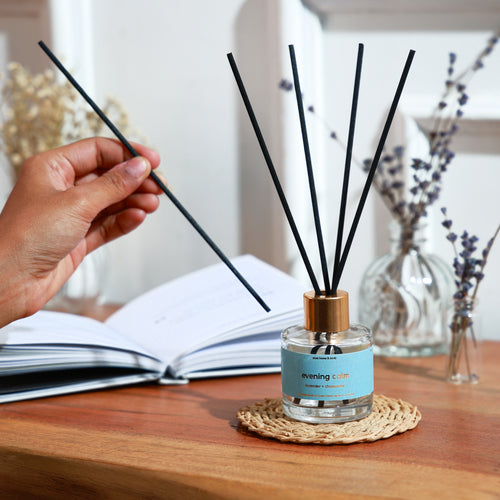
Then do the two-minute checks before concluding anything is wrong. Are the reeds still standing in oil, and have you flipped them in the last week or two? Flipping brings the soaked ends up and gives a real boost. Is the bottle genuinely low, or past its useful six-to-eight weeks for a 50ml? And is the room airy — a fan on full or an open balcony door scatters a passive reed's gentle scent faster than it can build. None of these is a defect; they're just the ordinary maintenance a passive diffuser asks for.
When "I want the day-one strength back" is a real wish
Sometimes, once we've cleared away the nose-blindness, you tell me something honest: I understand it's normal, but I actually loved that first day, and I want that intensity when I want it. That's a completely fair thing to want — and it's important I don't pretend a reed can give it to you. A passive reed's whole nature is to be steady and gentle. It was never built for a repeatable, room-filling burst; asking it for one is asking the wrong tool.
If that's you, the answer is a change of method, not a stronger bottle. An active waterless diffuser like SOSA Safar atomises neat fragrance into a fine dry mist on demand — so you can recreate that just-opened hit whenever you walk in, then switch it off. It's catalogued as a car-and-travel diffuser, and that's honestly where it started, but because it's cordless, waterless and high-throw it doubles beautifully as a compact, on-demand scenter for a bedroom or desk. The renewable "walk-in" moment is exactly what an active diffuser gives and a reed, by design, cannot.
Honest routing
Match the fix to what's actually happening
| What you're experiencing | Honest cause | What to do |
|---|---|---|
| Strong day one, softer by day 3–4 | Reeds settling from their opening peak | Nothing — this is normal. Flip weekly. |
| Fine on return, faint when you've been in a while | Nose habituation | A walk outside resets it, free |
| Genuinely faint even on a fresh return | Dry/unflipped reeds or a low bottle | Flip reeds; replace if past 6–8 weeks |
| You want the day-one burst on demand | You want active projection, not a reed | SOSA Safar ₹3,999 |
A ₹1,500 reed is not "stronger" than a ₹800 one — you pay for fragrance quality and longevity, not room-filling throw. Throw is a function of the diffusion method, not the price of the oil.
One honest caveat
Don't spend money to solve a problem a short walk outside already solves. If the fifteen-minute test brings the scent right back, your reed is working exactly as it should, and no stronger product will change what your own brain does with a constant smell — it will simply go quiet on the new one too, a few days later. Buy up the projection ladder only if you genuinely want more reach or an on-demand burst, not to chase a day-one high that was always going to settle.
Is it normal for a reed diffuser to be strong on day one and weaker after a few days?
Yes, completely. Two normal things happen at once. Fresh, dry reeds drink up a lot of oil quickly and throw their hardest on day one, then settle to a steady, lower level as the wicking balances out. At the same time your nose adapts to a scent it now smells constantly. Neither is a fault.
Does the day-one burst mean the diffuser will run out fast?
The first day or two does use a little more oil than the steady weeks that follow, but it is a small share of the bottle. A 50ml reed still lasts roughly six to eight weeks and a 130ml longer. The burst settling is the reeds finding their normal pace, not the bottle emptying.
How do I tell whether the reed weakened or my nose adjusted?
Leave the room for fifteen to twenty minutes, ideally step outside, then walk back in. If the scent greets you again, the reed is fine and your nose had simply adapted. If it is genuinely faint even on a fresh return, check the reeds are saturated and flip them, or the bottle may be near its end.
Should I buy a stronger reed to get the day-one strength back?
Not to fix habituation, which a short walk outside resets for free. But if you genuinely want that just-opened intensity available on demand, that is a diffusion-method question, not a fragrance one. An active waterless diffuser such as SOSA Safar gives a renewable, walk-in burst a passive reed is not built to.
Will flipping the reeds bring back the strong smell?
Flipping the reeds exposes freshly soaked ends and gives a genuine boost for about half an hour before it settles again. It is a useful top-up, but if you find yourself flipping daily just to notice the scent, that is the honest sign you want active diffusion rather than a passive reed.
The honest bottom line
Your reed didn't fail — it settled, and your nose adjusted. Both are normal.
Keep it, flip it weekly, and let a walk outside reset your nose. Only move up the ladder if you truly want an on-demand, walk-in burst — that's a job for active diffusion.
Shop reed diffusers → See SOSA Safar →Keep reading — "it was strong for two days"
More from this corner of the reed-diffuser diaries
About this guide
Written by Sonal Sahani, founder of SOSA Home & Body and a perfumer trained at ISIPCA, Versailles. The SOSA Hotel Collection are our own original interpretations inspired by the world's finest hotels; SOSA is independent and not affiliated with or endorsed by any hotel brand. A portion of every order funds girl-child education through Nanhi Kali. Prices and availability are subject to change.