



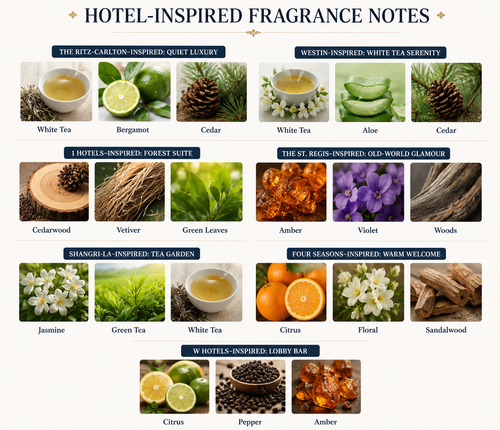
If you want sandalwood: the Four Seasons-inspired Warm Welcome at ₹299 for 15ml — citrus, floral and real sandalwood, the longest-staying of the seven. Water-based, ultrasonic only, so it needs a Boond ₹899 or a Sukoon ₹1,899.
If you want vetiver: the 1 Hotels-inspired Forest Suite at ₹299 — cedarwood, real vetiver and green leaves, the driest of the seven. Same machines.
If you want oud: do not buy one at a household price expecting oud. The nearest plush resinous register we make is the St. Regis-inspired Old-World Glamour at ₹299 — amber, violet and woods. It is an amber. It is not an oud, and this page will not pretend it is.
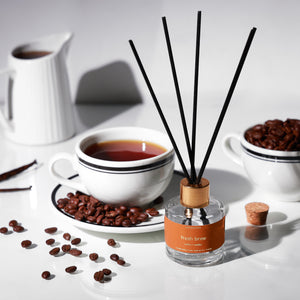
In reeds: Mountain Breeze at ₹849 and 9.4 is the driest reed we make and the nearest thing to the vetiver register; Fresh Brew at ₹849 and 9.5 is the deepest and the nearest to the plush warmth people want from oud, though it is a gourmand. Honest neighbours, not matches.
2. Then choose on temperature, because that decides more purchases than any other single axis. Oud runs hot: smoky, animal, medicinal, with a barnyard edge in the real material that most people are genuinely not prepared for. Sandalwood runs warm: creamy, soft, rounded, closer to skin than to timber. Vetiver runs cool: earthy, damp, green-bitter, with the smell of the underside of a garden about it. Ask yourself whether you want the room hotter, warmer or cooler than it is, and you have already narrowed three to one.
3. Match the projection to the room, not the price to the room. Oud projects hard and announces itself — a receiving room, an evening. Sandalwood projects softly and never leaves — a bedroom, a corner you sit still in. Vetiver projects almost not at all and provides a floor under everything else — a study, a hall, a hot afternoon. The most expensive of the three is also the one most likely to be wrong in the room you actually spend your life in.
4. Be realistic about what you are buying. At household prices, an oud home fragrance is nearly always a woody-amber accord wearing the name. A sandalwood one is often a legitimate Australian species or a respectable synthetic santalol, both of which are perfectly good if the label says so. A vetiver one is usually genuine, because vetiver is cheap enough that faking it saves nobody any money. That makes vetiver the one of the three you can actually trust at an ordinary price, which is the most useful sentence on this page.
5. And know where SOSA stands, plainly. None of the three exists in our reed line. Real sandalwood is in the Four Seasons-inspired ₹299 and real vetiver is in the 1 Hotels-inspired ₹299, both water-based and ultrasonic only, on a Boond ₹899 or Sukoon ₹1,899. Oud is in nothing we make and I would rather say that than sell you an amber under the wrong name.
Alcohol-free reeds, phthalate-free, made in Pune. A portion of every order supports girl-child education through Nanhi Kali.
The three dimensions that actually decide whether you live happily with the bottle
There are seven dimensions worth comparing across these three materials and I have tabled all of them further down, because a genuine comparison should not hide the ones that complicate the story. But three of the seven do nearly all the work. If you get temperature, projection and authenticity right, the other four sort themselves out; if you get those three wrong, no amount of correct note-listing will rescue the bottle. This is not a page about which of the three is best. There is no best. There is only which of the three you will still be pleased to walk into in six weeks.
 Hotel Collection₹299Every perfumer has a private thermometer for materials and hardly anybody puts it in writing, which is a shame, because it is the most transferable thing we know. Oud is hot. It reads smoky, animal and faintly medicinal, and in genuine distilled form it has a barnyard, almost sour-leather quality that is the reason it is an acquired taste rather than a universal one. It makes a room feel closer and denser. Sandalwood is warm. Creamy, soft, milky, rounded — it behaves more like skin than like wood, and it makes a room feel enveloping rather than dense. Vetiver is cool. Earthy, damp, green-bitter, rooty, with something of a wet garden bed about it; it makes a room feel airier and slightly darker at the same time, which is a strange combination until you have lived with it. In an Indian summer this axis is not a poetic flourish, it is a practical one: a hot material in a hot closed room in May is a very different proposition from the same material in a Delhi December.
 Mountain Breeze₹849Projection is how far a fragrance travels and how loudly it arrives. Persistence is how long it stays once it has. They are not the same property and these three materials separate along it almost perfectly. Oud projects hard and announces itself — it is at the door before you are, and it is the reason oud is a receiving-room material in the cultures that use it most seriously. Sandalwood projects softly and never leaves — you will not notice it entering a room, and you will notice it at two in the morning, which is precisely the behaviour you want beside a bed. Vetiver projects almost not at all and instead provides a floor, a low earthy plane that other things sit on top of and that you stop consciously registering within a day while continuing to benefit from it. Match this to the room and you will not go far wrong: oud for receiving, sandalwood for sleeping, vetiver for working and living. Getting this backwards is how people end up with an expensive bottle they have turned to face the wall.
 Fresh Brew₹849This is where the three diverge most sharply and where a buyer is most often quietly misled. Oud: very unlikely to be genuine at any household price. A home fragrance sold for a few hundred or a few thousand rupees is, with rare exceptions, a woody-amber accord — a perfectly competent construction of resinous and balsamic synthetics that produces a plush, dark, slightly sweet effect and contains no agarwood. It is not fraud when it is labelled as an accord. It becomes a problem when it is labelled as oud. Sandalwood: often legitimate. A great deal of what is sold is Australian Santalum, which is a real sandalwood grown on plantations, or a respectable synthetic santalol, which reproduces the creamy heart of the material very well indeed. Both are honest choices and both are fine if the label says which. Vetiver: usually genuine, and for the least romantic reason imaginable — it is cheap enough that there is no incentive to fake it. Nobody constructs an elaborate synthetic substitute for a material they can simply buy. That is why vetiver is the one of the three you can actually trust at an ordinary price, and it is the single most useful thing this page can tell you.
What each of the three actually is — and why the price order says nothing about quality
Oud, or agarwood, is not a wood in the ordinary sense at all. It is a resin that trees of the genus Aquilaria produce in response to a mould infection — a defensive secretion, laid down slowly into the heartwood over years, in a minority of trees, and only under conditions that cannot be reliably forced. An uninfected Aquilaria is pale, light and almost odourless. An infected one, decades later, contains dark resinous streaks that are distilled or burned. Wild agarwood is scarce and its trade is controlled under international convention, plantation inoculation is an imperfect and slow science, and the result is that oud oil is priced by the gram and sits among the most expensive raw materials on earth. There is no version of the economics in which a household diffuser at a household price is full of it.
Sandalwood is heartwood, and the constraint is time rather than infection. A Santalum tree takes decades to lay down heartwood rich enough in santalols to be worth distilling, which is a long wait for any grower and an impossible one for anyone in a hurry. The Indian species, Santalum album, is protected and its harvest and movement tightly regulated, for the very good reason that unregulated cutting nearly finished it. What fills the gap is Australian plantation sandalwood, which is genuine sandalwood from a related species and increasingly the workhorse of the industry, and synthetic santalol molecules, which are properly good and which any competent perfumer uses without embarrassment. Sandalwood is therefore expensive but obtainable, and the honest versions of it are all around you.
Vetiver is grass root, and it is abundant. Chrysopogon zizanioides is a tall clumping grass whose dense root system is dug up, washed, dried and distilled, and the roots are ready in a year or so rather than a lifetime. It grows extensively in India — Tamil Nadu, Kerala, Rajasthan and elsewhere — and also across Haiti, Java and Réunion. The plant is so vigorous it is used for soil stabilisation, and it can be harvested annually. None of that makes the material less beautiful; vetiver oil is one of the most complex and interesting things in the perfumer's cabinet, with smoky, nutty, citric and green facets that unfold over months in a room. So the price order — oud, then sandalwood, then vetiver — is a ranking of difficulty of supply, and nothing else. It is not a ranking of beauty, or of sophistication, or of how good the room will smell. A great many people spend a great deal of money moving up that ladder and end up with a house they enjoy less.
All seven dimensions, side by side
The complete comparison, dimension by dimension, with the SOSA position on each stated in the last column rather than buried. Where the answer is we do not make this, the table says so. A comparison table that quietly omits the row where the brand looks worst is an advertisement wearing a table's clothes.
| Dimension | Oud | Sandalwood | Vetiver | What SOSA actually has |
|---|---|---|---|---|
| What it actually is | Resin from an Aquilaria tree infected by mould — rare, slow, trade-controlled | Heartwood of a slow-maturing tree; the Indian species protected and tightly regulated | Root of a grass, harvested annually, abundant, grown extensively in India | Nothing / real sandalwood ₹299 / real vetiver ₹299 |
| Price order — and why | Most expensive by a wide margin, priced by the gram | Expensive but obtainable | The most affordable of the three | The order reflects difficulty of supply, not quality |
| Temperature ★ | Hot — smoky, animal, medicinal | Warm — creamy, soft, rounded | Cool — earthy, damp, green-bitter | Warm: Four Seasons-inspired ₹299 · Cool: 1 Hotels-inspired ₹299 |
| Projection vs persistence ★ | Projects hard, announces itself | Projects softly, never leaves | Projects almost not at all, provides a floor | Reeds: Mountain Breeze 9.4 · Fresh Brew 9.5 |
| Sweetness | Usually sweetened to make it palatable | Creamy but not sugary — a real distinction | The least sweet material in common use | Least sweet reed: Mountain Breeze ₹849 · sweetest: Fresh Brew ₹849 |
| Likely to be genuine ★ | Very unlikely at any household price — almost always a woody-amber accord | Often a legitimate Australian species or a respectable synthetic santalol — both fine if labelled | Usually genuine — it is cheap enough that faking it saves nobody anything | We label the material, not the fantasy — and we have no oud to label |
| Failure mode | Overdosed, it reads as a funeral | Overdosed, it reads as a temple | Overdosed, it reads as a basement | Reed count is the dose dial — 3 reeds, not 6, in a small room |
| Which room | Drawing room, hall, evening | Bedroom, meditation corner, all day | Study, hall, hot afternoons | Boond ₹899 to 150 sq ft · Sukoon ₹1,899 for 270–320 sq ft |
Sandalwood or vetiver · Hotel Collection₹299Shop →  The machine · Sukoon₹1,899Shop →
  Driest reed · Mountain Breeze₹849Shop →
Sweetness, failure modes and the room each one belongs in
Three quieter dimensions, and the ones people discover after they have bought. Sweetness first, because it is where oud is most misunderstood. Genuine agarwood is not sweet; it is dry, animal and difficult, and a great many people who have loved a bottle labelled oud have actually loved the sugar in it. Commercial oud accords are almost always sweetened — with amber, with resins, with vanillic and balsamic material — because unsweetened they are a hard sell in a living room. Sandalwood is a different case and worth teaching properly: it is creamy without being sugary, and those are two distinct sensations that English tends to blur. Cream is a texture; sugar is a taste. Sandalwood gives you the first and almost none of the second, which is why it works in a bedroom where an actually sweet fragrance would cloy by the third night. Vetiver, meanwhile, is the least sweet material in common use anywhere in perfumery — bitter, green, mineral — and for people who dislike sweetness in a home it is very nearly the only honest answer.
Then the failure modes, which are more useful to know than the note lists. Every material has one particular way of going wrong when it is overdosed, and if you know it you can recognise it in a shop in four seconds. Overdosed oud reads as a funeral — heavy, smoky, ceremonial, faintly mournful, the smell of a room where something solemn is happening. Overdosed sandalwood reads as a temple — devotional, creamy-sweet, incense-adjacent, and while that is a lovely smell it is not always the one you wanted in a bedroom you also work in. Overdosed vetiver reads as a basement — damp, rooty, mushroomy, faintly cold. None of these is a defect of the material. All three are defects of dose. And the practical consequence is that with all three the fix is almost always to use less rather than to buy something different, which on a reed diffuser means dropping from six reeds to three and, on an ultrasonic machine, means fewer drops in the tank and running it in intervals rather than continuously.
Finally the room, which follows from projection. Oud belongs where people arrive and do not stay all evening: a drawing room, a hall, an entrance, and generally in the evening rather than at two in the afternoon in June. Sandalwood belongs where you are still: a bedroom, a meditation or puja corner, a reading chair, and it holds up all day because it never demanded attention in the first place. Vetiver belongs where you work and pass through: a study, a home office, a hall, and it is particularly good on hot afternoons because its coolness does something genuinely useful to a room that is already too warm. If you are furnishing a whole flat rather than a room, the sensible arrangement is vetiver where you think, sandalwood where you sleep, and something bright where you cook — and no oud anywhere unless you already know you love it, because it is the one of the three most likely to be somebody else's taste rather than yours.
The verdict, given properly rather than hedged
A comparison page that ends in it depends on your preference has wasted your time. So here it is straight, with the honest gap in the last row where it belongs. SOSA has no oud, no sandalwood and no vetiver in the reed line, and no oud in any format at all. Two of the three exist properly on the ultrasonic side and I will point you there without pretending it is the same product. The reed line has honest neighbours to both registers, and they are neighbours rather than matches, which is a distinction I would rather make now than have you make in six weeks.
| Buy | What it is | When it is the right answer | Price |
|---|---|---|---|
| 1. Sandalwood — Four Seasons-inspired ₹299 ★ | Citrus, floral and real sandalwood — the longest-staying of the seven. Water-based, ultrasonic only | If it is for a bedroom, or you want a room to feel calm and enveloping. Needs a Boond ₹899 or Sukoon ₹1,899 | ₹299 |
| 2. Vetiver — 1 Hotels-inspired ₹299 | Cedarwood, real vetiver and green leaves — the driest of the seven. Same machines | If it is for a study or a hall, if you dislike sweetness, or if you want the most honest value of the three | ₹299 |
| 3. Boond ₹899 or Sukoon ₹1,899 | The machine either of the above needs — Boond covers up to 150 sq ft, Sukoon 270–320 sq ft and includes three 15ml scents | Bought once. The Sukoon is the better value if you want more than one of the three registers | ₹899 / ₹1,899 |
| 4. Mountain Breeze 50ml — the reed nearest vetiver | Himalayan pine, sage and Indian cedar at 9.4 — the driest reed we make, and dry-woody rather than earthy | If you want the vetiver register in sticks rather than a machine, and you accept it is a neighbour | ₹849 / ₹1,349 |
| 5. Fresh Brew 50ml — the reed nearest the oud feeling | Coorg coffee, Kerala vanilla and soft caramel at 9.5 — the deepest scent we make, and a gourmand rather than a resin | If what you actually wanted from oud was plush dark warmth, not agarwood | ₹849 / ₹1,349 |
| Do not buy oud at a household price: the honest gap | There is no oud anywhere at SOSA, reed or ultrasonic. The St. Regis-inspired ₹299 is amber, violet and woods — an amber, not an oud, and this page says so | Said plainly rather than sold under the wrong name | ₹299 |
Versailles
I was taught these three materials in the same term at Versailles and I remember being surprised that they were treated as entirely unrelated, because everything I had read in India had them filed together. They are unrelated. A resin, a heartwood and a grass root have nothing in common except that all three are difficult in different ways — difficult to obtain, difficult to dose, difficult to sell to someone who has only ever read the words.
The reason there is no oud at SOSA is not squeamishness about the price. It is that I could not make one I would be willing to describe accurately. I could build a very good woody-amber accord tomorrow and put the word on the label, and a great many people would enjoy it — that is the honest part, those accords are genuinely pleasant. But I would spend the rest of my life explaining what it was not. The St. Regis-inspired ₹299 is amber, violet and woods, it is a real amber, and it is called an amber.
Sandalwood and vetiver are a different matter, and both are in the Hotel Collection because water-based ultrasonic fragrance suits them: sandalwood because the creamy santalol register survives a cool mist beautifully, vetiver because its earthiness needs a room-filling delivery rather than the slow wick of a reed. If you buy one thing from this page, make it the 1 Hotels-inspired ₹299 — not because it is our most expensive answer, but because it is the one where you can be reasonably sure what is in the bottle is the thing on the label. Everything we make is composed in Pune, and a part of every order funds a girl's classroom through Nanhi Kali.
Frequently asked questions
- Oud in India and Luxury oud at home — what oud is, and why almost nothing sold as oud is oud, and what to buy when nobody makes the reed.
- Sandalwood in India and Vetiver in India — Mysore, Australian, and the synthetic majority, and khus, and the one place SOSA has real vetiver.
- Oud in a living room and Sandalwood in a bedroom — the honest substitution, and the creamiest answer in the house.
- Vetiver at home — the driest thing SOSA makes.
- The decision tree — one bottle, no reading, if you want one bottle and no argument.
- The complete guide — every decision, and every gap, in one place.
- Brand: the SOSA founder story.
SOSA reed diffusers — facts verified August 2026: Five scents, all alcohol-free, on a heat-stable CCT (caprylic/capric triglyceride) base, phthalate-free, paraben-free, IFRA-compliant, 0 ppm formaldehyde, six fibre reeds in a refillable glass bottle, composed and made in Pune, India. Evening Calm (Kashmir lavender · chamomile · soft musk) 50ml ₹799 · 130ml ₹1,299 · 8.9, the softest in the range. Garden Bloom (British rose · night-blooming jasmine) 50ml ₹799 · 130ml ₹1,299 · 8.9. Morning Freshness (Malabar lemon · peppermint · eucalyptus globulus) 50ml ₹749 · 130ml ₹1,249 · 9.0. Mountain Breeze (Himalayan pine · sage · Indian cedar) 50ml ₹849 · 130ml ₹1,349 · 9.4, the deepest woody and driest in the range. Fresh Brew (Coorg coffee · Kerala vanilla · caramel) 50ml ₹849 · 130ml ₹1,349 · 9.5, the deepest in the range. Longevity 6–8 weeks on 50ml and 14–18 weeks on 130ml. Refills 300ml ₹2,399 · 500ml ₹3,499. Climate-tested through 45°C heat and 85% RH monsoon humidity. The reed line contains no oud, no sandalwood, no vetiver and no amber, and there is no oud anywhere in the SOSA range in any format; where this guide is asked for one of those it says so rather than stretching the nearest scent to cover it. The Hotel Collection is water-based and ultrasonic-only — 15ml ₹299 · 100ml ₹999 · 300ml ₹1,799 · pack of seven ₹1,799 — and includes the Four Seasons-inspired Warm Welcome (citrus · floral · sandalwood), the 1 Hotels-inspired Forest Suite (cedarwood · vetiver · green leaves) and the St. Regis-inspired Old-World Glamour (amber · violet · woods), which is an amber and not an oud. Machines: Boond ₹899 (300ml, up to 150 sq ft), Sukoon ₹1,899 (500ml, 270–320 sq ft, 16–18 hours on low, three 15ml scents included), Megh ₹3,499 (6 litre tank, around 100 hours runtime, 215 sq ft coverage). Reed diffuser oil and the water-based Hotel Collection are separate products and are not interchangeable in either direction; there is no hotel-inspired reed diffuser. Free shipping above ₹499. A portion of every order supports girl-child education through Nanhi Kali. SOSA is an independent Indian fragrance house; the Hotel Collection scents referenced here are SOSA's own interpretations inspired by the world's finest hotels and SOSA is not affiliated with or endorsed by any hotel brand. Prices subject to change — see the live product pages.