



In clinical areas: indefensible. Consultation, examination, vaccination and injection, nebulisation and asthma, neonatal follow-up, procedure and sample collection, isolation waiting — none of them.
In a well-kept clinic: unnecessary. If the odour problem is already solved, fragrance is adding a presence where an absence was doing the job.
The decision owner: your clinical governance, infection-control and housekeeping leads. Not a supplier, and not this page.
2. In clinical rooms: no, and there is no version that works. Consultation, examination, vaccination and injection, nebulisation and asthma areas, neonatal and newborn follow-up, procedure and sample-collection rooms, and any isolation or infectious waiting area. Seven zones, and the objection is different in each of them — a clinician using their own nose, a child who cannot leave, a respiratory patient, a newborn, a painful procedure acquiring a smell. There is no intensity low enough to make a scented examination room a good idea, because the problem is not the level.
3. In the waiting area: only at the floor of the equipment. This is the genuinely contested zone and it deserves an honest hearing rather than a rule. Parent seating is not clinical, but it holds the longest exposure in the building: thirty to sixty minutes, often for a child who is already unwell. The setting that reads as pleasant on a twenty-second walk-through is a different experience at minute forty. If reception and waiting share air — and they almost always do — the level must be set for the seated child, not the standing parent.
4. In a clinic that already smells of nothing: probably not worth it. This is the argument suppliers never make. Fragrance in healthcare is usually bought to solve a problem: disinfectant after the morning clean, a nappy bin, an air conditioner that has been recirculating since eight o’clock. If you have genuinely solved those — correct dilution, lidded bins emptied on a schedule, filters and drain pan serviced, the building aired before opening — the thing fragrance was going to buy you is already on the shelf. Adding a scent then converts a neutral room into a room with an opinion.
5. In a clinic that has not fixed those things: no, and urgently no. Fragrance is additive. It introduces molecules and removes none. Scenting a reception that smells of phenyl produces a reception that smells of phenyl and fragrance, which parents dislike considerably more than phenyl alone. The order is source, then air, then surfaces, and only then — if you still want it — fragrance. A clinic that skips to the last step has bought an expensive way of making the original problem more noticeable.
Made in India, composed by an ISIPCA Versailles-trained perfumer — and a portion of every order supports girl-child education through Nanhi Kali.
Why the question splits into three, and why that matters
Ambient scenting arrived in healthcare through hospitality, and it brought hospitality’s framing with it: a building has an identity, the identity should have a smell, therefore every building should be scented. That framing works in a hotel because a hotel lobby has one kind of occupant doing one kind of thing for one length of time. A paediatric clinic is four different rooms with four different occupancies wearing a single address. The desk is a twenty-second transaction for an adult. The waiting area is a forty-minute stay for an unwell child. The consultation room is a professional assessment in which one of the assessor’s instruments is their own nose. The vaccination room is ninety seconds of something a child will remember. Applying one answer across all four is the error, and it is the error that produces both the over-scented clinic and the reflexive blanket ban.
The second reason the question splits is that the arguments against fragrance are not the same argument repeated. In the waiting area the objection is dwell time and the fact that the person least able to leave or complain is a child. In the examination room the objection is clinical: a doctor may be using smell as information — acetone, infection, a particular kind of breath — and a scented room removes that quietly and without announcing itself. In the vaccination room the objection is associative: a distinctive scent repeatedly paired with a needle becomes a cue for the needle, which is a genuinely poor outcome for a clinic that wants children to come back willingly. In nebulisation and neonatal areas the objection is the patient group. Four different objections, four different zones, and none of them is answered by turning the machine down.
The case for, the case against, and the case that usually wins
 Reception onlyFrom ₹299Parents arrive at a children’s clinic anxious, and they read the room for evidence that it is competently run. A reception that smells faintly of nothing in particular — dry, clean, unremarkable — sits alongside good light and an uncluttered counter as part of that evidence. In a private paediatric practice competing on experience rather than price, that is a legitimate thing to buy. The honest size of the benefit is small but not zero, and it is largest in clinics that have already done the unglamorous work and want a finishing detail rather than a rescue.
Zone by zone, with the verdict spelled out
Read the Why column rather than the Scented column. The reason a zone is excluded differs from row to row, and that is the whole argument of this page compressed into a table.
| Area of the clinic | Scented? | Why | What we would use |
|---|---|---|---|
| Entrance and reception desk ★ | Yes, low | Not a clinical space, adults, and exposure measured in seconds rather than the better part of an hour | Reed from ₹749, or Sukoon ₹1,899 |
| Parent and child waiting seating | Only at the floor | The longest exposure in the building, and the occupant least able to move away is a child | The reception source, at minimum — never a second unit |
| Consultation rooms | No | A clinician may be using their own sense of smell as information; added scent removes it silently | Nothing |
| Examination and procedure rooms | No | A child on the couch cannot leave the room, and the assessment is the reason the room exists | Nothing |
| Vaccination and injection rooms | Never | A distinctive scent repeatedly paired with a needle becomes a cue for the needle | Nothing |
| Nebulisation, asthma and neonatal follow-up | Never | Respiratory patients and newborns: the two groups with the least tolerance for added airborne load | Nothing |
| Before any of this: settle the housekeeping and ventilation list — disinfectant and dilution, bins, filter and drain pan, damp, airing before opening. Until those are closed out, the appropriateness question has not really been asked yet. | |||
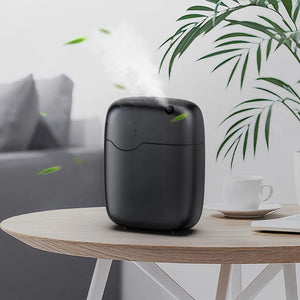
Small reception · no power neededFrom ₹749Shop →  Mid reception · has an off switch₹1,899Shop →
 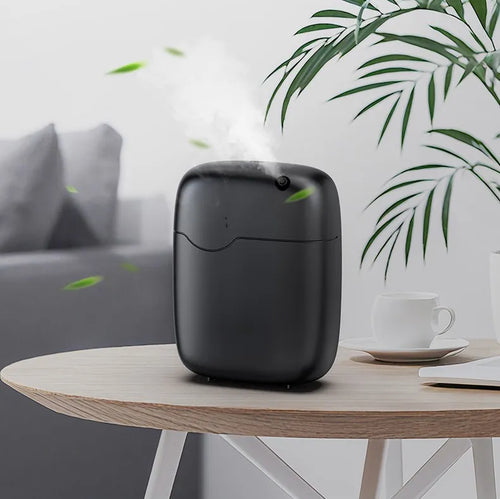 Large lobby · timed, dialable₹11,999Shop →
If the answer is yes, here is what yes looks like
Start at the equipment minimum and treat every increase as a decision, not an adjustment. Commercial scent machines ship on defaults written for retail and hospitality, where being noticed is the brief. Yours is the opposite brief. On a Vaayu that means the shortest on-time and longest off-time the unit offers, scheduled to clinic hours only — an empty building at ten at night does not need scenting, and running to the appointment book roughly halves consumption. On a Sukoon it means three drops rather than six and intermittent mode rather than continuous.
Set the level with a nose that has been outside for half an hour. Olfactory adaptation is essentially complete within about twenty minutes, so by mid-morning nobody working in the clinic can judge the intensity — and because they cannot smell it, they ask for more. That single mechanism is behind almost every over-scented reception in the country. Give the calibration to someone arriving from outside, or step out for thirty minutes and judge your own first breath on the way back in. Repeat it a fortnight later, because the second week is when the creep happens. Mount the unit high and aim it away from seating: a child’s breathing zone sits roughly 0.8 to 1.2 m from the floor against an adult’s 1.5 to 1.7 m, so a machine on a desk doses the child more heavily than the parent beside them.
Then make the off switch real, and tell people it exists. Any clinic scenting its reception should be able to stop within seconds and should be willing to, for any family who asks. A short line at the desk — that reception carries a light fragrance and staff will switch it off on request — costs nothing and converts a possible complaint into evidence of a clinic that thinks. Choose direction with the same restraint: dry and low-sweetness, such as Quiet Luxury or White Tea Serenity, rather than florals or anything gourmand. And put the whole decision in front of your infection-control and clinical governance leads before it goes anywhere near a purchase order.
What we would actually install
Matched to reception size and to how confident you are in the decision. The last row is on this table because for a substantial minority of the clinics that write to us it is the right one.
| Option | Suits | Control you get | Price |
|---|---|---|---|
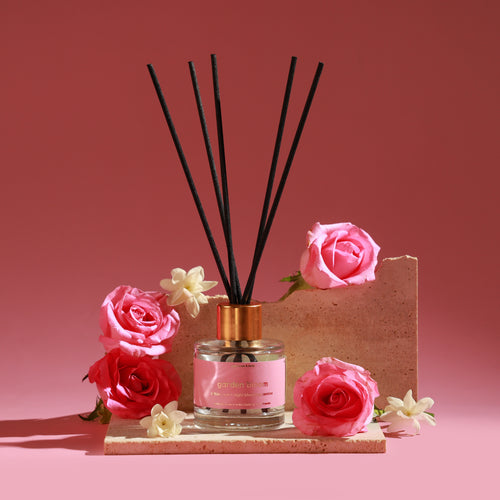
| Reed diffuser ★ | A small reception desk — up to about 150 sq ft on three reeds; the cheapest way to test whether anyone notices at all | Reed count only — no switch, no timer | from ₹749 |
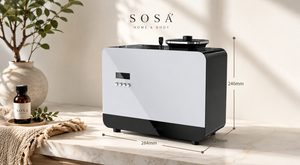
| Sukoon 500ml | A reception up to ~320 sq ft — up to about 320 sq ft, intermittent mode, three drops; a real off switch behind the counter | On/off, intermittent mode, you control the drops | ₹1,899 |
| Vaayu | A large lobby or a zoned duct — a genuinely large lobby, or a reception on its own duct zone; the duty cycle is why it can go low enough | Duty cycle in seconds, timer, app scheduling | ₹11,999 |
| Aangan | Whole-facility HVAC — a facility of 8,000–10,000 sq ft where the ducting is zoned and the clinical zones can be excluded | Zone-level control, but only if the ducting is zoned | ₹25,999 |
| Nothing at all | A clinic whose housekeeping and ventilation are already right, or any practice weighted towards newborn, respiratory or immunocompromised patients | Complete — and the correct answer more often than the trade admits | ₹0 |
Versailles
The question I am asked is almost always “is it safe”, and it is the wrong question to put to a perfumer. I can tell you what is in the bottle — phthalate-free, composed to IFRA standards for ambient diffusion — and I can tell you that we make no health claim of any kind for it. What I cannot do is tell a paediatrician what is appropriate inside their clinical areas, and any supplier who offers to is telling you something they are not qualified to know. That judgement sits with your infection-control and clinical governance leads, and the sensible sequence is to ask them before you ask us.
What I can be useful about is proportion. A reception fragrance in a children’s clinic is a small, pleasant thing. It is not a differentiator, it does not make a nervous four-year-old less nervous, and it will not rescue a room with a bin problem. I have watched owners spend a great deal of thought on which note to choose in a building where the air conditioner had not had its filter washed since the previous summer. Fix that, and the choice of note becomes a genuinely minor decision — which is what it should be.
So my honest position on appropriateness is this. Reception, yes, quietly, with an off switch and a notice at the desk. Clinical areas, no, in every clinic, without exception and without a conversation about intensity. And if you have already dealt with the disinfectant, the bins, the filters and the airing, you are welcome to buy nothing from me and lose nothing by it. A portion of every order that does get placed funds a girl’s classroom through Nanhi Kali.
Frequently asked questions
- Which areas should stay fragrance-free? — the seven zones, one by one.
- When is fragrance-free the better choice? — five clinics that should scent nothing.
- Does every premium clinic need a signature scent? — no — and here is why not.
- How do I decide for my own clinic? — a seven-question sequence you can run yourself.
- Brand: the SOSA founder story.
SOSA products & prices (verified August 2026): Hotel Collection water-based ultrasonic diffuser fragrance 15ml ₹299 · 100ml ₹999 · 300ml ₹1,799 · Pack of 7 (15ml, all fragrances) ₹1,799; refills 100ml from ₹999. Seven scents: The Ritz-Carlton-inspired (white tea · bergamot · cedar), Westin-inspired (white tea · aloe · cedar), 1 Hotels-inspired (cedarwood · vetiver · green leaves), The St. Regis-inspired (amber · violet · woods), Shangri-La-inspired (jasmine · green tea · white tea), Four Seasons-inspired (citrus · floral · sandalwood), W Hotels-inspired (citrus · pepper · amber). Diffusers: Boond 300ml ₹899 · Sukoon 500ml ₹1,899 · Megh 6L ₹3,499. Water-based, phthalate-free, composed to IFRA standards for home diffusion; 3–6 drops per tank. Made in India, Pune. The Hotel Collection scents are SOSA's own interpretations inspired by the world's finest hotels; all hotel names are trademarks of their respective owners and are used only to describe the scent style — SOSA is an independent Indian fragrance house, not affiliated with or endorsed by any hotel brand. Prices and availability subject to change — see the live product pages.