
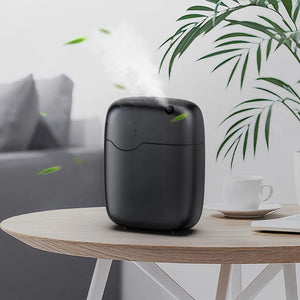



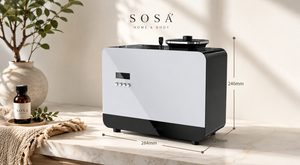
What we would use: a reed diffuser at the desk on three reeds, from ₹749. Nothing electrical, nothing to switch on, nothing a child can reach.
What we would not use: a commercial scent machine. The Vaayu is rated for large areas — at 300 sq ft it is the wrong machine, not the premium one.
What to do first: ten minutes of cross-ventilation before opening, and the bin in the injection corner emptied at midday, not at closing.
2. Choose the reed, and use three reeds not six. A reed diffuser is passive and evaporative. It has no pump, no timer and no way to be turned up by a well-meaning receptionist, and its practical reach on six reeds is around 150 sq ft. On three reeds it becomes a desk-radius effect rather than a room effect, which in a clinic this size is precisely what you want: something a parent registers while standing at the counter and does not carry with them into the cabin.
3. Do not buy a commercial machine for this room. This is the part suppliers do not say. The Vaayu at ₹11,999 is a genuinely good machine and it is rated for large areas — which is exactly why it is the wrong purchase at 300 sq ft. Sizing equipment above the room does not produce a subtler result at a lower setting; it produces a machine whose minimum sits above the room’s ceiling, and a clinic that smells of fragrance from the doorway to the examination couch.
4. Fix the air before you spend anything. A small clinic goes stale faster than a large one, because the volume is small and a closed room turns over its air perhaps a quarter of a time an hour. Ten minutes of genuine cross-ventilation before opening — two openings on different walls, not one window ajar — resets a 300 sq ft room completely. Combine that with a lidded bin emptied at midday rather than at closing, and most of the smell complaints in clinics this size disappear without a bottle being bought.
5. Accept that nothing is a normal outcome here. We sell scenting equipment and we still tell most 300 sq ft paediatric practices to install nothing. A clean, aired, well-lit small clinic reads as competent without any fragrance at all, and at this size the risk of over-scenting is higher than the reward of scenting well. If you take one thing from this page: a small clinic is the hardest size to scent well and the easiest size to scent badly.
Made in India, composed by an ISIPCA Versailles-trained perfumer — and a portion of every order supports girl-child education through Nanhi Kali.

Why 300 sq ft behaves as one air space
The instinct in a small clinic is to think in named areas — desk here, waiting there, cabin behind that partition — because that is how the lease and the layout drawing describe it. Air does not read layout drawings. Fragrance moves with bulk air movement, and in a 300 sq ft space with a single split AC there is one bulk air movement: out of the indoor unit, across the room, back to the same indoor unit. A partition that does not reach the slab, or a cabin door that stands open between patients, is not a boundary in any sense that matters to a fragrance molecule. Within ten or fifteen minutes of a source starting, the concentration across the whole clinic is closer to even than most owners expect.
The second thing that makes this size difficult is dilution. A pleasant intensity is not a property of the bottle; it is the amount released divided by the volume it disperses into, adjusted for how fast that volume is replaced. A 300 sq ft clinic with a nine-foot ceiling holds roughly a tenth of the air of a 3,000 sq ft facility, and if it is sealed and air-conditioned it may turn over only a fraction of that air each hour against three to eight air changes in a properly ventilated space. So the same emission rate produces a much higher concentration and holds it far longer. This is why equipment rated for large areas fails here in the specific way it does: not by being too expensive, but by having a minimum output the room cannot absorb.
The three decisions in a clinic this small
 Desk-sizedFrom ₹749Before any purchase, run the small-clinic list: disinfectant type and dilution, whether the morning clean happens with the door propped, the bin in the injection corner and how often it is emptied, the AC filter and its drain, damp under the basin, and whether anyone opens the place up before the first patient. In a 300 sq ft clinic each of those has ten times the effect it would have in a large one, because there is so little air to dilute anything. A small clinic that is aired and clean already smells the way you are trying to buy. Fragrance on top of an unresolved odour gives parents both at once.
Zone by zone in a 300 sq ft clinic
The striking thing about a small clinic table is how little of it can be scented. At this size the scentable area is a counter and the two metres around it — everything else is either clinical or shares air with something clinical.
| Area of the clinic | Scented? | Why | What we would use |
|---|---|---|---|
| Reception counter ★ | Yes, at the low ceiling | Short dwell, parents standing, and the only place a signature registers at all | Reed from ₹749 on three reeds |
| The six waiting chairs | Only as spillover | Thirty to sixty minutes of exposure for a child who cannot move away — never a separate source | Whatever the counter has, nothing added |
| Consultation and examination cabin | No | Shares air with the desk through an open door; the doctor also needs their own sense of smell | Nothing |
| Injection and vaccination corner | Never | A distinctive smell repeatedly paired with a needle becomes a cue for the needle | Nothing |
| Nebulisation chair, wherever it sits | Never | Respiratory patients; and in a small clinic the neb chair is often only a curtain from reception | Nothing — and move it away from the desk if you can |
| Washbasin, bin and storage corner | No | This is where small-clinic odour is actually generated, and fragrance does nothing about any of it | Lidded bin, midday emptying, check the trap |
| Before any of this: in a clinic this size, ten minutes of cross-ventilation before opening, a lidded bin emptied at midday, and a washed AC filter will change the room more than any bottle. Do those, live with the result for a fortnight, and only then decide whether you want a reed at all. | |||
Small reception · no power neededFrom ₹749Shop →  Mid reception · has an off switch₹1,899Shop →
 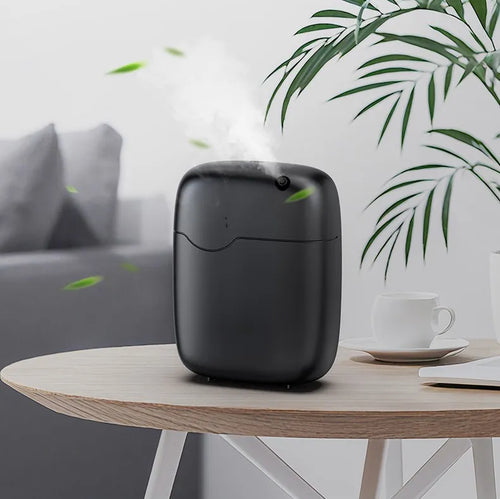 Large lobby · timed, dialable₹11,999Shop →
Keeping it under the ceiling
Three reeds, and resist the sixth. A 50ml reed diffuser at ₹749 ships with six fibre reeds because that is the full-strength setting for a home. In a 300 sq ft clinic, use three. You will get a softer effect and a longer-lasting bottle, and — more importantly — you will get an intensity that stays roughly where you set it instead of one that has to be managed. If after a fortnight nobody standing at the counter notices anything at all, that is not a failure; in a paediatric clinic it is close to the target.
Judge it with a nose that has been outside. Olfactory adaptation is essentially complete in about twenty minutes, so by mid-morning nobody working in the clinic can assess the level. In a small clinic this matters more than anywhere else, because staff sit inside the fragrance all day and will ask for the extra reeds. Have someone walk in from the street and give their first impression, or step out for half an hour yourself and judge your own first breath on returning. If a parent remarks on it, reduce — a comment is not a compliment to act on.
Choose dry over sweet, always. The direction matters more in a small clinic because there is nowhere for it to thin out. Dry, low-sweetness profiles — white tea, green tea, cedar — read as clean and stay unobtrusive. Sweet gourmand notes read as commercial rather than clinical and become cloying quickly in a small volume, which is why we would keep vanilla and coffee directions such as Fresh Brew out of any clinic. If you are running a powered Sukoon instead of a reed, the same logic points to Westin-inspired White Tea Serenity.
What we would actually install
Read this ladder from the bottom in a clinic this size. The last two rows exist because they are frequently the right answer for 300 sq ft, and the two above them are here mainly so you can see what you are not buying.
| Option | Suits | Control you get | Price |
|---|---|---|---|
| Reed diffuser ★ | A small reception desk — the right tool at 300 sq ft, on three reeds; nothing to switch, nothing for a child to reach | Reed count only — no switch, no timer | from ₹749 |
| Sukoon 500ml | A reception up to ~320 sq ft — rated for roughly your whole clinic, not your reception — three drops, intermittent, and only if you must | On/off, intermittent mode, you control the drops | ₹1,899 |
| Vaayu | A large lobby or a zoned duct — over-specified here; rated for large areas, so at 300 sq ft it is the wrong machine | Duty cycle in seconds, timer, app scheduling | ₹11,999 |
| Aangan | Whole-facility HVAC — a facility of 8,000–10,000 sq ft with zoned ducting — an entirely different building from yours | Zone-level control, but only if the ducting is zoned | ₹25,999 |
| Nothing at all | a well-aired 300 sq ft clinic with the bins and the AC filter under control — the commonest right answer at this size | Complete — and the correct answer more often than the trade admits | ₹0 |
Versailles
The smallest clinic I ever advised was about 280 square feet in a Pune side lane: one paediatrician, one assistant, a counter, five chairs and a curtain. The doctor wanted the Vaayu because she had smelled one in a hotel lobby and liked it. I told her not to buy it, which cost me eleven thousand rupees and took about four minutes to explain. A machine built to carry fragrance across a large hall does not become gentle in a small room; it becomes inescapable.
She bought a 50ml reed instead, put it behind the counter on three reeds, and started propping the door open for ten minutes before the first patient. Six months later she told me nobody had ever commented on the fragrance, which she initially reported as a disappointment. It is not a disappointment. In a room where children sit for forty minutes with a cough, nobody commenting is the whole objective.
So my advice for 300 square feet is deliberately unambitious. Air the place, sort the bin, wash the filter, and if you still want something at the counter, spend ₹749 rather than ₹11,999 and keep it to three reeds. Keep the consultation and injection corners clear of it entirely, and put the decision past your own infection-control and housekeeping people rather than past me. A portion of every order funds a girl’s classroom through Nanhi Kali.
Frequently asked questions
- Is a reed enough for a 500 sq ft reception? — usually yes — and the honest limits.
- When is the Vaayu too much? — the sizes where it is the wrong purchase.
- Reed or machine for reception? — the comparison, without the sales pitch.
- Stopping a machine over-scenting a small clinic — duty cycle, and the adaptation trap.
- Brand: the SOSA founder story.
SOSA products & prices (verified August 2026): Hotel Collection water-based ultrasonic diffuser fragrance 15ml ₹299 · 100ml ₹999 · 300ml ₹1,799 · Pack of 7 (15ml, all fragrances) ₹1,799; refills 100ml from ₹999. Seven scents: The Ritz-Carlton-inspired (white tea · bergamot · cedar), Westin-inspired (white tea · aloe · cedar), 1 Hotels-inspired (cedarwood · vetiver · green leaves), The St. Regis-inspired (amber · violet · woods), Shangri-La-inspired (jasmine · green tea · white tea), Four Seasons-inspired (citrus · floral · sandalwood), W Hotels-inspired (citrus · pepper · amber). Diffusers: Boond 300ml ₹899 · Sukoon 500ml ₹1,899 · Megh 6L ₹3,499. Water-based, phthalate-free, composed to IFRA standards for home diffusion; 3–6 drops per tank. Made in India, Pune. The Hotel Collection scents are SOSA's own interpretations inspired by the world's finest hotels; all hotel names are trademarks of their respective owners and are used only to describe the scent style — SOSA is an independent Indian fragrance house, not affiliated with or endorsed by any hotel brand. Prices and availability subject to change — see the live product pages.