



How: one blend, unchanged, never substituted, never allowed to run out, over many months.
How strong: below the level anyone remarks on. Intensity does not accelerate recognition; it only raises the chance of a complaint.
What usually breaks it: procurement. A stand-in bottle during a stock gap resets the clock.
2. Recognition happens at the door, not in the chair. This is the detail that changes the specification. Olfactory adaptation is essentially complete within about twenty minutes, so a parent who has been sitting in your waiting area for half an hour is no longer perceiving the fragrance at all. The only moment recognition can occur is the first breath after coming in from outside, when the nose is fresh and at its most sensitive. You are therefore designing for the most favourable detection condition that exists, which is precisely why the level can be — and should be — extremely low.
3. The hard part is procurement, not perfumery. Choosing a blend takes an afternoon. Running the same blend for three years without a single substitution takes a system. What breaks it is mundane: the usual size is out of stock, so someone buys a different one; a new receptionist tops up with whatever is in the cupboard; the reeds are refilled with last winter’s bottle; the machine is refilled with something similar. Each substitution resets the clock, because what parents were learning was the specific thing, not the general category. Buy larger sizes, hold one spare, and write the product name on the standing order.
4. It stops at reception, and stopping there is not a compromise. A recognisable house note that extends into consultation, examination or vaccination rooms is not a more complete brand experience; it is the same fragrance in the rooms where a distinctive smell does the most harm. The associative problem is at its worst exactly where recognition is strongest — a scent a child can recognise is a scent a child can recognise on the way to an injection. Keep it in the entrance and reception, where the encounter is brief and the occupant is an adult, and let the clinical areas stay unscented as a matter of standing policy.
5. And be honest that the scent is a small part of what is recognised. Ask a parent what they recognise about a children’s centre they have used for three years and you will hear about the person at the desk who knows the child’s name, the route from door to chair, the sound of the place, the way appointments actually run to time. Those are the load-bearing elements of a recognisable experience. A consistent low note at the entrance is a genuine part of it, and it is worth doing well, but it is a finishing detail on a structure built out of operations. A centre with a memorable scent and a chaotic desk is remembered for the desk.
Made in India, composed by an ISIPCA Versailles-trained perfumer — and a portion of every order supports girl-child education through Nanhi Kali.
Why repetition builds recognition and intensity does not
The intuition behind most signature-scent briefs is that recognition is a threshold effect — that if the fragrance is strong enough to be noticed, it will be strong enough to be remembered, and the job is therefore to be sufficiently present. That is not how a repeated environmental cue works. What makes a smell recognisable is that it has been encountered, in the same form, in the same place, on many separate occasions, each of them separated by a return to normal air. The variable that matters is the count of encounters and the identity of the stimulus, not the size of any single dose. This is good news for a children’s clinic, because it means the two things you want — recognisability and a level low enough to be defensible in a room full of unwell children — are not in tension. They only appear to be in tension if you are trying to build recognition in six weeks.
The second reason intensity is the wrong lever is that the moment of recognition is also the moment of maximum sensitivity, and it is the only moment available. A parent walks in from a street, a car park or a lift lobby with a nose that has been meeting other air for the last twenty minutes. That first breath is the whole event. Within a few minutes of sitting down they have adapted and the fragrance has effectively disappeared for them, which is why parents in an over-scented waiting room often do not complain until they leave and come back. You are designing for a fresh nose at a doorway, and a fresh nose at a doorway needs remarkably little. Everything above that threshold is being spent on people who cannot detect it any more, and imposed on children who are still sitting in it.
Three requirements, in the order they will break
 Buy the large size300ml ₹1,799Pick a blend you can obtain reliably for years, not the one that most impresses you in a sample. Buy it in a size that survives a supply gap — 300ml at ₹1,799 rather than a run of 15ml bottles — and keep one unopened spare in the cupboard at all times. Write the exact product name into the standing order and into the reception SOP, so that "something similar" never becomes an option for a member of staff who is trying to be helpful on a Friday evening. Two substitutions a year is enough to ensure no parent ever learns your scent.
Zone by zone, for a recognisable house note
The scented list does not grow because the scent is meant to be recognisable. If anything the argument for keeping it small gets stronger the better the signature works.
| Area of the clinic | Scented? | Why | What we would use |
|---|---|---|---|
| Entrance and reception desk ★ | Yes, low | The only place recognition can occur — a fresh nose at a doorway, arriving from outside air | Hotel Collection 300ml ₹1,799, or reeds from ₹749 |
| Administrative and billing | Yes | Continuous with reception, staff-facing, no patients seated for long periods | The same source, no separate unit |
| Waiting seating | Only at the floor | Adaptation means nobody sitting here is perceiving the signature anyway — but children still are being exposed to it | The reception source at minimum |
| Consultation and examination rooms | No | A recognisable note in an assessment room is a more complete brand and a worse clinical room | Nothing |
| Vaccination, injection and procedure rooms | Never | The better your signature works, the more effective it becomes as a cue for the needle | Nothing |
| Nebulisation, asthma and neonatal follow-up | Never | Respiratory patients and newborns; no branding argument survives contact with these rooms | Nothing |
| Before any of this: settle the supply arrangement before you start counting months. One named product, one large size, one unopened spare on the shelf, and a written instruction that no substitute is acceptable. Recognition that gets interrupted twice a year never accumulates. | |||
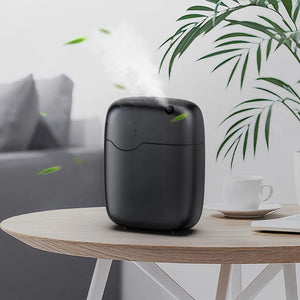
Small reception · no power neededFrom ₹749Shop →  Mid reception · has an off switch₹1,899Shop →
 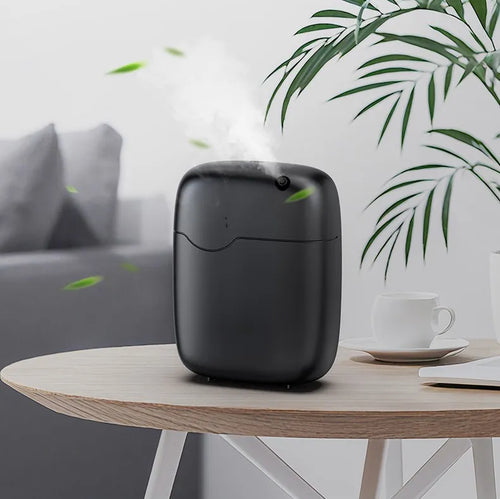 Large lobby · timed, dialable₹11,999Shop →
Setting the level for something meant to be recognised
Set it to be detectable on entry and nowhere else in the building. The target is a level at which a person arriving from outside notices something faintly on their first breath and has stopped noticing it by the time they reach the chairs. That is a much lower setting than most owners expect, because they are testing from inside the building where they have already adapted. On a Sukoon it is three drops in intermittent mode. On a Vaayu it is the shortest on-time and longest off-time the unit offers, scheduled to clinic hours. Neither number needs to rise as the months pass — the recognition is accumulating whether or not anybody can feel it working.
Audit it twice a year, with an outside nose, and record the finding. The purpose of the audit is not to fine-tune the pleasure of the fragrance; it is to catch drift. Have someone who has been out of the building for thirty minutes walk in and answer three questions in writing: did you notice anything on the first breath, could you still notice it at the chairs, and does it smell like the same thing as last time. The third question is the one that matters and it is the one nobody asks. Keep the answers in the same file as the setting. Two years of that file is what a genuine signature is actually made of.
Keep the switch-off available, and do not let the signature argue against it. This is where a house note can quietly go wrong. Once a clinic has invested in being recognisable, there is a temptation to treat requests to turn it off as a threat to the brand. They are not, and a centre that hesitates for that reason has got its priorities backwards. Any receptionist should be able to switch it off in five seconds without asking permission, there should be a plainly worded line at the desk saying so, and a family who asks should never be given a reason. Take the whole arrangement to your own infection-control and clinical governance leads before you commit to it, and accept that they may decide a recognisable scent is not something your building should be doing at all.
What we would actually install
Chosen for supply stability as much as for coverage. For this particular objective, the larger consumable size and the simpler machine are usually the better buy.
| Option | Suits | Control you get | Price |
|---|---|---|---|
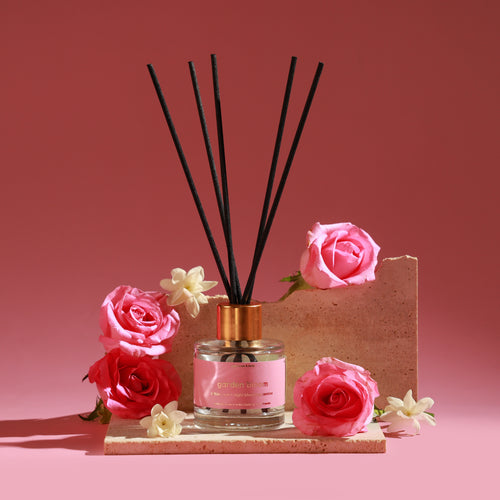
| Reed diffuser ★ | A small reception desk — up to about 150 sq ft on three reeds; nothing to drift, and a 130ml bottle covers fourteen to eighteen weeks | Reed count only — no switch, no timer | from ₹749 |
| Sukoon 500ml | A reception up to ~320 sq ft — up to about 320 sq ft, three drops, intermittent — buy the 300ml fragrance size and hold a spare | On/off, intermittent mode, you control the drops | ₹1,899 |
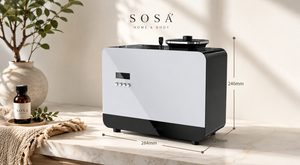
| Vaayu | A large lobby or a zoned duct — a genuinely large lobby or a reception on its own duct zone, with the setting written down and locked | Duty cycle in seconds, timer, app scheduling | ₹11,999 |
| Aangan | Whole-facility HVAC — a facility of 8,000–10,000 sq ft with zoned ducting, where every clinical zone is excluded from the loop | Zone-level control, but only if the ducting is zoned | ₹25,999 |
| Nothing at all | A centre that cannot commit to one blend for three years, or one whose reception shares a return-air path with clinical rooms | Complete — and the correct answer more often than the trade admits | ₹0 |
Versailles
People come to me for a signature and expect a conversation about notes. The conversation that actually determines whether they get one is about purchasing. Recognition is built out of sameness, and sameness is an administrative achievement rather than a creative one. I would rather sell a clinic a blend they find slightly boring and can buy identically for five years than the one they fell in love with in the studio and will substitute the first time it is out of stock.
I also want to be plain about how little strength this needs. A parent who visits you a dozen times over three years will learn a note they never once described as noticeable, because they meet it fresh, at the door, every time. The clinics that turn it up are not accelerating anything; they are just spending the extra on the children in the waiting room, who are the only people in the building still breathing it twenty minutes later. If your reception has a level a parent could comment on, you have overpaid for a result you would have got anyway.
And the last thing, which is the part suppliers leave out. Most of what a family recognises about a children’s centre has nothing to do with me. It is the receptionist who remembers the child’s name, the clinic that runs to time, the route from the door to the chair that does not require anybody to ask where to go. Build those, keep every clinical room unscented, run one quiet note at the entrance and never change it, and put the whole idea past your own clinical governance and infection-control people before you start. A portion of every order funds a girl’s classroom through Nanhi Kali.
Frequently asked questions
- Should a children’s clinic have a signature at all? — the borrowed word, examined.
- Does every premium clinic need one? — no — and the premise is imported.
- A recognisable experience without the gloss — what parents actually remember.
- Should every branch smell the same? — standardise the policy, not the air.
- Brand: the SOSA founder story.
SOSA products & prices (verified August 2026): Hotel Collection water-based ultrasonic diffuser fragrance 15ml ₹299 · 100ml ₹999 · 300ml ₹1,799 · Pack of 7 (15ml, all fragrances) ₹1,799; refills 100ml from ₹999. Seven scents: The Ritz-Carlton-inspired (white tea · bergamot · cedar), Westin-inspired (white tea · aloe · cedar), 1 Hotels-inspired (cedarwood · vetiver · green leaves), The St. Regis-inspired (amber · violet · woods), Shangri-La-inspired (jasmine · green tea · white tea), Four Seasons-inspired (citrus · floral · sandalwood), W Hotels-inspired (citrus · pepper · amber). Diffusers: Boond 300ml ₹899 · Sukoon 500ml ₹1,899 · Megh 6L ₹3,499. Water-based, phthalate-free, composed to IFRA standards for home diffusion; 3–6 drops per tank. Made in India, Pune. The Hotel Collection scents are SOSA's own interpretations inspired by the world's finest hotels; all hotel names are trademarks of their respective owners and are used only to describe the scent style — SOSA is an independent Indian fragrance house, not affiliated with or endorsed by any hotel brand. Prices and availability subject to change — see the live product pages.