


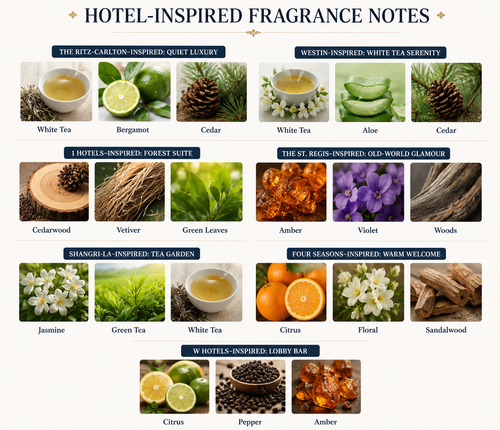
The real vetiver: 1 Hotels-inspired Forest Suite — cedarwood, vetiver and green leaves. ₹299 for 15ml. Water-based, ultrasonic-only.
The machine it needs: Boond ₹899 for a room up to 150 sq ft, or Sukoon ₹1,899 for 270–320 sq ft, which includes three 15ml scents of your choice.
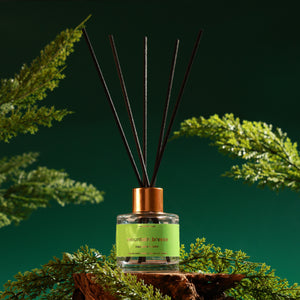
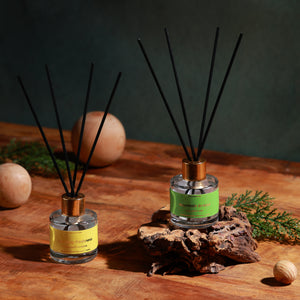
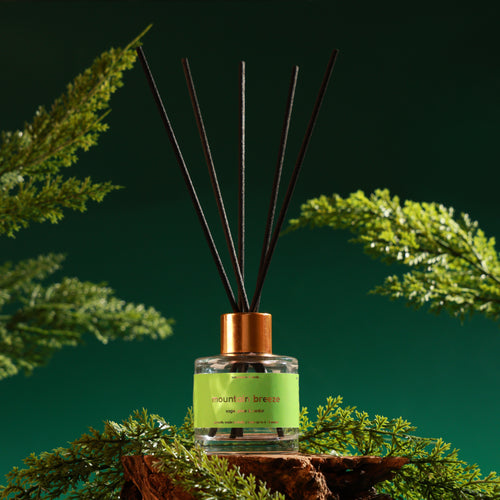
If it must be a reed: Mountain Breeze ₹849 — Himalayan pine, sage and Indian cedar, 9.4 on the SOSA scale. The driest reed we make and the only one that shares vetiver's cool, unsweet, structural quality. It is a green forest wood, not a root. An honest neighbour, not a match.
2. The real vetiver is Forest Suite at ₹299. Cedarwood, vetiver and green leaves — the driest of the seven Hotel Collection scents, with no sweetness, no powder and no cream anywhere in it. This is genuinely the note you asked for, not a near miss.
3. It needs a machine, because it is water-based. Boond ₹899 covers a room up to 150 sq ft; Sukoon ₹1,899 covers 270–320 sq ft, runs 16–18 hours a fill on low and includes three 15ml scents of your choice. Dose 3–6 drops per tank. Hotel Collection oil cannot go into a reed diffuser and reed oil cannot go into a machine — in either direction it is the wrong chemistry.
4. If it has to be a reed, buy Mountain Breeze at ₹849 knowing what it is. Himalayan pine, sage and Indian cedar at 9.4 on the SOSA strength scale — our driest, coolest, least sweet reed, sharing vetiver's structural, unsugared character. But it is a green forest wood and vetiver is a root, and those smell different. Neighbour, not match.
5. For vetiver specifically, take the machine. I usually argue the other way, because a reed needs no socket and never stops. Here the reed cannot contain the note at all, so the trade is not permanence against convenience — it is having the fragrance you came for, or not having it.
Alcohol-free, phthalate-free, made in Pune. A portion of every order supports girl-child education through Nanhi Kali.
Khus is vetiver — and that is the most interesting fact on this page
Before any of the shopping, the thing worth knowing. The grass they weave into a khus tatti is Chrysopogon zizanioides, and Chrysopogon zizanioides is vetiver. Same plant, two names, one from the perfumery counter and one from the veranda. India is one of the world's significant producers of the oil, distilled largely from the roots, and the roots are the same roots that go into the screens. So when an Indian reader types "vetiver" into a search box, they are usually asking about a smell they have known their entire life without ever once filing it as fragrance.
Think about how the screen actually worked. The tatti hangs across a doorway or a window through the worst of a north Indian May, somebody keeps it wet, and as the water evaporates the room cools by several degrees. That is straightforward physics — evaporative cooling, the same principle as a desert cooler, which is why desert coolers were once lined with khus for exactly this reason. But the tatti did a second thing nobody designed, which is that the wet roots gave off their own smell, damp and earthy and green and faintly bitter, and it travelled through the house with the cooled air. An entire generation learned to associate that smell with relief from heat, and learned it so early that it does not present itself as a smell at all. It presents itself as the feeling of a cool room.
This matters commercially, and it is why this page exists rather than simply saying "we do not make one" and closing. Most fragrance notes have to be introduced to an Indian buyer. Vetiver does not. It has to be re-introduced — the reader already owns the memory, and all the work is in connecting the word on the bottle to the screen in the doorway. Once that connection is made, vetiver stops being an obscure Western perfumery material for people who read fragrance blogs and becomes the most obviously domestic note in this entire cluster. It is the only one I can point at and say: you have already smelled this, in your own house, for months at a time.
 Forest Suite₹299Described honestly and without romance: vetiver smells of earth after rain, damp roots pulled out of wet ground, dry grass, and something faintly smoky at the edges. There is a bitterness in it and a nuttiness under that, and neither is unpleasant once you stop expecting a fragrance to be pleasant in the biscuit sense. It is the least sweet material in common use. Nothing in it is candied, nothing is rounded, nothing has been softened for the customer. If you have ever smelled a bottle and thought this is a smell, not a treat, it was probably built on vetiver.
 Mountain Breeze₹849Base notes are supposed to be warm. Amber is warm, vanilla is warm, sandalwood is warm, oud is warm. Vetiver is a base note that reads cool, which is close to a contradiction in terms and is the reason perfumers value it so highly. It anchors a composition the way any heavy material does — it stops the top notes flying off, it gives the thing a floor — but it does this without making the air feel thicker. That is the trick. A room with vetiver in it is grounded and still feels open. Perfumers use it as structure rather than as decoration; it is the beam, not the paint.
 Sukoon₹1,899Here is the genuine case, and it is not marketing. We spend most of the Indian year trying to make rooms feel less hot. Citrus is often called cooling and it is not — it is bright, which is a different axis, and a sharp lemon in a 40°C room can read as agitated. Florals add humidity to the impression of the air. Gourmands are actively worse. Vetiver is one of very few materials that suggests damp earth and wet grass, and damp earth and wet grass are what a hot room is missing. The khus tatti cooled by physics. Vetiver in a room cools by association. The physics is gone but the ending is the same feeling, and I have never found another note that does it.
Why almost nobody in India sells a vetiver home fragrance
You will have noticed, if you went looking before you arrived here, that vetiver home fragrance is close to absent from the Indian market — plenty of khus attar, plenty of khus sherbet, almost no diffusers. That is not an oversight and it is not because Indians dislike it. It is because vetiver fails the one test that decides which fragrances get made, which is the shelf test. A buyer picks up a bottle, uncaps it, sniffs once, and decides in about two seconds. Everything about the way home fragrance is sold rewards a material that performs in those two seconds.
Vetiver has no bright opening. It has no opening at all in the usual sense — it is a slow material, all base and no top, and what you get from a single sniff is earth and bitterness and a vague impression of damp. It does not announce itself, it does not flatter you, and it certainly does not smell expensive in the way a jasmine or an amber immediately smells expensive. In a room, over three days, it becomes the most quietly sophisticated thing you own. On a shelf, over two seconds, it loses to almost anything. So the category avoids it, and the avoidance becomes self-fulfilling: buyers never encounter it, so it stays unfamiliar as a named note, so it tests badly, so nobody makes it.
The other half of the problem is that vetiver is unsweet, and the Indian home fragrance market is built on sweetness almost end to end. Rose, jasmine, sandalwood, vanilla, amber, the whole floral-oriental spine of what sells here — all of them are sweet or at least rounded. Vetiver is the opposite instinct. It is a connoisseur's note in the precise sense that it rewards living with rather than sniffing, and a market organised around sniffing will never surface it. Which is a shame, because the same market is full of people who tell me they hate all home fragrance, and a great many of them do not hate fragrance at all. They hate sugar.
| Material | Character | Warm or cool | Sweetness | What it does in a room | Where SOSA has it |
|---|---|---|---|---|---|
| Vetiver — khus ★ | Earth after rain, damp roots, dry grass, faint smoke, faintly nutty | Cool — unusually, for a base note | None. The least sweet material in common use | Gives the room a floor without adding weight; makes the air read cooler | Not in reeds. Real vetiver in Forest Suite ₹299 — ultrasonic only |
| Cedar | Dry pencil-shaving wood, clean, a little pointed | Cool-neutral | Very low | Steadies a room and holds attention; the concentration wood | In reeds: Mountain Breeze ₹849 (Indian cedar). Also in Forest Suite ₹299 |
| Pine | Green resin, crisp, outdoor air at altitude | Cool | Low | Opens a room outward; adds lift rather than depth | In reeds: Mountain Breeze ₹849 (Himalayan pine) |
| Sandalwood | Creamy, milky, soft-edged wood | Warm | Mild but definitely present | Rounds and softens; blurs the edges of a room | Not in reeds. Real sandalwood in the Four Seasons-inspired ₹299 — ultrasonic only |
| Oud | Resinous, dense, medicinal, animalic | Warm | Not sweet, but reads rich and heavy | Saturates a room; fills the air rather than structuring it | Nowhere at SOSA — not in the reed line and not in the Hotel Collection. Said plainly |
Real vetiver · Forest Suite₹299Shop →  The machine · Sukoon₹1,899Shop →
  Driest reed · Mountain Breeze₹849Shop →
Reed or machine — the trade, and which rooms vetiver belongs in
I normally argue for the reed, and the arguments are good ones. A reed diffuser needs no socket, no water, no button and no attention. It is permanent in a way a machine is not — it is simply there on the console, working at a low constant level for six to eight weeks on a 50ml or fourteen to eighteen on a 130ml, and you never think about it. A machine asks for a plug point, a refill and a decision every day. For most fragrances I would tell you the reed wins on those grounds alone.
For vetiver the calculation collapses, because the reed side does not contain the note at all. The trade is not permanence against convenience; it is having the fragrance you came for against not having it. Reed oil and the water-based Hotel Collection are separate products and cannot be swapped in either direction — the Hotel Collection is water-based and would sit in a reed bottle doing nothing, and reed oil in an ultrasonic machine would clog the plate. There is no hotel-inspired reed diffuser and there is no vetiver reed diffuser, and no amount of wanting one changes the chemistry. So for this one note, take the machine. Boond at ₹899 if the room is under 150 sq ft, Sukoon at ₹1,899 if it is 270–320 sq ft, three to six drops of Forest Suite per tank, and the Sukoon includes three 15ml scents of your choice, which makes the entry cost less painful than it looks.
On rooms, vetiver is more particular than most notes and it is worth being told where it fails. It belongs in a study, because it is the note that gives you a floor without any distraction on top of it. It belongs in a hall, where a cool unsweet register reads as composure rather than as welcome, and composure is often what you want a hall to say. It belongs in the bedroom of somebody who dislikes sweetness — and if you have been buying diffusers for such a person for years and getting them wrong, this is the answer you have been missing. And it belongs anywhere you want a room to feel cool and unfussy. It is the wrong choice for a room where you want warmth or welcome: a dining room before guests, a nursery, a drawing room at a winter party. Vetiver will not embrace anybody. That is not what it is for.
What to buy for vetiver, in order — and the gap stated again
In the order I would actually buy it, with the honest gap in the last row where it belongs. The reed line contains no vetiver, no sandalwood and no oud, and this table is not going to pretend that Mountain Breeze is a root when it is a forest. What it will do is tell you exactly which product contains the material you searched for, and what it costs to run it.
| Buy | What it is | When it is the right answer | Price |
|---|---|---|---|
| 1. Forest Suite 15ml ★ | Cedarwood, real vetiver, green leaves — the driest of the seven Hotel Collection scents | First, always. This is the actual note you searched for | ₹299 |
| 2. Boond | The small ultrasonic machine — a room up to 150 sq ft | Study, bedroom, home office. The cheapest way into real vetiver | ₹899 |
| 3. Sukoon | 270–320 sq ft, 16–18 hours a fill on low, three 15ml scents included | Halls, living rooms, or if you want the scents bundled in | ₹1,899 |
| 4. Mountain Breeze 50ml | Himalayan pine, sage, Indian cedar — 9.4, the driest and least sweet reed we make | If it must be a reed: no socket, no refilling, 6–8 weeks. A neighbour, not a match | ₹849 |
| 5. Forest Suite 100ml | The refill size, once you know vetiver is a note you live with rather than visit | After the first 15ml has proved the point | ₹999 |
| No vetiver reed diffuser: the honest gap | There is no vetiver in the SOSA reed line, and no sandalwood and no oud either. Mountain Breeze ₹849 shares the cool, unsweet, structural register but is a green forest wood rather than a root | Said plainly rather than stretched to fit. For the material itself, the machine is the only honest route | ₹849 / ₹299 |
Versailles
At Versailles we were taught vetiver as a French perfumery pillar, with the Haitian and Javanese origins discussed at length and the Indian one mentioned in passing. It took me an embarrassingly long time to make the connection walking home in a Pune summer, which is that the material on the blotter in a classroom in France was the material in the screens at my grandmother's door in Rajasthan. Nobody had ever called it vetiver there. It was khus, and it was a cooling device, not a perfume.
That is why I will not make a vetiver reed diffuser badly just to have one on the site. The note deserves the format that can actually carry it, and at SOSA that is the water-based side — Forest Suite at ₹299, on a Boond or a Sukoon. If one day I can build a vetiver that holds properly on fibre reeds through an Indian August without going bitter, I will. Until then the reed line has five scents and none of them is this one.
If you buy nothing from this page, take the fact instead. Khus is vetiver. The next time somebody tells you they do not like perfume, ask them whether they liked the smell of the screens in summer, because a surprising number of people who think they hate fragrance simply hate sugar, and this is the note that has none. Everything is composed in Pune, and a part of every order funds a girl's classroom through Nanhi Kali.
Frequently asked questions
- Oud in India and Luxury oud at home — what oud is, and why almost nothing sold as oud is oud, and what to buy when nobody makes the reed.
- Sandalwood in India and Oud in a living room — Mysore, Australian, and the synthetic majority, and the honest substitution.
- Sandalwood in a bedroom and Vetiver at home — the creamiest answer in the house, and the driest thing SOSA makes.
- Oud versus sandalwood versus vetiver — three woods, three different rooms.
- The decision tree — one bottle, no reading, if you want one bottle and no argument.
- The complete guide — every decision, and every gap, in one place.
- Brand: the SOSA founder story.
SOSA facts verified August 2026: The reed line is five scents, all alcohol-free, on a heat-stable CCT (caprylic/capric triglyceride) base, phthalate-free, paraben-free, IFRA-compliant, 0 ppm formaldehyde, six fibre reeds in a refillable glass bottle, composed and made in Pune, India. Mountain Breeze (Himalayan pine · sage · Indian cedar) 50ml ₹849 · 130ml ₹1,349 · 9.4 on the SOSA strength scale, the deepest woody in the range. Evening Calm (Kashmir lavender · chamomile · soft musk) 50ml ₹799 · 130ml ₹1,299 · 8.9, the softest. Garden Bloom (British rose · night-blooming jasmine) 50ml ₹799 · 130ml ₹1,299 · 8.9. Morning Freshness (Malabar lemon · peppermint · eucalyptus globulus) 50ml ₹749 · 130ml ₹1,249 · 9.0. Fresh Brew (Coorg coffee · Kerala vanilla · caramel) 50ml ₹849 · 130ml ₹1,349 · 9.5, the deepest in the range. Longevity 6–8 weeks on 50ml and 14–18 weeks on 130ml. Refills 300ml ₹2,399 · 500ml ₹3,499. Climate-tested through 45°C heat and 85% RH monsoon humidity. The reed line contains no vetiver, no sandalwood, no oud, no amber, no orange blossom and no aquatic, marine or clean-linen accord; where this guide is asked for one of those it says so rather than stretching the nearest scent to cover it. Real vetiver appears only in the water-based Hotel Collection, in the 1 Hotels-inspired Forest Suite (cedarwood · vetiver · green leaves); real sandalwood only in the Four Seasons-inspired scent; oud appears nowhere in the house. Hotel Collection 15ml ₹299 · 100ml ₹999 · 300ml ₹1,799, dosed 3–6 drops per tank. Machines: Boond ₹899 (300ml tank, up to 150 sq ft) and Sukoon ₹1,899 (500ml tank, 270–320 sq ft, 16–18 hours on low, three 15ml scents included). Reed diffuser oil and the water-based Hotel Collection are separate products and are not interchangeable in either direction; there is no hotel-inspired reed diffuser. Free shipping above ₹499, and a portion of every order supports girl-child education through Nanhi Kali. SOSA is an independent Indian fragrance house; the Hotel Collection scents referenced here are SOSA's own interpretations inspired by the world's finest hotels and SOSA is not affiliated with or endorsed by any hotel brand. Prices subject to change — see the live product pages.