


Why it does not go off in summer: indole is held deliberately below the fecal threshold, so the jasmine stays warm and floral above 30°C instead of tipping over in April.
If you want a greener, lighter jasmine: the Shangri-La-inspired Hotel Collection scent at ₹299 — jasmine, green tea, white tea. It is water-based and needs an ultrasonic machine: Sukoon ₹1,899 or Boond ₹899.
The honest gap: there is no jasmine-solo reed diffuser at SOSA. Garden Bloom is a rose-and-jasmine composition. If you want jasmine on its own, we do not make it — and there is no tuberose, gardenia, ylang-ylang, magnolia, champa or frangipani in the reed line either.
2. Ask which species before you ask anything else. Sambac is creamy, warm and full; grandiflorum is green, sharp and tea-like. Both are real jasmine and both are lovely, but only one of them is the smell an Indian nose recognises from a gajra or a temple garland. A label that says only "jasmine" is usually telling you it is neither, and is a synthetic reconstruction.
3. Ask what the indole level is doing at 34°C. Indole is the molecule that makes jasmine smell alive rather than merely pretty, and above a concentration threshold it smells frankly fecal. Heat pushes it across. A jasmine formulated for a 21°C European room will not hold in a Chennai afternoon. Garden Bloom is deliberately calibrated below the threshold for exactly this reason.
4. Do not buy a jasmine with nothing next to it. Jasmine is heady, and headiness you can walk away from after three hours on skin becomes exhausting in a room you occupy for fourteen. The British rose in Garden Bloom is cool, structured and daylit, and it is the thing that stops the jasmine filling the room.
5. Use the reeds as the volume control. Six for a living room or entryway, three or four for a bedroom, and flip them every five to seven days. Changing the reed count is free and fixes almost every complaint that a floral is too much.
Alcohol-free, phthalate-free, made in Pune. A portion of every order supports girl-child education through Nanhi Kali.
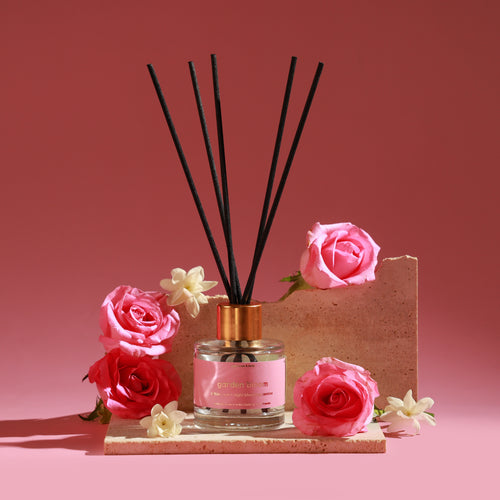
The three things that decide whether a jasmine works in an Indian home
Jasmine is the flower India knows best and the one it is sold worst. It arrives in more Indian households than any other flower — as a gajra bought at a traffic light, as a garland at a temple, as the string of buds a grandmother keeps by the bed — and yet almost every jasmine home fragrance on sale here is built on a species most Indians have never actually smelled, at an indole level that will fail in April, with nothing beside it to stop it becoming overwhelming. Those are three separate decisions, and a bottle can get two of them right and still be wrong in your flat. Here they are in the order that matters.
 Garden Bloom₹799Two species carry almost all of perfumery's jasmine and they smell meaningfully different. Jasminum grandiflorum — chameli in the north, Spanish jasmine in the trade — is the one grown for the great French and Egyptian absolutes and the one under most Western fine fragrance. It is greener, brighter, sharper at the edges, with a tea-like transparency and a faint fruitiness. Jasminum sambac — mogra, mallige, Arabian jasmine — is the small, thick-petalled one that opens after dark. It is creamier, warmer, rounder and fuller, with less green cut and more body. Garden Bloom is built on night-blooming sambac, and that is a decision made for this market rather than inherited from a European brief. When an Indian buyer says jasmine, the memory being described is nearly always sambac: the gajra, the wedding, the evening the flowers opened on the balcony. Grandiflorum is a beautiful material that will not touch that memory, and a bottle can be expensive, well made and completely beside the point.
Below threshold₹799This is the technical heart of the page and the thing nobody tells Indian jasmine buyers. Real jasmine of either species contains indole. At low concentration indole is what makes jasmine smell warm, floral and living rather than merely pretty — it is the reason a real jasmine has presence and a synthetic one has only shape. Above a certain concentration the same molecule reads as frankly fecal. Nothing about the material changes; only the amount reaching your nose does. And the amount reaching your nose is a function of how fast the oil is leaving the reeds, which is a function of temperature. Indole mobilises with heat. A sealed flat through a Delhi May, a Chennai afternoon in the high thirties, a west-facing Mumbai living room in June — these are rooms that routinely push a jasmine formulated for 21°C across its threshold and hold it there from March to October. That is the real mechanism behind the complaint I hear more than any other in this family: it smelled beautiful when I bought it and went off in the summer. The oil did not spoil. It was never built for the temperature. Garden Bloom is formulated with indole held deliberately below the threshold, at a level chosen so that the jasmine stays warm and floral above 30°C. It costs a little of the swagger a jasmine can have in a cool room; it buys you the same fragrance in April that you bought in December. Priya S. in Bengaluru put it exactly: "the jasmine is the real surprise. It stays warm and floral all summer — I expected it to turn awful by April. It hasn't." She expected it to turn because every jasmine she had previously owned did.
Garden Bloom₹799Two species carry almost all of perfumery's jasmine and they smell meaningfully different. Jasminum grandiflorum — chameli in the north, Spanish jasmine in the trade — is the one grown for the great French and Egyptian absolutes and the one under most Western fine fragrance. It is greener, brighter, sharper at the edges, with a tea-like transparency and a faint fruitiness. Jasminum sambac — mogra, mallige, Arabian jasmine — is the small, thick-petalled one that opens after dark. It is creamier, warmer, rounder and fuller, with less green cut and more body. Garden Bloom is built on night-blooming sambac, and that is a decision made for this market rather than inherited from a European brief. When an Indian buyer says jasmine, the memory being described is nearly always sambac: the gajra, the wedding, the evening the flowers opened on the balcony. Grandiflorum is a beautiful material that will not touch that memory, and a bottle can be expensive, well made and completely beside the point.
Below threshold₹799This is the technical heart of the page and the thing nobody tells Indian jasmine buyers. Real jasmine of either species contains indole. At low concentration indole is what makes jasmine smell warm, floral and living rather than merely pretty — it is the reason a real jasmine has presence and a synthetic one has only shape. Above a certain concentration the same molecule reads as frankly fecal. Nothing about the material changes; only the amount reaching your nose does. And the amount reaching your nose is a function of how fast the oil is leaving the reeds, which is a function of temperature. Indole mobilises with heat. A sealed flat through a Delhi May, a Chennai afternoon in the high thirties, a west-facing Mumbai living room in June — these are rooms that routinely push a jasmine formulated for 21°C across its threshold and hold it there from March to October. That is the real mechanism behind the complaint I hear more than any other in this family: it smelled beautiful when I bought it and went off in the summer. The oil did not spoil. It was never built for the temperature. Garden Bloom is formulated with indole held deliberately below the threshold, at a level chosen so that the jasmine stays warm and floral above 30°C. It costs a little of the swagger a jasmine can have in a cool room; it buys you the same fragrance in April that you bought in December. Priya S. in Bengaluru put it exactly: "the jasmine is the real surprise. It stays warm and floral all summer — I expected it to turn awful by April. It hasn't." She expected it to turn because every jasmine she had previously owned did.
 Warmth & Bloom₹1,598Jasmine is heady. That is not a flaw, it is the flower's defining quality — it is a night-scented bloom whose entire evolutionary job is to be found in the dark from a distance. On skin, headiness is an asset: you wear it for three hours and you can walk away from it. In a room you inhabit for fourteen hours a day, headiness is exhausting in a way it never is on a wrist. A jasmine with nothing beside it will keep making the same statement at you until you stop being able to hear it, and then start resenting it. So Garden Bloom sets the sambac against British rose — the cool, structured, daylit garden-rose register rather than the sweetened soap-rose one — with a soft musk drydown underneath to land it. The rose is the counterweight. It gives the jasmine an edge to press against, it holds the top of the composition open, and it is the single reason the bottle reads as elegant rather than as an attar. Sneha B. in Mumbai described the result from the other direction: "finally a rose that isn't Phenyl rose. The jasmine warmth is the bonus. The combination is unfairly elegant." She came for the rose and the jasmine is what she noticed.
Why heat is jasmine's specific enemy — and what the carrier has to do about it
Every scent in a hot country is under pressure, but jasmine is under more of it than anything else on the shelf, and the reason is the indole. Indole is the material in the whole palette most sensitive to being pushed by temperature, because the distance between its good concentration and its bad one is small and heat is very good at closing that distance. A woody scent that shifts in the heat still smells like wood. A citrus that shifts smells thinner. A jasmine that shifts smells like something has gone wrong in the room. That asymmetry is why I treat the climate question as a jasmine question first and a general formulation question second.
Half of the answer is the indole level itself. The other half is what the fragrance is dissolved in. Most reed diffusers sold in India sit on DPG, which is inexpensive and perfectly adequate in a temperate flat, and which begins to crack above roughly 40°C — that is the mechanism behind an oil going sour, bitter or acrid rather than merely faint. When the carrier degrades it does not degrade politely; it changes what is being carried, and a floral is the least forgiving passenger there is. Every SOSA reed instead sits on a heat-stable CCT base — caprylic/capric triglyceride, coconut-derived — and every scent in the line is climate-tested through a 45°C heat soak, 85% relative humidity monsoon conditions and sealed air-conditioned bedrooms. It is more expensive and it does not appear anywhere on a note list. It is also the difference between a jasmine that fades and a jasmine that turns.
The reeds do the third part. Ours are six fibre reeds rather than rattan, and the distinction matters most in exactly the conditions jasmine is worst in. Rattan is a natural cane with an irregular capillary structure that swells and clogs in Indian humidity; it gives you the pattern people blame on the oil, where a diffuser is strong for a fortnight, weak for a month and then dead while the bottle is still visibly half full. Fibre wicks evenly and keeps wicking at 85% RH. For Garden Bloom specifically, flip the reeds every five to seven days rather than the three to five a citrus wants — a floral has more body and does not need refreshing as often, and flipping a heavy floral too frequently is a good way to make a room feel crowded.
Sambac, grandiflorum and synthetic jasmine, side by side
The three things that can be in a bottle labelled jasmine, and how each of them behaves in an Indian room. This is the table I wish existed when I started buying jasmine materials, because the differences between these three columns explain almost every disappointing jasmine purchase anyone in this country has ever made.
| Jasminum sambac | Jasminum grandiflorum | Synthetic jasmine reconstruction | |
|---|---|---|---|
| Origin & names | Arabian jasmine — mogra, mallige, malli. Night-blooming; grown across India | Spanish jasmine — chameli, jati. Grown for absolutes in Grasse, Egypt, India | No origin. Built from hedione, benzyl acetate and related materials at a bench |
| Character | Creamy, warm, full, rounded — body rather than edge | Greener, sharper, tea-like, faintly fruity — edge rather than body | Clean, flat, correct in outline; no depth and nothing living in it |
| Indole behaviour | Present and meaningful; must be held below the fecal threshold on purpose | Present, usually read as greener; the same threshold problem applies | Usually stripped out entirely, which is why it smells safe and lifeless |
| Heat performance | Excellent when formulated for it — Garden Bloom stays floral above 30°C | Fine at 21°C; frequently crosses the threshold in an Indian summer | Does not turn, because there is nothing there to turn. It simply thins |
| Cultural memory in India | The gajra, the temple garland, the wedding, the balcony after dark | Recognised as jasmine, but not the remembered one for most Indians | Recognised as jasmine-scented product — soap, agarbatti, room spray |
| What SOSA uses | This one — night-blooming sambac in Garden Bloom ₹799 | Not used in the reed line | Not used as the jasmine in the reed line |
Sambac · Garden Bloom₹799Shop → 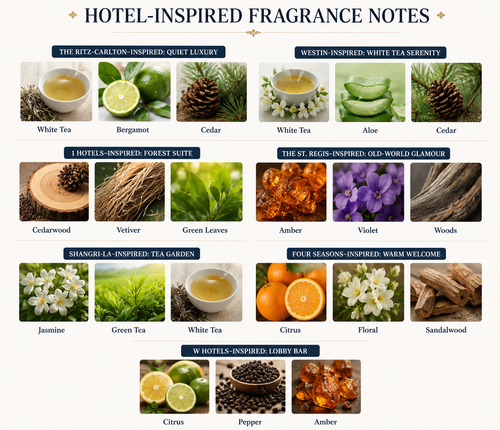 Greener · Shangri-La-inspired₹299Shop →
 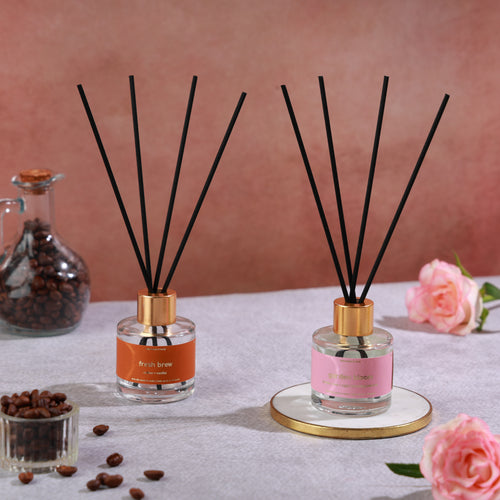 Duo · Warmth & Bloom₹1,598Shop →
Where a jasmine belongs in an Indian home, and how loud to run it
Jasmine has a natural place in an Indian house and it is not the bedroom, whatever the marketing says. It belongs where people arrive. Entryways, halls, the drawing room, the corner of the living room guests are steered towards — these are rooms you pass through rather than occupy, and a heady white floral is at its best in a space that is met rather than lived in. Ritu K. in Delhi put the 130ml in an entryway and reported that "three different guests asked which hotel it reminded them of", which is the entire argument for that placement in one sentence. Karan D. in Gurugram made the living-room case: "our living room used to smell like whatever we cooked. Now it smells like a quiet luxury hotel even after Sunday biryani." A composed floral holds its own against cooking in a way a single flower cannot.
For a bedroom, the same bottle works but the reed count has to come down. Use three or four rather than six, put it on the far side of the room from the bed rather than the nightstand, and never directly under a running split AC, which strips the top of a floral within days and leaves you sitting in the drydown. Reed count is the volume dial and it is free. Six reeds is full strength for a living room, entryway or a 200 sq ft kitchen; three or four is a bedroom; two or three in a small bathroom will stretch a 50ml close to three months. Almost every message I get that begins "it's a bit much" is solved by removing two reeds, and almost nobody tries that before deciding they dislike the fragrance.
Sizes follow rooms. The 50ml at ₹799 suits anything up to about 150 sq ft — a bedroom, a home office, a bathroom — and runs 45 days to 2 months. The 130ml at ₹1,299 is for above that, so living rooms, halls and open-plan ends of a flat, and runs 14–18 weeks. At roughly ₹13 a day for the 50ml, jasmine in a hall is one of the cheaper things a house can be given. And when you have settled on it, a 300ml refill at ₹2,399 keeps the same bottle and the same reeds going rather than buying the glass twice.
What to buy for jasmine — and the gap I am not going to talk around
Here is the jasmine edit in the order I would buy it, and then the honest part. There is no jasmine-solo scent anywhere in the SOSA reed range. Garden Bloom is a rose-and-jasmine composition, and while I would argue at length that a composition is the right answer for a home, that is an argument, not the thing you asked for. If what you want is jasmine on its own, standing alone, we do not make it and I would rather say so on the page than let you discover it in your hall. The same goes for the rest of the white florals: no tuberose, no gardenia, no ylang-ylang, no magnolia, no champa and no frangipani. Those are real absences, not oversights I am hoping you will not notice.
| Buy | What it is | When it is the right answer | Price |
|---|---|---|---|
| 1. Garden Bloom 50ml ★ | Night-blooming sambac against British rose, soft musk drydown, indole below threshold | First, for almost every Indian jasmine buyer. 45 days to 2 months | ₹799 |
| 2. Garden Bloom 130ml | The same composition, sized for above 150 sq ft, 14–18 weeks | For a hall, entryway or living room — the rooms jasmine is best in | ₹1,299 |
| 3. Shangri-La-inspired Hotel Collection 15ml | Jasmine · green tea · white tea — a greener, lighter, more transparent jasmine. Water-based, ultrasonic only | If sambac creaminess is more than you want. Needs Sukoon ₹1,899 or Boond ₹899 | ₹299 |
| 4. Warmth & Bloom duo | Garden Bloom with Fresh Brew — floral in the hall, warm gourmand in the living room | If you are scenting a flat rather than one room | ₹1,598 |
| 5. Evening Calm 50ml | Kashmir lavender and chamomile at 8.9 — the softest thing we make | If what you actually wanted was soft rather than white-floral | ₹799 |
| No jasmine soliflore, no tuberose, no gardenia: the honest gap | SOSA does not make a jasmine-only reed diffuser, and there is no tuberose, gardenia, ylang-ylang, magnolia, champa or frangipani anywhere in the reed line. Garden Bloom is the nearest and it is a two-flower composition; the Shangri-La-inspired ₹299 is the only other jasmine in the house and it is ultrasonic-only | Said plainly rather than stretched to fit | ₹799 / ₹299 |
Versailles
I was taught jasmine in France, which means I was taught grandiflorum. It is a magnificent material and I still love working with it. But the first time I put a grandiflorum-led trial in front of my mother in Pune, she said something I have thought about ever since: it is lovely, but it is not our flower. She was right, and she had identified in four seconds a distinction that most of this industry sells around.
So Garden Bloom was built on sambac, and then the hard part started, which was the indole. Every version I made that was safe was also dead — jasmine without indole is a jasmine-shaped hole. Every version that was gorgeous in my studio at 24°C failed the 45°C heat soak, because indole mobilises and the room changes what you smell. The finished level is lower than my instinct wanted and it took a great many trials to accept that, because I had to give up some of the drama a jasmine can have in a cool room to buy a fragrance that is the same fragrance in a Chennai May. That trade is the whole product.
The rose came last and it is the piece I am proudest of. Jasmine alone in a room you live in for fourteen hours a day will wear you out; a British garden rose beside it — cool, structured, daylit — gives it something to press against and keeps it from filling the space. It is why people describe the bottle as elegant rather than as an attar. Everything is composed and made in Pune, and a portion of every order funds a girl's classroom through Nanhi Kali.
Frequently asked questions
- A jasmine home and Bedrooms — where to put the one bottle, and night-blooming jasmine at three reeds.
- Living rooms and White florals — jasmine, dinner and the third smell, and what the category actually contains.
- Not too sweet and Sophisticated white florals — why cheap jasmine goes syrupy, and restraint, and the indole threshold.
- Jasmine versus the rest — a straight comparison.
- The decision tree — one bottle, no reading, if you want one bottle and no argument.
- The complete jasmine guide — every decision in one place.
- Brand: the SOSA founder story.
SOSA reed diffusers — facts verified August 2026: Five scents, all alcohol-free, on a heat-stable CCT (caprylic/capric triglyceride) base, phthalate-free, paraben-free, IFRA-compliant, 0 ppm formaldehyde, six fibre reeds in a refillable glass bottle, composed and made in Pune, India. Garden Bloom (British rose · night-blooming jasmine, sambac/mogra · soft musk drydown) 50ml ₹799 · 130ml ₹1,299 · 8.9 on the SOSA strength scale · 45 days to 2 months on the 50ml and 14–18 weeks on the 130ml · 4.9 from 138 verified reviews · indole held below the fecal threshold so the jasmine stays floral above 30°C. Evening Calm (Kashmir lavender · chamomile · soft musk) 50ml ₹799 · 130ml ₹1,299 · 8.9, the softest in the range. Morning Freshness (Malabar lemon · peppermint · eucalyptus globulus) 50ml ₹749 · 130ml ₹1,249 · 9.0. Mountain Breeze (Himalayan pine · sage · Indian cedar) 50ml ₹849 · 130ml ₹1,349 · 9.4. Fresh Brew (Coorg coffee · Kerala vanilla · caramel) 50ml ₹849 · 130ml ₹1,349 · 9.5, the deepest in the range. Duos: Warmth & Bloom ₹1,598, Day & Night ₹1,498, Fresh & Grounded ₹1,548 (50ml × 2). Refills 300ml ₹2,399 · 500ml ₹3,499. Climate-tested through 45°C heat soak and 85% RH monsoon humidity. The reed line contains no jasmine soliflore, no tuberose, no gardenia, no ylang-ylang, no magnolia, no champa or frangipani, and no oud, sandalwood, vetiver, amber or orange blossom; where this guide is asked for one of those it says so rather than stretching the nearest scent to cover it. The Shangri-La-inspired Hotel Collection scent (jasmine · green tea · white tea) is 15ml ₹299 · 100ml ₹999 · 300ml ₹1,799 and is water-based and ultrasonic-only; machines are Boond ₹899 and Sukoon ₹1,899. Reed diffuser oil and the water-based Hotel Collection are separate products and are not interchangeable in either direction; there is no hotel-inspired reed diffuser. Free shipping above ₹499. A portion of every order supports girl-child education through Nanhi Kali. SOSA is an independent Indian fragrance house; the Hotel Collection scents referenced here are SOSA's own interpretations inspired by the world's finest hotels and SOSA is not affiliated with or endorsed by any hotel brand. Prices subject to change — see the live product pages.