


The principle: evenness is a mixing property. Air movement distributes; oil quantity only raises the peak. If your room has a strong end and a dead end, more fragrance widens the difference rather than closing it.
Free evenness, tonight: close the door, run the ceiling fan on its lowest speed, keep the split AC recirculating, and move the bottle out of the dead corner into the air’s path — but never directly under the AC outlet.
The honest gap: the machine that delivers hotel-grade evenness in one bedroom without water does not exist in this range. Safar ₹3,999 is personal scale and named and sold as a car and travel diffuser; Vaayu ₹11,999 is rated to 2,000–3,000 sq ft. Nothing sits between them.
2. More oil does not produce evenness. It produces a steeper gradient. This is the single most useful sentence on the page. If a room is not mixing its own air, increasing the source strength raises the concentration near the source and leaves the far corner almost untouched — so the room becomes overwhelming in one place and empty in another. The instinct to turn it up makes the specific problem you are complaining about worse.
3. Evenness in time matters as much as evenness in space. A hotel machine holds one intensity on a fixed schedule, so the level does not drift between morning and midnight. A reed diffuser’s evaporation rises and falls with the room’s temperature, humidity and airflow all day, and it cannot be turned down when it is generous or up when it is quiet. Vaayu exposes that control directly with 1, 4, 8 or 24-hour windows, chosen days, adjustable intensity and a key-lock.
4. In a home, the mixing you already own is free. A ceiling fan on its lowest speed, a split AC on recirculate, and a closed door will do more for evenness in a bedroom than any amount of additional fragrance. Test this before you spend: it takes one evening and costs nothing.
5. And be honest about the room’s shape. An L-shaped flat or a long room with a wardrobe across the middle is not one volume, it is two, and no single source at one end will ever make both halves equal. Two reeds in two places is often the genuinely cheaper right answer, and it gives you two zones rather than one uniform room — which is a different thing, and sometimes the better one.
Free shipping above ₹499, and a portion of every order supports girl-child education through Nanhi Kali.

Evenness is a mixing property, and mixing is done by air
Picture a spoonful of sugar in a cup of tea that nobody stirs. There is a great deal of sugar in the cup and almost none of it where your mouth is. You can add three more spoonfuls and the top of the tea will still taste of nothing. That is precisely what happens when a room is not mixing and somebody responds by buying a stronger fragrance. The dose is not the problem; the stirring is. Everything below is a way of stirring.
 Safar₹3,999Any machine that ejects a plume is doing two things at once: releasing fragrance, and setting the surrounding air in motion. That second effect is what turns a source into a distribution. An ultrasonic machine such as Sukoon does it with a wet mist; a cold-air nebuliser such as Safar ₹3,999 or Vaayu ₹11,999 does it with pressurised air and undiluted oil. A reed diffuser does neither: it releases fragrance into whatever the air happens to be doing, which in a closed room is very little. That is the mechanical reason a reed produces a zone rather than a room — and Safar, it should be said plainly, is named and sold as a car and travel diffuser, with no published room-coverage figure, however sound the principle is.
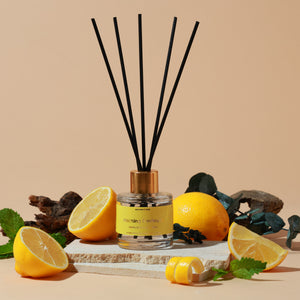
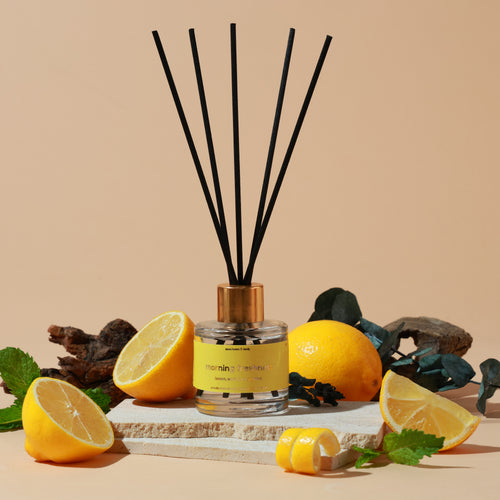
 Morning Freshness₹749Your flat already contains stirring equipment and you are probably not using it for this. A ceiling fan on its lowest speed will redistribute a reed diffuser’s output around a bedroom far more effectively than a second bottle would. A split AC on recirculate is doing continuous mixing of a closed volume, which is why an air-conditioned bedroom with the door shut is genuinely the easiest room in an Indian home to scent evenly. And closing the door is the cheapest tool in this entire subject, because it stops the fragrance leaving and lets a small volume reach a perceptible, even concentration quickly. One caution: place the bottle in the path of moving air, never in the direct blast of a running split AC, which strips the top notes within days and leaves you with the base.
 Vaayu₹11,999Evenness across a day is the half of the word people forget. Because evaporation follows temperature and humidity, a reed is at its most generous on a warm afternoon and at its quietest in a cold, sealed room — and it has no dial. A hotel simply removes the variable: one intensity, one schedule, indefinitely. Vaayu gives you 1, 4, 8 or 24-hour run windows over Bluetooth or its onboard buttons, a choice of days, adjustable intensity and a key-lock, and runs under 38 dB on 5W. Safar gives the small version — three speeds and a 1, 2 or 3-hour auto-off — though that also means it is not a set-and-forget always-on device and it needs recharging.
Why a dry mist is more even than a wet one
There is a second, quieter reason hotels favour waterless machines, and it is about what happens to the mist after it leaves the nozzle. A wet droplet is heavier than a dry one, and heavier things come out of the air sooner. Ultrasonic mist is mostly water, which is why you can see it and why it tends to fall and dampen the surface below the machine. A cold-air nebuliser produces a dry mist of undiluted oil, which stays suspended for longer and therefore has time to be carried around the volume before it settles. Longer time in the air is more distance travelled, and more distance travelled is more evenness.
The same property explains three practical things hotels care about that have nothing to do with smell: nothing feels damp, nothing is deposited on marble or upholstery, and in hard-water regions there is no white mineral dust, because there is no water to leave minerals behind. If you live in a hard-water city and have watched a fine pale film appear around an ultrasonic diffuser, you have met that problem already. It is not a defect in the machine; it is dissolved minerals doing what dissolved minerals do when the water they were in evaporates.
And there is dilution. What leaves an ultrasonic machine is oil carried in water; what leaves a nebuliser is oil. That single difference accounts for a great deal of the perceived intensity gap between a hotel corridor and a home diffuser, and it is why comparing them on price per millilitre of fragrance oil is misleading. You are not comparing two amounts of the same thing. You are comparing fragrance with fragrance-in-water, and only one of them is what reached your nose in the lobby.
| Format | Does it move air? | Wet or dry? | Evenness across a room | Evenness across a day |
|---|---|---|---|---|
| Reed diffuser from ₹749 | No air added at all | Neither — pure evaporation | Low. A steep gradient: a fragrant zone, not a fragranced room | Excellent within the zone. No bursts, no cycling, no on/off transient — the steadiest output of any format |
| Boond ₹899 | Yes, a small plume | Wet | Up to ~150 sq ft, 300ml, about 6 hours | Good while running; it stops when the tank empties |
| Sukoon ₹1,899 ★ | Yes — the value mixer | Wet, and it adds humidity | 270–320 sq ft of genuine coverage from a 500ml tank | 16–18 hours on low, then a refill |
| Megh ₹3,499 | Yes | Wet, and a great deal of humidity | Only ~215 sq ft — less than Sukoon. Never a coverage upgrade | About 100 hours from a 6L tank. This is what it is for |
| Safar ₹3,999 | Yes — pressurised air | Dry, undiluted | Personal and small-space scenting. No published coverage figure; named and sold as a car and travel diffuser | 3 speeds, 1/2/3-hour auto-off, up to 10 hours continuous per charge |
| Vaayu ₹11,999 | Yes, and it can feed the HVAC | Dry, undiluted | Up to 1000 m³ — roughly 2,000–3,000 sq ft. Wrong for one bedroom | 1h/4h/8h/24h windows, chosen days, fixed intensity, key-lock |
 Steadiest output · Morning Freshness₹749Shop → Real mixing · Sukoon₹1,899Shop →
  The oils · Hotel Collection₹999Shop →
Buying evenness for nothing, before you buy it for money
Four adjustments, in this order, all free. Close the door. A small closed volume reaches an even, perceptible concentration far faster than an open-plan floor ever will, and this is the one respect in which your bedroom beats a hotel lobby outright. Stir the air. Ceiling fan on its lowest setting, or the AC on recirculate. Twenty minutes is enough to tell the difference. Move the source into the moving air — near a doorway, on a console, about a metre from where you actually sit — and out of a dead corner, a bookshelf recess or the gap behind a curtain, but not into the AC’s direct blast. Use all six fibre reeds. Six is full projection, three is a soft bedside level with roughly double the life, and the reed count is the only output dial a reed has. Almost nobody touches it before deciding a fragrance is weak.
Then check that you are measuring honestly, because you are the least reliable instrument in the room. Olfactory adaptation removes a constant smell from your awareness within minutes, so the person who lives with a fragrance is precisely the person who cannot judge it. Leave the room for ten minutes and come back, or better, ask somebody who does not live with you what they notice at the door. A meaningful share of the readers who write to us about weak, patchy fragrance have homes that smell lovely to every visitor. That does not make the question silly; it makes it a question about perception rather than about equipment, and it saves ₹1,899 to find out.
And here is the place to be fair to the reed, because on this particular criterion it has a genuine advantage that no machine can match. A reed never surges. It has no on/off transient, no cycling, no burst when the timer fires and no drop when the tank runs low. Within its zone the output is the steadiest of any format there is, which is exactly why it belongs on a bedside table where a sudden puff of fragrance at two in the morning would be unwelcome. It is silent, it needs no power, no water, no filling and no charging, it runs at about ₹13–₹15 a day, and it looks like an object rather than an appliance. If your ambition is a beautiful, permanent, undemanding presence in one part of one room, evenness is not your problem and you already own the right product.
What to buy for evenness, in order
Mixing first, dose second, machine third. The last row is the honest gap, and on this page it matters more than usual, because evenness in a single bedroom without water is precisely the thing the range does not have a perfect answer for.
| Step | What it is | When it is the right answer | Price |
|---|---|---|---|
| 1. Door closed, fan on low, bottle out of the dead corner, six reeds in ★ | Mixing and placement — the two things that actually produce evenness | Always first. It is free, and it settles more of these questions than any machine | ₹0 |
| 2. The correctly sized reed | 50ml for rooms up to ~150 sq ft, 130ml above it; six fibre reeds, flipped every 3–5 days | When the bottle is simply under-specified for the room. Also the steadiest, quietest output of any format | ₹749–₹1,349 |
| 3. Two reeds, two places | Two zones rather than one uniform room — the honest answer for a long or L-shaped space | When the room is really two volumes with furniture in between | from ₹1,498 |
| 4. Sukoon | The cheapest genuine mixer: a moving plume, 270–320 sq ft, 16–18 hours on low, three 15ml Hotel Collection scents included | When you want the whole bedroom at one level and can accept water, dilution, humidity and refilling | ₹1,899 |
| 5. Vaayu | Dry, undiluted, scheduled, wall or HVAC mountable, under 38 dB, 1000 m³ | An open-plan floor, a villa, a clinic, a showroom, or one machine for the whole flat. Not one bedroom | ₹11,999 |
| The honest gap | A waterless machine sized for one bedroom — which SOSA does not make. Safar ₹3,999 is the nearest, and it is named and sold as a car and travel diffuser with no published room coverage | Stated plainly, because “even, strong, one room, no water” is the request this range cannot fully serve | — |
Versailles
When somebody writes to me using the word “even”, I pay attention, because it means they have noticed something more precise than most people bother to articulate. They are not saying the fragrance is too weak. They are saying it is in the wrong places, and that is a completely different fault with a completely different fix.
The uncomfortable part is that the fix is usually not a purchase. It is a fan on its lowest speed, a door that gets closed, and a bottle moved eighteen inches out of a recess. I have watched that combination transform a room that its owner had already decided was hopeless, and it costs nothing, which makes it a difficult thing to build a business on and an easy thing to be honest about.
Where a purchase genuinely helps is when you want the whole volume at one level all evening, every evening, without thinking about it. That is a machine, and the mechanism to look for is waterless cold-air nebulising because dry mist travels further and settles less. Just buy it for the space you actually have. Vaayu is rated to 1000 m³ and belongs in a large home, not a bedroom, and I would rather say so here than take the order. Everything is composed in Pune, and part of every order funds a girl’s classroom through Nanhi Kali.
Frequently asked questions
- How hotels do it — four decisions, only one of which is the oil.
- What luxury hotels use — the equipment, and how it is sized.
- Everywhere in a hotel, nowhere at home — the mechanism page.
- How fragrance travels — the transport page.
- Do hotels use reed diffusers? — the honest answer.
- The fragrance cloud on entry and why it feels more present.
- Oil or system? — the cluster’s thesis.
- Recreating it at home — the ladder in full.
- Brand: the SOSA founder story.
Facts verified August 2026: Passive capillary — SOSA reed diffusers, five scents, 50ml ₹749–₹849 for rooms up to ~150 sq ft lasting 6–8 weeks, 130ml ₹1,249–₹1,349 above 150 sq ft lasting 14–18 weeks, six fibre reeds included (six for full projection, three for a soft bedside level and roughly double the life), flipped every 3–5 days, about ₹13–₹15 a day, heat-stable CCT carrier, alcohol-free, phthalate-free, paraben-free, IFRA-compliant, 0 ppm formaldehyde, refillable glass, tested at 45°C and 85% RH, composed in Pune; duos from ₹1,498. Ultrasonic water mist — Boond ₹899 (300ml, up to ~150 sq ft, ~6 hours, USB, night light), Sukoon ₹1,899 (500ml, 270–320 sq ft, 16–18 hours on low, three 15ml Hotel Collection scents included), Megh ₹3,499 (6L tank, ~100 hours, ~215 sq ft — less than Sukoon, and never a coverage upgrade). Waterless cold-air nebulising — Safar ₹3,999 (20ml bottle, 2000 mAh Type-C, up to 10 hours continuous or around 30 hours intermittent, 3 speeds, 1/2/3-hour auto-off, 6.9 cm, named and sold as a car and travel diffuser with bedside and hotel room among its stated uses, no published room-coverage figure) and Vaayu ₹11,999 (up to 1000 m³ or roughly 2,000–3,000 sq ft, 400ml tank lasting up to about 90+ days, Bluetooth app plus onboard buttons, 1h/4h/8h/24h run windows, choice of days, adjustable intensity, key-lock, under 38 dB, freestanding or wall/HVAC mount, 5W, CE, RoHS, SGS). Hotel Collection oils are water-based and ultrasonic-only — 15ml ₹299 (a refill), 100ml ₹999, 300ml ₹1,799, pack of 7 ₹1,799 — and cannot be used in reed diffusers, nor reed oil in ultrasonic machines. No health, air-quality or antimicrobial claims are made, and fragrance does not remove a smell: source, ventilation, then fragrance. Free shipping above ₹499. A portion of every order supports girl-child education through Nanhi Kali. SOSA is an independent Indian fragrance house; the Hotel Collection scents referenced here are SOSA’s own interpretations inspired by the world’s finest hotels, and SOSA is not affiliated with, endorsed by or a supplier to any hotel brand. Prices subject to change — see the live product pages.