
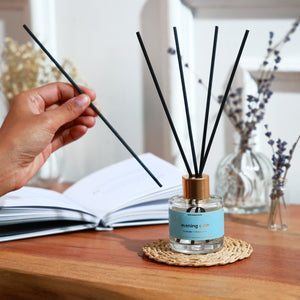


Why it works: light molecules evaporate off the exposed tip first, so heavy ones concentrate there. Flipping puts that loaded end back into the oil and brings a clean surface up to the air.
The tell that you have left it too long: the fragrance has not gone quiet so much as gone flat — base-heavy, thicker, less like the bottle you bought.
What flipping is not: a strength upgrade. It restores the rate the composition was designed for; it never exceeds it.
2. The reason is a gradient, not dryness. Fragrance leaves a reed in order of volatility. The bright, light material at the top of the composition goes first and goes from the exposed end; the heavy, tenacious material cannot follow it at the same speed and builds up exactly where evaporation happens. You end up with a plug of the slowest molecules sitting on the working surface.
3. That is why the smell changes character before it changes volume. People describe it as "flatter", "thicker", "less like the sample". They are smelling the base of the composition without its top, because the top has already left and the bottom is what remains at the tip.
4. Flipping inverts the gradient in one movement. The loaded end goes back under the oil where the residue redisperses; the end that has been sitting in the bath, saturated and clean, comes up to meet the air. Delivery normally returns within two to four hours and the composition reads correct again by evening.
5. It restores; it does not amplify. A flip returns you to the rate the fragrance was dosed for at six reeds. It cannot take you above that. If a freshly flipped bottle is still quieter than you want, the answer is airflow, reed count or a louder composition — and you now know that for free.
6. Eventually the gradient stops responding. Fibre reeds hold up well, but after a few months the accumulated heavy residue is in the structure rather than on the surface, and a flip buys you a day instead of a fortnight. That is the point at which the reeds, not the oil, are the thing to change.
Composed and handmade in small batches in Pune, and a portion of every order supports girl-child education through Nanhi Kali.
Part one — how a reed turns into a reservoir
Nothing about this process is a fault, and nothing about it is visible from across the room. It is simply what happens when a mixture of many molecular weights is asked to evaporate through a fixed surface for weeks on end. The three cards below are the whole story in sequence: what a composition is made of, what the exposed end becomes, and why the fibre matters to both.
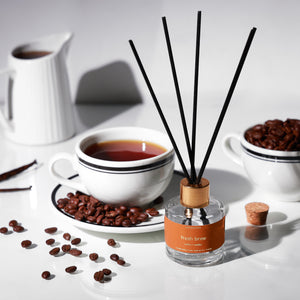
 Evening Calm₹799 · 8.9/10Concentration has a mechanical consequence. Heavy, viscous material at the exposed centimetre of a reed sits in the very pores that the rest of the oil has to travel through, and it evaporates far too slowly to clear itself. The result is a partial seal: the reed is still saturated below, but the exit is congested, so both the rate and the character of what reaches the room change together. This is why the classic complaint is not "I cannot smell it" but "it does not smell like it used to". A five-week-old unflipped Evening Calm still delivers chamomile and the soft base; what it has stopped delivering is the cool lavender top that made you buy it. In a hot flat the effect arrives faster, because heat accelerates the departure of the light fraction without doing much for the heavy one.
Part two — one reed, mapped from tip to base
Lift a single reed out of a bottle that has been running unflipped for a month, hold it against the light, and you can read the whole argument on the stick itself. Here is what is happening at each height, and what the flip does to that zone. Do this over the bottle or over a tray — reed oil marks wood and stone permanently.
| Zone of the reed | What has collected there | How it looks | What it is doing to the room | What the flip does to this zone |
|---|---|---|---|---|
| Exposed tip ★ | The heaviest, least volatile fraction — vanilla, cedar, musk, resin | Darkest, often slightly tacky to a gloved finger | Delivering base notes only, slowly, and congesting the exit | Goes under the oil, where the residue redisperses into the bath |
| Upper third, above the wet line | A thinning mixture — some mid notes, very little top | Amber, dry to the touch, colour fading downwards | Contributing the "flat" quality people describe | Drops towards the oil and re-wets within an hour or two |
| The wet line itself | The live boundary between soaked fibre and dry fibre | A visible edge; high and dark means saturated and stalled | Nothing directly — but its height is your diagnostic | Inverts; a new boundary forms from the other direction |
| Immersed length | Full, fresh composition in its correct proportions | Uniformly wet, closest to the original colour | Nothing — it is under the oil and cannot evaporate | Comes up into the air as a clean working surface |
| The neck of the bottle | Where six reeds crowd and where dust settles first | Occasionally a fine crust after several months | Restricting how freely each reed can wick | Nothing — this is a sign the reeds themselves are ageing |
| The honest caveat: a wet-looking reed is not a working reed. The commonest misreading of this table is to see oil right up the stick, conclude that everything is fine, and never flip. Saturation tells you the capillary path is intact; it tells you nothing about whether the exposed surface is still capable of releasing anything but base notes. Judge by smell and by cadence, not by how wet the fibre looks. | ||||
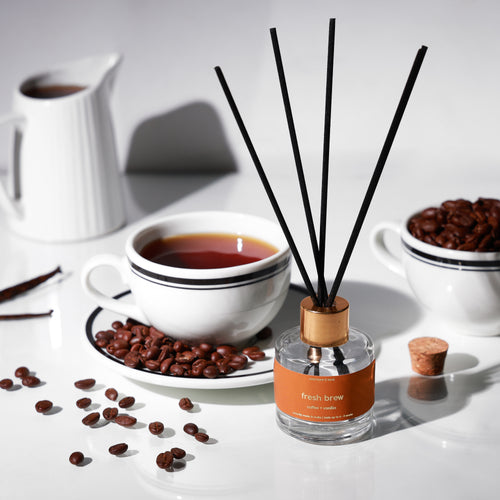
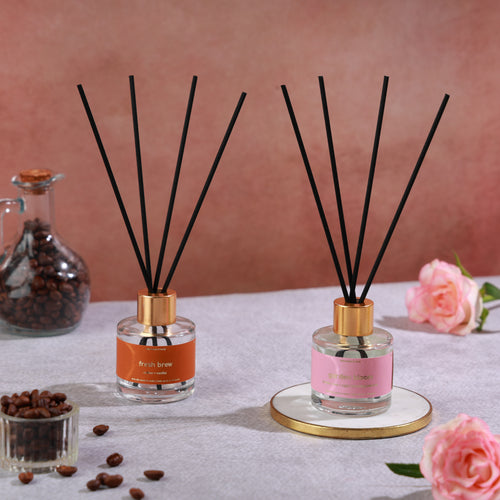
Fresh Brew · widest spreadfrom ₹849Shop → 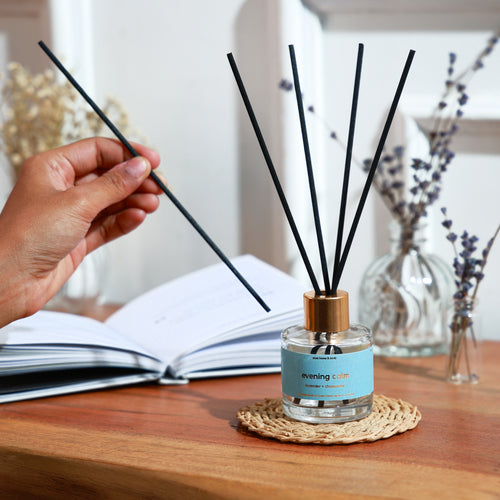 Evening Calm · quietest tellfrom ₹799Shop →
  Oil refill · 8–11 months₹2,399Shop →
Part three — what inversion actually does, hour by hour and month by month
When you turn a reed over you do two separate things at once, and it is worth separating them because they have different timescales. The first is immediate: a clean, fully saturated surface that has been sitting under oil is now exposed to the air. It carries the composition in its correct proportions, because nothing has been evaporating off it, and it begins releasing at close to the designed rate within minutes. The second is slower and less obvious: the loaded end you have just submerged is now surrounded by fresh oil, and the concentrated heavy fraction sitting in its pores gradually redisperses back into the bath. That takes hours to days rather than minutes, and it is the part that makes flipping sustainable rather than a trick you can only play once. A reed that has been flipped weekly for six weeks is genuinely a different object from a reed flipped for the first time in week six.
This is also why the cadence matters more than the force. There is no benefit in flipping harder, leaving the reeds out longer, or wiping them down. What you are managing is a slow sorting process, and the way to manage it is to reverse it before it has gone far — roughly weekly in an ordinary Indian room, sooner in a hot west-facing one, and a fortnight is often fine in a cool sealed room. The cadence question has its own piece. What matters here is the direction of causation: you are not topping the reed up, you are unsorting it.
There is an end to it, and I would rather state it than let you find it by disappointment. Every flip redistributes slightly less than the one before, because a fraction of the heavy residue binds into the fibre rather than returning to the oil. After several months of weekly flipping the reeds are visibly darker along their whole length, the wet line climbs sluggishly, and a flip buys a day instead of a fortnight. At that point the reeds are the consumable and the oil is the stable part — which is the reverse of what almost everyone assumes. Our refills are oil only, at ₹2,399 for 300ml, because the oil is the expensive part and your glass vessel is perfectly good. I will say the awkward thing plainly: we do not sell replacement reeds as a separate line, which is a genuine gap in the range, and our guidance is to refresh reeds every few months. Never pour a good refill through reeds that stopped working two months ago.
Part four — the ten-second routine, and what to buy around it
The routine itself is trivial and the equipment costs nothing. What follows is how to do it without ruining a console table, and what is worth spending money on once the free move is in place.
| Step | Why this step exists | What goes wrong if you skip it |
|---|---|---|
| 1. Gloves on ★ | Neat reed oil is concentrated and stays on skin | Fragrance on your hands all evening, and on everything you touch |
| 2. Lift all six together, not one at a time | Keeps the bottle balanced and halves the handling | An uneven set where two reeds are a fortnight behind the others |
| 3. Rest the wet ends against the neck for a moment | Lets the excess run back into the bottle rather than onto the tray | Oil down the outside of the glass, and a slick ring on the surface |
| 4. Invert and return, dry ends down | The clean saturated surface comes up; the residue cap goes under | Nothing changes and you conclude that flipping does not work |
| 5. Fan them slightly in the neck | Six reeds crowded into a tight cone wick unevenly | A bunched set that delivers less than its count suggests |
| 6. Wipe the neck and the tray | Stops residue building where the reeds meet the glass | A crust at the neck within a few months and marks on wood or stone |
Versailles
The first time I understood the residue gradient properly was not in a classroom in Versailles but on a shelf in a Pune workshop, comparing two bottles of the same trial formula that had been standing side by side for seven weeks. One had been flipped weekly by habit; one had been forgotten. They were not a loud bottle and a quiet bottle. They were two different fragrances — the forgotten one had lost its whole top and was delivering a warm, slightly monotonous base that I would never have signed off.
That is the part I want people to take away. A neglected reed diffuser does not simply fade; it edits your fragrance without asking, and it edits out exactly the part that made you choose it. Ten seconds a week prevents an edit that no amount of money can undo afterwards.
I would rather you flipped a ₹749 bottle of Morning Freshness properly than bought a ₹1,349 one and left it standing. Everything we make is composed and handmade in small batches in Pune, tested through 45°C heat and 85% humidity, and a part of every order funds a girl's classroom through Nanhi Kali.
Frequently asked questions
- How often should you flip the sticks? — cadence by heat, humidity and reed count.
- What happens after a flip — the first ten minutes, the first hour, the first evening.
- Does flipping make it stronger? and does it finish the oil faster? — the two honest trade-offs.
- The complete reed-flipping guide, and why can't I smell my reed diffuser?
- Brand: the SOSA founder story.
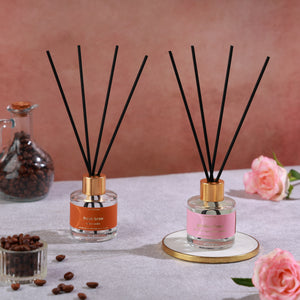
SOSA reed diffuser range & prices (verified August 2026): alcohol-free, phthalate-free, paraben-free and IFRA-compliant compositions on a heat-stable coconut-derived (CCT) carrier, low-VOC, supplied in a refillable glass bottle with six fibre reeds; 50ml lasts 6–8 weeks and 130ml lasts 14–18 weeks. Morning Freshness (Malabar lemon · peppermint · Nilgiri eucalyptus) 50ml ₹749 · 130ml ₹1,249 · 9.0/10; Garden Bloom (British rose · night-blooming jasmine) 50ml ₹799 · 130ml ₹1,299 · 8.9/10; Evening Calm (Kashmir lavender · chamomile) 50ml ₹799 · 130ml ₹1,299 · 8.9/10; Fresh Brew (Coorg coffee · Kerala vanilla) 50ml ₹849 · 130ml ₹1,349 · 9.5/10; Mountain Breeze (Himalayan pine · sage · Indian cedar) 50ml ₹849 · 130ml ₹1,349 · 9.4/10. Reed diffuser refills are oil only — you reuse your own vessel and reeds: 300ml ₹2,399 (roughly 8–11 months) · 500ml ₹3,499 (roughly 14–18 months), about ₹7–8 per ml against ₹15–17 per ml for a 50ml bottle. Duo sets ₹1,498–₹1,598 for 2 × 50ml and ₹2,498–₹2,598 for 2 × 130ml. Strength figures are positions on SOSA’s own internal strength scale, not an industry standard. Replacement reeds are not sold as a separate SKU; SOSA guidance is to refresh reeds every few months. The reed line is separate from the water-based Hotel Collection for ultrasonic machines (15ml ₹299 · 100ml ₹999 · 300ml ₹1,799) and the two are not interchangeable. Diffusers: Boond 300ml ₹899 · Sukoon 500ml ₹1,899 · Megh 6L ₹3,499 · waterless Vaayu ₹11,999. Composed and handmade in small batches in Pune, India; tested through 45°C summer heat and 85% monsoon humidity. Free shipping above ₹499. A portion of every order supports girl-child education through Nanhi Kali. Prices subject to change — see the live product pages.