



What that means for you: your oil is fine. A bottle that is emptying on schedule has already ruled out every fault a reed diffuser can have.
Where the millilitres go: into the small volume of air around the reeds, where they are concentrated; then thinned across the tens of cubic metres your bedroom holds; then partly carried out of the room altogether by ordinary air exchange under the door and through the windows.
Free fixes, in order: six reeds rather than three, halve the distance, nose height, out of the draught but not a dead corner, shut the door, and the ceiling fan on low — the only free change on the list that adds transport rather than emission.
The honest gap: if the level is falling fast and you cannot smell it, the room is being flushed. That is an airflow problem, and no bottle you can buy solves it.
2. You have therefore proved your own oil is fine. This is the useful part. A bottle whose level is dropping steadily has demonstrated that the reeds are wicking, the carrier is releasing, the composition is volatilising and nothing is clogged. Those are every fault a reed diffuser is capable of. You have ruled them all out with a measurement you took without meaning to.
3. The fragrance is not disappearing into nowhere. It is being diluted, and then partly removed. The vapour enters the small volume of air immediately around the reeds and stays concentrated there, because nothing pushes it. Whatever slow circulation your room has stirs a fraction of it outwards, where it is thinned across the tens of cubic metres a bedroom holds — and some of it leaves the room entirely, under the door and through the window gaps, because rooms are not sealed boxes.
4. The rate itself is a diagnostic, and worth reading. If your 50ml is going in six to eight weeks and the far side of the room is quiet, that is normal distribution and the free fixes below will help. If it is emptying far faster than that and still quiet, you have high air exchange — an open window, a balcony door, real heat, or a fan running hard — and your room is being flushed. Nothing you buy fixes a flushed room; closing it does.
5. Do the free things, then choose deliberately. Six reeds instead of three, half the distance, nose height, out of the draught, door shut, ceiling fan on low. If the room you want still needs air moved for you, that is a machine, and I would look at Sukoon at ₹1,899 long before anything dearer.
Alcohol-free, phthalate-free, made in Pune. A portion of every order supports girl-child education through Nanhi Kali.
What the falling level actually proves — and what it cannot
Most people who write to me about a diffuser are working from a single piece of evidence: I cannot smell it. You have two, and the second one is much better than the first. A level that drops is a direct, physical, unarguable record of material leaving the bottle. It is the closest thing to an instrument you have in the house. So let us be precise about what it certifies and what it is silent on, because the distinction is the whole answer.
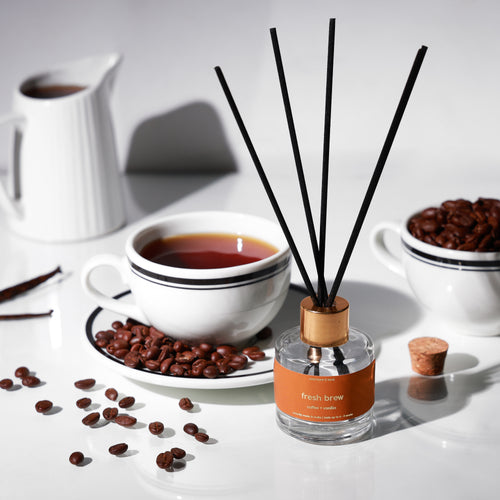
 Morning Freshness₹749A reed diffuser can fail in a small number of ways and all of them stop the bottle emptying. Reeds that will not wick. Reeds clogged at the top so oil never reaches the exposed length. A composition too heavy to volatilise at room temperature. A carrier that has gone thick. Every one of those shows up as a level that does not move, and yours does. This is why I say you have proved your own oil is fine: not as reassurance, but as a deduction. The material is arriving in your room at the designed rate. Whether you can find it there is a separate question about your room, and it is the only question you have left.
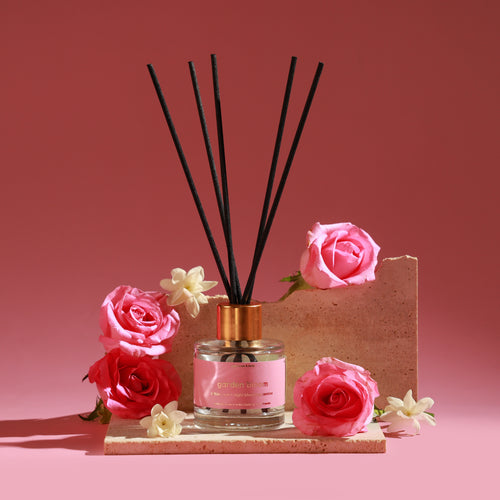
 Garden Bloom₹799A kettle boiling dry proves water left the kettle. It does not tell you which corner of the kitchen is humid. In exactly the same way, a bottle emptying tells you material left the reeds and nothing whatever about its distribution afterwards, because the reed had no involvement in that part at all. There is no fan, no pump, no pressure, nothing to give the vapour a direction. Left entirely to itself, a fragrance molecule spreads through still air by molecular diffusion, and molecular diffusion is far too slow to cross the width of a bedroom in any time that matters. What actually moves fragrance about a room is the room's own air — convection off a warm wall, a fan, an air conditioner, the slow drift under a door.
 Evening Calm₹799This is the part worth taking seriously, because the emptying rate splits your situation into two quite different diagnoses. A SOSA 50ml on six reeds is built to run 6–8 weeks. On schedule and faint across the room is ordinary distribution, and the free fixes below are the answer. Much faster than that and still faint is a flushed room: air is leaving and taking the fragrance with it, whether through an open window, a balcony door left ajar all evening, real heat speeding evaporation, or a fan running hard. Neither is a fault. But they take opposite remedies — the first wants more transport, and the second wants less air exchange, which usually means shutting something for the hours that actually matter to you.
Where one millilitre actually ends up
Follow a single millilitre out of the bottle and the whole thing stops being mysterious. It climbs the fibre by capillary action, spreads across the exposed length of six reeds, and evaporates from that surface into the air touching it — a volume of perhaps a few litres. In that small pocket the concentration is high, and it is continuously topped up, which is why the bottle neck smells complete and beautiful even in week seven. That pocket is the fragrant zone, and it is the product working exactly as designed.
From there the millilitre has only two ways out, and neither of them is fast. It can spread by molecular diffusion, which in still air is a slow business measured in a scale that makes crossing a bedroom impractical, or it can be picked up by whatever air the room is moving. In a closed, still bedroom the second channel is weak, so most of the output stays concentrated near the source, and the fraction that does get away is thinned across the tens of cubic metres a room of ordinary size contains. Same millilitre, two wildly different concentrations, purely because of the volume it is asked to occupy. Near the reeds it is well above the level at which you notice anything. Spread through the room it is below it, and below your threshold the honest report of your nose is not faint, it is nothing.
And then there is the third destination, which nobody thinks about: outside. Rooms are not sealed. Air leaves under the door, past window frames, up a bathroom vent, and every bit of it that leaves takes fragrance with it. This is the real reason an open window feels like it stops a diffuser working — the bottle is not weaker, the room is being flushed. It is also the honest answer to the question people are slightly embarrassed to ask, which is whether the oil is being wasted. You do get the whole bottle; every millilitre passes through the reeds and into the air. The only genuine waste is oil evaporating into a room with nobody in it, and that is a placement and occupancy question rather than a product one — a good argument for putting the bottle where you sit rather than where it looks best.
Emission, transport, containment — the three quantities that decide everything
Almost every question in this cluster becomes easy once these three are separated. Two of them you can change for nothing. The third is the one a reed diffuser does not supply and cannot be made to supply, no matter what you spend on the bottle.
| Quantity | What it means | What sets it | How to check it at home | Does a reed supply it? |
|---|---|---|---|---|
| Emission | How much fragrance leaves the bottle per hour | Reed count, exposed surface, temperature, humidity, the oil | Watch the level fall. You have already done this | Yes — this is what it is for |
| Transport | How far that fragrance is carried once airborne | Moving air: convection, a ceiling fan, an AC, a draught | Turn a fan on low and walk to the far wall | No. None at all, at any price |
| Containment | How much of it stays in the room rather than leaving | Door open or shut, windows, balcony, cross-ventilation | Shut the door for an hour and come back in | No — but it is free to change |
| What raises emission | Six reeds not three · a larger bottle · a deeper scent · a warm room | All of these make the strong zone stronger | None of them makes it wider | This is the trap the whole cluster is about |
| What adds transport | A ceiling fan on low · an AC recirculating in a closed room · an active diffuser | Two of those three are free and already in your bedroom | A fan shortens the bottle's life. Say it out loud and choose | The honest answer to the whole question |
The free fixes, and the one that actually adds transport
Five of these six raise emission or improve containment. Only one of them supplies transport, and it is the one I would do first. Still, take them in order, because a great many readers are finished before they reach the end of the list. Reed count. Six fibre reeds come in every SOSA bottle and a lot of people use three because three looks tidier. Six is full projection; three is a soft bedside level and roughly doubles the life. Distance. Halve the gap between the bottle and where you actually sit — this is worth more than any change of fragrance, and moving a diffuser to the bedside table is the correct use of a point source rather than an admission of defeat. Height. At or a little below nose height, on a surface, not the floor and not a high shelf.
Draught, then door. Keep the bottle out of a window, out of the direct blast of a split unit and away from an open balcony door, all of which strip the reeds and throw the fragrance at one wall — but do not bury it in a dead corner behind a wardrobe either. Then shut the door, because containment is half of this equation and it costs nothing at all. If your bottle is emptying quickly and you still cannot smell it, this is the paragraph that matters most: your room is exchanging its air faster than the diffuser can scent it, and the remedy is closing something rather than buying something.
And then the best free advice in this entire cluster: turn the ceiling fan on low. A fan is exactly the transport a reed structurally lacks. It takes the concentrated pocket around the reeds and spreads it through the room, and the result is closer to the even fragrance most people are picturing than any reed count will ever produce. It also shortens the bottle's life, because faster air across the reeds means faster evaporation, and I would rather say so plainly than leave a free fix out in order to sell you something. The same trade explains why a closed bedroom with the air conditioning on often smells strongest at night: recirculation distributes the fragrance beautifully while dry air speeds it out of the bottle. Better distribution, shorter bottle, both true.
If you want the room rather than the zone
Then you are asking for transport, you have already proved you do not need more emission, and the purchase that follows is a machine rather than another bottle. Here is the ladder in the order I would work through it, with the two things in our own range I would talk most readers out of sitting in the last row where you can see them.
| Step | What it is | When it is the right answer | Price |
|---|---|---|---|
| 1. Shut the door, fan on low, bottle at half the distance ★ | Containment plus the only free transport there is | First. Especially if the bottle is emptying quickly | Free |
| 2. All six reeds in a 50ml | Full emission from the bottle you already own, 6–8 weeks, silent, no power | When the zone where you sit is genuinely what you want | ₹749–₹849 |
| 3. The same scent in 130ml | 14–18 weeks rather than 6–8. Duration, not coverage | If the bottle empties fast and you are tired of repurchasing | ₹1,249–₹1,349 |
| 4. Sukoon ultrasonic ★ | 500ml, 270–320 sq ft, 16–18 hours on low, three 15ml Hotel Collection scents included | When the missing quantity is transport and you want it on demand | ₹1,899 |
| 5. Safar waterless | Named and sold as a car and travel diffuser. Undiluted oil, 20ml, cordless, three speeds, a 1 / 2 / 3-hour auto-off timer — not set-and-forget, and it needs recharging | For emphatic personal-scale projection with no water and no dilution | ₹3,999 |
| The gap, and the trap: Megh and Vaayu | Megh ₹3,499 has a six-litre tank and around 100 hours of runtime yet covers only ~215 sq ft — less than the ₹1,899 Sukoon, and the clearest illustration anywhere that tank size is runtime rather than reach. Vaayu ₹11,999 is rated to 1000 m³, roughly 2,000–3,000 sq ft. Between Safar and Vaayu there is no mid-sized waterless bedroom nebuliser in the range | Megh is a runtime and humidity machine, never a coverage upgrade. Vaayu is wrong for one bedroom, where nine-tenths of it is wasted | ₹3,499 / ₹11,999 |

Versailles
This is my favourite question in the whole cluster, because the person asking it has already done the experiment and does not realise what they have found. They write to say the bottle is emptying, almost apologetically, as though it were evidence against them. It is the strongest evidence in their favour that exists. A diffuser whose level drops on schedule has passed every test I could run on it in a laboratory, and it did so on a bedside table without being asked.
What I have learned is that the confusion is entirely ours, as an industry. We sell bottles and we describe them in millilitres and weeks, and then we let people assume that a bottle is a room-scenting device. It is not. It is a beautifully controlled evaporation surface, and everything past the first metre or so belongs to the building rather than to us. I would rather a customer understood that and bought a ₹749 bottle happily than misunderstood it and bought a ₹3,999 machine to solve a problem they had already ruled out.
So my practical advice is unglamorous. Note how long the bottle takes to empty. If it is running six to eight weeks and the room is quiet, shut the door and put the fan on low. If it is running out in three, close a window for the hours you are actually in the room and you may find you have been scenting your neighbourhood. And if after all of that you still want fragrance to be waiting for you at the far wall, buy the Sukoon and know in advance that the scent inside it will be a different one. Everything is composed in Pune, and a part of every order funds a girl's classroom through Nanhi Kali.
Frequently asked questions
- Why can I smell it only when I stand next to it? — the point-source explanation from the beginning.
- Amazing within two feet and nowhere else — is that normal? — yes, and here is why.
- Why doesn't the fragrance travel across the room? — molecular diffusion, and how slow it really is.
- Strong beside the bottle, weak from the bed — the distance problem, with the free answers.
- How far should it actually travel? — why no honest brand publishes a figure.
- One strong corner, the rest nothing — the smooth gradient and the edge that is not there.
- Is it weak if I have to walk close to it? — no, and what weak would really look like.
- Walking past versus sitting still — two mechanisms, stacked.
- I love the fragrance — how do I get it everywhere? — the full ladder, free fixes first.
- Brand: the SOSA founder story.
SOSA products — facts verified August 2026: Reed diffusers in 50ml and 130ml only. Morning Freshness ₹749 / ₹1,249 · Evening Calm ₹799 / ₹1,299 · Garden Bloom ₹799 / ₹1,299 · Mountain Breeze ₹849 / ₹1,349 · Fresh Brew ₹849 / ₹1,349. 50ml suits rooms up to ~150 sq ft and lasts 6–8 weeks; 130ml suits above 150 sq ft and lasts 14–18 weeks; roughly ₹13–₹15 a day. Six fibre reeds in a refillable glass bottle, on a heat-stable CCT (caprylic/capric triglyceride) carrier rather than DPG, alcohol-free, phthalate-free, paraben-free, IFRA-compliant, 0 ppm formaldehyde, climate-tested at 45°C and 85% RH, composed in Pune. Duos ₹1,498–₹1,598 (50ml × 2). Refills 300ml ₹2,399 · 500ml ₹3,499, oil only and never a first purchase. Machines: Boond ₹899 (300ml, ≤~150 sq ft, ~6h) · Sukoon ₹1,899 (500ml, 270–320 sq ft, 16–18h on low, three 15ml Hotel Collection scents included) · Megh ₹3,499 (6L, ~100h runtime, ~215 sq ft) · Safar ₹3,999, named and sold as a waterless car perfume diffuser, 20ml, 2000 mAh, up to 10 hours continuous or around 30 hours intermittent per charge, three speeds and a 1 / 2 / 3-hour auto-off timer, 6.9 cm — SOSA publishes no room coverage figure for it and none is given here · Vaayu ₹11,999 (up to 1000 m³, roughly 2,000–3,000 sq ft, 400ml, under 38 dB). Hotel Collection oils are water-based and ultrasonic-only: 15ml ₹299 · 100ml ₹999 · 300ml ₹1,799. Reed oil and Hotel Collection oil are not interchangeable in either direction and there is no hotel-inspired reed diffuser. No health, air-quality or sleep claims are made for any SOSA product; fragrance does not remove an unwanted smell, which is a matter of source, then ventilation, then fragrance. Free shipping above ₹499. A portion of every order supports girl-child education through Nanhi Kali. SOSA is an independent Indian fragrance house; the Hotel Collection scents are SOSA's own interpretations inspired by the world's finest hotels, and SOSA is not affiliated with or endorsed by any hotel brand. Prices subject to change — see the live product pages.