
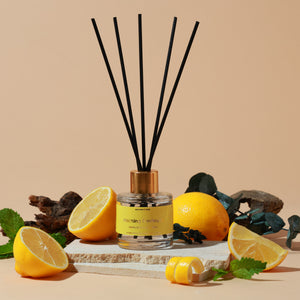
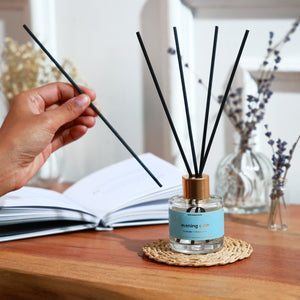
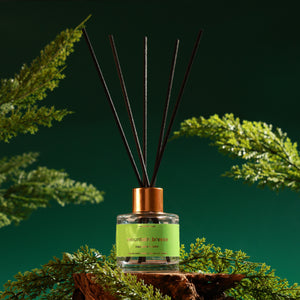

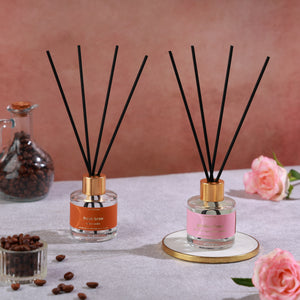
The two quantities to keep apart: emission is how much scent leaves the bottle — reed count, bottle size, temperature, the oil. Transport is how far it gets — moving air, which a reed does not supply. Almost every disappointing fix raises emission and leaves transport untouched.
Free things to try before you spend anything: use all six reeds instead of three; halve the distance between the bottle and where you sit; put it at or just below nose height on a surface; keep it out of a draught but not in a dead corner; close the door; and run the ceiling fan on low — a fan is precisely the transport a reed lacks.
The honest gap: SOSA has published no figure for how far a reed projects, because there is not an honest one to publish. And between Safar at ₹3,999 — which is named and sold as a car and travel diffuser — and Vaayu at ₹11,999, we have no mid-sized waterless nebuliser built for one bedroom.
2. The gradient is real and it is smooth. Concentration falls away continuously from the bottle. You are not standing at the edge of a bubble. You are standing at the top of a slope, and the slope has no cliff on it even though your nose reports one, because perception compresses a very wide range of concentrations into a narrow range of impressions.
3. Separate two things that are easy to confuse. Emission is how much scent leaves the bottle. Transport is how far that scent gets. More reeds, a bigger bottle, a deeper fragrance and a second diffuser all raise emission. None of them adds a single unit of transport, which is precisely why each of those purchases tends to disappoint in the same way.
4. Try the free fixes before you buy anything. Six reeds instead of three. Halve the distance between the bottle and the chair or the pillow. Put it at or just below nose height on a surface rather than on the floor or a high shelf. Keep it out of a direct draught but not in a dead corner. Close the door. And turn the ceiling fan on low, which is the single most effective free thing in this whole subject, because a fan supplies exactly the transport a reed structurally does not have.
5. If you want evenness rather than a zone, that is a mechanism decision. A passive source cannot produce an even room, by design. Sukoon at ₹1,899 covers 270–320 sq ft and moves its own air; Safar at ₹3,999 is a waterless cold-diffusion device that is named and sold as a car and travel diffuser, with a 1, 2 or 3-hour timer and a battery to recharge. Neither replaces what the reed does well: silence, no power, nothing to fill, and about ₹13–₹15 a day.
Alcohol-free, phthalate-free, paraben-free, IFRA-compliant, 0 ppm formaldehyde. Six fibre reeds in a refillable glass bottle, composed in Pune. Free shipping above ₹499, and a portion of every order supports girl-child education through Nanhi Kali.
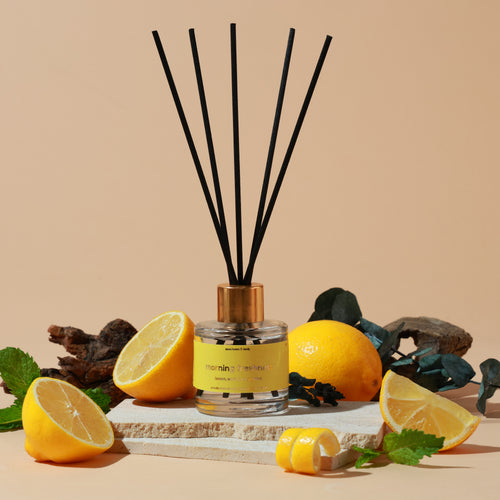
Emission, transport and your nose — three different things, usually blamed on one
Almost every frustrated message we get about reach is really a case of three separate quantities being collapsed into one word, strength. When someone says a diffuser is not strong enough, they might mean it is not putting enough scent into the air, or that the scent is not reaching them, or that they have stopped noticing it. Those have three different causes and three different answers, and only one of them is solved by buying anything. So it is worth taking them apart properly, because once you can see which of the three you have, the correct action is usually obvious and often free.
 Mountain Breeze₹849Emission is the part you control from the bottle, and it is genuinely adjustable. Reed count is the dial: six fibre reeds is full output, three is a quieter bedside level that roughly doubles the life of the bottle. Warmth raises it, so the same bottle empties faster in a hot room. The oil matters too — on our perceived-intensity scale Evening Calm sits at 8.9 and Fresh Brew at 9.5, which is a real difference in the room. Flipping the reeds every three to five days restores output for a few hours. All of this is worth doing. None of it moves anything anywhere.
 Sukoon₹1,899Transport is the quantity the bottle has no say in. Vapour leaves the reeds and then depends entirely on two things. The first is molecular diffusion, the slow random wandering of molecules through still air, which is perfectly good over centimetres and hopeless over metres. The second is bulk air movement — convection off a warm wall, a fan, an air conditioner, a draught under a door — and it does virtually all of the useful work. Transport is borrowed from the room, not supplied by the product. That is why the same bottle behaves differently in two rooms, and why a machine that moves its own air is a different category of object rather than a stronger version of the same one.
 Evening Calm₹799The third quantity sits behind your eyes rather than in the room. Olfactory receptors respond strongly to change and weakly to constancy: sit in a steady concentration and within minutes the signal is still arriving but your brain has stopped forwarding it. This is ordinary and it happens to everyone, including me, in my own house. It is why a person can sit in a properly scented room and honestly report smelling nothing while a visitor comments on it from the doorway. A guest is a better instrument than you are, and the cheapest test is to leave for fifteen minutes and walk back in.
Why you smell it walking past and not sitting down
Here is the observation that makes sense of this whole subject, and I want to introduce it carefully because eight other questions in this cluster depend on it. Two entirely separate effects stack on top of each other when you walk past a reed diffuser, and neither of them is happening when you sit still across the room.
The first is geometry. Walking past means crossing the gradient — you travel from low concentration to high and out again in a second or two, and because the nose reports change far more reliably than it reports steady state, a crossing registers as a distinct event. You did not walk into a stronger fragrance. You walked up a slope quickly, and speed is what your receptors noticed.
The second is adaptation, working in the opposite direction. Sitting still in a fragranced room is a constant stimulus, and constant stimuli fade from awareness within minutes. So the person on the sofa is subject to two disadvantages at once: they are lower down the concentration slope, and they are being served a signal their brain has already decided is not news. Both are normal. Neither is evidence of a weak bottle. If you want a fair reading of your own room, leave it for a quarter of an hour and come back, or ask someone who has just arrived.
What raises emission, what adds transport, and why the difference decides your purchase
This is the table I would like every reader of this cluster to see once. The middle two columns are the whole argument: several of the most popular fixes tick the first box and leave the second one empty, and those are exactly the fixes that leave people feeling they have spent money without changing anything. The last two rows cost nothing.
| What you might change | Raises emission? | Adds transport? | What actually happens | Cost |
|---|---|---|---|---|
| Three reeds to six | Yes | No | Higher concentration near the bottle, shorter bottle life. A louder source, not a wider one | Free |
| 50ml to 130ml | No | No | A duration change, not a coverage change — 14–18 weeks instead of 6–8 | +₹500 |
| A deeper fragrance (8.9 to 9.5) | Slightly | No | Perceived intensity rises at the source. The far corner is unchanged | ₹749–₹849 |
| A second reed diffuser | Yes | No | Two concentration peaks with a valley between them, not a plateau | ₹749–₹849 |
| Halve the bottle-to-person distance | No | Not needed | Puts you inside the zone instead of outside it. The single most reliable free change | Free |
| Ceiling fan on low, door closed | No | Yes | Supplies the transport a reed has no way of supplying. Also shortens bottle life | Free |
| An active diffuser | Yes | Yes | The only category that changes both — which is what you are paying for | ₹1,899 up |
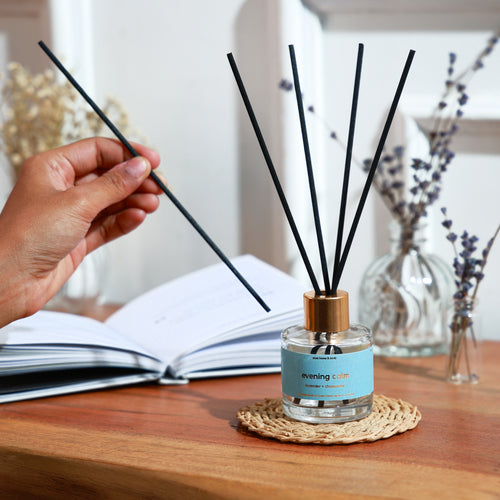
The free fixes, in the order I would actually try them
A large share of the people who write to us about this are fixed for nothing, and I would rather say so plainly than let anybody spend first. Start with the reeds: if you are running three, put all six in. Six is full projection and three is a soft bedside level that roughly doubles how long the bottle lasts, so the reed count is a genuine volume dial and most people never touch it. Then flip them, once, and note that a flip restores output for a few hours but adds no range at all — it is a dose adjustment wearing the costume of a distribution fix.
Then move the bottle, because halving the distance between the bottle and the person does more than any change of fragrance. Put it at or just below nose height, on a surface — a console, a bedside table, a shelf at chest level — rather than on the floor, where the fragrance has to climb, or on top of a wardrobe, where it sits above the air you breathe. Keep it out of a direct draught: not on a windowsill, not in the blast of a split AC, not beside an open balcony door, because air that leaves the room takes the fragrance with it. But do not overcorrect into a dead corner behind a curtain either, where nothing circulates at all. You want it in the room's circulation, not in its exhaust.
Then close the door, which is half the equation and costs nothing: containment matters as much as output, and it is the whole reason the same bottle feels powerful in a small closed bathroom and modest in a bedroom with a balcony. And finally, the best free advice in this entire subject — turn the ceiling fan on low. A fan is exactly the transport a reed structurally lacks. It takes the concentrated air sitting around the reeds and mixes it through the room, which is the one thing the bottle cannot do for itself. It also shortens the life of the bottle, because more air across the reeds means faster evaporation, and you should know that before you switch it on. In my experience most people take the trade willingly.
If the free fixes are not enough — what to buy, and what to skip
Suppose you have done all of it. Six reeds, bottle moved to the bedside, door shut, fan on low, and you still want the fragrance to be the same wherever you stand rather than concentrated where the object is. That is a legitimate requirement and a passive device cannot meet it, so the honest next step is a change of mechanism rather than a change of scent. Before you look at the ladder, one warning that saves more disappointment than anything else on this page: reed oil cannot go into an ultrasonic machine, and the water-based Hotel Collection cannot go into reeds. If you love a particular reed scent, moving to a machine means finding a new one you love. The instruction is usually add, not switch.
| Step | What it is | When it is the right answer | Price |
|---|---|---|---|
| 1. The free fixes ★ | Six reeds, halve the distance, nose height, door closed, ceiling fan on low | First, for everybody. A large share of readers stop here | Free |
| 2. A reed sized to the room | 50ml up to ~150 sq ft, 6–8 weeks · 130ml above that, 14–18 weeks | When the bottle is under-sized for the room, or you want longer between repurchases | ₹749 / ₹1,249 |
| 3. Sukoon | Ultrasonic, 500ml, 270–320 sq ft, 16–18 hours on low, three 15ml Hotel Collection scents included | When you want a bedroom evenly fragranced on demand. Water-diluted, adds humidity, needs filling | ₹1,899 |
| 4. Safar | Waterless cold diffusion of undiluted oil, 20ml, cordless, three speeds, 1/2/3-hour timer. Named and sold as a car and travel diffuser | For a personal-scale space when you want undiluted oil and no water. Not set-and-forget — the timer runs out and the battery needs recharging | ₹3,999 |
| 5. Vaayu | Waterless cold-air nebuliser, up to 1000 m³ — roughly 2,000–3,000 sq ft, 400ml, up to ~90+ days | Only for a whole floor, an open-plan home or a commercial space. In one 120 sq ft bedroom nine-tenths of it is wasted | ₹11,999 |
| The gap: no mid-sized waterless bedroom nebuliser | Between Safar at ₹3,999 and Vaayu at ₹11,999 there is nothing that is "a Vaayu for one room". If you want waterless, undiluted oil at bedroom scale, that product does not exist here | Said plainly, because the alternative is selling you the wrong end of the ladder | — |

Versailles
I want to say something about the shape of this question, because the people asking it are almost always apologising when they should not be. The message usually opens with a version of I love the fragrance, but… — and that first half is the important half. You have not chosen badly. You have bought a device that does one thing very well and asked it to do a second thing it was never built to do, and nobody told you the two were different.
The reason nobody told you is that our industry has been careless with the word diffuser. It is used for an object that emits and for a machine that emits and distributes, as though they were the same category at two price points. They are not. A reed diffuser is a beautifully honest thing — silent, needing no socket, nothing to fill or charge, nothing to remember, working perfectly well in a power cut, and it never breaks. At about ₹13 to ₹15 a day it is also an object rather than an appliance, which is a large part of why people like living with it. What it cannot do is push. Once you know that, you stop asking it to.
So my advice is always the same, and it costs nothing to follow. Put all six reeds in. Move the bottle to where you actually sit. Shut the door. Run the fan on low for an hour before you want the room to feel scented, and accept that the bottle will run out a little sooner. If after all of that you still want the room to be the same everywhere, then you want a machine, and I would rather you bought the ₹1,899 one that fits your bedroom than the ₹11,999 one that fits a showroom. Everything is composed in Pune, and part of every order funds a girl's classroom through Nanhi Kali.
Frequently asked questions
- Amazing within two feet but nowhere else — is that normal? — yes, and here is why.
- Why it doesn't travel across the room — diffusion, and how slow it really is.
- Strong beside the bottle, weak from the bed and how far it should travel — the distance pages.
- One corner fragranced, the rest nothing — why a smooth slope feels like an edge.
- Is it weak if I have to walk close? and it's evaporating, so why can't I smell it?
- Walking past versus sitting across the room — adaptation in full.
- I love the fragrance — how do I get it everywhere? — the family pillar.
- Brand: the SOSA founder story.
SOSA facts verified August 2026: Reed diffusers are supplied in 50ml and 130ml only — 50ml suits rooms up to about 150 sq ft and lasts 6–8 weeks, 130ml suits larger rooms and lasts 14–18 weeks. Morning Freshness 50ml ₹749 / 130ml ₹1,249 · Evening Calm ₹799 / ₹1,299 · Garden Bloom ₹799 / ₹1,299 · Mountain Breeze ₹849 / ₹1,349 · Fresh Brew ₹849 / ₹1,349. Perceived-intensity scale: Evening Calm 8.9, Garden Bloom 8.9, Morning Freshness 9.0, Mountain Breeze 9.4, Fresh Brew 9.5 — a measure of intensity in the room, not of quality. Six fibre reeds in a refillable glass bottle, heat-stable CCT carrier, alcohol-free, phthalate-free, paraben-free, IFRA-compliant, 0 ppm formaldehyde, tested through 45°C heat and 85% RH, composed in Pune. Refills 300ml ₹2,399 and 500ml ₹3,499 are oil only and are never a first purchase. Machines: Boond ₹899 (300ml, up to ~150 sq ft, ~6h) · Sukoon ₹1,899 (500ml, 270–320 sq ft, 16–18h on low) · Megh ₹3,499 (6L, ~100h runtime, ~215 sq ft) · Safar ₹3,999 (waterless, 20ml, 2000 mAh, up to 10 hours continuous, three speeds, 1/2/3-hour timer — named and sold as a car and travel diffuser, with no published room-coverage figure) · Vaayu ₹11,999 (up to 1000 m³, roughly 2,000–3,000 sq ft, 400ml, under 38 dB). Reed oil and the water-based Hotel Collection are separate products and are not interchangeable; there is no hotel-inspired reed diffuser. Free shipping above ₹499. A portion of every order supports girl-child education through Nanhi Kali. SOSA is an independent Indian fragrance house; the Hotel Collection is SOSA's own interpretation inspired by the world's finest hotels, and SOSA is not affiliated with or endorsed by any hotel brand. Prices subject to change — see the live product pages.