


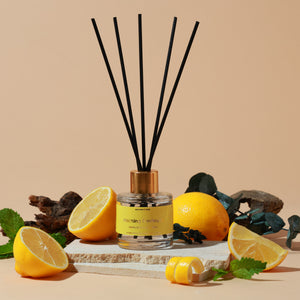
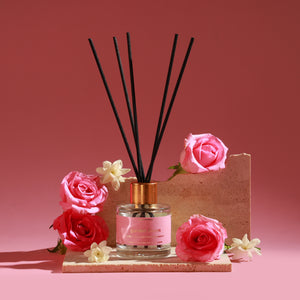
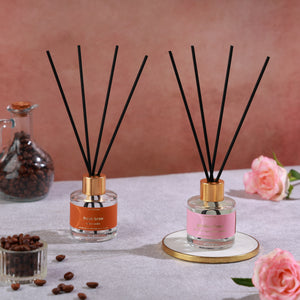
The proof, in one move: put a hotel’s actual oil into your reed diffuser and you will still get a fragrant zone around the bottle. Put a modest oil into a machine that atomises undiluted and releases into moving air and you will still get presence across the room. The variable that changed the outcome was never the bottle.
Where the oil is decisive and nothing else is: composition quality, coherence over hours, heat stability, and taste. No machine has ever fixed a scent somebody does not like.
The honest gap: if this page moves you from oil to system, know what the system ladder actually contains. Sukoon ₹1,899 covers 270–320 sq ft with water; Safar ₹3,999 is waterless and undiluted but is named and sold as a car and travel diffuser with no published room-coverage figure; Vaayu ₹11,999 is rated to 2,000–3,000 sq ft. Between the last two there is no mid-sized waterless bedroom machine.
2. The oil cannot compensate, because the limit it would have to overcome is not a chemical one. There is no concentration of anything that makes a passive surface into a pump. This is why “stronger hotel reed diffuser” is a search for a product that does not exist — not because nobody has made it, but because the category has a ceiling set by geometry rather than by ambition.
3. And yet the oil is not a detail, and it is the half most pages skip. Presence with a composition you dislike is worse than no presence at all, because now you cannot escape it. The oil decides recognisability, which is most of what a signature is; it decides whether the room still smells interesting at hour eight or has flattened into one note; and it decides whether the thing survives a 40°C afternoon without turning bitter, which is a carrier question that no machine can help with.
4. The right way to hold both truths at once is sequence. Buy the system for the room you actually have, then choose the oil you want to live inside. In that order, because a beautiful composition in the wrong mechanism disappoints and gets blamed on the composition — which is exactly the mistake this whole cluster exists to prevent, and it is the most natural mistake in the category rather than a careless one.
5. There is one case where the oil genuinely is the answer, and it deserves saying. If you have presence and you still are not happy, no upgrade will help you. That is taste, and taste is the oil’s department entirely. Changing the machine at that point is money spent making something you do not like more noticeable.
Alcohol-free, phthalate-free, IFRA-compliant, six fibre reeds in a refillable glass bottle. Free shipping above ₹499, and a portion of every order supports girl-child education through Nanhi Kali.

The two questions hiding inside one
Almost every message we receive on this subject is two questions wearing a single coat. The first is “will the fragrance be there?” — will it reach me across the bed, will a guest notice it before they sit down, will the room feel changed rather than containing a nice-smelling object. The second is “will I like it when it is?” — is this the smell I want to live in, does it read as expensive or as an air freshener, will I be tired of it in three weeks. The first question is answered entirely by hardware and placement. The second is answered entirely by composition. They are so different that the answers have almost no vocabulary in common, and yet the market sells them both as “fragrance”.
 Hotel Collection₹999Four things, and no machine touches any of them. Identity — what makes a scent recognisable two years later, which is most of what a signature actually is. Structure — the arc from the lightest materials through the heart to the base, which decides whether hour six is still interesting or has flattened into one sweet impression. Survival — whether the thing holds its character at 40°C, which is a carrier decision: SOSA reeds sit on a heat-stable CCT base rather than the industry-standard DPG, which can crack and go bitter above 40°C, and are tested through a 45°C heat soak and 85% RH. And taste, which is the whole point of the exercise.
 Sukoon₹1,899Whether the material is in the air at all, how much of it, how similar the level is at the door and at the bed, and whether any of that is the same tomorrow. A reed diffuser works by passive capillary action and adds no air, so it produces a fragrant zone and cannot be switched off — both facts are the design rather than a failing. An ultrasonic machine moves air and therefore covers a room: Sukoon at 270–320 sq ft, 16–18 hours on low. A cold-air nebuliser adds control on top: Safar has three speeds and a 1/2/3-hour auto-off, and Vaayu has app scheduling with 1h/4h/8h/24h windows.
 Morning Freshness₹749Oils are not interchangeable across hardware, and this is the one place where a bottle can genuinely break a system. The SOSA Hotel Collection is water-based and made for ultrasonic machines; it cannot go into a reed diffuser, and reed oil cannot go into an ultrasonic machine. There is no hotel-inspired reed diffuser, in either direction, because they are different physical systems. Cold-air nebulisers want oils formulated for cold diffusion — Safar runs on SOSA fragrance oils or good-quality pure essential oil, while thick, sticky or water-based blends can clog the mechanism, and thick undiluted essential oils can clog Vaayu’s fine nozzle over time.
This is why the most useful sentence anybody sends me is “it smells right up close but does not transform the room”. That sentence has separated the two questions without meaning to: it says the composition is fine and the transport is missing. The correct response is not a different bottle. It is either a free adjustment — more reeds, better placement, a closed door, a smaller volume to fill — or a change of mechanism. Buying a deeper scent at that point raises the level near the bottle, shortens the bottle’s life, and leaves the far side of the room exactly as it was.
And the reverse case is worth naming with equal care, because it is the one where I would talk you out of a machine. If you already have presence — a guest notices, the level is similar at the door and at the bed — and you are still unsatisfied, you have a taste problem, and taste belongs to the oil. There is a related trap here that catches good compositions: dose. Almost any fragrance at too high a concentration flattens into a single sweet or sharp impression, which is precisely what people mean when they say something smells cheap. The same oil at a lower dose reads as layered, because the nose has room to resolve the separate materials. Restraint costs nothing, and it is more often the fix than an upgrade is.
The swap test that settles the argument
If you want to know which of two variables is responsible for an outcome, hold one still and change the other. Do it in your head with these two and the answer is immediate. Swap the oils. Take the exact composition a hotel runs and put it into your reed diffuser at home: you will get a beautiful fragrant zone around the bottle and nothing at the door, because a reed still emits vapour from a bounded surface and still adds no air. Now take an ordinary, competent, unremarkable oil and run it through a machine that atomises undiluted material into moving air on a schedule: you will get presence across the room, evenness as you cross it, and consistency at nine in the morning and nine at night.
The variable that changed the outcome was the mechanism in both directions. That is as clean a demonstration as this subject allows, and it is the reason this cluster exists. It also explains a pattern I see constantly: somebody buys a second, more expensive hotel-inspired fragrance after the first disappoints, gets the same result, and concludes that home fragrance is a con. It is not a con. They ran the experiment twice while changing the variable that was not responsible, which is an entirely reasonable thing to have done given how the category is sold.
There is one place the swap test breaks down, and it is a compatibility issue rather than a quality one. Oils are not universally interchangeable across hardware. The SOSA Hotel Collection is water-based and made for ultrasonic machines; it cannot go into a reed diffuser, and reed oil cannot go into an ultrasonic machine. A cold-air nebuliser wants oils formulated for cold diffusion — Safar runs on SOSA fragrance oils or good-quality pure essential oil, and thick, sticky or water-based blends can clog the mechanism, while a fine nozzle of the kind Vaayu uses wants alcohol-free, water-free oils and can clog over time on thick undiluted essential oils. So the oil does not decide presence, but the wrong oil can certainly prevent a system from delivering it. And it bears repeating: there is no hotel-inspired reed diffuser at SOSA, because the two lines are different physical systems.
Which of the two actually decides what
Every property people care about, assigned to the half of the pair that genuinely controls it. The bottom rows are the ones that surprise people.
| Property | Decided by | Why | What changing it costs |
|---|---|---|---|
| Presence across a room | The system, almost entirely | Material has to be moved. A passive surface adds no air; a nebuliser or an ultrasonic machine does | Free adjustments first, then ₹1,899+ |
| Evenness across the room | The system, entirely | Evenness is a property of air movement. There is no compositional route to it | A fan on low, or a machine |
| Being on at 7pm and off at midnight | The system, entirely | A reed cannot be switched off. Safar has 3 speeds and a 1/2/3-hour auto-off; Vaayu has 1h/4h/8h/24h windows and day selection | ₹3,999 / ₹11,999 |
| What the room smells of | The oil, entirely | Identity and recognisability — the part that makes a signature a signature rather than merely a level | ₹299 refill to ₹1,799, or ₹749 for a reed |
| Still interesting at hour eight | The oil, entirely | The arc from top to heart to base is composition. A machine can only deliver what it was given | The price of a better composition |
| Surviving 40°C without turning | The oil and its carrier | SOSA reeds use a heat-stable CCT carrier rather than DPG, which can crack and go bitter above 40°C, and are tested at 45°C and 85% RH | Built in, not an upgrade |
| Whether the hardware works at all | Both — compatibility | Hotel Collection is water-based and ultrasonic-only; reed oil cannot go in an ultrasonic; thick or water-based blends can clog a cold-air nozzle. There is no hotel-inspired reed diffuser | Getting it wrong costs the machine |
| Whether you are happy | The oil, and dose | No system fixes a composition you dislike, and any composition at too high a dose flattens into one impression. Fewer reeds is often the fix | Free, in the direction most people never try |
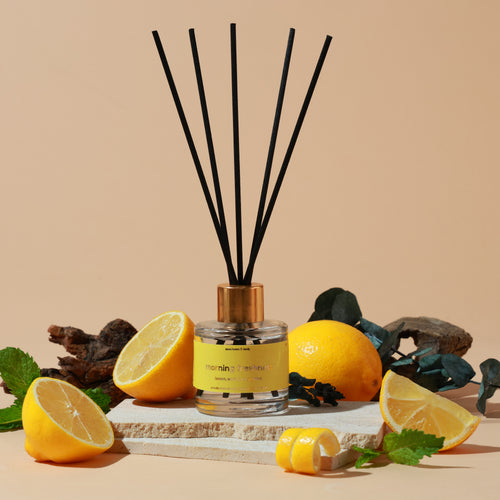
In defence of the oil — four things no machine can do
Having spent a page saying the system wins, I want to be precise about what that does not mean, because a reader who concludes that composition is irrelevant will make a different and equally expensive mistake. The first thing only the oil can do is be recognisable. A signature is not a level, it is an identity. What makes a returning guest recognise a lobby after two years is not intensity; it is a specific set of materials in a specific proportion, held constant. A machine can deliver anything with equal enthusiasm, including something forgettable. Choosing what is worth recognising is the entire craft, and it is not on any spec sheet.
The second is structure over time. A composition is an arc: the lightest materials leave first, then the heart, then the base. Get that wrong and hour one is thrilling and hour six is a flat sweetness. Get it right and the room stays interesting all evening at a constant dose. This is why the first days of a new reed run hot — the reeds are saturating and the most volatile materials are leaving first — and why week three is not fading but settling into the composition as designed. Flipping the reeds restores projection without opening a new bottle.
The third is survival in this climate, which is where I would spend the money if I could only spend it once. Most reed diffusers sit on DPG, which is cheap and which can crack and go bitter above about 40°C — an ordinary afternoon across much of India, and the actual mechanism behind a diffuser going sour in a Delhi May. Every SOSA reed sits on a heat-stable CCT carrier, tested through a 45°C heat soak and 85% monsoon humidity. That decision is invisible, is not a note on any list, and is the reason the thing you can smell survives. And the fourth is simply taste. No machine has ever made somebody like a fragrance. If you have presence and are still unhappy, stop shopping for hardware.
What to buy, in what order — and the gap in the middle
System first, oil second, and free adjustments before either. The last row is what SOSA does not make, stated here rather than discovered at checkout, because the reader most likely to act on this page is exactly the reader that gap affects.
| Buy | What it is | When it is the right answer | Price |
|---|---|---|---|
| 1. Nothing — run the three-point test | Smell at the bottle, at one metre, at the door. Then leave for fifteen minutes and walk back in | Always first. Strong at the bottle and gone at the door means the oil is fine and the transport is missing | Free |
| 2. A 50ml or 130ml reed | Passive capillary. Six fibre reeds, refillable glass, 6–8 weeks on 50ml and 14–18 on 130ml, about ₹13–₹15 a day | Bathrooms, bedsides, small studies. Silent, no power, no water, nothing to charge or schedule — genuinely unbeaten on that list | ₹749–₹1,349 |
| 3. Sukoon | Ultrasonic water mist, 500ml, 270–320 sq ft, 16–18 hours on low, three 15ml Hotel Collection scents included | The best-value system upgrade for a real bedroom. Accept the water: dilution, humidity, and white dust in hard-water cities | ₹1,899 |
| 4. Hotel Collection oil | Water-based, ultrasonic-only. 100ml ₹999, 300ml ₹1,799. The 15ml at ₹299 is a refill, never a first purchase | After the machine, not before. This is the half that decides whether you enjoy the room, once presence exists | ₹999–₹1,799 |
| 5. Vaayu | Waterless cold-air nebulising — the hotel mechanism. 1000 m³, roughly 2,000–3,000 sq ft, 400ml tank up to about 90+ days, app scheduling, under 38 dB | A whole floor, open-plan living-dining, a large home, a villa, a clinic, a salon or a reception. Not for one bedroom | ₹11,999 |
| The honest gap | SOSA has no mid-sized waterless bedroom nebuliser. Safar ₹3,999 is the same mechanism at personal scale — undiluted oil, 3 speeds, 1/2/3-hour auto-off, rechargeable — but it is named and sold as a car and travel diffuser and SOSA publishes no room-coverage figure for it. Megh ₹3,499 is not the missing rung either: at ~215 sq ft it covers less than Sukoon | Said before you spend rather than after. If the requirement is the hotel mechanism in one bedroom, this is the thing the range does not have | ₹3,999 |
Versailles
This is not a comfortable page for a perfumer to write. I was trained to believe the composition is the product, and for a personal fragrance on skin that is very nearly true. For a room it is not, and the sooner I said so out loud the fewer disappointed messages we received. Mostly what you are paying for at the higher price points is the machine, and that is the honest answer to the whole hotel question — a ₹1,000 reed and a ₹11,999 nebuliser can run related scents and produce completely different rooms, because what the higher price buys is transport, control and evenness rather than a better smell.
What I will not do is pretend the oil is decoration. Everything I know goes into decisions nobody can see: holding indole below the threshold where jasmine turns animalic above 30°C, putting a eucalyptus base under a lemon so that a two-week citrus becomes a six-to-eight-week one, choosing a heat-stable CCT carrier over the industry-standard DPG that cracks in an Indian afternoon. None of that helps a fragrance cross a room. All of it decides whether crossing the room was worth doing.
So my advice is unglamorous and it has never changed. Diagnose first, free of charge. Buy the system for the room you actually have. Then choose the oil you want to live inside, keep it for a year rather than rotating four, and use less of it than you think — restraint is what makes a composition read as layered rather than as an air freshener. And if the room you have is one bedroom and you want the hotel mechanism in it, I will keep telling you that we do not make the right machine for that, because you deserve to know it now. Everything is composed in Pune, and a part of every order funds a girl’s classroom through Nanhi Kali.
Frequently asked questions
- How hotels do it — the decisions behind a signature.
- What luxury hotels use — the equipment, sized honestly.
- Everywhere there, barely here — a bounded surface against a pump.
- Strong and even — the word “even”, taken seriously.
- How fragrance travels across a room — the transport page.
- Do hotels use reed diffusers? — where they genuinely appear.
- The fragrance cloud on entry — droplet size and how long mist stays up.
- Why hotel scent feels more present — the three components of presence.
- Recreating it at home — the whole ladder, gap included.
- Brand: the SOSA founder story.
Facts verified August 2026: SOSA reed diffusers — five scents, 50ml ₹749–₹849 suiting rooms up to ~150 sq ft and lasting 6–8 weeks, 130ml ₹1,249–₹1,349 suiting above 150 sq ft and lasting 14–18 weeks; six fibre reeds included, six for full projection and three for a soft bedside level with roughly double the life; flipped every 3–5 days; about ₹13–₹15 a day; heat-stable CCT (caprylic/capric triglyceride) carrier rather than DPG; alcohol-free, phthalate-free, paraben-free, IFRA-compliant, 0 ppm formaldehyde; refillable glass bottle; tested at 45°C and 85% RH; composed in Pune. Morning Freshness’s eucalyptus globulus base slows lemon evaporation 3–4×; Garden Bloom’s indole is held below the threshold at which jasmine reads animalic above 30°C. Duos ₹1,498–₹1,598 (50ml × 2). Refills 300ml ₹2,399, 500ml ₹3,499. Ultrasonic water mist — Boond ₹899 (300ml, up to ~150 sq ft, ~6 hours, USB, night light), Sukoon ₹1,899 (500ml, 270–320 sq ft, 16–18 hours on low, three 15ml Hotel Collection scents included), Megh ₹3,499 (6L tank, ~100 hours, ~215 sq ft, less than Sukoon and never a coverage upgrade). Waterless cold-air nebulising — Safar ₹3,999 (20ml bottle, 2000 mAh Type-C, up to 10 hours continuous or around 30 hours intermittent, 3 speeds, 1/2/3-hour auto-off, 6.9 cm, runs on SOSA fragrance oils or good-quality pure essential oil while thick, sticky or water-based blends can clog it, named and sold as a car and travel diffuser with bedside and hotel room among its stated uses, no published room-coverage figure) and Vaayu ₹11,999 (up to 1000 m³ or roughly 2,000–3,000 sq ft, 400ml tank lasting up to about 90+ days, Bluetooth app and onboard buttons, 1h/4h/8h/24h windows, adjustable intensity, key-lock, under 38 dB, freestanding or wall/HVAC mount, 5W, CE, RoHS, SGS, and formulated oils rather than thick undiluted essential oils, which can clog the fine nozzle over time). Hotel Collection oils are water-based and ultrasonic-only — 15ml ₹299 (a refill), 100ml ₹999, 300ml ₹1,799 — and are not interchangeable with reed oil in either direction; there is no hotel-inspired reed diffuser. No health, air-quality or antimicrobial claims are made, and fragrance does not remove a smell: source, ventilation, then fragrance. Free shipping above ₹499. A portion of every order supports girl-child education through Nanhi Kali. SOSA is an independent Indian fragrance house; the Hotel Collection scents referenced here are SOSA’s own interpretations inspired by the world’s finest hotels, and SOSA is not affiliated with, endorsed by or a supplier to any hotel brand. Prices subject to change — see the live product pages.