


Why the door and not the diffuser: the hit you are describing is a gradient — low concentration on one side of a threshold, higher on the other, crossed by a nose that has not adapted to it. A closed door builds that gradient for nothing. An open door dilutes your 100 sq ft into the whole flat and there is no threshold left to cross.
If you want a level you can switch on rather than a zone that simply exists: Sukoon ₹1,899, ultrasonic water mist, 270–320 sq ft — over-specified for your room, which is precisely why it is controllable in it. It dilutes oil in water and adds humidity. Or Safar ₹3,999, waterless cold-air diffusion of undiluted oil, which is named and sold as a car and travel diffuser and has no published room-coverage figure.
The honest gap: between Safar at personal scale and Vaayu at ₹11,999 and 1000 m³, SOSA makes no mid-sized waterless bedroom nebuliser. Nothing in the range is a Vaayu for one room.
2. Then get the dose right, which at 100 sq ft means being careful in the other direction. A 50ml reed diffuser at ₹749–₹849 is specified for rooms up to about 150 sq ft, so in your room it is not under-sized — it is comfortably within specification. Six fibre reeds is full projection and is what you want if the arrival moment is the goal. Three is a soft bedside level and roughly doubles the life. Most people who tell me a diffuser is weak in a small room have three reeds in and have not flipped them in a fortnight.
3. Place it a little inside the room, not on the door. The doorway is the most turbulent point in the whole flat — air exchanges every time it opens, which strips whatever is sitting there and then hits it at close range. A bottle on a chest of drawers a metre or two in, in the path the room’s air already takes, gives a better arrival and a longer bottle than the same bottle on a shelf beside the handle.
4. If you have done all three and still want more, you want transport, and transport costs money. A reed adds no air to a room, so it produces a fragrant zone rather than a fragranced room. To get an even level across all 100 sq ft you need something that moves air: Sukoon at ₹1,899, which covers 270–320 sq ft and is therefore over-specified for you and controllable because of it, or Safar at ₹3,999, which throws undiluted oil with no water at all.
5. Do not buy a large machine for this. Vaayu at ₹11,999 is rated to 1000 m³, roughly 2,000 to 3,000 sq ft. Against your 100, nine-tenths of it is unused, and it is the wrong purchase for one bedroom no matter how much you like the idea of it.
Free shipping above ₹499, and a portion of every order supports girl-child education through Nanhi Kali.
Why the door is the biggest lever you own, and it costs nothing
The sentence in your question that decides everything is “when I open the door”. That is not a description of a smell; it is a description of a boundary being crossed. What a good hotel room does at the threshold is hold one concentration inside and a lower one outside, so that the moment of entry contains a change. Change is the thing your nose is built to report. A steady, unchanging concentration — even a high one — stops being reported within minutes, which is why a hotel room that is magnificent on Friday evening is unremarkable by Saturday lunch without a single molecule having altered.
A hundred square feet is an unusually good volume for this. There is not much air in it, so a modest release rate reaches a perceptible concentration reasonably quickly, and a closed door means the fragrance leaving the reeds accumulates rather than escapes. Open that door and you have connected your eleven-odd cubic metres to the entire flat; the same output now has to raise the concentration of five or ten times as much air, and it cannot. This is the whole reason people with large open-plan homes buy large machines and people with small closed rooms do not need to. You are on the fortunate side of that arithmetic, and the only thing that throws it away is a door left open all day.
The practical version is unglamorous. Shut the bedroom door when you leave the room in the morning, not just at night. Let the room sit closed and accumulating during the hours nobody is in it. Then the arrival happens on the evening return, which is exactly the moment you described. If you also run a split AC in there, so much the better: a running AC recirculates air within a closed room, which distributes fragrance far more evenly than still air ever will, and it dries that air, which lets fragrance travel more readily. Both effects are free. Both are wasted the instant the door is open.
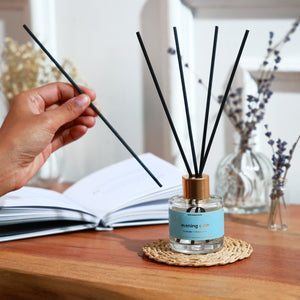
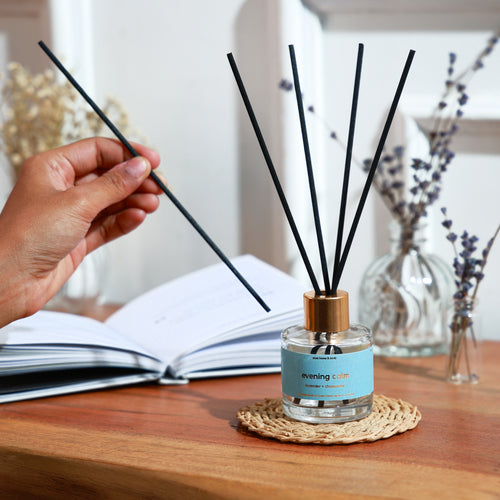
 Evening Calm₹799The one adjustment that changes the outcome more than any purchase on this page. A closed 100 sq ft room accumulates; an open one leaks into the flat. It is worth being deliberate about the hours rather than the habit: the room should be shut while you are out and shut while you are at work, so that concentration has eight or nine uninterrupted hours to build before you open the door in the evening. Ventilate the room first thing and then close it — fragrance goes onto clean, aired air, never over the top of something you would rather not smell, because adding a pleasant odour to an unpleasant one produces a mixture rather than a cancellation.
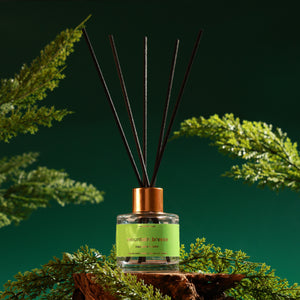
 Mountain Breeze₹849Every SOSA bottle ships with six fibre reeds, and the count is a dial rather than a decoration. Six is full projection; three is a soft bedside level and roughly doubles the life. If the arrival moment is what you are after, six is the setting, and you should flip them every three to five days — each flip restores projection without opening a new bottle. Fibre rather than rattan matters more in Indian air than people expect: rattan is a natural cane with irregular internal channels, and it wicks unevenly in humidity, producing the fade-then-nothing pattern that gets blamed on the oil. Placement is the other free lever. A metre or two inside the room, on a surface in the path the air already takes, out of the direct blast of a split AC and off a sunlit windowsill.
 Sukoon₹1,899If the two free levers are already pulled and the room still reads as a fragrant corner rather than a fragranced volume, what is missing is air movement, and that is the only thing the machines sell you. Sukoon at ₹1,899 vibrates a water-and-oil mixture into a visible wet mist, covers 270–320 sq ft from a 500ml tank, runs 16–18 hours on low and comes with three 15ml Hotel Collection scents. Its coverage is nearly three times your room, which sounds like a mismatch and is in fact the argument for it: in 100 sq ft you will run it on low, in short windows, and it will still do the job. The cost is that the oil is diluted in water, the output adds humidity, and in a hard-water building it can leave a fine white mineral dust.
Dose, and why a 100 sq ft room is the easiest one to overshoot
There is a failure mode specific to small rooms that almost nobody anticipates, and it is the opposite of the one you are worried about. At 100 sq ft it is far easier to over-dose than to under-dose, and over-dosing does not read as “strong”. It reads as cheap. Almost any composition pushed past a certain concentration collapses into a single sweet or sharp impression — which is precisely what people mean when they say something smells like air freshener. The same oil at a lower dose reads as layered, because the nose has room to resolve the separate materials in it. Restraint is not a compromise here; it is what makes a fragrance sound expensive.
So the honest target for your room is not maximum output. It is enough concentration to register at the threshold, and not so much that the room is exhausting to sit in for three hours. Those two are compatible, and the reason they are compatible is adaptation: within a few minutes of entering, your receptors stop reporting the steady signal, so a level that is striking on arrival becomes comfortable background by the time you have put your bag down. That is not the fragrance fading. It is your nose doing what it is built to do. A diffuser you can smell continuously in your own home is set too strong for the volume, and the fix is fewer reeds rather than a different scent.
If you want to be deliberate about it, the SOSA strength scale exists for exactly this decision. It measures perceived intensity in a room, not quality and not concentration. Evening Calm at 8.9 is the softest thing we make and Garden Bloom sits alongside it at 8.9, with Morning Freshness at 9.0, Mountain Breeze at 9.4 and Fresh Brew at 9.5, the deepest. For a small sealed bedroom where you want presence at the door and calm inside it, I would take Mountain Breeze at 9.4 with all six reeds in, or Evening Calm at 8.9 if the room is somewhere you read and sleep rather than pass through.
| Option | Mechanism | What it gives you at 100 sq ft | Control | Cost of it | Price |
|---|---|---|---|---|---|
| Closed door + reed, six reeds ★ | Passive capillary | A strong fragrant zone that a closed room lets accumulate into a real threshold effect | None — no off switch. Reed count is the only dial | No transport; concentration falls with distance from the bottle | ₹749–₹849 |
| Boond | Ultrasonic water mist, 300ml | Up to ~150 sq ft, about 6 hours — sized close to your room | On/off, USB, night light | Adds humidity; oil diluted in water | ₹899 |
| Sukoon ★ | Ultrasonic water mist, 500ml | 270–320 sq ft — over-specified for you, and controllable because of it. 16–18 hours on low | On demand; three 15ml Hotel Collection scents included | Adds humidity; needs filling; possible white mineral dust in hard water | ₹1,899 |
| Megh | Ultrasonic water mist, 6L tank | Only ~215 sq ft — less than Sukoon. Never a coverage upgrade | About 100 hours of runtime | The most humidity of anything we sell | ₹3,499 |
| Safar | Waterless cold-air nebulising, undiluted oil | No published room coverage. Personal and small-space scenting; named and sold as a car and travel diffuser | 3 speeds, 1/2/3-hour auto-off, 2000 mAh Type-C, up to 10h continuous | Needs recharging; not a set-and-forget always-on device | ₹3,999 |
| Vaayu | Waterless cold-air nebulising, 400ml | 1000 m³, roughly 2,000–3,000 sq ft — twenty to thirty times your room | App plus onboard, 1h/4h/8h/24h windows, under 38 dB | Nine-tenths wasted in a bedroom this size | ₹11,999 |
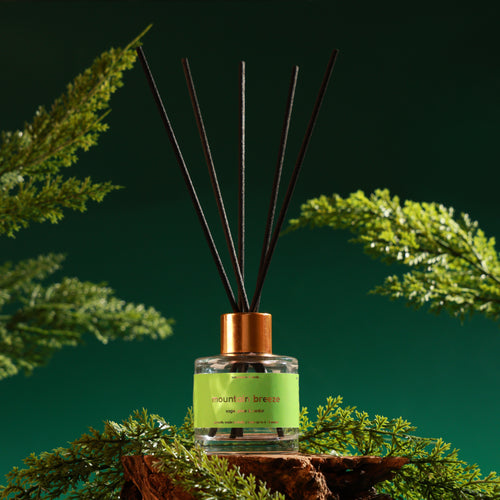 Presence at 9.4 · Mountain Breeze₹849Shop → Softest at 8.9 · Evening Calm₹799Shop →
  A level you switch on · Sukoon₹1,899Shop →
Why you cannot judge your own arrival, and what to do about it
Here is the part that trips up almost everybody who asks this question, and it is worth knowing before you spend anything. Olfactory receptors stop reporting a constant, unchanging stimulus within minutes. The molecules keep arriving; your brain concludes that nothing has changed and stops mentioning it. This is why you can smell your own home only after being away from it, and it is a large part of why a hotel registers so forcefully — you arrive at it un-adapted, from outside, with no accumulated familiarity to cancel against.
The consequence is that walking from your living room into your bedroom is a weak test, because you have been marinating in the same flat's air all evening. The correct test costs nothing: leave the flat entirely for fifteen minutes with the bedroom door closed, then come back and open it. If the room greets you, the setup is working and the problem was never the product. If it does not, you have a genuine dose or transport question and the rest of this page applies. Better still, ask someone who does not live with you. A guest is a far better instrument than you are, and they will tell you the truth in the first thirty seconds without being asked.
The related anxiety, which people rarely say out loud, is the reverse: everyone else can smell it and you cannot. That is expected rather than a fault. Sensitivity to individual materials varies enormously between people, and on top of that you are adapted to your own home in a way no visitor is. If friends remark on it and you detect nothing, the diffuser is doing its job for everybody except you — and buying a stronger one to fix that is how a pleasant room becomes an overwhelming one.
What to buy, cheapest first — and the gap in the middle of our range
In the order I would actually go through it, with the free adjustments genuinely first rather than as a polite preamble. The last row is the honest gap, and it is the reason this page does not end with a ₹11,999 recommendation.
| Step | What it is | When it is the right answer | Price |
|---|---|---|---|
| 1. Close the door during the empty hours ★ | A shut 100 sq ft room accumulates concentration instead of leaking it into the flat, which is the entire basis of a threshold effect | Always first, and for most people it is most of the answer. It is also the only step here that costs nothing | ₹0 |
| 2. Six reeds instead of three, flipped every 3–5 days, bottle moved a metre inside the room | Reed count is the volume dial; six is full projection, three is a soft bedside level and roughly doubles the life | Before any purchase. Most “weak diffuser” letters are three reeds, unflipped, in a corner out of the airflow | ₹0 |
| 3. A 50ml reed diffuser ★ | Passive capillary, six fibre reeds, refillable glass, up to ~150 sq ft, 6–8 weeks, about ₹13–₹15 a day | The cheapest real answer for a room your size, and a genuinely good one: silent, unpowered, no filling, no charging, no schedule | ₹749–₹849 |
| 4. Sukoon | Ultrasonic water mist, 500ml, 270–320 sq ft, 16–18 hours on low, three 15ml Hotel Collection scents included | When you want an even level you can switch on and off rather than a zone that simply exists. Accepts water, humidity and refilling | ₹1,899 |
| 5. Safar | Waterless cold-air diffusion of undiluted oil, 20ml bottle, 2000 mAh Type-C, up to 10h continuous or ~30h intermittent, 3 speeds, 1/2/3-hour auto-off, 6.9 cm | When you want the hotel mechanism with no water at all. Named and sold as a car and travel diffuser; no published room coverage | ₹3,999 |
| Not for you: Vaayu | 1000 m³, roughly 2,000–3,000 sq ft, 400ml tank lasting up to about 90+ days, app scheduling, under 38 dB | A whole floor, an open-plan living-dining, a villa, a clinic, a salon or a showroom. Never a 100 sq ft bedroom | ₹11,999 |
| The honest gap | A mid-sized waterless nebuliser built for one bedroom, which SOSA does not make. Safar has no published room coverage; Vaayu is rated to 2,000–3,000 sq ft. There is nothing between them | Stated plainly, because a reader who wants the dry hotel mechanism at room scale has nowhere in this range to land | — |
Versailles
I like this question because the room size is doing you a favour and you may not realise it. Most of the difficult letters I answer come from people trying to scent three hundred or six hundred square feet of connected open-plan space. A hundred square feet behind a door is the opposite problem, and it is the one where the cheap answer is allowed to be the right answer. I would be doing you a disservice if I let the price of the question make me reach for the expensive end of the range.
So the sequence I would follow in your flat, honestly. Air the room in the morning, close the door, put a 50ml reed on a chest of drawers a metre or so inside, all six reeds in, and leave it alone for a fortnight. Flip the reeds on a Sunday. Then test it the only way that means anything: go out, stay out for a quarter of an hour, come back and open that door. If the room meets you, you have what you asked for and it cost ₹749.
If it does not, the missing thing is transport rather than fragrance, and then it is Sukoon at ₹1,899 if you can accept water in the air, or Safar at ₹3,999 if you cannot — and Safar says car perfume diffuser on the box, which you should know now rather than on the doorstep. What we do not have is the thing that ought to sit between Safar and Vaayu: a dry, room-sized nebuliser for one bedroom. It is the most frequently implied purchase in this whole cluster and we do not make it. Everything is composed in Pune, and part of every order funds a girl’s classroom through Nanhi Kali.
Frequently asked questions
- A 10 × 12 AC bedroom where the reed only reaches the bottle — distance decay, and why a closed AC room is easy.
- Mumbai, small, humid, no water — the constraint stack that most exposes the gap in our range.
- 150 sq ft, on only when I am home — the control question, and why a reed has no off switch.
- Bedroom only, not the whole 2BHK — the answer is no, and here is the arithmetic.
- Safar in one room and Vaayu in the other? — usually the wrong shape, and the case where it is not.
- Expensive oil, no scent cloud — the diffusion answer, with the composition defended.
- What type of diffuser should I search for? — the vocabulary that makes your next search work.
- “Strongest hotel reed diffuser” — why that product does not exist.
- Reed, Safar or Vaayu — the whole decision in one place.
- Brand: the SOSA founder story.
Facts verified August 2026: Passive capillary — SOSA reed diffusers, five scents, 50ml ₹749–₹849 for rooms up to ~150 sq ft lasting 6–8 weeks, 130ml ₹1,249–₹1,349 above 150 sq ft lasting 14–18 weeks, six fibre reeds included (six for full projection, three for a soft bedside level and roughly double the life), flipped every 3–5 days, about ₹13–₹15 a day, heat-stable CCT carrier rather than DPG, alcohol-free, phthalate-free, paraben-free, IFRA-compliant, 0 ppm formaldehyde, refillable glass, tested at 45°C and 85% RH, composed in Pune; strength scale Evening Calm 8.9, Garden Bloom 8.9, Morning Freshness 9.0, Mountain Breeze 9.4, Fresh Brew 9.5; duos ₹1,498–₹1,598; refills 300ml ₹2,399 and 500ml ₹3,499, oil only and never a first purchase. Ultrasonic water mist — Boond ₹899 (300ml, up to ~150 sq ft, ~6 hours, USB, night light), Sukoon ₹1,899 (500ml, 270–320 sq ft, 16–18 hours on low, three 15ml Hotel Collection scents included), Megh ₹3,499 (6L tank, ~100 hours, ~215 sq ft — less than Sukoon, and never a coverage upgrade); all three dilute oil in water and add humidity. Waterless cold-air nebulising — Safar ₹3,999 (20ml bottle, 2000 mAh Type-C, up to 10 hours continuous or around 30 hours intermittent per charge, 3 speeds, 1/2/3-hour auto-off, 6.9 cm, named and sold as a car and travel diffuser with bedside and hotel room among its stated uses, no published room-coverage figure) and Vaayu ₹11,999 (up to 1000 m³ or roughly 2,000–3,000 sq ft, 400ml tank lasting up to about 90+ days, Bluetooth app plus onboard buttons, 1h/4h/8h/24h run windows, choice of days, adjustable intensity, key-lock, under 38 dB, freestanding or wall/HVAC mount, 5W, CE, RoHS, SGS). Between Safar and Vaayu there is no mid-sized waterless bedroom nebuliser in the SOSA range. Hotel Collection oils are water-based and ultrasonic-only — 15ml ₹299 (a refill), 100ml ₹999, 300ml ₹1,799, pack of 7 ₹1,799 — and cannot be used in reed diffusers or waterless nebulisers, nor reed oil in ultrasonic machines; there is no hotel-inspired reed diffuser. No health, air-quality, allergy or antimicrobial claims are made, and fragrance does not remove a smell: source, ventilation, then fragrance. Free shipping above ₹499. A portion of every order supports girl-child education through Nanhi Kali. SOSA is an independent Indian fragrance house; the Hotel Collection scents referenced here are SOSA’s own interpretations inspired by the world’s finest hotels, and SOSA is not affiliated with, endorsed by or a supplier to any hotel brand. Prices subject to change — see the live product pages.