


The most common single cause: reeds that are not properly standing in the oil — leaning against the shoulder of the bottle, or left behind as the level dropped. Look down into the neck rather than at the reeds from the side.
The second: a crowded neck. Reeds jammed together are pinched, cannot stand upright and press against each other along their length, and the ones in the middle wick badly. Six fibre reeds is what the neck is sized for.
The thing that is not a fault: oil does not climb to the tip. It rises to a height where the capillary pull balances gravity and evaporation, and stops. A wet line partway up an otherwise dry reed is the system working correctly.
2. Check the level against the reeds, not against the label. As a bottle empties, the surface falls away from reeds that are held up by the neck. There is a point in every bottle's life where the reeds are technically in the bottle and no longer in the oil. Top up, or tilt and reseat.
3. Count the reeds and free the neck. Six fibre reeds is the count each composition is dosed for and the number the neck is sized to hold. Crowding the neck with nine or ten pinches them together, and reeds pressed along their length against each other wick far worse than reeds with air around them. If you want a high count, you want them fanned, not bundled.
4. Look at what the reeds actually are. Diameter matters: a thicker reed carries more oil but climbs more slowly, a very thin one climbs quickly and delivers little. Mixing thin craft-shop sticks with fibre reeds gives you six reeds behaving six different ways and a wet line at six different heights.
5. Consider the oil's temperature before you consider the reeds. A cool room makes the oil more viscous and the climb slower and lower. That is a season, not a fault, and it corrects itself.
6. And accept the ceiling. Oil rises until capillary pull, gravity and evaporation balance, then stops. It is not going to reach the tip and it does not need to — the fragrance leaves from the wetted surface, and the length above the wet line is doing nothing except giving the reed something to stand up with.
Composed and handmade in small batches in Pune, and a portion of every order supports girl-child education through Nanhi Kali.
Part one — the three mechanical faults, in the order they occur
Everything here is about arrangement rather than material. A reed can be brand new, made of the right fibre and in perfect condition, and still deliver nothing because of how it is sitting. That distinction matters practically, because arrangement faults are free to fix and material faults are not. Work through these three before you conclude anything about the reeds themselves, and do it over a sink or a tray with gloves on, because reed oil marks wood and stone and always finds the one surface you care about.
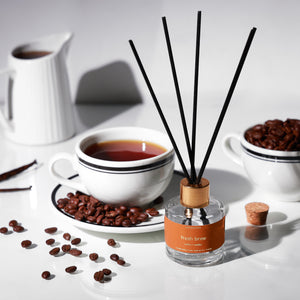
 Fresh Brew₹849 · 9.5/10The neck does two jobs: it holds the reeds upright and it decides how much air is around them. Six fibre reeds is what a SOSA neck is sized for, and at six they stand with space between them. Push in ten and the geometry changes in three unhelpful ways at once. They are pinched at the neck, so the ones in the middle are compressed. They press against each other along their exposed length, so the wetted surfaces are in contact with fibre instead of air and evaporate more slowly. And they lean, which shortens the effective vertical climb and encourages oil to creep down the outside of the glass. A bundle of ten reeds frequently delivers less to a room than a well-spaced six, which is not the result anybody expects when they add reeds for strength. If you do want a high count for a hosting weekend, fan them into a wide splay rather than a bunch, and expect to wipe the neck afterwards.
Part two — the four variables side by side
Find the row that matches what you are looking at. The middle columns are deliberately concrete, because the difference between a correct arrangement and a broken one is usually visible once you know what you are looking for.
| Variable | What correct looks like | What wrong looks like | Effect on the climb | The correction |
|---|---|---|---|---|
| Immersion depth ★ | Lower ends dark and wet for a good length | Dry ends, or damp only at the extreme tip | No climb at all — nothing is being drawn | Reseat upright, top up if needed, flip once |
| Neck geometry | Six reeds standing with air between them | Reeds bundled, pinched, leaning; oil on the outside of the glass | Lower and slower — contact between reeds suppresses evaporation | Return to six, or fan a high count into a splay |
| Reed diameter | Six matched reeds of the same make | Wet lines at three or four different heights | Uneven — some reeds race, others look stalled | Replace the whole set at once with matched reeds |
| Oil viscosity | A wet line that moves a little with the weather | A wet line that drops through a cold snap | Slower and lower while the room is cold | Nothing — it returns; add reeds for the season if you want |
| Not a variable: reed length above the line | Dry fibre above the wet line, always | Expecting the oil to reach the tip | None — the dry length is structural, not functional | Leave it alone; nothing is wrong |
| The honest caveat: the third row assumes you can buy matched reeds, and from us you cannot — SOSA does not sell replacement reeds as a separate product and the refill is oil only. If your set has become a mixture, the two routes are a new bottle, which arrives with six matched fibre reeds and new oil, or a single matched set of plain unscented reeds from a craft or packaging supplier. Fibre for preference; rattan's pores swell in Indian humidity. Buying three replacement sticks to top up an existing set is the one thing I would advise against, because a mixed bottle is harder to read than a tired one. | ||||
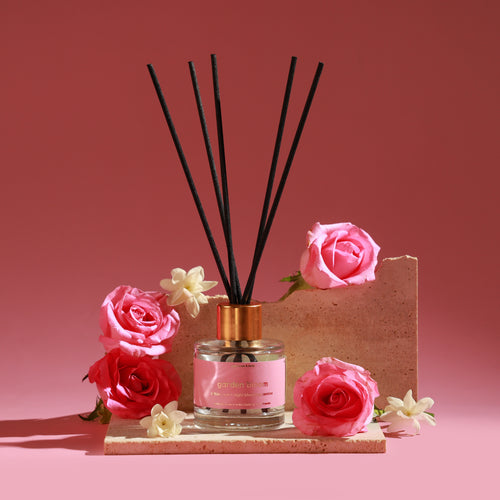
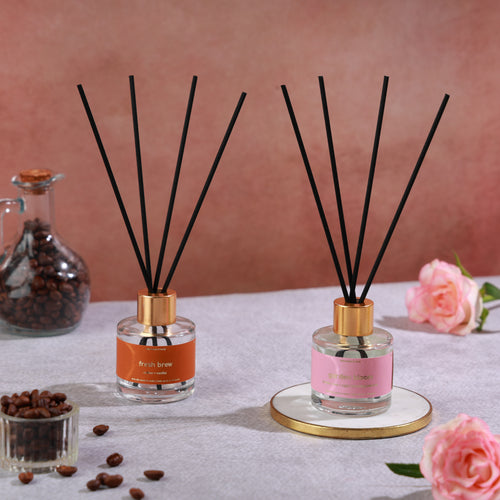
Garden Bloom · neck sized for sixfrom ₹799Shop → 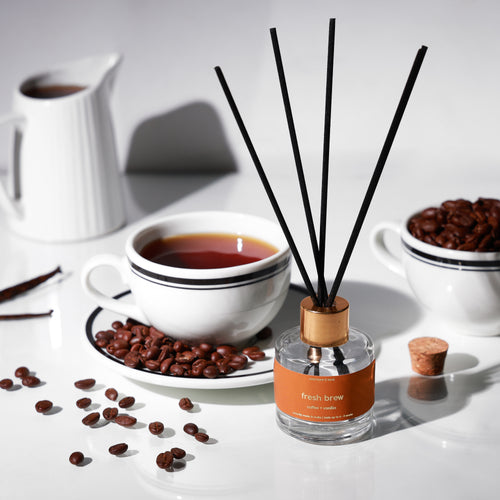 Fresh Brew · six matched fibre reedsfrom ₹849Shop →
  Oil refill · restores immersion depth₹2,399Shop →
Part three — viscosity, and the height that is not a fault
The fourth variable is the oil itself, and it is the one nobody can see. Viscosity — how thick the liquid is — sets how easily it moves through a narrow channel, and it changes with temperature. Our carrier is a heat-stable coconut-derived CCT, chosen because it holds through a 45°C summer without turning, and like every oil it thickens as a room cools. In a Chandigarh or Shimla January the same bottle that was climbing happily in October will settle at a visibly lower wet line and drop more slowly. Nothing has broken and nothing needs replacing. The check is free: bring the bottle into the warmest room in the house for a day and watch the line. If it climbs, that was your answer, and the correct response is either to accept a quieter winter or to add two or three reeds until the weather turns.
There is a second, more interesting point buried in the same physics, and it is the source of a great deal of unnecessary worry. Oil is never going to travel all the way to the top of a reed. The climb is a balance between three forces — capillary pull upward, gravity downward, and evaporation removing oil from the wetted surface — and it settles at whatever height those three agree on. In a warm, well-ventilated room that height is lower, because evaporation is taking more away at the top. In a cool, still room it is higher. So a dry upper length on an otherwise working reed is not a partial failure; it is the equilibrium doing exactly what it does. The fragrance leaves from the wetted surface, and the dry length above it is structure, not function — it is what lets the reed stand up and what gives you somewhere to hold when you flip it. If you want a genuinely diagnostic reading rather than a worried one, mark where the line sits with a fingernail against the glass at the fortnight mark and compare a month later. A line that has fallen substantially is telling you something. A line that has simply never reached the top is telling you nothing at all.
One practical consequence for refilling, since this is where mechanics and habit meet. The method is four steps and the order matters: remove the reeds, pour to the neck, return the reeds, and flip once so both ends are coated. People skip the first step and pour around the reeds, which floods the exposed length, sends oil down the outside of the glass and leaves you with a dripping bottle and a saturated set that will stall for a week. People also over-pour, filling above the neck, which puts liquid where the reeds are pinched and produces exactly the creeping seepage the tray under the bottle exists to catch. Pour to the neck, not past it. A 300ml refill at ₹2,399 gives a vessel roughly 8–11 months of oil at about ₹7–8 per millilitre against ₹15–17 for a fresh 50ml, so it is worth doing well. And do it over a tray: the oil marks wood and stone, and it should be kept away from children and pets.
Part four — setting the climb up correctly, from the start
Five steps, in order, that between them eliminate every mechanical reason oil fails to travel. None of them costs anything, and all of them take less time than reading about them.
| Step | Why it matters mechanically | The common mistake | What good looks like |
|---|---|---|---|
| 1. Insert all six reeds, then flip once ★ | Coats both ends so the climb starts from a wetted surface | Inserting dry reeds and waiting for days | Both ends dark within minutes; a lift the same evening |
| 2. Space them, do not bundle them | Air around each reed is what lets the wetted surface evaporate | Pushing all six into the middle of the neck | A relaxed splay with visible gaps |
| 3. Stand the bottle level, on a tray | A tilted bottle immerses some reeds and lifts others | A sloping shelf, or a bottle wedged among frames | All six lower ends equally submerged |
| 4. Check immersion monthly as the level falls | The surface drops away from reeds held up by the neck | Assuming reeds stay immersed for the life of the bottle | Lower ends still wet for a good length at week ten |
| 5. Keep the set matched when you replace | Equal diameter means one wet line rather than four | Topping up an old set with a few new sticks | Six reeds behaving identically |
Versailles
When I was learning formulation at ISIPCA the reed diffuser was treated as an afterthought — a delivery method rather than a discipline. It was only when I started testing in Indian homes that I understood how much of the experience is decided by the vessel and the arrangement rather than by the juice. You can compose something beautiful and lose all of it to a neck that holds the reeds in a bundle. The glass, the neck opening and the count of six are one design, and they were arrived at together.
The mistake I make myself, every single time, is the refill. I know the order — reeds out, pour to the neck, reeds back, one flip — and I still occasionally pour around the reeds because I am in a hurry, and I still end up wiping down a sideboard. Take the reeds out. It takes four seconds and saves the tray.
And if you take nothing else from this page, take the fingernail. Mark where the wet line sits when a bottle is a fortnight old. Everything else on this page becomes easy to judge once you have a reference, and you stop worrying about a dry upper length that was never going to be wet. Everything is composed and handmade in Pune, and a part of every order funds a girl's classroom through Nanhi Kali.
Frequently asked questions
- Why have my reeds stopped absorbing oil? — the material side: silting, dust, rattan and cold.
- Why are my reeds dry at the top? — where the wet line settles, and why that is normal.
- How do you know when reeds need replacing? and how often should you replace them?
- The complete reed replacement guide and the complete strength guide.
- Brand: the SOSA founder story.
SOSA reed diffuser range & prices (verified August 2026): alcohol-free, phthalate-free, paraben-free and IFRA-compliant compositions on a heat-stable coconut-derived (CCT) carrier, low-VOC, supplied in a refillable glass bottle with six fibre reeds; 50ml lasts 6–8 weeks and 130ml lasts 14–18 weeks. Morning Freshness (Malabar lemon · peppermint · Nilgiri eucalyptus) 50ml ₹749 · 130ml ₹1,249 · 9.0/10; Garden Bloom (British rose · night-blooming jasmine) 50ml ₹799 · 130ml ₹1,299 · 8.9/10; Evening Calm (Kashmir lavender · chamomile) 50ml ₹799 · 130ml ₹1,299 · 8.9/10; Fresh Brew (Coorg coffee · Kerala vanilla) 50ml ₹849 · 130ml ₹1,349 · 9.5/10; Mountain Breeze (Himalayan pine · sage · Indian cedar) 50ml ₹849 · 130ml ₹1,349 · 9.4/10. Reed diffuser refills are oil only — you reuse your own vessel and reeds: 300ml ₹2,399 (roughly 8–11 months) · 500ml ₹3,499 (roughly 14–18 months), about ₹7–8 per ml against ₹15–17 per ml for a 50ml bottle. Duo sets ₹1,498–₹1,598 for 2 × 50ml and ₹2,498–₹2,598 for 2 × 130ml. Strength figures are positions on SOSA’s own internal strength scale, not an industry standard. Replacement reeds are not sold as a separate SKU; SOSA guidance is to refresh reeds every few months. The reed line is separate from the water-based Hotel Collection for ultrasonic machines (15ml ₹299 · 100ml ₹999 · 300ml ₹1,799) and the two are not interchangeable. Diffusers: Boond 300ml ₹899 · Sukoon 500ml ₹1,899 · Megh 6L ₹3,499 · waterless Vaayu ₹11,999. Composed and handmade in small batches in Pune, India; tested through 45°C summer heat and 85% monsoon humidity. Free shipping above ₹499. A portion of every order supports girl-child education through Nanhi Kali. Prices subject to change — see the live product pages.