
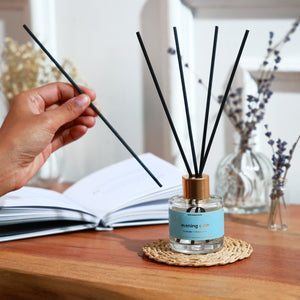




Why a small closed space wins twice: the volume is small, so the same output produces a higher concentration; and the exchange is low, so what is emitted accumulates instead of leaving. A shut bathroom gains fragrance all day. An open living room is being continuously flushed.
And a third reason people forget: in a small room you are always within a metre or two of the bottle. A reed is a point source with no transport, so concentration is highest at the reeds and falls with distance — in a small room there is nowhere to stand that is outside the fragrant zone.
The practical consequence, and it saves you money: a small enclosed room needs less, not more. Two or three reeds in a 50 sq ft bathroom is usually plenty, and can make a 50ml bottle last close to three months rather than 6–8 weeks. Six reeds is full projection and belongs in a large room.
The honest limits: this rule explains why a small room feels powerful, not how to make a large one feel the same. No reed count, bottle size or fragrance strength adds transport — only moving air does, which is why a ceiling fan on low is the best free fix there is. And between Safar at ₹3,999 — named and sold as a car and travel diffuser — and Vaayu at ₹11,999, SOSA has no mid-sized waterless nebuliser for one room.
2. Then the room either keeps that air or replaces it. Fragrance in a room is a balance between what arrives and what leaves. Behind a shut door with no window open, almost nothing leaves, so what the reeds emit accumulates hour after hour and is waiting for you when you walk in. In a room with a balcony door open and a fan running, the air is turning over continuously and taking the fragrance with it. Containment is not a minor factor; it is a second division applied on top of the first.
3. And a small room puts you inside the source's own zone. A reed diffuser is a point source with no transport: concentration is highest at the reeds and falls away continuously with distance, and nothing in the bottle pushes it outwards. In a 50 or 60 sq ft room there is simply nowhere to stand that is more than a metre or two from the bottle. You are never observing the fragrant zone from outside it, which is exactly what you are doing when you lie in bed four metres from a dressing table.
4. So the rule to carry away is this. Perceived strength = output ÷ air volume, further reduced by air exchange, and measured at your distance from the source. Only the first term belongs to the product. The other three belong to the room, and three-quarters of them are adjustable by moving an object or closing a door.
5. Which means a small closed room should be dosed downwards, not upwards. Six reeds is full projection and belongs in a large room. In a 50 sq ft bathroom two or three reeds is usually plenty, reads as more elegant, and makes a 50ml bottle last close to three months rather than 6–8 weeks. That is the single best-value adjustment in the entire range and it costs nothing at all.
Alcohol-free, phthalate-free, paraben-free, IFRA-compliant, 0 ppm formaldehyde. Six fibre reeds in a refillable glass bottle, composed in Pune. Free shipping above ₹499, and a portion of every order supports girl-child education through Nanhi Kali.
The rule, in its three terms
I would like this section to be quotable, because the question gets asked in a hundred specific forms and the general answer serves all of them. Three terms decide what you smell, and only the first is a property of the diffuser. Take them one at a time and you can predict how any bottle will behave in any room in your home before you carry it there.
 Morning Freshness₹749A given number of molecules leaving the reeds each hour has to distribute itself through whatever air is present. Fewer cubic metres, higher concentration — and the relationship is direct and unforgiving. It is also three-dimensional, which is why floor plans mislead: a small room usually has the lower ceiling as well, so the volume gap between a cloakroom and a living room is wider than the plan suggests. This is the term SOSA's sizing addresses honestly rather than heroically: a 50ml is built for rooms up to about 150 sq ft and runs 6–8 weeks; a 130ml is for above that and runs 14–18. Note what that sizing is really saying — the larger bottle exists because a larger room empties a bottle faster, not because it reaches further.
 Mountain Breeze₹849This is the term that makes closed as important as small, and it is the one people leave out. A room is not a sealed jar that fills once; it is a balance. Everything the reeds emit is arriving, and everything the ventilation removes is leaving, and the level settles where those two rates meet. Shut the door of a small room with no window open and the removal rate falls close to nothing, so the level climbs all day. Open a balcony door and the entire room's air turns over — the bottle has not weakened, the room is being flushed, and no reed count will out-run an open door. This is also why a bedroom often smells strongest at night: closed up with the AC recirculating rather than exhausting.
 Garden Bloom₹799Even inside one room the concentration is not uniform, because a reed diffuser is a point source and has nothing with which to push its vapour outward. What exists is a smooth slope, highest at the reeds and falling away from them. Your nose compresses that slope, so a gentle falloff is experienced as a fragrant corner with an edge on it — but there is no edge in the air, only a gradient your senses have rounded off. A small room is small enough that every position on the slope is a high one. Which is why the most reliable free change in a large room is simply to halve the distance between the bottle and the person, and why a bedside table is not a compromise placement but the correct use of a point source.
Reading the rule backwards, for the room that disappoints you
Almost nobody arrives at this question because their bathroom smells too good. They arrive because a second room does not, and the bathroom is the evidence that something ought to be possible. So it is worth turning the rule around. Every term that made the small room powerful is a term you can act on in the large one, and two of the three are free. Containment costs a closed door and a closed balcony for the hours that matter. Distance costs moving an object two metres to the side table or the bedside. Only volume is genuinely fixed — and volume is what the reed count and the bottle size exist to answer.
There is a fourth thing worth knowing, and it is the most useful sentence in the cluster: turn the ceiling fan on low. A reed diffuser has no transport of its own, so all the movement in the room is borrowed. A fan supplies precisely what the bottle structurally lacks, taking the concentrated air sitting around the reeds and mixing it through the room, and in a closed room on a low setting it is the nearest a passive diffuser ever gets to behaving like a machine. It also shortens the life of the bottle, because faster air across the reeds means faster evaporation, and I would rather you knew that before you switch it on than discover it in week five. In my experience nearly everybody takes the trade once it is put honestly.
One caution that saves people from the wrong purchase. All of the above changes concentration; none of it changes evenness. You cannot fix a transport problem by increasing emission, so more reeds, a bigger bottle, a deeper fragrance and a second diffuser will each raise output and add no reach at all — which is exactly why each of those purchases disappoints in the same way. If what you want is the same fragrance wherever you stand in a large room, that is a mechanism decision rather than a dose decision, and it is worth naming as such before any money moves.
Every room in the house, scored on the same rule
The rule applied down a typical flat, from the room a reed flatters most to the room that exposes it. Nothing in this table is a property of the bottle.
| Room | Volume | Containment | Your distance | How it reads, and what to do |
|---|---|---|---|---|
| Small bathroom or cloakroom | Smallest in the house, often a low ceiling | Door shut, rarely a window open | One to two metres, always | Powerful. Use two or three reeds — a 50ml can then run close to three months |
| Walk-in wardrobe or store | Very small | Closed, and opened only briefly | Arm's length | Strong on opening. Two reeds, and choose downwards on the strength scale |
| Home office or study | Moderate | Door usually closed while in use | Desk-side, if you place it there | Good. Three or four reeds, bottle on the desk rather than the shelf |
| Bedroom | Around 150 sq ft, full ceiling | Door ajar, window or balcony, fan or AC | Bottle to pillow is the room's long line | Modest. Six reeds, bottle to the bedside, door shut, fan on low |
| Living room or open plan | Largest, often the tallest ceiling too | Usually no door at all — open to hall, dining, kitchen, balcony | Console to sofa | Hardest room for any passive source. 130ml, six reeds, and consider moved air |

The one place a small closed room works against you
Everything above sounds like an argument for small rooms, so let me give the honest other half. The same rule that makes a bathroom easy makes it easy to over-dose, and over-dosing is the commonest reason a good composition is described as cheap. Almost any fragrance, held at too high a concentration, flattens into a single sweet or sharp impression — which is precisely what people mean when they say something smells like an air freshener. It is very rarely a judgement about the materials. It is a judgement about the dose, and restraint costs nothing.
So in a small enclosed room, go down rather than up. Two or three reeds instead of six. Choose deliberately downwards on the strength scale if the room is genuinely sealed — our scale runs from Evening Calm and Garden Bloom at 8.9 up to Fresh Brew at 9.5, and it exists for exactly this decision. And take the money that comes with it: two or three reeds in a 50 sq ft bathroom can make a 50ml bottle last close to three months instead of six to eight weeks, which is roughly a doubling of the life of the bottle for the price of removing three sticks. There is no cleverer purchase in the range than the one you do not have to make.
And a related point that surprises people: you are not meant to smell it constantly. A home fragrance you notice every minute is set too strong for its room. The pleasure of it lives at arrivals and transitions — walking in from outside, opening a door, coming back after fifteen minutes. Receptors adapt to a constant stimulus within minutes anyway, so the person sitting in the room is the worst judge of it. A visitor is a better instrument than you are. If guests remark on a scent you cannot detect, the room is working for everybody except its resident, and the correct response is to change nothing.
What to buy once you accept the rule — and what to skip
The rule makes the shopping list short, because it tells you which purchases can and cannot help. A bottle sized to the room fixes duration; reed count fixes dose; nothing in the bottle fixes reach. If the requirement is a large room that behaves evenly, only moving air will do it, and that is a change of mechanism rather than a change of scent. One thing to know before you make that change, because it prevents more disappointment than anything else on this page: reed oil cannot go into an ultrasonic machine, and the water-based Hotel Collection cannot go into reeds. Safar takes pure fragrance oil. If you love a particular reed scent, moving mechanism means finding a new one to love, so the honest instruction is usually add, not switch.
| Step | What it is | When it is the right answer | Price |
|---|---|---|---|
| 1. Change the dose, not the product ★ | Two or three reeds in a small closed room, all six in a large one. Flip every three to five days | First, always. In a 50 sq ft bathroom this alone can stretch a 50ml to close to three months | Free |
| 2. Change the room, not the bottle | Close the door, close the balcony for the hours that matter, halve the bottle-to-person distance, nose height on a surface, ceiling fan on low | Second, always. The fan is the only free thing that adds transport, and it shortens bottle life | Free |
| 3. A reed sized to the volume | 50ml up to about 150 sq ft, 6–8 weeks · 130ml above that, 14–18 weeks. Six fibre reeds, refillable glass bottle | When the room is emptying the bottle faster than you would like. This is a duration decision, not a coverage one | ₹749 / ₹1,249 |
| 4. Sukoon | Ultrasonic, 500ml, 270–320 sq ft, 16–18 hours on low, three 15ml Hotel Collection scents included. It moves its own air | When the requirement is evenness across a bedroom or an ordinary living room. Water-diluted, adds humidity, needs filling | ₹1,899 |
| 5. Safar | Waterless cold diffusion of undiluted oil, 20ml, cordless, three speeds, 1/2/3-hour timer. Named and sold as a car and travel diffuser | For a personal-scale space when you want undiluted oil and no water. Not set-and-forget — the timer runs out and the battery needs recharging | ₹3,999 |
| The gap: no mid-sized waterless nebuliser, and no reed that beats the rule | Between Safar at ₹3,999 and Vaayu at ₹11,999 — the latter rated to roughly 2,000–3,000 sq ft and wasted on one bedroom — there is nothing built for a single room. And no reed diffuser at any price escapes the volume term | Said plainly, because the alternative is selling you a bigger bottle for a problem bottles do not solve | — |
Versailles
When I was training, the first thing anybody teaches you about evaluating a fragrance is to control the conditions — same blotter, same distance, same room, same time since application. The moment a condition drifts, you are no longer measuring the fragrance; you are measuring the drift. Homes are the opposite of a controlled environment, and nobody tells buyers that. Every room in a flat is a different measuring instrument, and we sell people one bottle to be judged by all of them.
So I like this question because it is the general case, and the general case is more useful than any of its specific forms. Once you can say output divided by volume, divided again by exchange, read at my distance, you can predict what any bottle will do in any room before you carry it in there. You will also stop buying the wrong thing, because you will see immediately that a larger bottle changes none of those terms except how often you repurchase.
And I would rather you spent less. The advice that follows from the rule is to take reeds out of the small room, not to add them to it, and to move the bottle in the large one before buying anything for it. That leaves the reed doing what only it does — silent, no socket, no water, nothing to fill or charge, nothing to remember, perfectly happy in a power cut, and it never breaks — at about ₹13 to ₹15 a day. If you eventually want a large room to be even rather than merely fragrant, that is a machine, and I would rather you bought the ₹1,899 one that fits the room than the ₹11,999 one built for a whole floor. Everything is composed in Pune, and a part of every order funds a girl's classroom through Nanhi Kali.
Frequently asked questions
- Fills the bathroom, barely works in the bedroom — the rule applied to the commonest pair of rooms.
- Powerful in the bathroom, weak in the living room — the widest gap, with the arithmetic written out.
- 60 sq ft to 150 sq ft — what changed? — nothing about the product; three things about the room.
- Does the bathroom prove the fragrance isn't weak? — yes, and why that is a real result.
- Moving it to the bathroom makes it strong again — the same fact from the other direction.
- Does a reed need a small enclosed room to feel powerful? — to feel powerful, largely yes.
- Why the same fragrance performs differently in two rooms and bathroom vs bedroom vs living room.
- My diffuser isn't bad — is my bedroom asking more of it? — the family pillar.
- Brand: the SOSA founder story.
SOSA facts verified August 2026: Reed diffusers are supplied in 50ml and 130ml only — 50ml suits rooms up to about 150 sq ft and lasts 6–8 weeks, 130ml suits larger rooms and lasts 14–18 weeks. Two to three reeds in a 50 sq ft bathroom can make a 50ml last close to three months. Morning Freshness 50ml ₹749 / 130ml ₹1,249 · Evening Calm ₹799 / ₹1,299 · Garden Bloom ₹799 / ₹1,299 · Mountain Breeze ₹849 / ₹1,349 · Fresh Brew ₹849 / ₹1,349. Perceived-intensity scale: Evening Calm 8.9, Garden Bloom 8.9, Morning Freshness 9.0, Mountain Breeze 9.4, Fresh Brew 9.5 — a measure of intensity in the room, not of quality. Six fibre reeds in a refillable glass bottle, heat-stable CCT carrier, alcohol-free, phthalate-free, paraben-free, IFRA-compliant, 0 ppm formaldehyde, tested through 45°C heat and 85% RH, composed in Pune. Refills 300ml ₹2,399 and 500ml ₹3,499 are oil only and are never a first purchase. Machines: Boond ₹899 (300ml, up to ~150 sq ft, ~6h) · Sukoon ₹1,899 (500ml, 270–320 sq ft, 16–18h on low) · Megh ₹3,499 (6L, ~100h runtime, ~215 sq ft) · Safar ₹3,999 (waterless, 20ml, 2000 mAh, up to 10 hours continuous, three speeds, 1/2/3-hour timer — named and sold as a car and travel diffuser, with no published room-coverage figure) · Vaayu ₹11,999 (up to 1000 m³, roughly 2,000–3,000 sq ft, 400ml, under 38 dB). Reed oil and the water-based Hotel Collection are separate products and are not interchangeable; there is no hotel-inspired reed diffuser. Free shipping above ₹499. A portion of every order supports girl-child education through Nanhi Kali. SOSA is an independent Indian fragrance house; the Hotel Collection is SOSA's own interpretation inspired by the world's finest hotels, and SOSA is not affiliated with or endorsed by any hotel brand. Prices subject to change — see the live product pages.