
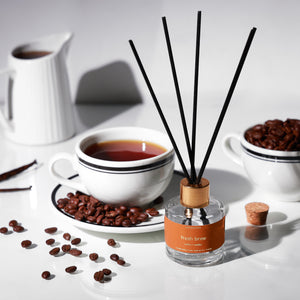
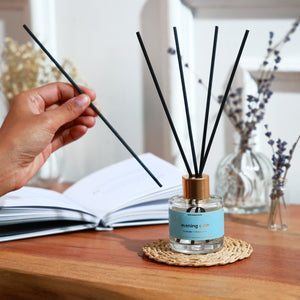


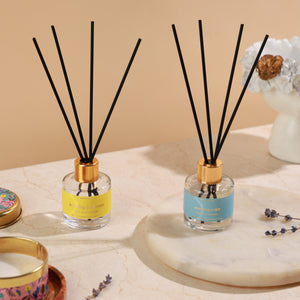
The single most useful test: flip all six reeds, wait twenty-four hours, and pay attention when you walk back in. If a flip does nothing at all, the reed is the problem. If a flip gives you a day and then fades, the reed still works and something else is wrong.
How often it happens: our guidance is to refresh reeds every few months — sooner after a monsoon, sooner at high reed counts, later in a cool sealed bedroom running four reeds.
The honest gap: SOSA does not sell replacement reeds as a separate product. The two practical routes are a new bottle, which arrives with six fresh fibre reeds, or plain unscented reeds from a craft or packaging supplier.
2. Find the wet line, then find it again a week later. There is a visible boundary on every reed between oil-soaked fibre and dry fibre. On a healthy reed in a settled bottle that line sits some way up the exposed length and moves a little with the weather. If it has not moved in a fortnight and sits barely above the oil, the reed has stopped drawing.
3. Flip all six and wait a day. This is the test that separates the two possible worlds. A reed with life in it gives you a clear lift within a few hours and a fuller room that evening. A finished reed gives you nothing — you flip it, and twenty-four hours later the room is exactly as it was.
4. Check the neck. Where the reeds pass through the bottle opening you may find a pale, slightly gritty crust — dried residue plus household dust bound together by oil. A crust that has welded the reeds into position is a late sign, and it is usually accompanied by all of the above.
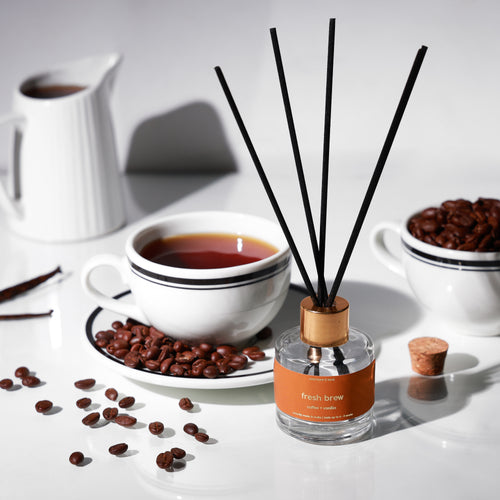
5. Listen to the shape of the fragrance, not its volume. The last sign is the subtlest: the composition stops smelling like itself. Fresh Brew becomes vanilla with no coffee. Morning Freshness loses its lemon and reads as a vague green. That is a reed passing only its heaviest molecules.
6. Then decide honestly which half you are replacing. If the bottle still holds oil and the reeds fail these tests, you need reeds, not oil. We do not sell reeds separately, and I would rather say that plainly than let you buy a ₹2,399 refill that will disappoint you.
Composed and handmade in small batches in Pune, and a portion of every order supports girl-child education through Nanhi Kali.
Part one — the three signs you can see and test in five minutes
Everything in this guide is free to check, and I want you to check before you buy anything at all. The reason is arithmetic: a person who cannot tell a spent reed from a stalled one will eventually buy the wrong product twice, and the commonest sequence I see is oil, then a bigger bottle, then a second bigger bottle, with the same six exhausted reeds carried across all three. Five minutes with a paper towel and a pair of gloves settles it. Take the reeds out over the sink, lay them on a paper towel, and work through the three cards below in order. The oil marks wood and stone, so do not do this on your dining table.
 Morning Freshness₹749 · 9.0/10Lift one reed and hold it against a window. Somewhere along its length there is a boundary between oil-soaked fibre and dry fibre — the wet line. It is the most informative thing on the whole product and nobody has ever been told to look at it. Where it sits tells you which of three problems you have. High and dark, with the reed heavy and slick to the tip, means saturated and stalled: flip, and it will recover. Barely above the oil, with almost the whole exposed length dry, means the reed is no longer drawing — that is a replacement sign. Somewhere sensibly in between, with a quiet room, means the problem is airflow or your own nose adapting, not the reed. Mark the height with a fingernail against the glass and look again in a week; a line that has not moved at all in a fortnight is a line that has stopped.
Part two — the five signs in the order they actually appear
These do not arrive together. They arrive in a sequence, over months, and knowing the sequence is what lets you catch the problem before you have wasted half a bottle of oil pushing it through fibre that cannot carry it. The table below is the order I see in my own home and in customer photographs. Timings are indicative and depend heavily on how many reeds you run, how hot the room gets and what the humidity has been doing.
| Sign | Typically appears | What you notice | How conclusive on its own | What it actually means |
|---|---|---|---|---|
| 1. Uniform dark fibre ★ | From around three months | No pale-to-amber gradient left; a faint tack at the tip | Weak — darkening alone is normal | Heavy residue has reached the whole length of the reed |
| 2. Wet line stops climbing | Soon after sign one | The boundary sits just above the oil and does not move in a fortnight | Strong | Capillary channels have narrowed; the reed cannot draw |
| 3. A flip changes nothing | Days after sign two | Flip all six, wait 24 hours, the room is identical | Decisive | Both ends equally loaded — there is no fresh surface left |
| 4. Crust at the neck | Late, often after a monsoon | A pale gritty ring binding the reeds where they enter the glass | Moderate — clean it and re-test | Dried residue plus household dust; reeds may be welded in place |
| 5. Flat, base-heavy fragrance | Can precede or follow sign three | All body, no top — the composition stops smelling like itself | Strong, but easily blamed on the oil | Only the heaviest molecules are still getting through |
| The honest caveat: none of these five is a defect and none of them is a warranty matter — a reed is a consumable and it is supposed to reach the end of its working life. What they are is a purchase signal, and unfortunately not one we can currently answer with a product. SOSA does not sell replacement reeds as a separate SKU. The two honest routes are a new bottle, which arrives with six fresh fibre reeds and new oil, or plain unscented reeds from a craft or packaging supplier — fibre if you can find it, since rattan clogs quickly in Indian humidity. I would rather write that sentence than pretend a refill solves it. | ||||
Fresh Brew · new bottle, new reedsfrom ₹849Shop → 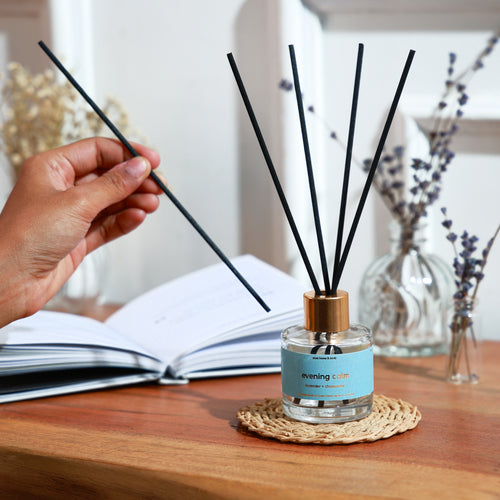 Evening Calm · gentlest on reedsfrom ₹799Shop →
  Oil refill · only over young reeds₹2,399Shop →
Part three — the fifth sign, and why almost everyone blames the wrong thing
The four signs above are physical and you can settle them with your eyes and a fingernail. The fifth is olfactory, and it is the one that generates the most unhappy emails, because it does not present as weak. It presents as wrong. The room still smells of something. It is just that the something is not what you bought. A silted reed passes molecules by weight — the small, light, volatile ones need the least channel to escape through, but they also leave the bottle first over the life of a fill, and what remains in a heavily loaded reed is the heavy end that was always slowest to move. So the composition arrives in the room stripped of its opening and thick with its base.
You can hear it most clearly in the compositions with the biggest contrast between top and base. Fresh Brew is Coorg coffee over Kerala vanilla; through a spent reed it becomes vanilla alone, sweet and slightly stale, and customers describe it as "gone sickly". Morning Freshness is Malabar lemon, peppermint and Nilgiri eucalyptus; through a spent reed the lemon vanishes first, the mint follows, and you are left with a vague green that reads as medicinal. Evening Calm shows it least, because Kashmir lavender and chamomile sit closer together in weight — which is also why a bedroom bottle can carry on for months past the point where the same reeds in a living room would have been obviously finished. If you want an early-warning composition in the house, put Morning Freshness somewhere you pass often; it will tell you what is happening to your reeds weeks before anything else does.
There is one honest confound to rule out before you accept this sign, and it is the reason I put it fifth rather than first. Every reed diffuser goes through a three-phase curve: a spike over days one to three as dry reeds saturate and the top notes leave in a rush, a settle over the first fortnight, and then a plateau that should hold to the end of the bottle. During the settle the fragrance genuinely does get quieter and rounder, and it can read as base-heavy for a week or two before it steadies. That is the product working, not failing. The distinction is time: a settle happens in the first fortnight of a fresh fill and then stabilises, while a spent reed produces a flat, base-only room that gets no better and does not respond to a flip. And there is a second confound worth naming — your own nose stops reporting a constant within minutes and adapts hardest in your own home. Before you condemn a set of reeds on the smell test alone, ask someone who does not live with you.
Part four — what to do once you have decided they are finished
Here is the decision laid out honestly, including the part where the answer is not a product we make. Work down the left column until you find your picture; the right-hand columns tell you whether reeds are actually the thing to change and what it will cost.
| What you are seeing | Are the reeds the problem? | Do this | Cost |
|---|---|---|---|
| Flip changes nothing after 24 hours ★ | Yes — this is the decisive test | Start fresh: a new bottle brings six new fibre reeds and new oil | From ₹749 |
| Reeds dark and slick, wet line very high | No — saturated and stalled, not spent | Flip all six and wait a day; it will recover | Free |
| Reeds pale, wet line barely above the oil, bottle still full | Yes — they have stopped drawing | Replace reeds; plain unscented reeds from a craft supplier will do | Not a SOSA product |
| Reeds young, oil almost gone | No — this is an oil problem | 300ml refill, remove reeds, pour to the neck, return, flip once | ₹2,399 · 8–11 months |
| Crust at the neck, reeds welded in place | Probably — but clean and re-test first | Wipe the neck, reseat the reeds, flip, give it 48 hours | Free |
| Everything checks out but the room stays quiet | No — this is airflow or adaptation | Move the bottle near a doorway at waist-to-chest height; ask a guest | Free |
| Reeds fine, room simply too large | No — this is the format's ceiling | A second bottle, or a Sukoon for scent on demand | From ₹749 · Sukoon ₹1,899 |
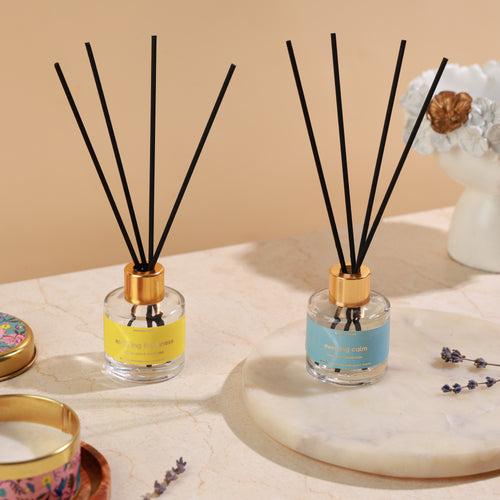
Versailles
The most uncomfortable sentence on this page is the one about not selling reeds. I have been asked about it enough times that I could have quietly stopped mentioning reed replacement altogether and let people carry on pouring good oil through bad fibre. That would have been better for the refill numbers and worse for everybody's evening, so instead I have written the diagnostic out in full and named the gap where the gap is.
What I can tell you is why the reeds in our bottles are fibre. When I was testing the range through a Pune monsoon I ran rattan alongside fibre in identical bottles, and the rattan sets were visibly struggling by the second month — pores swollen, wet lines stalled, that faint crust at the neck arriving early. Fibre held its rate. It is a less romantic material and it costs more, and it is the reason our replacement interval is measured in months rather than weeks.
If you take one habit away from this piece, make it the fingernail mark against the glass. Note where the wet line sits when a bottle is a fortnight old, look at it once a month, and you will never again be surprised by a diffuser that has quietly stopped working. Everything is composed and handmade in Pune, and a part of every order funds a girl's classroom through Nanhi Kali.
Frequently asked questions
- How often should you replace reed diffuser sticks? — the cadence, season by season.
- Why have my reeds stopped absorbing oil? and why are they dry at the top? — the two diagnoses this page points to.
- Should you use new reeds when refilling? — the ₹2,399 mistake, in detail.
- The complete reed replacement guide and why can't I smell my reed diffuser?
- Brand: the SOSA founder story.
SOSA reed diffuser range & prices (verified August 2026): alcohol-free, phthalate-free, paraben-free and IFRA-compliant compositions on a heat-stable coconut-derived (CCT) carrier, low-VOC, supplied in a refillable glass bottle with six fibre reeds; 50ml lasts 6–8 weeks and 130ml lasts 14–18 weeks. Morning Freshness (Malabar lemon · peppermint · Nilgiri eucalyptus) 50ml ₹749 · 130ml ₹1,249 · 9.0/10; Garden Bloom (British rose · night-blooming jasmine) 50ml ₹799 · 130ml ₹1,299 · 8.9/10; Evening Calm (Kashmir lavender · chamomile) 50ml ₹799 · 130ml ₹1,299 · 8.9/10; Fresh Brew (Coorg coffee · Kerala vanilla) 50ml ₹849 · 130ml ₹1,349 · 9.5/10; Mountain Breeze (Himalayan pine · sage · Indian cedar) 50ml ₹849 · 130ml ₹1,349 · 9.4/10. Reed diffuser refills are oil only — you reuse your own vessel and reeds: 300ml ₹2,399 (roughly 8–11 months) · 500ml ₹3,499 (roughly 14–18 months), about ₹7–8 per ml against ₹15–17 per ml for a 50ml bottle. Duo sets ₹1,498–₹1,598 for 2 × 50ml and ₹2,498–₹2,598 for 2 × 130ml. Strength figures are positions on SOSA’s own internal strength scale, not an industry standard. Replacement reeds are not sold as a separate SKU; SOSA guidance is to refresh reeds every few months. The reed line is separate from the water-based Hotel Collection for ultrasonic machines (15ml ₹299 · 100ml ₹999 · 300ml ₹1,799) and the two are not interchangeable. Diffusers: Boond 300ml ₹899 · Sukoon 500ml ₹1,899 · Megh 6L ₹3,499 · waterless Vaayu ₹11,999. Composed and handmade in small batches in Pune, India; tested through 45°C summer heat and 85% monsoon humidity. Free shipping above ₹499. A portion of every order supports girl-child education through Nanhi Kali. Prices subject to change — see the live product pages.