





What that means: ventilating a room with loaded fabric in it clears the air and then the fabric refills it, which is why the smell comes back and why people conclude the building is at fault.
The inventory: sofa covers quarterly, cushion pads sunned seasonally, curtains twice a year, rugs beaten and vacuumed monthly, bedlinen weekly, pillowcases twice weekly, mattress protector every one to two months, towels every three uses, dining chair pads quarterly, and the fabric headboard that nobody ever touches.
Then fragrance: a background scent only works when it is the only thing in the room with a smell.
2. So treat the fabric as the source and the air as the symptom. Every household smell investigation that stalls has stalled because somebody kept changing the reading instead of emptying the reservoir.
3. Then work through the inventory, which is longer than anybody expects. Sofa covers and pads, curtains, cushions, rugs, bedlinen, the mattress and pillows, towels, cushioned dining chairs and the upholstered headboard nobody has ever cleaned. Real intervals are in the table below.
4. Do it free, and do it in order. Everything washable into the machine at the warmest temperature its label allows; everything unwashable into two hours of sun a side; everything else vacuumed with the right head; then twenty minutes of exchange with two openings on opposite walls.
5. Only then fragrance, and here is the sentence that carries this whole group: a background scent works when it is the only thing in the room with a smell. That is not a slogan. It is the reason fabric comes first, and it always has.
A portion of every order supports girl-child education through Nanhi Kali.

Part one — the reservoir and the reading
Nine pages come before this one and they all rest on the same piece of arithmetic, which is worth stating once, properly, in numbers. Two openings on opposite or adjacent walls will exchange the air in an ordinary room within about twenty minutes. A loaded textile in that same room will go on releasing for weeks, and in the case of something large and never laundered, for a great deal longer than that. Those two timescales differ by a factor of several hundred, and almost every frustrating household smell story is somebody running the fast process repeatedly against the slow one and concluding that their building is at fault.
Part two — the complete soft-furnishing inventory
Every soft surface in a typical Indian home, what loads it, how often it genuinely needs dealing with, and what happens when it is not. Every row costs ₹0 except the last, and the intervals are the real ones rather than the impressive ones. Most readers will find that three or four rows are badly overdue and the rest are fine, which is the useful outcome — this table exists to be triaged rather than completed.
| Soft surface | What loads it | Real interval | What happens if it is not done | Cost |
|---|---|---|---|---|
| Sofa covers ★ | Cooking aerosol, body and hair oil, dust, everything airborne in the room | Every two to three months with an Indian kitchen in the flat | The largest untreated textile in the house becomes the room's main reservoir. This is the commonest single answer in the group | ₹0 |
| Sofa cushion pads and foam | Spills that passed through the cover, plus moisture in monsoon | Aired outdoors a full day after any spill; sunned two hours a side seasonally | A smell that appears when somebody sits and fades when they stand, which surface cleaning never reaches | ₹0 |
| Curtains | Outdoor particulate, re-entering cooking air, humidity cycling against cold glass, sunlight on the finish | Twice a year; four times if they hang near an open kitchen | Washed on a timescale of years by most households. Large area, worst position in the room | ₹0 |
| Cushion covers and throws | The same as the sofa, plus actual food, because they sit at plate height | Monthly, and they are the easiest item on this list | They read as faintly old food rather than as dinner, which is the oxidised fatty end of a meal | ₹0 |
| Rugs and carpets | Whatever is walked in, dropped or spilled; and in monsoon, moisture from the coldest surface in the room | Beaten and vacuumed both faces monthly; dried before anything else in monsoon | The underside is usually worse than the top, so vacuuming the visible face achieves less than expected | ₹0 |
| Bedlinen and pillowcases | Roughly half a litre of moisture a night, sebum, shed skin, hair oil and skincare | Sheets weekly, pillowcases twice weekly, duvet cover monthly | Oils oxidise across days into the stale note that arrives around day ten and is worst in the morning | ₹0 |
| Mattress protector and mattress | Everything the sheet lets through, over years | Protector every one to two months; mattress vacuumed and aired seasonally | The protector is usually fitted once and never removed, which defeats the reason for owning one | ₹0 |
| Pillows | Face, scalp and hair oil straight through the case, over years | Sunned two hours a side monthly; replaced on the label's schedule | Washing the case stops helping, because the reservoir has moved into the pillow itself | ₹0 |
| Towels | Water, skin, and the bacteria that grow on a towel that never fully dries in a humid bathroom | Washed every three uses; hung spread out rather than folded on a hook | The sour note that makes a clean bathroom smell wrong within a day of being cleaned | ₹0 |
| Cushioned dining chairs | Food, directly, at the exact height food is served — and almost never cleaned | Wiped or washed quarterly; covers off where they come off | A dining area that smells of last month's meals while the table itself is spotless | ₹0 |
| The fabric headboard | Scalp oil and hair product, from the one place your head rests every night | Vacuumed monthly, wiped or cleaned twice a year | Nobody has ever cleaned yours. It is inches from your face for eight hours a night | ₹0 |
| Fixed upholstery with years in it | All of the above, with no way to launder any of it | Professional low-moisture clean every 18 months to two years | SOSA does not provide this and sells no substitute for it. Ask for low moisture, not a wet shampoo | Paid service |
 Steady · months, no routinefrom ₹749Shop → Timed · steady, 2H, 4H₹1,899Shop →
  300ml · about ₹6/ml₹1,799Shop →
Part three — the order of work, and then the fragrance layer
The weekend, in sequence, because the dependencies matter and doing this in the wrong order wastes a day. Saturday morning, start the laundry, because drying is the long pole: every removable sofa and cushion cover, every throw, all the bedlinen, and the curtains if they are due — all at the warmest temperature each care label allows, since body oil and cooking residue respond to heat and detergent and are essentially untouched by a cold cycle. Skip the fabric conditioner on this particular wash; it works by coating the fibre, and coating is the opposite of what you are doing. While the machine runs, open two openings on opposite or adjacent walls and leave them a full twenty minutes — one window is ventilation, two is exchange — and take everything unwashable outside: cushion pads on edge, pillows on edge, the rug over a rail to be beaten, for two hours a side. Then vacuum, and the head order matters: crevice tool first into the crease between seat and back and along the seat deck edges, then the upholstery head over the frame, then the rug on both faces, then the headboard, then the dining chairs. Saturday evening: bicarbonate of soda over the bare upholstery, left overnight, then vacuumed off in two slow passes on Sunday morning. Refit nothing that is not completely dry. And while you are at it, spend ninety seconds on the two free checks that catch the most misdiagnosed rooms in this cluster: a mug of water down every floor drain, basin and unused shower, because a U-bend seal evaporates in two to four weeks of disuse and then the drain vents into the room; and the washing machine door and detergent drawer left open with the rubber gasket wiped dry. Then do nothing scented for the rest of Sunday, and take the reading in the evening with a cold nose.
One seasonal exception, because it reverses part of the advice above and it applies to a third of the year in much of this country. In monsoon, moisture is the input rather than residue, and the treatment is drying rather than washing. Indoor relative humidity commonly runs 80 to 95 per cent from June to September, microbial growth accelerates above roughly 60 per cent, and in those months opening the windows on a wet day imports moisture instead of removing it — the one situation in this entire cluster where the ventilation instruction is wrong. Use the air-conditioner's dry mode rather than cross-ventilation, run fans to keep air moving across textiles, get the rug up off a cold floor, and do not wash anything you cannot dry fully indoors. And do not buy an ultrasonic diffuser for a damp room: a cool-mist machine adds 30 to 50 millilitres of water an hour on low and roughly double on high, which is exactly the wrong direction for a flat you are trying to dry out. A candle adds no moisture at all and a small amount of warmth, and a reed adds neither, so those are the honest products for a monsoon month even though they are the cheapest things on the site. Buy the machine in October for the same room and it is excellent. The rest of the year, everything in the paragraph above stands.
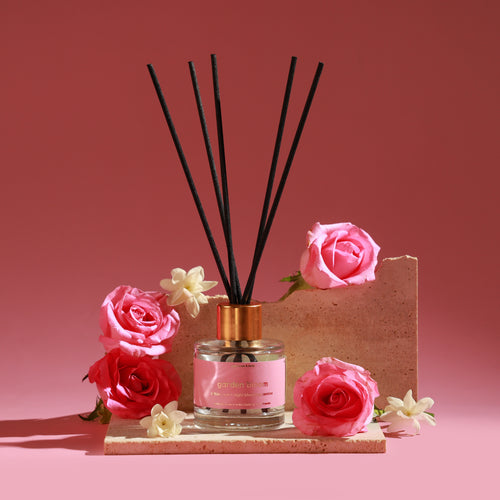
Then the fragrance layer, which is the last part of this guide and the only part with a price on it. Decide first whether you want a routine or no routine, because that question sorts the range better than any description of the scents does. If you want no routine, a reed diffuser from ₹749 in the separate alcohol-free line is the answer: Morning Freshness at ₹749 is Malabar lemon, peppermint and eucalyptus, Garden Bloom and Evening Calm are ₹799, Fresh Brew and Mountain Breeze are ₹849, 130ml from ₹1,249, duos from ₹1,498 and 300ml refills ₹2,399. It needs 24 to 72 hours to reach its level, which makes it wrong for guests arriving tonight and right for a room you would like to stop thinking about, and you set the strength by how many sticks you turn. If you want tonight, a Bookshop candle at ₹379 scents a normal room in fifteen to twenty minutes across roughly 15 to 18 hours of burn, with Amber Rose candle at ₹599 for 130g and ceramic jar candle at ₹949; candles must be attended and put out, and Pure Calm wax melt set at ₹854 is the flameless version of the same idea. If you want control of the hour, the Sukoon at ₹1,899 covers 270–320 sq ft, gives 16–18 hours per fill on low at 30–50 ml/h against 9–12 on high, has a 2.4MHz cool-mist plate, a remote, auto shut-off and steady, 2H and 4H timers, and includes three 15ml Hotel Collection scents of your choice. The Boond at ₹899 is the 300ml version and the Megh at ₹3,499 has a six-litre tank for a genuinely open-plan flat. Dose is three to six drops per tank and per tank rather than per litre: three in a bedroom or study, four in a living room or hall. Placement is waist height or above, at the edge of the room, out of a draught and away from the soft furnishings you have just spent a weekend on, because cool mist falls rather than rises. Two constraints: the Hotel Collection is water-based and runs in the Sukoon, Boond and Megh only, never in a reed and never in the waterless Vaayu at ₹11,999; and SOSA makes no room, linen or fabric spray for the home, since the sprays in the range are car perfumes. Buy 15ml at ₹299 before the 300ml 300ml refill at ₹1,799, expect to stop smelling your own home within a fortnight, and ask one honest guest rather than adding drops.
Part four — the complete edit
The whole group in buying order, with the free work above the paid work because that is the actual sequence rather than a gesture. The last row prints what SOSA does not make and does not do, since this is the page a reader lands on hoping there is a shortcut, and there is not one.
| Step | What it is | Why it comes here in the order | Cost |
|---|---|---|---|
| 1. Everything washable, at the warmest label temperature ★ | Sofa and cushion covers, throws, bedlinen, curtains if due, towels — dried completely before anything goes back on | First. It is the only step that removes material from the house rather than moving it around | ₹0 |
| 2. Everything unwashable, into two hours of sun a side | Cushion pads, pillows, the rug over a rail to be beaten, mattress if it can be moved. On edge, and turned | Second. Dry heat and ultraviolet at once, on the items that can never go through a machine | ₹0 |
| 3. Vacuum in head order, then bicarbonate overnight | Crevice tool, upholstery head, rug both faces, headboard, dining chairs; then bicarbonate on bare upholstery and two slow passes off | Third. It reaches what washing could not, and the overnight version does noticeably more than the one-hour version | ₹0 |
| 4. Twenty minutes of exchange, drains, and the washing machine left open | Two openings on opposite or adjacent walls; a mug of water down every floor drain and unused basin; gasket wiped, door and drawer open | Fourth. Clean air for clean fabric, and it eliminates the two commonest misdiagnoses in this whole cluster | ₹0 |
| 5. A reed, a candle or the Sukoon | From ₹749 for one level held for months after 24 to 72 hours; ₹379 for scent in fifteen to twenty minutes; ₹1,899 for timers and three included 15ml scents | Fifth. A reed for no routine, a candle for tonight, the machine for control of the hour. All three belong after the first four | from ₹379 |
| 6. Hotel Collection 15ml, then the 300ml refill | Seven water-based scents, three to six drops per tank — three in a bedroom, four in a living room. ₹299 for 15ml against ₹1,799 for 300ml at about ₹6 per ml | Sixth. Test at roughly ₹20 per millilitre before committing at about ₹6, and rinse the tank when you change scent | ₹299 / ₹1,799 |
| Not from SOSA: a fabric spray, or a cleaning service | No room, linen or fabric spray for the home — the sprays in the range are car perfumes — and no upholstery cleaning service or partner | Printed rather than implied, on the pillar page where a reader is most hoping one of the two exists | — |
Versailles
If I could put one sentence on the front of this shop it would be the one this page is built on. Air is fast and fabric is slow, so the air is only ever telling you about the fabric. I have lost count of the number of people who have written to me convinced that their flat has a problem, and who turn out to have a sofa whose covers have not come off in three years, curtains that have never been washed at all, and a headboard nobody has considered as an object with a surface. None of that is negligence. It is simply that nobody has ever put the list in front of them, which is what the table above is for.
The commercial part I will say plainly, since this is the page where the group is summed up. Nothing I make removes anything. A candle, a reed and a diffuser all add a small consistent quantity of something pleasant to the air, and that is the whole of their function. Added to a room whose textiles have been dealt with, it reads as a property of the place, which is what people are actually buying and it is worth every rupee. Added to a room whose textiles have not, it is a second smell standing next to the first, and everybody who walks in can hear both. The order of operations is the entire product. Do the free weekend, take the reading with a cold nose on the Sunday evening, and then buy something for a house that has earned it.
Everything is made and supported from Pune, and a part of every order funds girl-child education through Nanhi Kali. You get a home that smells like somewhere you chose; a girl gets a classroom. That equation has always felt right to me.
Frequently asked questions
- The sofa, the cushions and getting cooking smell out of upholstery — the largest reservoir in the house, and the method for emptying it.
- Curtains and the carpet in monsoon — the worst-placed textile in the room, and the one where moisture rather than residue is the input.
- Can fabric hold a smell for longer than the air does? and why a room smells stale at seated height — the mechanism, and the ten-second test that locates it.
- Spray it or wash it and why a bedroom smells better on laundry day — the question with a one-word answer, and the room that already resets itself every week.
- Brand: the SOSA founder story.
Facts verified August 2026: Diagnostic facts used in this guide: a closed room accumulates what it cannot exchange, so cross-ventilation needs two openings rather than one; a drain's U-bend water seal evaporates in roughly two to four weeks of disuse and then admits sewer gas, which is corrected by pouring water down the drain; microbial growth in fabric and on surfaces accelerates above about 60% relative humidity, and Indian monsoon indoor humidity commonly runs 80–95%, which is the one situation where ventilating on a wet day can import moisture rather than remove it; an air-conditioner's cold, wet evaporator coil and filter grow biofilm that is blown into the room on start-up; textiles adsorb cooking aerosol and body oils and re-release them for weeks; and olfactory adaptation makes a constant household smell undetectable to its residents within about a fortnight while visitors still perceive it. Timings: a scented candle scents a normal room in roughly 15–20 minutes, a Sukoon ultrasonic diffuser reaches a steady level in about 20 minutes from cold, and a reed diffuser needs roughly 24–72 hours. SOSA products and prices: Sukoon 500ml ₹1,899 (270–320 sq ft, 16–18h on low, 9–12h high, 30–50 ml/h, 2.4MHz cool mist, remote, steady/2H/4H timers, BPA-free, auto shut-off, includes three 15ml Hotel Collection scents of your choice); Boond 300ml ₹899; Megh 6-litre ₹3,499; waterless Vaayu ₹11,999 (up to 1000m³); Aangan ₹25,999. Hotel Collection water-based fragrance 15ml ₹299, 100ml ₹999, 300ml ₹1,799, Pack of 7 at 15ml ₹1,799; dose 3–6 drops per tank. Reed diffusers (separate alcohol-free line): Morning Freshness from ₹749, Garden Bloom and Evening Calm from ₹799, Fresh Brew and Mountain Breeze from ₹849; 130ml from ₹1,249; duos from ₹1,498; 300ml refills ₹2,399. Scented candles: Bookshop 80g ₹379, Amber Rose 130g ₹599 and 220g ₹799, Smoked Oudh 130g ₹449, ceramic jar candles ₹949, Pure Calm wax melt set ₹854. Free shipping above ₹499. SOSA does not make a room or linen spray for the home. The Hotel Collection scents are SOSA's own interpretations; SOSA is not affiliated with or endorsed by any hotel brand. Prices subject to change — see the live product pages.