
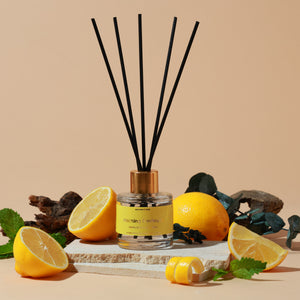



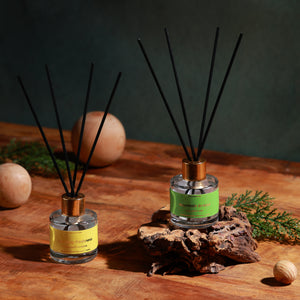
Why that makes a corner: evaporation only puts molecules into the thin layer of air touching the reeds. Getting them three metres across a room is a transport job, and nothing in the product does transport. So the fragrance sits in a zone around the bottle and thins out sharply beyond it.
What this means practically: a reed diffuser produces a fragrant zone, not a fragranced room. The ceiling on how far it reaches is structural, and no scent, no bottle size and no reed count moves it very far.
What the reed does better than any machine: it is silent, it uses no power, it needs no filling, charging, cleaning or scheduling, it cannot be forgotten or left on, it costs about ₹13–₹15 a day, and it looks like an object on a console table rather than an appliance.
The honest gap: if you want the whole room, the mechanisms that move air are Sukoon ₹1,899 (ultrasonic, 270–320 sq ft, oil diluted in water) and Safar ₹3,999 (waterless, undiluted oil, but named and sold as a car and travel diffuser with no published room-coverage figure). Between Safar and the 2,000–3,000 sq ft Vaayu at ₹11,999, SOSA has no mid-sized waterless bedroom nebuliser.
2. Emission happens at a surface, and that surface is small. Oil rises through the porous fibre of six reeds by capillary action and leaves from the wetted length exposed to the air — a few square centimetres in total. That is the entire interface between your bottle and your bedroom. It is enough to load the air immediately around it, and it is not enough to load 120 sq ft of air at the same concentration.
3. Transport, in a still room, is almost nothing. Once a molecule leaves a reed, it moves by two means. Molecular diffusion — the random spreading of a gas — is genuinely slow across the distance of a room. Convection, the slow drift of air caused by warm walls, a person walking past or a fan somewhere, is faster but weak, undirected and intermittent. The reed contributes neither. It waits for the room to do the work.
4. The result is a gradient, and the corner is the top of it. Concentration is highest at the reeds and falls with distance in every direction. Your nose does not read a gradient as a gradient; it reads it as “strong here, nothing there”, because perception compresses a smooth decline into an on-and-off impression. That is why the corner has an edge you can almost walk through.
5. Which means the ceiling is structural, not a quality problem. A deeper fragrance, a larger bottle or a more expensive oil changes the height of the gradient a little. None of them changes its shape. If what you want is even concentration across a whole room, you need a mechanism that supplies transport — and that is a different machine, with its own real costs.
Alcohol-free, phthalate-free, paraben-free, IFRA-compliant, 0 ppm formaldehyde. Free shipping above ₹499, and a portion of every order supports girl-child education through Nanhi Kali.
The three things that decide where the fragrance ends up
Put the products aside for a moment. Any scenting system anywhere in the world — a reed on your dresser, a machine in a lobby, a bowl of jasmine on a windowsill — is doing three separable things, and its character comes from how well it does each one. Emission rate. Transport. Removal. A reed diffuser is respectable at the first, has nothing for the second, and has no influence over the third at all. Read the three cards below and the corner will stop being mysterious.
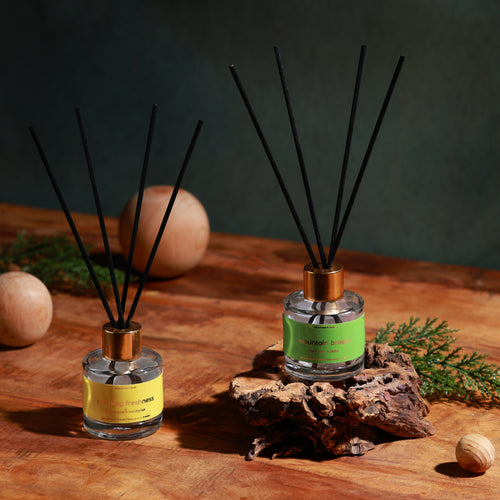
 Morning Freshness₹749Capillary action pulls oil up the fibre until the reed is wet along its exposed length, and from that wetted length the volatile materials leave into the air. The rate is decided by three things you do not control — temperature, humidity and local airflow — and one you do: how many reeds are in the bottle. Six is full projection; three is a soft bedside level and roughly doubles the life. Flipping every three to five days re-wets the dry upper length and restores the lift. All of that is real and all of it adjusts emission. None of it adjusts transport, which is why a reader who has already gone to six reeds and still has a corner has correctly exhausted the lever and should stop pulling it.
 Sukoon₹1,899This is the whole page in one card. Fragrance molecules go where the air goes, and in a closed bedroom the air mostly does not go anywhere. Left to itself, a gas spreads by molecular diffusion, and over metres that process is slow enough to be irrelevant on the timescale of an evening. What actually carries scent across an ordinary room is bulk air movement: a fan, an air conditioner recirculating, a door opening, a person walking. A reed adds none of that, and an ultrasonic or cold-air machine exists precisely to add it. This is also why a running AC in a closed room makes a reed seem to work better — the machine is doing the reed’s missing job for it, and drying the air, which speeds emission too. Better distribution and a shorter bottle life in the same season.
 Evening Calm₹799The third term is the one nobody counts. Concentration in a room is emission minus removal, and removal is air exchange — an open window, a gap under a door, an exhaust fan, a balcony on a high floor where wind speed is considerably greater than at street level. A room ventilating continuously is not a home-fragrance environment during those hours; it becomes one the moment it closes. This is why the same bottle reads completely differently at three in the afternoon with the windows open and at eleven at night with the door shut. Closing the door is the single most effective free thing available to you, and it works by cutting removal rather than by raising emission.
Why the corner forms exactly where it does, and why its edge feels so sharp
Take the three terms together and the geometry follows. Emission loads the air within a few tens of centimetres of the reeds. Transport, weak and undirected, drags a little of that outward in whatever direction the room’s convection happens to run that evening. Removal quietly subtracts from the far end. The steady state is a plume — a zone of high concentration wrapped around the bottle, elongated slightly in the direction of whatever airflow exists, thinning as you move away. If your diffuser sits on a corner console, the plume sits on the corner console. The bottle is not making a corner; the corner is where you put the bottle.
The reason the edge feels abrupt, when the underlying gradient is smooth, is a fact about noses rather than about air. Olfactory perception is compressive: a large change in concentration produces a comparatively small change in perceived intensity, and below a certain threshold the sensation goes to nothing rather than to very slightly. So a decline that is mathematically gradual is experienced as a boundary. This is worth knowing because it explains why doubling the emission does so little for the far end of the room: you can raise the whole curve and still leave the far corner below the threshold, having spent real money and shortened your bottle to do it.
There is a second reason people describe the effect as a corner rather than a cloud, and it is placement. Most reed diffusers in Indian homes live where an object looks good — a console, a shelf, the end of a dresser — and those places are almost by definition out of the airflow. The one place a reed is genuinely mis-sited is the entrance itself, which people choose for the best of reasons and which is the most turbulent point in a home: the door opens, air exchanges wholesale, and the bottle is repeatedly stripped and then met at close range. Slightly inside the room, out of the draught but still in the path air already takes, gives a better impression and a longer bottle. That is a real fix and it is free, and I would run it before spending anything.
| Mechanism | How it emits | How it transports | What it produces in a room | What it costs you |
|---|---|---|---|---|
| Passive capillary — the reed diffuser | Evaporation from six wetted fibre reeds | Nothing. It borrows the room’s own air | A fragrant zone around the bottle, decaying with distance | No power, no water, no filling, no charging, silent, about ₹13–₹15 a day |
| Ultrasonic water mist — Boond ₹899, Sukoon ₹1,899, Megh ₹3,499 | A piezo plate shatters a water-and-oil mixture into a visible wet mist | The mist plume moves air and carries droplets outward | Genuine room coverage — Sukoon 270–320 sq ft; Boond up to ~150; Megh only ~215 | Mains power, refilling, oil diluted in water, added humidity, possible white mineral dust in hard-water cities |
| Waterless cold-air nebulising — Safar ₹3,999, Vaayu ₹11,999 | Pressurised air shatters undiluted oil into a dry micro-mist | The mist travels with the room’s airflow; Vaayu can be mounted into HVAC | The mechanism hotels use. Vaayu is rated to 1000 m³, roughly 2,000–3,000 sq ft | Charging or power, a device on the shelf, and money. Safar runs on a 1/2/3-hour auto-off, not always-on |
| The honest gap: Safar is named and sold as a car and travel diffuser and SOSA has published no room-coverage figure for it. Vaayu is nine-tenths wasted in one bedroom. Between them there is no mid-sized waterless bedroom nebuliser in the range, and that is why this decision is a trade-off rather than a ladder. | ||||
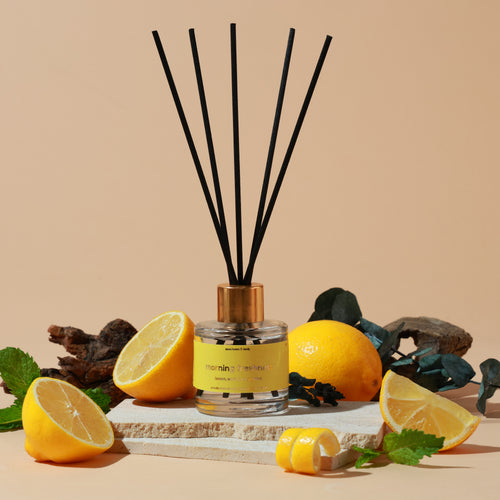 Passive · Morning Freshness₹749Shop →
  Ultrasonic · Sukoon₹1,899Shop →
  The oils · Hotel Collection₹999Shop →
Making the corner bigger, and moving it to where you actually sit
Before anything is bought, there are four adjustments that genuinely change what you experience, and they are all free. First, put the bottle where you are, not where it looks best. If your reed is on a corner console and you spend your evenings in bed four metres away, you have placed the zone in the part of the room nobody occupies. Moving it to the bedside table does not fragrance the room, but it puts you inside the zone, which is what you actually wanted. This is the reframe I offer most often: you cannot move the room to the fragrance, so move the fragrance to the person.
Second, close the door for the hours you are in there — that cuts removal, and in a 120 sq ft bedroom a closed door will raise the whole gradient noticeably within an hour. Third, use all six reeds if the room is above about 100 sq ft, and match the size honestly: a 50ml is built for up to about 150 sq ft over six to eight weeks, a 130ml for above that over fourteen to eighteen. A 50ml being asked to hold a 300 sq ft room reads as weak while performing exactly to specification. Fourth, take the reading properly. Leave the room for fifteen minutes, come back, and see what you notice on the way in.
That last one matters more than people expect, because there is an entirely separate phenomenon hiding inside this complaint. “Has it stopped working, or have I stopped noticing?” is almost always the second. Olfactory receptors stop reporting a constant, unchanging stimulus within minutes — the molecules still arrive, the brain stops mentioning them because nothing has changed. It is the reason you cannot smell your own home and can smell everybody else’s. So before concluding that your room has a corner, ask somebody who has just walked in from outside where they can smell it. A visitor is a better instrument than you are, and they are free. If they tell you the room smells lovely from the doorway, you do not have a diffusion problem at all; you have a perfectly working diffuser and an adapted nose, and no purchase fixes that.
What to buy, in order — and the rung that does not exist
Ordered by what it costs rather than by what I would like you to spend, because in this family the first two rows solve a genuine share of the problem for nothing. The last row is the honest gap in the range, and it is the row I would want to read first if I were the one buying.
| Do this | What it is | When it is the right answer | Price |
|---|---|---|---|
| 1. Move the zone to where you sit ★ | Bottle to the bedside or the desk, out of the draught and off the threshold, six reeds, door closed for occupied hours | First, always. It does not fragrance the room, it puts you inside the fragrant part of it — which is usually the real request | ₹0 |
| 2. Two zones instead of one | A second bottle at the other end of the room — a duo is two 50ml bottles, six fibre reeds each | For a long room or two connected spaces. Two zones, still not one even room — but often the cheaper right answer | ₹1,498–₹1,598 |
| 3. Real transport, water acceptable | Sukoon — ultrasonic water mist, 500ml, 270–320 sq ft, 16–18 hours on low, three 15ml Hotel Collection scents included | The value answer for a bedroom that genuinely needs even coverage. You accept dilution, humidity and refilling | ₹1,899 |
| 4. Real transport, no water at all | Safar — waterless cold-air nebulising, undiluted oil, 20ml bottle, 2000 mAh Type-C, up to 10 hours continuous or around 30 intermittent, 3 speeds, 1/2/3-hour auto-off, 6.9 cm. Named and sold as a car and travel diffuser, with bedside and hotel room among its stated uses | When water is the deal-breaker and you want the hotel mechanism at personal scale. No published room-coverage figure, so treat it as personal scenting | ₹3,999 |
| Never for this problem: Megh | 6L tank, around 100 hours of runtime, about 215 sq ft of coverage | Less coverage than the ₹1,899 Sukoon. A runtime and humidity machine, never a coverage upgrade | ₹3,499 |
| The honest gap | No mid-sized waterless bedroom nebuliser exists at SOSA — nothing between Safar and Vaayu ₹11,999, which is rated to 1000 m³ or roughly 2,000–3,000 sq ft and is the wrong purchase for one bedroom | Said plainly, because it is the reason there is no single automatic answer to your question | — |
Versailles
When somebody writes to me with the word corner in it, I am quietly pleased, because they have described the physics correctly without meaning to. Most messages arrive as “it is too weak”, which sends everybody towards a stronger fragrance and therefore towards a purchase that cannot help. A corner is a spatial complaint, and spatial complaints have spatial answers.
I want to be straightforward about what we sell here. The reed diffuser is our core product and I am not going to be embarrassed about the thing it cannot do, because the list of things it can do is the reason people keep it. It makes no sound. It has no plug and no battery and nothing to fill. It cannot be left on by mistake and it cannot be forgotten to be switched on. It asks for four minutes of your attention every three to five days and nothing else, and it costs about ₹13 to ₹15 a day, and it looks like a glass object on a table rather than a small appliance. There is no machine on earth that beats it on any of that, and there is no machine we make that I would put on a bedside table for its looks.
What it will not do is deliver. If you want the far end of a room at the same concentration as the near end, you are asking for transport, and transport costs energy — a plug or a battery, a fill or a charge, a device that is visibly a device. That trade is completely reasonable and plenty of people should make it. I would just rather you made it knowing what you were giving up, than made it hoping a deeper scent would do the job of a fan. Everything is composed in Pune, and part of every order funds a girl’s classroom through Nanhi Kali.
Frequently asked questions
- Can a reed make an entire bedroom smell like a hotel? — the answer in the first sentence.
- Strong beside the bottle, weak from the bed — the distance-decay page.
- I added more reeds and it still is not hotel-like — why the ceiling is structural.
- Two reeds or an upgrade? — two bottles give two zones, not one room.
- Flipping the reeds constantly — a 3–5 day cadence, not a daily fix.
- Are reeds the wrong format for me? — sometimes yes, said plainly.
- Is a reed designed for lobby projection? — two design briefs, compared.
- When to stop searching for a stronger reed — the checklist.
- Did I actually need active scenting? — the family pillar.
- Brand: the SOSA founder story.
Facts verified August 2026: Three diffusion mechanisms are described — passive capillary (reed diffusers), ultrasonic water mist (Boond ₹899, 300ml, up to ~150 sq ft, ~6 hours, USB, night light; Sukoon ₹1,899, 500ml, 270–320 sq ft, 16–18 hours on low, three 15ml Hotel Collection scents included; Megh ₹3,499, 6L tank, ~100 hours runtime, ~215 sq ft, which is less coverage than Sukoon) and waterless cold-air nebulising (Safar ₹3,999, 20ml bottle, 2000 mAh Type-C battery, up to 10 hours continuous or around 30 hours intermittent, 3 speeds, 1/2/3-hour auto-off timer, 6.9 cm, named and sold as a car and travel diffuser with car, handbag, desk, bedside and hotel room among its stated uses, no published room-coverage figure; Vaayu ₹11,999, coverage up to 1000 m³ or roughly 2,000–3,000 sq ft, 400ml refillable tank lasting up to about 90+ days, Bluetooth app and onboard buttons, 1h/4h/8h/24h run windows, adjustable intensity, key-lock, under 38 dB, freestanding or wall/HVAC mount, 5W, CE, RoHS, SGS). SOSA reed diffusers: five scents, 50ml ₹749–₹849 lasting 6–8 weeks and suiting rooms up to ~150 sq ft, 130ml ₹1,249–₹1,349 lasting 14–18 weeks and suiting above 150 sq ft, six fibre reeds included and flipped every 3–5 days, about ₹13–₹15 a day, heat-stable CCT carrier rather than DPG, alcohol-free, phthalate-free, paraben-free, IFRA-compliant, 0 ppm formaldehyde, refillable glass bottle, climate-tested at 45°C and 85% RH, composed in Pune. Duos are two 50ml bottles at ₹1,498–₹1,598; 130ml duos ₹2,498–₹2,598; refills 300ml ₹2,399 and 500ml ₹3,499, oil only and never a first purchase. SOSA strength scale: Evening Calm 8.9, Garden Bloom 8.9, Morning Freshness 9.0, Mountain Breeze 9.4, Fresh Brew 9.5. Hotel Collection fragrance oils are water-based and ultrasonic-only at 15ml ₹299 (a refill), 100ml ₹999, 300ml ₹1,799 and a pack of seven at ₹1,799; they cannot be used in reed diffusers and reed oil cannot be used in ultrasonic machines, so no hotel-inspired reed diffuser exists. No health, air-quality, allergy or antimicrobial claims are made, and fragrance does not remove a smell — source, then ventilation, then fragrance. Free shipping above ₹499. A portion of every order supports girl-child education through Nanhi Kali. SOSA is an independent Indian fragrance house; the Hotel Collection scents referenced here are SOSA’s own interpretations inspired by the world’s finest hotels, and SOSA is not affiliated with, endorsed by or a supplier to any hotel brand. Prices subject to change — see the live product pages.