
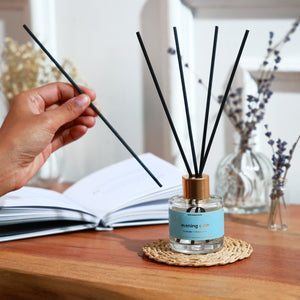


The three free fixes, in order of effect: put all six reeds in rather than three; move the bottle nearer to where your head actually is and out of any draught; close the bedroom door so the volume you are scenting is 120 sq ft rather than a bedroom plus a landing.
What will not help: a deeper fragrance. The SOSA scale runs Evening Calm 8.9 to Fresh Brew 9.5, and it measures perceived intensity in the room, not reach. A deeper composition released from the same six sticks still stops at the same edge.
The honest gap: between Safar at ₹3,999 — named and sold as a car and travel diffuser, with no published room-coverage figure — and Vaayu at ₹11,999 and 2,000–3,000 sq ft, SOSA has no mid-sized waterless bedroom nebuliser. And Megh at ₹3,499 is not the fix either, at about 215 sq ft — less than the ₹1,899 Sukoon.
2. That means the oil has already passed its test. A genuinely weak or degraded composition reads thin at every distance, including with your nose an inch away, and often reads slightly wrong as well — flat, or sour where it should be sweet. Yours is strong up close. Nothing in your description points at the bottle.
3. So change the distance before you change anything else. Two feet nearer your head is a large proportional change when the total is only three or four feet, and it is free. The bedside table beats the dressing table; the shelf at pillow height beats the low chest by the door. Reeds sit best a little above the level of your head when you are lying down, not on the floor.
4. Then use all six reeds. Reed count is the volume dial and almost nobody adjusts it deliberately. Six is full projection; three is a soft bedside level with roughly double the life. If you have been running three, you have been assessing the fragrance at half volume, and that is the single commonest cause of these letters.
5. Then close the door and let a guest judge it. A contained 120 sq ft bedroom reaches a perceptible concentration far faster than a bedroom open to a hallway. And you adapt to your own home within minutes, so the honest test is to leave for a quarter of an hour and come back, or to ask somebody arriving from outside what they notice. If they can smell it and you cannot, you do not have a weak diffuser.
Alcohol-free, phthalate-free, paraben-free, IFRA-compliant, 0 ppm formaldehyde. Free shipping above ₹499, and a portion of every order supports girl-child education through Nanhi Kali.
The arithmetic of two feet, and why it beats changing the fragrance
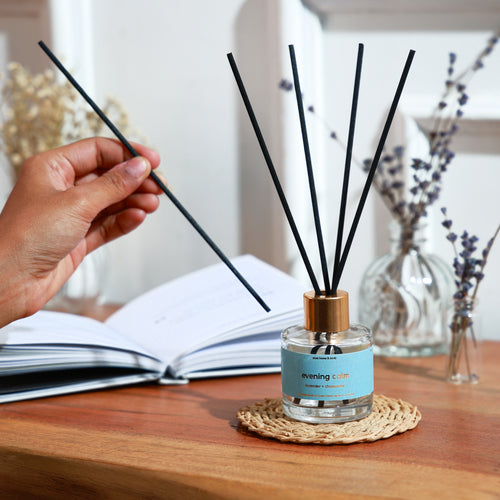
Most people place a diffuser where it looks well and then judge it from where they sleep, which are rarely the same place. It is worth being literal about the numbers for a moment. If your bottle stands on a dressing table four feet from the pillow and you move it to the bedside table two feet away, you have halved the distance — and because the air a source has to fill grows very quickly as you move outward, halving the distance is a far larger change than anything you could buy in a different bottle. The scent you are describing as weak has not lost strength. It has been asked to arrive somewhere it was never going to arrive from.
 Evening Calm₹799Stand where the bottle is now and count the paces to your pillow. Anything over about a metre and a half is a long way for a passive source in still air, and anything across the room is optimistic. Height matters too, and is almost never considered: reeds release from their exposed length, so a bottle on the floor or on a very low shelf delivers into the coolest, stillest layer of the room, well below the level of your face on a pillow. A bedside table or a shelf at roughly headboard height is a better position than a beautiful console on the far wall, every single time. Two feet of movement will do more for you than moving from 8.9 to 9.5 on our own strength scale.
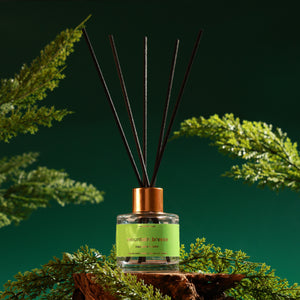
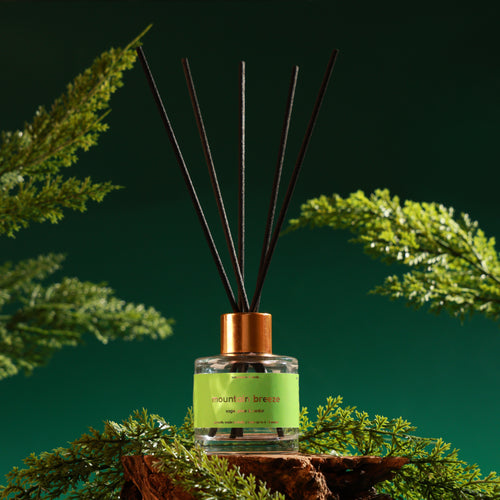
 Mountain Breeze₹849There are two kinds of air movement in a bedroom and they do opposite things. Recirculating air distributes; escaping air removes. A running split AC in a closed room recirculates, which is why a sealed AC bedroom is often the best room in an Indian flat for a passive diffuser — it supplies for free the distribution a reed cannot supply for itself. An open window, a balcony door or a bathroom extractor removes, and a home ventilated all day is simply not a home-fragrance environment during those hours; it becomes one the moment the windows close. On a high floor this is more aggressive than people expect, because wind speed rises with height and a twentieth-floor balcony door turns the room’s air over far faster than a second-floor window. The one placement to avoid outright is directly in the AC’s blast, which strips the lightest top notes within days and leaves you with the base wondering what happened.
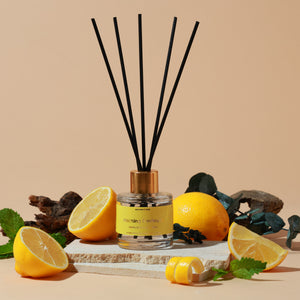
 Garden Bloom₹799Here is the awkward one. You go to bed at the end of an evening spent in that room, which means you have been adapting to its smell for hours before you lie down and start assessing it. Receptors stop reporting a constant stimulus within minutes; the signal still arrives, the brain stops mentioning it. The bottle beside you smells strong because leaning over it is a change in stimulus, and change is the only thing an adapted nose reliably reports. So part of the difference you are measuring between the bottle and the bed is the difference between a fresh stimulus and a familiar one, not only distance. Test it honestly: leave the room for fifteen minutes, come back and lie down immediately. Or ask somebody staying the night what they notice as they walk in. Sensitivity to individual materials varies enormously between people, so a household where one person smells it and another does not is completely ordinary.
Why the same bottle behaves differently in June and January
If the gap between bottle and bed seems to widen and narrow through the year, that is real and it is the room rather than the oil. Humidity makes the curve steeper. Saturated monsoon air carries fragrance molecules less readily, so projection shortens and the scent hangs close to the source — which is precisely the season when moving the bottle beats adding reeds, and adding reeds is what most people try. Heat empties the bottle without lengthening its reach. A bedroom at 40°C evaporates oil faster, so you get fewer weeks rather than more metres. And a genuinely still, closed, warm room in the middle of a summer afternoon has almost no air movement at all, which is when a reed reads at its weakest across distance and its strongest at the neck.
The other seasonal effect is compositional, and it is worth knowing so you do not misread it as fading. A new bottle runs hot for a few days while the reeds saturate and the lightest, most volatile materials leave first. By the third week you are smelling the heart and base — the composition as it was designed to sit. That is not fading; it is settling. A flip of the reeds every three to five days restores projection without opening anything new, and this is a maintenance rhythm rather than a rescue.
One more honest note, because it changes what people buy. A 50ml is specified for rooms up to about 150 sq ft and a 130ml for above that. A 50ml quietly asked to hold a 200 sq ft bedroom reads as weak while performing exactly to specification, and that is a sizing question with a cheap answer. But do not read that in reverse and assume the 130ml is a projection upgrade: it is a duration upgrade, 14 to 18 weeks against 6 to 8. More oil in the bottle becomes more weeks, not more metres.
| Where the bottle stands | What happens at the bed | What it does to the bottle’s life | Verdict |
|---|---|---|---|
| Bedside table, at about headboard height ★ | The strongest honest reading you will get from a passive source in that room | Normal — 6–8 weeks on a 50ml with six reeds | Start here. It is free and it is usually the whole fix |
| Dressing table or chest across the room | Markedly weaker, and highly dependent on whether any air is moving that night | Normal | Where most disappointed readers have it. Move it |
| Low shelf or floor level | Weak at pillow height — the release sits in the coolest, stillest layer of the room | Slightly longer, because evaporation is slower down there | Looks tidy, reads faint. Raise it |
| Directly in the blast of a running split AC | A brief lift, then a distinctly different fragrance within days | Much shorter, and the lightest top notes go first | The one placement to avoid outright |
| Beside an open window or balcony door | Very little, because the air carrying it is leaving the room | Shorter — you are scenting the outdoors | Fine as decoration, useless as diffusion |

Six reeds against three — and the case for using fewer
Every SOSA bottle ships with six fibre reeds, and reed count is the only output control the format has. Six is full projection. Three is a soft bedside level and roughly doubles the life. If your complaint is that the bed reads empty, six is the correct setting and you should use them all. But the opposite complaint arrives just as often, and I want to name it here because a reader who over-corrects tonight will write to me about it next week: in a small, sealed, cool bedroom, six reeds is frequently too many. What people describe as a fragrance being cloying or headachy is usually over-dosing rather than the composition, because almost any perfume at too high a concentration flattens into a single sweet or sharp impression — which is exactly what “smells like an air freshener” means. The same oil at a lower dose reads as layered, because the nose has room to resolve the separate materials.
There is also a limit that is worth stating plainly so nobody spends money finding it. Adding reeds beyond six buys a shorter bottle, not a longer reach. Output rises, the bottle empties faster, and the shape of the gradient in the room is unchanged, because the reeds are the source and nothing in the format is distributing what leaves them. Fibre rather than rattan is a related choice with a real effect on evenness — rattan is a natural cane with irregular internal channels that wicks unevenly in high humidity and fades at the dry end, which produces the strong-then-nothing pattern people usually blame on the oil — but fibre improves consistency, not range.
If you have done all of it — six reeds, a metre from your head, at pillow height, out of the draught, door closed, and a guest confirming what you cannot smell yourself — and the bed still reads empty, then you have found the ceiling of passive diffusion rather than a fault. At that point a machine is the honest recommendation, and I would rather say so than sell you a fourth bottle. It is also worth remembering what you would be giving up: a reed is silent, needs no power point and works through a cut, has no water to add, no battery to charge and no timer to remember, and looks like an object rather than an appliance. For the surface beside a bed, those are not small things.
What to buy, in order — and the rung that is missing
Zero first, then the cheapest real change, then the mechanism. The last row is the honest gap in our own range, and it is the row I would read first if I were buying.
| Step | What it is | When it is the right answer | Price |
|---|---|---|---|
| 1. Move it, fill it, close the door ★ | Bottle within a metre of your head at pillow height, all six reeds in, out of the AC blast and away from an open window, bedroom door closed | First, always. This resolves a real share of these letters and costs nothing at all | ₹0 |
| 2. A reed sized to the room | 50ml for up to about 150 sq ft, 130ml above it. Six fibre reeds, refillable glass, flipped every 3–5 days, about ₹13–₹15 a day | When a 50ml has quietly been asked to hold a 200 sq ft bedroom. Note the 130ml buys weeks, not metres | ₹749–₹1,349 |
| 3. Sukoon with the Hotel Collection | Ultrasonic water mist, 500ml, 270–320 sq ft, 16–18 hours on low, three 15ml scents included | When the bed must be inside the coverage rather than at the edge of a zone, and water, humidity and refilling are acceptable | ₹1,899 |
| 4. Safar | Waterless cold-air nebulising — undiluted oil, 20ml, 2000 mAh Type-C, up to 10 hours continuous or about 30 intermittent, 3 speeds, 1/2/3-hour auto-off, 6.9 cm. Named and sold as a car and travel diffuser, with bedside and hotel room among its stated uses | When no water is the requirement, and you want it running only for the hour you are falling asleep. No published room coverage | ₹3,999 |
| Not this: Megh, and not Vaayu | Megh is a 6L tank and about 100 hours of runtime at roughly 215 sq ft. Vaayu is rated to 1000 m³, about 2,000–3,000 sq ft | Neither answers this question. Megh covers less than the ₹1,899 Sukoon; Vaayu is for a whole floor, an open-plan living-dining, a villa, a clinic or a showroom | ₹3,499 / ₹11,999 |
| The honest gap | No mid-sized waterless bedroom nebuliser exists at SOSA — nothing sits between Safar at personal scale and Vaayu at 2,000–3,000 sq ft | Said plainly, because it is why the answer is sometimes Sukoon accepting the water, sometimes Safar understanding what it is, and often the reed you own, moved | — |
Versailles
When somebody writes to me with your sentence, the first thing I ask is not which scent they bought. It is where is the bottle, and where is your head. Roughly as often as not, the answer is a dressing table on the far wall, chosen because that is where it looks best — and the fix is a fifteen-second move that costs nothing and that no brand has an incentive to tell you about.
I am aware how convenient it sounds for a perfumer to say the fragrance is not the problem. So here is the part that is inconvenient for me. If you move it, fill it with all six reeds, close the door and it is still not reaching the bed, then the format has hit its ceiling and no reed I could ever compose will change that. Passive diffusion has an output bounded by evaporation from six sticks and no means of distribution at all. That is a design, not a defect, and it is why our range also contains machines.
What I would not want you to conclude is that the reed failed. It is the only thing I sell that makes no sound beside a sleeping person, needs no socket, survives a power cut, adds no water to a Mumbai bedroom and looks like something you chose. If the zone around a bedside table is genuinely what you want — and for a bedroom it very often is — then the whole answer to your question is two feet and four extra reeds. Everything is composed in Pune, and part of every order funds a girl’s classroom through Nanhi Kali.
Frequently asked questions
- Can a reed do an entire bedroom? — the honest no, and what it will do instead.
- I added more reeds and it still isn’t hotel-like — why output rose and reach did not.
- Two reed diffusers or active diffusion? — two zones against one covered room.
- I keep flipping my reeds — the 3–5 day cadence, and what daily flipping means.
- A fragrant corner instead of a scented room — the mechanism, in full.
- Are reeds the wrong format for me? — sometimes yes, and how to tell.
- Was a reed designed for lobby projection? — design intent, respected.
- When to stop searching for a stronger reed and whether you actually need active scenting.
- Brand: the SOSA founder story.
Facts verified August 2026: Three diffusion mechanisms are described — passive capillary (reed diffusers), ultrasonic water mist (Boond ₹899, 300ml, up to ~150 sq ft, ~6 hours; Sukoon ₹1,899, 500ml, 270–320 sq ft, 16–18 hours on low, three 15ml Hotel Collection scents included; Megh ₹3,499, 6L tank, ~100 hours runtime, ~215 sq ft, which is less coverage than Sukoon) and waterless cold-air nebulising (Safar ₹3,999, 20ml bottle, 2000 mAh Type-C battery, up to 10 hours continuous or around 30 hours intermittent, 3 speeds, 1/2/3-hour auto-off timer, 6.9 cm, named and sold as a car and travel diffuser with car, handbag, desk, bedside and hotel room among its stated uses, no published room-coverage figure; Vaayu ₹11,999, coverage up to 1000 m³ or roughly 2,000–3,000 sq ft, 400ml refillable tank lasting up to about 90+ days, Bluetooth app and onboard buttons, 1h/4h/8h/24h run windows, adjustable intensity, key-lock, under 38 dB, freestanding or wall/HVAC mount, 5W, CE, RoHS, SGS). SOSA reed diffusers: five scents, 50ml ₹749–₹849 lasting 6–8 weeks and suiting rooms up to ~150 sq ft, 130ml ₹1,249–₹1,349 lasting 14–18 weeks and suiting above 150 sq ft, six fibre reeds included and flipped every 3–5 days, about ₹13–₹15 a day, heat-stable CCT carrier rather than DPG, alcohol-free, phthalate-free, paraben-free, IFRA-compliant, 0 ppm formaldehyde, refillable glass bottle, climate-tested at 45°C and 85% RH, composed in Pune. SOSA strength scale: Evening Calm 8.9, Garden Bloom 8.9, Morning Freshness 9.0, Mountain Breeze 9.4, Fresh Brew 9.5 — a measure of perceived intensity in the room, not of reach. Duos ₹1,498–₹1,598 for two 50ml bottles; reed refills 300ml ₹2,399 and 500ml ₹3,499, oil only. Hotel Collection fragrance oils are water-based and ultrasonic-only at 15ml ₹299 (a refill), 100ml ₹999 and 300ml ₹1,799; they cannot be used in reed diffusers and reed oil cannot be used in ultrasonic machines, so no hotel-inspired reed diffuser exists. No health, air-quality, allergy or antimicrobial claims are made, and fragrance does not remove a smell — source, then ventilation, then fragrance. Free shipping above ₹499. A portion of every order supports girl-child education through Nanhi Kali. SOSA is an independent Indian fragrance house; the Hotel Collection scents referenced here are SOSA’s own interpretations inspired by the world’s finest hotels, and SOSA is not affiliated with, endorsed by or a supplier to any hotel brand. Prices subject to change — see the live product pages.