





What comes back is not dirt: it is the room's baseline — fabric, drains, the bin, the fridge, a closed cupboard — which the cleaner was briefly covering rather than removing.
The free part: treat the evening smell as your diagnosis. Two openings on opposite walls for twenty minutes, a mug of water down every floor drain and unused shower, and the cushion covers in the wash.
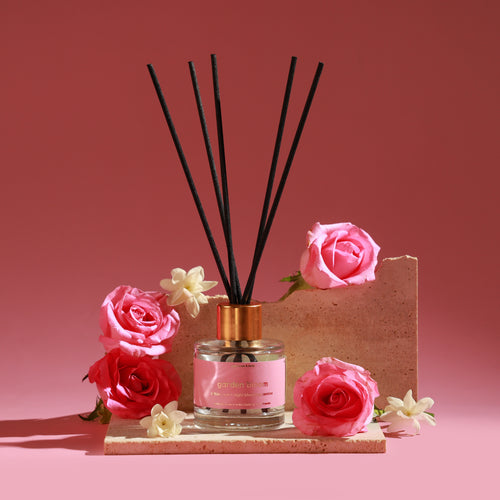
The honest commercial part: a cleaning smell is designed to leave and a home fragrance is designed to stay. That difference is the whole product category, and a reed diffuser from ₹749 is the version that holds one level for months.
2. So the fade is the specification, not the failure. Most of what you smell at eleven in the morning has evaporated off the drying floor within about two to four hours in a normal Indian flat, and faster in a warm one with a fan running. There is no base underneath it to carry on afterwards, because nothing was put there.
3. What returns in the evening is your home's baseline, not the dirt. The cleaner was covering it, briefly, rather than removing it. Fabric, a dry drain trap, the bin, the fridge, a cupboard that has not been opened in a fortnight — all of it carries on quietly through the morning and simply becomes audible again once the covering has gone.
4. Which makes mopping the most useful diagnostic tool you own. It resets the room to zero for a few hours, so what comes back is the pure signal with nothing on top of it. Stand in the hall at six, before you start cooking, and write down what you smell. That sentence is your actual problem.
5. Then fix the baseline for free before you buy anything. Two openings on opposite walls for twenty minutes rather than one window ajar for an hour, a mug of water down every floor drain, basin and unused shower, and the cushion covers and throws in the wash.
6. Only then is fragrance the right answer, and it is a different category of product. A cleaning smell is engineered to leave. A home fragrance is engineered to stay at one level. Once the baseline is clean, that is what fills the gap the mop cannot.
A portion of every order supports girl-child education through Nanhi Kali.
A floor cleaner is a top note with nothing underneath it
Perfumery sorts materials by volatility more than by anything else — by how readily a molecule leaves a liquid and becomes something a nose can receive. A finished perfume is built in layers along that scale: a bright top that arrives in seconds and is gone in half an hour, a middle that holds the shape for a few hours, and a base of heavy, reluctant materials that are still there the next morning. A floor cleaner has the first of those three and almost nothing of the other two, and once you know that, the entire mystery of this page dissolves.
What the evening smell is, in the order I would check it
Use the hours after mopping, when the room is briefly at zero, and match what you notice against this table. Every row has a free fix and most of them work the same day. The last column is what it costs, and for the first five rows the answer is nothing at all — which is the honest shape of this cluster and the reason this table comes before any product on the page.
| What you smell at six | What it usually is | The free fix | How long it takes | Cost |
|---|---|---|---|---|
| Sharp, faintly sulphurous, hard to place ★ | A dried-out drain trap. The U-bend water seal evaporates in two to four weeks of disuse and the drain starts venting into the room | A mug of water down every floor drain, basin, unused shower and second bathroom | Minutes | ₹0 |
| Stale, closed, faintly like a shut cupboard | No air exchange. A closed room does not stop producing smell, it stops removing it | Two openings on opposite or adjacent walls for twenty minutes. One window is ventilation; two is exchange | 20 minutes | ₹0 |
| Faintly of food, hours after cooking | Fabric. Cooking aerosol and body oils deposit on textiles and re-release for weeks — the room's memory | Cushion covers, throws, curtains and bedlinen washed; two hours of sun on a rug or a mattress | A wash cycle | ₹0 |
| Sweetish, organic, worse near the kitchen | The bin or the fridge. The bin is usually dirtier than the rubbish in it | Liner changed and the bin itself wiped out; the vegetable drawer, the door seal and anything at the back older than a week | 10 minutes | ₹0 |
| Musty, and much worse in July than in January | Humidity. Microbial growth accelerates above about 60% RH and Indian monsoon indoor humidity commonly runs 80–95% | Dry the room rather than ventilating it on a wet day — this is the one case where opening windows imports moisture | Days | ₹0 |
| Nothing wrong, but nothing there either | A room with no smell at all, which reads as institutional rather than as welcoming | Air movement first, and then a chosen background scent — a reed diffuser from ₹749 or the Sukoon at ₹1,899 | 24–72h / 20 min | from ₹749 |
Reeds · one level, months₹749Shop →  Sukoon · timed, and it stops₹1,899Shop →
  Candle · 15–20 minutes₹379Shop →
Two clocks: the cleaner's and the room's
The practical trick on this page is to stop running the two clocks together. The cleaner's clock is short and it belongs to the floor: bucket, mop, dry, and about two to four hours of pine before the room returns to itself. The room's clock is long and it belongs to everything except the floor. Most people try to solve the second with the first, which is why they end up mopping twice on a Sunday and wondering why it made no difference by Monday. So separate them. On the cleaner's clock, the only thing worth changing is ventilation: open two windows on opposite or adjacent walls while the floor dries, because the same draught that carries the cleaner away also carries away the stale air that has been sitting in the room since morning, and a floor dries faster into moving air than into still air. Twenty minutes of genuine cross-draught does more than an hour of one window ajar, and it costs nothing. Then, on the room's clock, work through the free fixes in the table above one at a time rather than all at once, because doing all six in a weekend tells you that something worked and never which. I would start with the drains, since it is the fastest, the cheapest and by a distance the most commonly missed: a mug of water down every floor drain, every basin, the unused second bathroom and any shower that has not run in a fortnight. Mopping temporarily tops those traps up, which is a small and rather satisfying reason a smell that vanishes after cleaning and returns two days later is so often plumbing rather than housework.
Then the fragrance, once and only once the baseline is honest, and here the timings decide the product rather than the scent. A candle puts scent into a normal room in fifteen to twenty minutes and must be attended and put out; the Sukoon reaches a steady level in about twenty minutes from cold and stops on a timer; a reed diffuser needs 24 to 72 hours before it is doing its job at all. That last figure is the one that catches people, and it is exactly why a reed is the right purchase on this page rather than the wrong one: you are not solving a deadline, you are solving a Tuesday. Set it up on a Sunday after the deep clean and by Wednesday the flat has a level of its own, held without electricity, a switch or a routine. Sizes run from ₹749 for Morning Freshness through ₹799 for Garden Bloom and Evening Calm to ₹849 for Fresh Brew and Mountain Breeze, with 130ml from ₹1,249, duos from ₹1,498 and 300ml refills at ₹2,399. If you would rather have a level you can start and stop, the Sukoon at ₹1,899 gives you 270–320 sq ft, 16–18 hours per fill on low at 30–50 ml/h against 9–12 on high, a 2.4MHz cool-mist plate, a remote, steady, 2H and 4H timers and three 15ml Hotel Collection scents of your choice — run at three to six drops per tank, and the dose is per tank rather than per litre, so a 300ml Boond at ₹899 takes the same drops as the 500ml machine. A Megh at ₹3,499 with six litres is for an open-plan flat.
Three constraints and the principle. The first is that a cool-mist ultrasonic adds 30 to 50 millilitres of water to the air every hour, so it is the wrong machine for a room you are trying to dry out — a monsoon flat, a bathroom that never dries, a wall with damp in it. Candles and reeds add no moisture at all and are the right choice there. The second is that SOSA does not make a room spray or a linen spray for the home; the sprays in the range are car perfumes, sized and formulated for about three cubic metres of hot moving air, and a page like this one is exactly where somebody would otherwise be sold one. The third is that the two fragrance lines do not cross: the water-based Hotel Collection runs in the Sukoon, the Boond and the Megh and nowhere else — not in a reed, where it will not climb the sticks, and not in the waterless Vaayu at ₹11,999, which takes its own undiluted oil — while reed oil is undiluted and clogs a 2.4MHz misting plate. Rinse the tank when you change scent, never substitute raw essential or carrier oils, and buy the 15ml at ₹299 before the 300ml 300ml refill at ₹1,799. And expect to stop noticing whatever you settle on within about a fortnight, because a nose reports change and discards constants. The instinct that produces is to add drops. The correct response is to ask one honest guest, who is still receiving the level you set. The principle underneath all of it: fragrance is a finishing layer on air that is already clean and moving, and it is the last step rather than the first.
The SOSA edit
In the order I would actually spend, which for most people on this page starts at nothing. The first three rows cost ₹0 and solve the problem for a meaningful share of readers; the products underneath are for the gap that remains once the baseline is clean, and the last row says plainly what this category cannot do.
| Do this | What it is | When it is the right answer | Price |
|---|---|---|---|
| 1. A mug of water down every drain ★ | Refills the U-bend seal that stops sewer gas entering the room; it evaporates in two to four weeks of disuse | First, always, and especially if the evening smell is sharp and hard to place. It works within minutes | ₹0 |
| 2. Two windows, twenty minutes | Cross-ventilation on opposite or adjacent walls, ideally while the floor is still drying | Every day, and particularly on the day you clean. One window is ventilation; two is exchange | ₹0 |
| 3. Wash the fabric, not the room | Cushion covers, throws, curtains, bedlinen; two hours of sun on a rug or a mattress | If the evening smell is faintly of food. Textiles hold cooking aerosol and release it for weeks | ₹0 |
| 4. A reed diffuser | Alcohol-free, no electricity, one level held for months — but 24–72 hours to establish | Once the baseline is honest. The right buy for a habit and the wrong one for tonight | from ₹749 |
| 5. Sukoon or Boond | 500ml for 270–320 sq ft with steady/2H/4H timers and three 15ml scents included, or 300ml for one room | If you would rather start and stop a level. Twenty minutes from cold, then off on the timer | ₹1,899 / ₹899 |
| What none of it does: remove a source | Fragrance does not touch damp, a dry trap, a loaded sofa, a bin or an unwashed filter | Printed rather than discovered. Scent on top of a source gives you two smells instead of one | — |
Versailles
I get this question more than almost any other, and it is always written in the same slightly apologetic tone, as though the reader has been caught out. So let me put the reassurance first: your cleaner worked. It was never going to last, and it was never meant to. I have sat in meetings where fragrance briefs for household products are written, and the instruction is explicit — strong immediately, gone within hours. Nobody wants a floor that is still insisting on itself on Wednesday. The whole composition is top note, and top notes are small, light and in a hurry by definition. Asking one to hold a house together until evening is like asking a match to heat a room.
What I find genuinely interesting is the other half, and it is the reason I wanted this page to open the group. Mopping gives you something no product can: three or four hours in which your home is silent, followed by the slow return of whatever it actually is. Most people experience that as a disappointment. It is a free diagnostic, and the sentence you say out loud at six o'clock — a bit stale, or faintly of last night's fish, or something odd near the bathroom — is worth more than anything I could sell you. Deal with that first. Then, when the room has nothing wrong with it and simply has nothing in it, come back and choose a scent that was built to stay, which is a different object from the one in your bucket.
Everything is made and supported from Pune, and a part of every order funds girl-child education through Nanhi Kali. You get a home that smells like somewhere you chose; a girl gets a classroom. That equation has always felt right to me.
Frequently asked questions
- How long a freshly cleaned smell actually lasts — the numbers behind the fade, hour by hour.
- Why your house smells clean but not fresh — the difference between an absence and a presence.
- What a dried-out drain trap is — the free fix behind the sharp evening smell nobody can place.
- Why the clean smell disappears by evening, and how to make it stay — the pillar for this group.
- Brand: the SOSA founder story.
Facts verified August 2026: Diagnostic facts used in this guide: a closed room accumulates what it cannot exchange, so cross-ventilation needs two openings rather than one; a drain's U-bend water seal evaporates in roughly two to four weeks of disuse and then admits sewer gas, which is corrected by pouring water down the drain; microbial growth in fabric and on surfaces accelerates above about 60% relative humidity, and Indian monsoon indoor humidity commonly runs 80–95%, which is the one situation where ventilating on a wet day can import moisture rather than remove it; an air-conditioner's cold, wet evaporator coil and filter grow biofilm that is blown into the room on start-up; textiles adsorb cooking aerosol and body oils and re-release them for weeks; and olfactory adaptation makes a constant household smell undetectable to its residents within about a fortnight while visitors still perceive it. Timings: a scented candle scents a normal room in roughly 15–20 minutes, a Sukoon ultrasonic diffuser reaches a steady level in about 20 minutes from cold, and a reed diffuser needs roughly 24–72 hours. SOSA products and prices: Sukoon 500ml ₹1,899 (270–320 sq ft, 16–18h on low, 9–12h high, 30–50 ml/h, 2.4MHz cool mist, remote, steady/2H/4H timers, BPA-free, auto shut-off, includes three 15ml Hotel Collection scents of your choice); Boond 300ml ₹899; Megh 6-litre ₹3,499; waterless Vaayu ₹11,999 (up to 1000m³); Aangan ₹25,999. Hotel Collection water-based fragrance 15ml ₹299, 100ml ₹999, 300ml ₹1,799, Pack of 7 at 15ml ₹1,799; dose 3–6 drops per tank. Reed diffusers (separate alcohol-free line): Morning Freshness from ₹749, Garden Bloom and Evening Calm from ₹799, Fresh Brew and Mountain Breeze from ₹849; 130ml from ₹1,249; duos from ₹1,498; 300ml refills ₹2,399. Scented candles: Bookshop 80g ₹379, Amber Rose 130g ₹599 and 220g ₹799, Smoked Oudh 130g ₹449, ceramic jar candles ₹949, Pure Calm wax melt set ₹854. Free shipping above ₹499. SOSA does not make a room or linen spray for the home. The Hotel Collection scents are SOSA's own interpretations; SOSA is not affiliated with or endorsed by any hotel brand. Prices subject to change — see the live product pages.