




Why Does My Bedroom Smell Different After Sleeping With the Door Closed?

Why Does My Bedroom Smell Different After Sleeping With the Door Closed?

★ The bedroom that smells fine at midnight and wrong at seven · what is actually happening overnightCandle ₹379 · reed ₹749 · Boond ₹899 · Sukoon ₹1,899 · free shipping above ₹499A portion funds girl-child education
★ SOSA · find the cause, then scent the room
Eight hours, one closed door and two people breathing. The morning smell is not dirt — it is air that has not been anywhere
★ ★ ★ ★ ★
★★★★★
"Turned out to be nothing I owned. Window open ten minutes before bed and ten on waking, and the smell I had been chasing for a year simply stopped."
Devika R. Bedroom, Pune
Free fix · ventilation
★★★★★
"I had washed everything twice. It was the mattress, which nobody had thought to mention. Two hours in the sun and it was a different room."
Harsh M. Mattress, Ahmedabad
Diagnosed the source
★★★★★
"Was ready to buy three reeds. Was told to check the bathroom drain first because the room had been shut for a fortnight. That was it. Cost me a mug of water."
Sneha T. Bedroom, Bengaluru
Told not to buy
★★★★★
"Bedroom is the one room I now under-scent rather than over-scent. Three drops on the 2H timer, off before I sleep. Completely different from what I was doing."
Arjun K. Sukoon · 3 drops
2H timer
★★★★★
"Summer made it much worse and I could not work out why. Warmth speeds everything up — that one sentence explained six years of it."
Lakshmi N. Summer bedroom, Chennai
Understood the cause
★★★★★
"Evening Calm on the chest of drawers, nothing plugged in, nothing to switch off. The bedroom just holds one quiet level now."
Rehan A. Evening Calm reed
₹799 · no electricity
★★★★★
"Turned out to be nothing I owned. Window open ten minutes before bed and ten on waking, and the smell I had been chasing for a year simply stopped."
Devika R. Bedroom, Pune
Free fix · ventilation
★★★★★
"I had washed everything twice. It was the mattress, which nobody had thought to mention. Two hours in the sun and it was a different room."
Harsh M. Mattress, Ahmedabad
Diagnosed the source
★★★★★
"Was ready to buy three reeds. Was told to check the bathroom drain first because the room had been shut for a fortnight. That was it. Cost me a mug of water."
Sneha T. Bedroom, Bengaluru
Told not to buy
★★★★★
"Bedroom is the one room I now under-scent rather than over-scent. Three drops on the 2H timer, off before I sleep. Completely different from what I was doing."
Arjun K. Sukoon · 3 drops
2H timer
★★★★★
"Summer made it much worse and I could not work out why. Warmth speeds everything up — that one sentence explained six years of it."
Lakshmi N. Summer bedroom, Chennai
Understood the cause
★★★★★
"Evening Calm on the chest of drawers, nothing plugged in, nothing to switch off. The bedroom just holds one quiet level now."
Rehan A. Evening Calm reed
₹799 · no electricity
Find the source first · two windows for twenty minutes beats any product for a closed smell Fragrance is the finishing layer. It does not remove damp, a dry drain or a loaded sofa Sukoon ₹1,899 · 270–320 sq ft · 16–18 hours per fill · three 15ml scents included


Founder Diaries · Home Fragrance · Why Your Bedroom Smells
By Sonal Sahani · ISIPCA Versailles 11 min read Updated August 2026
This is the most useful version of the bedroom question, because it names the variable. You have already run the experiment: the same room, the same bedding, the same two people, one night with the door open and one with it shut, and two different results. What a closed door does is not simply hold the smell in. It disconnects the room from the circulation of the rest of the flat, so the bedroom stops being part of a home with air moving through it and becomes a separate small climate with its own humidity, its own temperature and its own accumulation. And since a great many people close that door for reasons nobody should argue with, the useful part of this page is the version that works with it shut.
Quick answers — read this first
What the door actually does: it removes the bedroom from the flat's own circulation. The room stops sharing air with a home that has doors opening, fans running and windows ajar, and becomes an isolated volume with its own humidity and its own build-up.

Why the gap under the door is not enough: one opening is not an exchange. Air needs two apertures and a pressure difference between them to move; a single gap gives a trickle driven by nothing.

The workable version if the door must stay shut: a window cracked behind a mesh screen gives you the second opening, and a bathroom extractor left running for ten minutes gives you a powered one.

Then ten deliberate minutes of cross-draught in the morning, at ₹0 — with the fragrance layer, three drops of the Hotel Collection at ₹299, going in afterwards rather than instead.
The short answer
Short answer: because a closed door isolates the room rather than merely sealing it. The rest of a flat ventilates itself continuously and by accident — doors opening, fans pushing air between rooms, a window ajar somewhere — and a shut bedroom door removes your room from all of it, so it develops its own humidity, its own temperature and its own accumulation over eight hours.
Why the gap under the door does not save you: air movement needs two openings and a pressure difference. One aperture gives you a slow trickle with nothing driving it. Two openings on opposite or adjacent walls give you a current, which is why twenty minutes of genuine cross-draught beats an hour of a single window ajar.
The workable compromise, all at ₹0: door shut, window cracked behind a mesh screen if you have one; an attached bathroom's extractor left running for ten minutes to give the room a powered second opening even with the door closed; and a deliberate ten-minute cross-draught with the door open in the morning. Then the fragrance layer: the Hotel Collection at ₹299 for 15ml at three drops, or Evening Calm at ₹799 for a room that stays shut. Free shipping above ₹499.
Straight answer
Why does my bedroom smell different when I sleep with the door closed?
1. Because the door is not a lid, it is a disconnection. With it open, your bedroom is part of a flat that ventilates itself all night by accident — a window ajar in another room, a fan moving air along a corridor, a balcony door, the pressure changes of a building. With it shut, the room is on its own.

2. So the room develops its own climate. Its own humidity, which climbs all night from two people breathing. Its own temperature. Its own concentration of everything the room and its occupants produce. It is no longer a corner of your home; it is a separate small volume that happens to be inside one.

3. The gap under the door does not fix this, and here is why. Air needs two openings and a pressure difference to move. A single aperture gives you a slow trickle with nothing driving it. That is ventilation of a kind, but it is not exchange, and the difference between the two is the difference between this page existing and not.

4. Which does not mean you should sleep with the door open. People shut it for privacy, for noise, to keep an air-conditioner's cold air in one room, or because a small child is asleep on the other side of it. Advice that ignores all of that is useless advice.

5. So do this instead, and it is free. Door closed all night; a window cracked behind a mesh screen if you have one, which gives you the second opening; and a deliberate ten-minute cross-draught with the door open in the morning, two apertures on opposite or adjacent walls.

6. And if there is an attached bathroom, use its extractor. Left running for ten minutes it pulls air out of the bedroom through the bathroom, which gives you a genuine second opening even with the bedroom door shut. It is the most underused device in an Indian flat.

A portion of every order supports girl-child education through Nanhi Kali.
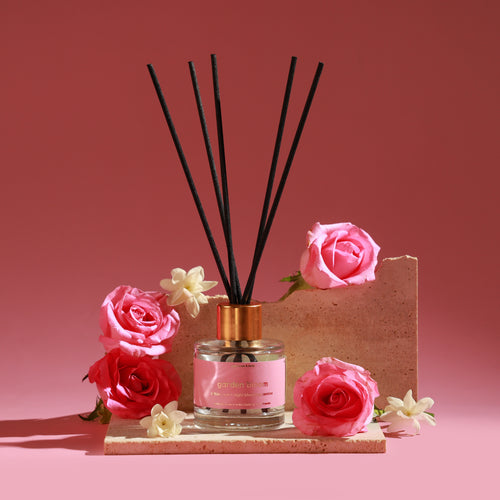
TL;DR: a closed door does not just stop air leaving — it cuts the bedroom out of the flat's own circulation, so the room becomes its own small climate. The gap under the door is one opening and one opening is a trickle, not an exchange. Crack a window behind mesh, run the bathroom extractor for ten minutes, and give the room a real cross-draught in the morning.
SOSA reed diffusers · alcohol-free
The format that suits a door that has to stay shut
SOSA reed diffusers · alcohol-free from ₹749
Five scents in a separate alcohol-free line: Morning Freshness at ₹749, Garden Bloom and Evening Calm at ₹799, Fresh Brew and Mountain Breeze at ₹849. In a room whose door is closed every night by necessity — a baby asleep, a shared flat, a main road, an air-conditioner that has to keep its cold air — a reed is the honest choice, because it asks for nothing at the hour when nobody is going to give it anything. Evening Calm is the bedroom one and Morning Freshness, despite the name, is composed to wake a room rather than settle it. A reed will not exchange the air in a sealed room and nothing sold anywhere will. It gives that room one steady level for months. 130ml from ₹1,249, duos from ₹1,498, refills ₹2,399.

What a closed door does to the air path

It helps to stop thinking about the door as a barrier to smell and start thinking about it as a piece of plumbing. Air in a flat moves along paths, and every path needs a way in, a way out and something pushing. During the day your home has dozens of those paths and you never notice a single one of them: a balcony door and a kitchen window make a route across the whole flat, a ceiling fan drives air along a corridor, an extractor pulls, a front door opening changes the pressure of the entire building for a moment. Every one of them touches the bedroom while its door is open. Close it and you have not put a lid on the room — you have taken the room off the network, and everything that follows comes from that.

1
THE DISCONNECTION
The room stops sharing air with the rest of the flat and starts keeping its own climate
Consider what is actually true of a bedroom with an open door at three in the morning. It is sharing its air with the corridor, and through the corridor with a sitting room that probably has a window cracked, and with a kitchen that has a permanent vent, and with a bathroom that has an extractor duct standing open. The whole flat is one slow, connected, low-grade ventilation system, and the bedroom is a node in it. The moisture two sleeping adults produce is being distributed across the volume of the entire home rather than the volume of one room, which is a difference of perhaps four or five times. The same is true of everything else the room emits. Close the door and all of that stops. The room now has to absorb its own output within its own cubic metres, and it develops, over eight hours, a genuinely different climate from the flat it sits inside. Its relative humidity is higher, sometimes markedly so; its temperature is different, especially with an air-conditioner running or two bodies warming it; and its concentration of every slowly emitted material is several times what the same house measures in the corridor. This is why the difference between a door-open night and a door-shut night is not subtle and why people notice it immediately. It is also why the smell of a closed bedroom is characteristically its own: warmer, closer, more humid and more bodily than the general closed-up smell of a flat that has been locked for a weekend. You are not smelling a stale house. You are smelling a small, warm, humid, isolated room, and it smells like exactly what it is.
2
ONE OPENING IS NOT AN EXCHANGE
Why the gap under the door gives you a trickle and not a current
Now the objection everybody raises, and it deserves a proper answer rather than a dismissal. There is a gap under the door. Air can get through it. So why is the room not ventilated? Because ventilation is not about whether air can pass through an opening; it is about whether there is anything making it. Moving air requires two things: a route with an entrance and an exit, and a pressure difference between the two ends of that route. A single aperture provides neither. Air does not flow in and out of one gap in any useful quantity, because whatever goes in has to displace what is already there and it has nowhere to displace it to. What you get instead is slow diffusion and a small amount of exchange driven by temperature differences across the gap, and that is genuinely something — it is why a closed bedroom is not a sealed box and why nobody suffocates — but it is one or two orders of magnitude short of what the room needs to keep up with two people. Two openings are a different physical situation entirely. A window on one wall and a door on another give you a route through the room, and any pressure difference at all — wind outside, a temperature gradient, a fan, an extractor — drives a current along it. This is the reason the standard instruction is two openings on opposite or adjacent walls rather than simply open a window, and it is the single most useful piece of physics in this whole cluster. Twenty minutes of a real cross-draught will do more for a bedroom than an hour of a single window ajar, and it is not close.
The test that settles it in your own flat: open one window in the bedroom and stand in the doorway. Now open a window in the room opposite as well. You will feel the difference through the doorway within seconds, and that difference is the entire subject of this page.
3
THE HONEST COMPROMISE
Nobody is going to leave the door open, so here is the version that works shut
Here is where most advice on this subject becomes useless, and I would rather not add to it. The instruction sleep with your bedroom door open is technically correct and practically worthless, because the reasons people close it are not casual ones. Privacy in a shared flat or a joint family home. Noise from a corridor, a television, a street door. An air-conditioner that cannot cool the bedroom and the passage at the same time and should not be asked to. A child asleep on the other side of it, or a child asleep on this side of it. In a great many Indian homes the closed door is not a preference, it is the only arrangement that works, and telling somebody to abandon it is telling them to ignore the page. So the workable version is three things, all free. First, keep the door shut and give the room its second opening at the window: even a few centimetres, behind a mesh screen if you have one, converts the room from one aperture to two and gives whatever pressure difference exists outside something to work with all night. Second, and this is the one almost nobody uses: if there is an attached bathroom, leave its extractor running for ten minutes. An extractor is a powered opening. Running it with the bedroom door shut pulls air out of the bedroom, through the bathroom door and up the duct, and the replacement air comes in under the bedroom door — which is to say you have created a genuine two-opening path with a fan providing the pressure, without opening anything to the corridor at all. Ten minutes of that before bed and ten on waking is a real exchange. Third, take the ten minutes you can get with the door open, deliberately, in the morning: bedroom door wide, a window in the bedroom and a window somewhere across the flat, and let it run while the kettle boils.

Six arrangements, and the exchange each one actually gives you

The same bedroom in six different configurations, with the number of genuine openings each one provides and what you get from it. The count of openings is the thing to read, because that is what decides whether you have ventilation or exchange. Every row costs ₹0 except the mesh screen, which SOSA does not sell and which is nonetheless the best money in this entire cluster.

Air paths, arrangement by arrangement
How many openings each arrangement really gives the room
The arrangement Openings What you actually get What it costs
Door shut, window shut ★ One — the gap under the door Slow diffusion with nothing driving it. The room keeps its own humidity and climate for eight hours ₹0 — and it is the arrangement that produced the question
Door shut, window cracked behind mesh Two, with whatever pressure difference exists outside Continuous slow exchange all night. The best result available with the door closed ₹0 if the mesh exists. A fitted screen is the one purchase worth making, and SOSA does not sell it
Door shut, bathroom extractor running Two, and one of them powered A genuine driven exchange for as long as it runs. Ten minutes at each end of the night is real ₹0, plus a few paise of electricity
Door open, windows shut Two in effect — the room rejoins the flat's circulation Dilution into the rest of the home rather than exchange with outside. Better than nothing, and it costs you privacy, noise or the AC ₹0
Door open, window open, ten minutes Two, on opposite or adjacent walls An actual cross-draught. Twenty minutes clears an entire night's accumulation ₹0 · the most effective thing on this page
AC running, everything shut None Recirculation. A split unit cools and dries the air it already has; it brings none in ₹0 · and the reason a cold room can still read as closed
Shop this guide
What a room with a shut door can still have
The SOSA principle
A closed door does not put a lid on the bedroom. It takes the bedroom off the networkand a room with no connection to the rest of the flat starts keeping a climate of its own.
One opening is a trickle driven by nothing. Two openings and any pressure difference at all is a current, which is why twenty minutes of cross-draught beats an hour of a single window ajar.

The version that works with the door shut

Take the routine as a set of openings rather than as a set of chores, because that is what makes it easy to remember. Every instruction on this page is really the same instruction: give the room a second aperture, and give the air a reason to move between the two. Overnight, the second aperture is the window, cracked as far as your street, your mosquitoes and your security will allow, with a mesh screen if one exists — and a screen is genuinely the best purchase in this cluster, which is awkward for me because SOSA does not make one and would not be the right place to buy it if we did. On the nights the window has to be shut as well, the second aperture is the extractor in the attached bathroom: leave it running for ten minutes with the bathroom door open and the bedroom door closed, and you have a powered path out of the bedroom that does not involve the corridor at all. In the morning, take the ten minutes properly. Bedroom door wide, a window in the bedroom, a window in a room across the flat, and leave it while you do something else — a genuine cross-draught, not a token one. Then two free specifics that reduce what the closed room has to cope with in the first place. Throw the bed open rather than making it, so the night's moisture leaves the mattress instead of being held under a duvet all day, which matters more in an isolated room than in a connected one because there is nowhere for it to be distributed to. And pour a mug of water down the floor drain and basin of an attached bathroom that is not used daily: with the bedroom door shut, a dry U-bend seal vents directly into your isolated small climate rather than into a ventilated flat, and it is the single most misdiagnosed smell in this cluster.

Then the fragrance, which on this page has an unusually specific job. A room that stays closed all night is the one that most benefits from a background level and the one least able to tolerate a large one. Both halves of that are consequences of isolation: a disconnected room holds whatever you give it, so a small amount lasts, and a large amount has nowhere to go. The Hotel Collection is composed at three to six drops per tank and a closed bedroom takes three, on low, on the 2H timer, running while you are getting ready rather than through the night. The dose is per tank and not per litre, since you are scenting the mist rather than the water, so a 300ml Boond at ₹899 takes the same three drops as a 500ml Sukoon at ₹1,899 — the larger machine buys hours and coverage rather than intensity. For a room whose door is shut every night by necessity, though, the format I would actually recommend is a reed diffuser. It holds one level for months with no electricity, no timer and nothing to switch off, which suits a room nobody is going to attend to at eleven at night; Evening Calm at ₹799 is the bedroom scent of the five, Mountain Breeze at ₹849 the drier alternative, and Morning Freshness belongs on a landing rather than beside a bed. The honest timing: a reed needs 24 to 72 hours to establish, against fifteen to twenty minutes for a candle and about twenty for a Sukoon from cold. Buy it for the next four months rather than for tomorrow morning.

Then the limits, which on a page about closed rooms are worth stating hard. Fragrance does not provide an air path. Everything described above is a way of moving air, and no product moves air; the ten minutes of extractor and the cracked window are doing the work, and the bottle is doing something else entirely, which is giving the room a consistent background once the work is done. Put scent into a room that has had no exchange for eight hours and you have added one more material to an accumulation, which reads as two smells rather than one, and readers reliably blame the composition. The second limit is moisture: a cool-mist ultrasonic puts 30 to 50 millilitres of water an hour into the air, and an isolated room with the door shut is already the highest-humidity space in the flat by morning. In monsoon, or in any closed bedroom that feels clammy rather than merely stale, use a reed at ₹799 or a candle from ₹379, since neither adds water. The third is habituation, which a closed room accelerates: eight sealed hours a night means you adapt to whatever is in there faster than to any other room, and within about a fortnight you will not be able to audit it at all while every visitor still can. Ask one honest person rather than adding drops. The Hotel Collection is water-based and runs in the Sukoon, Boond and Megh only, never in reeds and never in the waterless Vaayu, and SOSA makes no room or linen spray for the home. And the principle: fragrance is a finishing layer on air that is already clean and moving. In a room with the door shut, moving is the word that has to be earned first.

A shut door is not a lid on a room. It is a room taken off the network, and a disconnected room starts keeping a climate of its own.
— Sonal Sahani, SOSA

The SOSA edit

In the order I would do it for a bedroom whose door has to stay closed. The first four rows are ways of giving the room a second opening and they cost nothing; the fifth is the format that suits a room nobody attends to at night; and the last row is the machine to avoid in a closed room that is already humid.

The SOSA edit
A bedroom with the door shut, in the order that works
Do this What it addresses When it is the answer Cost
1. Ten deliberate minutes of cross-draught in the morning ★ Eight hours of isolation, cleared with two openings and a real current Every morning, door wide and a window across the flat. Twenty minutes beats an hour of one window ₹0
2. A window cracked behind mesh, overnight Converts a one-aperture room into a two-aperture one for the whole eight hours Whenever the street, the mosquitoes and the security of the flat allow it ₹0 · a fitted mesh screen is not a SOSA product and is worth buying
3. The bathroom extractor, ten minutes at each end of the night A powered second opening that does not involve opening the door at all The best option on nights when the window must stay shut too. Bathroom door open, bedroom door closed ₹0
4. A mug of water down the attached bathroom's drains A dry U-bend venting into an isolated room rather than into a ventilated flat If the smell is sharp rather than stale, and after any week the bathroom went unused ₹0
5. Evening Calm or another reed A background level held for months with nothing to switch on at eleven at night The right format for a door that is shut every night. Allow 24–72 hours to establish ₹799 / from ₹749
Do not buy for a humid closed room: a cool-mist diffuser It adds 30–50 ml of water an hour to what is already the dampest room in the flat by morning In monsoon use a reed or a candle from ₹379 instead. Neither adds moisture
Honest notes for buyers: fragrance is the last step, never the first. It layers on air that is already clean and moving, and it will not remove a source — not damp, not a dry drain trap, not a loaded sofa, not a filter that needs washing. Deal with the cause, change the air, then scent the room. On timing: a candle puts scent into a room in fifteen to twenty minutes and a Sukoon reaches a steady level in about twenty, while a reed diffuser needs a day to three days before it is doing its job — the wrong buy for a deadline and the right buy for a room you want to hold one level for months. SOSA does not make a room or linen spray for the home; the sprays in the range are car perfumes. A cool-mist ultrasonic adds 30–50 ml of water an hour to the air, so it is the wrong machine for a room you are trying to dry out. The Hotel Collection is water-based and runs in the Sukoon, Boond and Megh only — not in reeds and not in the waterless Vaayu. Reed diffusers are a separate alcohol-free line with their own scents. Candles must be attended and put out. The Hotel Collection scents are SOSA's own interpretations inspired by the world's finest hotels; SOSA is an independent Indian fragrance house, not affiliated with or endorsed by any hotel brand. A portion of every order supports girl-child education through Nanhi Kali.
SOSA Hotel Collection · 15ml
Three drops, after the morning exchange rather than instead of it
SOSA Hotel Collection · 15ml ₹299 / 15ml
Water-based, ultrasonic only, three to six drops per tank, and in a bedroom the number is three. The sequence matters more than the bottle: open the room, give it its ten minutes, and start the machine into air that has already been changed. Fragrance put into an unexchanged room does not replace the missing exchange — it joins whatever was already in there, and the result is two smells rather than one. The 1 Hotels-inspired Forest Suite — cedarwood, vetiver and green leaves — is the driest of the seven and the one I would give a room that stays shut, because dry and low is what a small sealed volume tolerates. ₹299 for 15ml, ₹999 for 100ml, ₹1,799 for 300ml.
SS
ISIPCA
Versailles
A note from Sonal

The advice I refuse to give is the one this question usually attracts, which is to sleep with the door open. People close bedroom doors for privacy, for noise, for an air-conditioner that cannot be asked to cool a corridor, and for a child asleep on one side of it or the other, and none of those are habits worth arguing with. A page that opens by telling you to abandon the arrangement your household actually runs on is a page you will stop reading, and rightly. So the interesting question is not how to persuade you to open the door. It is what a closed room can still be given, and the answer turns out to be quite a lot.

The one I would push hardest is the bathroom extractor, because almost nobody uses it this way. An extractor is a powered opening, and running it for ten minutes with the bedroom door closed and the bathroom door open pulls air out of the bedroom and up a duct while replacement air comes in under the door. That is a real two-opening path with a fan supplying the pressure, and you have not opened anything to the corridor at all. It costs a few paise. In an Indian flat with an attached bathroom it is the single most under-used device in the house, and I would put it above anything I sell for a reader whose door has to stay shut. What SOSA is for comes afterwards: a reed at ₹799 on the chest of drawers, holding one quiet level for months in the room you have now given a way to breathe.

Everything is made and supported from Pune, and a part of every order funds girl-child education through Nanhi Kali. You get a home that smells like somewhere you chose; a girl gets a classroom. That equation has always felt right to me.

Frequently asked questions

Why does a closed bedroom door change the smell so much?
Because it disconnects the room rather than merely sealing it. With the door open your bedroom shares air with a flat that ventilates itself continuously by accident, so its moisture and emissions are distributed across the whole home. Shut, the room has to absorb its own output within its own cubic metres and develops its own humidity, temperature and accumulation over eight hours.
Is the gap under the door not enough ventilation?
No, and the reason is worth knowing. Air movement needs two openings and a pressure difference between them. A single aperture gives you slow diffusion with nothing driving it, because anything coming in has to displace what is already there and has nowhere to displace it to. Two openings turn a trickle into a current.
I have to sleep with the door closed. What can I actually do?
Three free things. Crack a window behind a mesh screen, which gives the room a genuine second opening all night. Leave an attached bathroom's extractor running for ten minutes with its door open and the bedroom door shut, which is a powered exchange that never involves the corridor. And take a deliberate ten-minute cross-draught with the door open in the morning.
Does running the air-conditioner ventilate the room?
No. A split unit recirculates: it cools and dries the air already in the room and brings none in from outside. That is why an air-conditioned bedroom can be pleasantly cold and still read as closed, and why the morning smell in an AC room is often stronger rather than weaker than in a fan room.
Should I put a diffuser in a bedroom that stays closed?
Only after the air path is dealt with, and at three drops rather than four — an isolated room holds whatever you give it, so a small amount lasts and a large amount has nowhere to go. For a door that is shut every night, a reed such as Evening Calm at ₹799 is the better format, since it holds one level for months with nothing to switch on.
Two openings, or none
Give the closed room a second openingthen a level it can hold for months
The reed diffusers are a separate alcohol-free line from ₹749, with Evening Calm at ₹799, 130ml from ₹1,249, duos from ₹1,498 and 300ml refills at ₹2,399; allow 24 to 72 hours for a reed to establish. The Hotel Collection is ₹299 for 15ml, ₹999 for 100ml and ₹1,799 for 300ml at about ₹6 per millilitre, and the Sukoon is ₹1,899 for 270–320 sq ft with three 15ml scents of your choice included. Free shipping above ₹499, and a portion of every order supports girl-child education through Nanhi Kali.
Shop the reed diffusers → See the seven scents · ₹299
Continue the read
More from SOSA
Editorial standards & sources
About this guide: Written by Sonal Sahani, ISIPCA Versailles-trained founder and perfumer at SOSA Home & Body, on why a closed bedroom door changes how a room smells — the difference between sealing a room and disconnecting it from a flat's continuous accidental ventilation, why a single opening such as the gap under a door produces diffusion rather than exchange, the six common arrangements and the number of genuine openings each provides, and the free compromise for households where the door has to stay shut.

Facts verified August 2026: Diagnostic facts used in this guide: a closed room accumulates what it cannot exchange, so cross-ventilation needs two openings rather than one; a drain's U-bend water seal evaporates in roughly two to four weeks of disuse and then admits sewer gas, which is corrected by pouring water down the drain; microbial growth in fabric and on surfaces accelerates above about 60% relative humidity, and Indian monsoon indoor humidity commonly runs 80–95%, which is the one situation where ventilating on a wet day can import moisture rather than remove it; an air-conditioner's cold, wet evaporator coil and filter grow biofilm that is blown into the room on start-up; textiles adsorb cooking aerosol and body oils and re-release them for weeks; and olfactory adaptation makes a constant household smell undetectable to its residents within about a fortnight while visitors still perceive it. Timings: a scented candle scents a normal room in roughly 15–20 minutes, a Sukoon ultrasonic diffuser reaches a steady level in about 20 minutes from cold, and a reed diffuser needs roughly 24–72 hours. SOSA products and prices: Sukoon 500ml ₹1,899 (270–320 sq ft, 16–18h on low, 9–12h high, 30–50 ml/h, 2.4MHz cool mist, remote, steady/2H/4H timers, BPA-free, auto shut-off, includes three 15ml Hotel Collection scents of your choice); Boond 300ml ₹899; Megh 6-litre ₹3,499; waterless Vaayu ₹11,999 (up to 1000m³); Aangan ₹25,999. Hotel Collection water-based fragrance 15ml ₹299, 100ml ₹999, 300ml ₹1,799, Pack of 7 at 15ml ₹1,799; dose 3–6 drops per tank. Reed diffusers (separate alcohol-free line): Morning Freshness from ₹749, Garden Bloom and Evening Calm from ₹799, Fresh Brew and Mountain Breeze from ₹849; 130ml from ₹1,249; duos from ₹1,498; 300ml refills ₹2,399. Scented candles: Bookshop 80g ₹379, Amber Rose 130g ₹599 and 220g ₹799, Smoked Oudh 130g ₹449, ceramic jar candles ₹949, Pure Calm wax melt set ₹854. Free shipping above ₹499. SOSA does not make a room or linen spray for the home. The Hotel Collection scents are SOSA's own interpretations; SOSA is not affiliated with or endorsed by any hotel brand. Prices subject to change — see the live product pages.
Retour au blog

