



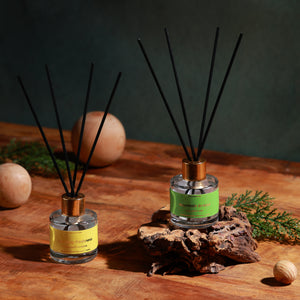
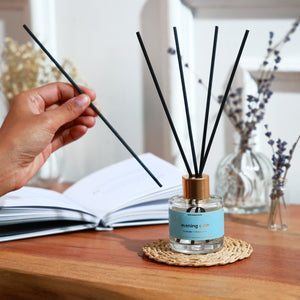
Where the oil sits: inside concentration only, and as the smaller half of it. The mechanism decides how much material enters the air per hour and whether it travels. The oil decides what that material smells like when it arrives.
The term you cannot buy: novelty. Receptors stop reporting a constant unchanging stimulus within minutes, so your own home is the one smell your nose knows best. A guest is a better instrument than you are.
The honest gap: if evenness is what you are missing in one bedroom, the range does not have the perfect answer. Safar ₹3,999 is waterless and undiluted but named and sold as a car and travel diffuser with no published room-coverage figure, and Vaayu ₹11,999 is rated to 2,000–3,000 sq ft. Nothing sits between them.
2. Concentration is set by the mechanism, not by the price of the oil. A machine decides how much material enters the air per hour. A reed lets the room decide — temperature, humidity and airflow set the evaporation rate, so the same bottle is generous in a warm May and reticent in a cold air-conditioned January. Consistency of concentration is itself a large part of what reads as professional.
3. Evenness is entirely a transport question, and this is the one people never think about. If the level at the door and the level at the bed are different, the room does not feel scented; it feels like it contains a scented object. Evenness comes from air movement and nothing else. A reed adds no air, so it cannot produce it. A machine that moves air can, and a building that moves air does it effortlessly.
4. Novelty is doing more work than anybody credits, and you cannot purchase it. Olfactory receptors adapt to a constant unchanging stimulus within minutes: the signal still arrives, the brain stops reporting it. You are un-adapted in a hotel and thoroughly adapted at home. The staff at that hotel stopped smelling the lobby in their first week, which should tell you how much of the effect belongs to your nose rather than to their equipment.
5. Which means the fix depends on which term is failing, and they have different prices. Low concentration in a small room is often free to fix — more reeds, better placement, a closed door. Poor evenness costs money, because it requires moved air. Low novelty is not a fault and cannot be fixed by spending; it is corrected by leaving the house and coming back, or by asking somebody who has just arrived.
Alcohol-free, phthalate-free, IFRA-compliant, six fibre reeds in a refillable glass bottle. Free shipping above ₹499, and a portion of every order supports girl-child education through Nanhi Kali.

The three components of presence, taken one at a time
I find it helps to separate these because they fail independently and they cost wildly different amounts to fix. Two of the three have nothing to do with what is in the bottle, which is inconvenient for a fragrance house to say and is nevertheless the reason this page exists.
 Fresh Brew₹849This is the only term the oil touches, and even here it is the junior partner. Concentration is set by how much material enters the air per hour, divided by the volume of the room, adjusted for how fast that air is being replaced. A machine controls the numerator directly. A reed lets the weather control it. And volume is unforgiving arithmetic: a 50ml is specified for rooms up to about 150 sq ft and a 130ml above that, so a 50ml in a 300 sq ft open-plan living room reads as weak while performing exactly to specification. Dose matters in the other direction too — almost any composition at too high a concentration flattens into a single sweet impression, which is what people mean when they call a fragrance cheap.
 Sukoon₹1,899Evenness is the component that separates a scented room from a room containing a scented object, and it is bought with air movement rather than with fragrance. In a hotel there is no strongest point to walk towards, because the fragrance was handed to air that was already travelling. At home there almost always is one, and you can find it in ten seconds. A reed cannot be even by construction: it adds no air, so concentration falls away from the bottle and the far corner is untouched however many reeds you add. An ultrasonic machine like Sukoon genuinely moves air, which is why 270–320 sq ft is a real coverage figure rather than a marketing one.
 Evening Calm₹799The third term is free, uncontrollable and frequently the one that has collapsed. Receptors adapt to a constant unchanging stimulus within minutes — the signal keeps arriving and the brain stops reporting it, because a constant is not information. Sensitivity also varies enormously between individuals, so it is entirely normal for guests to remark on a fragrance the owner cannot detect at all. That is not a faulty bottle and it is not a weak oil. It is two people with different receptors, one of whom has been sitting in the room since breakfast. The hotel gets this term for nothing, from every guest, every single day, and it is the component no purchase reproduces in your own hallway.
Why the three multiply rather than add up
If presence were a sum, a very high score on one component would carry the other two, and buying a more concentrated oil would work. It is not a sum. A near-zero in any one term takes the whole product to near zero, and this single structural fact explains almost every disappointed message I receive. Consider three familiar rooms. The first has a beautiful composition in a still corner of a large open-plan flat: concentration is fine at the bottle, evenness is close to zero, and the room reads as unscented three metres away. The second has a machine running at full intensity in a small bedroom occupied all day: concentration is high, evenness is good, novelty has collapsed, and the owner is convinced the machine has stopped working while every visitor finds the room heavily scented. The third has all three moderate and reads as more present than either.
The commercial consequence is uncomfortable and worth stating. The term most people spend money on is the one they are least often failing. They buy a stronger oil, a deeper scent, a larger bottle — all of which push on concentration, which was rarely the problem — while evenness stays exactly where it was, because nothing about that purchase moved any air. This is why the phrase “strong beside the bottle but weak from the bed” is the single most diagnostic sentence a reader can send us. It says concentration is fine and transport is missing, and it tells you not to buy another bottle.
There is also a fourth thing hotels do that is not in the equation but multiplies its effect over time, and it is free: they hold the composition constant for years. Recognition is a large part of what a signature is. A returning guest is not smelling a strong fragrance, they are smelling that fragrance, and the pleasure is partly memory. At home this argues for choosing one scent and keeping it for a year in one or two places, rather than rotating four monthly. A home that smells identical in every room stops registering within a week, and a home that changes scent monthly never acquires a signature at all. Two or three registers across a flat, held steady, is the arrangement that works.
What raises each component — and what only appears to
The same three terms, with the honest cost of improving each. Note how much of the first column is free and how little of the second can be bought with fragrance.
| Component | Set by | What genuinely raises it | What does not | Cost |
|---|---|---|---|---|
| Concentration | Material entering the air per hour, room volume, air exchange | All six reeds, the right bottle size for the room, a closed door, a smaller volume, a machine with an intensity setting | A “stronger” scent in a room twice the size the bottle was specified for | Often free, then ₹749+ |
| Evenness | Air movement, and only air movement | A fan on low, AC recirculating in a closed room, an ultrasonic machine, a cold-air nebuliser | More oil, more reeds, a deeper composition, a second bottle in the same corner | Free, then ₹1,899+ |
| Novelty to your nose | Your own adaptation, and individual receptor sensitivity | Leaving and returning, asking a guest, keeping one scent constant so it stays recognisable | Anything you can buy. This term is not for sale | Free |
| Consistency over time | Scheduling and a fixed composition | A machine with timed windows; one scent kept for a year rather than four rotated | Variety. A new scent every month prevents a signature forming | Free, or ₹3,999–₹11,999 for scheduling |
| The trap | Assuming tank size means coverage | Checking the coverage figure, not the litres | Megh ₹3,499 has 6L and ~100 hours but only ~215 sq ft — less than Sukoon at ₹1,899. A runtime machine, never a coverage upgrade | — |
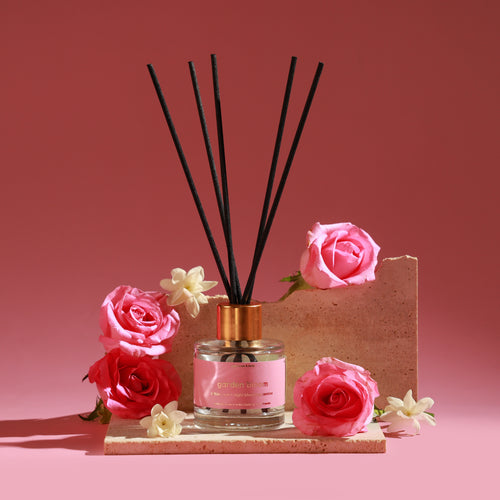 Concentration · Garden Bloom₹799Shop →
  Evenness · Sukoon₹1,899Shop → Consistency · Hotel Collection₹999Shop →
Auditing your own room in ten minutes, before spending anything
This is worth doing properly, because it tells you which of the three terms has failed and therefore what the fix costs. Start with the walk. Stand at the bottle and note the level. Walk to the middle of the room and note it again. Stand at the doorway and note it a third time. If it is strong at the bottle and gone at the door, concentration is fine and evenness has failed — and no further bottle will help you. If it is faint even at the bottle, you have a concentration problem instead, which is usually reed count, bottle size against room volume, or a placement in a still corner or directly under a running split air conditioner, which strips the top notes within days and leaves you with the base.
Then test yourself rather than the product. Leave the flat for fifteen minutes — genuinely leave, not just move to another room — and walk back in without pausing. If it is obvious on re-entry, nothing is wrong with anything you own and the third term is simply doing what the third term does. Better still, ask the next person who arrives, before you mention the diffuser. A visitor who says the room smells lovely while you cannot detect it has given you a definitive answer: the diffuser is working for everybody except you, and a larger machine would only mean a room that is too strong for guests and still invisible to you.
Then fix in order of price. Free first: close the door for the hours you want the room scented, move the bottle a metre inside the doorway and into the path air already takes, put all six reeds in if the room is large or take it down to three if the room is small and the fragrance has been feeling like a lot, and flip them every three to five days. If a fan is available, run it on its lowest speed — it is the cheapest evenness in existence. Only when those have been tried and the walk still shows a steep gradient is a machine the right purchase, and at that point you are buying transport rather than fragrance and should expect to pay for a motor rather than for a composition.
What to buy for each failing term — and the gap in the middle
Sorted by which component you have diagnosed rather than by price, though it happens to run cheapest first anyway. The last row is what SOSA does not make, which matters most precisely to the reader who has diagnosed evenness in a single bedroom.
| If this failed | Buy | Why it is the right answer | Price |
|---|---|---|---|
| Novelty | Nothing at all | You have adapted to your own home. Leave for fifteen minutes, or ask a guest. Buying a bigger machine here produces a room too strong for everybody else | Free |
| Concentration, small room | A 50ml reed, all six reeds in | Up to about 150 sq ft, 6–8 weeks, about ₹13–₹15 a day, silent, no power, no water, nothing to service | ₹749–₹849 |
| Concentration, larger room | A 130ml reed | Specified above 150 sq ft, 14–18 weeks. The right answer when a 50ml was simply under-specified for the volume | ₹1,249–₹1,349 |
| Evenness, one room | Sukoon | Moved air is the only thing that buys evenness. 270–320 sq ft, 16–18 hours on low, three 15ml Hotel Collection scents included. The oil is diluted in water and it adds humidity — that is the trade | ₹1,899 |
| Evenness and scheduling, whole home | Vaayu | Waterless cold-air nebulising, undiluted oil, 1000 m³ — roughly 2,000–3,000 sq ft — with 1h/4h/8h/24h windows and under 38 dB. The wrong purchase for one bedroom; in 120 sq ft nine-tenths of it is wasted | ₹11,999 |
| The honest gap | Nothing SOSA makes | There is no mid-sized waterless bedroom nebuliser in the range. Safar ₹3,999 is the right mechanism at personal scale — 3 speeds, a 1/2/3-hour auto-off, rechargeable — but it is named and sold as a car and travel diffuser and SOSA publishes no room-coverage figure for it. Say that before buying, not after | ₹3,999 |
Versailles
I spent my training learning to make the first term better — how a composition holds together over hours, how to keep a jasmine floral rather than animalic at thirty degrees, why a carrier decides whether the thing you can smell survives an Indian afternoon. None of that training touches the second term at all. Evenness is building physics, not perfumery, and it took me longer than I would like to admit to stop treating a projection complaint as a composition problem.
The third term is the one I find people are quietly embarrassed about, and they should not be. Being unable to smell your own home is not a defect in you or in the bottle; it is what receptors do with a constant. I would go further and say a diffuser you can smell continuously in your own home is set too strong for the room, because home fragrance is designed to be noticed on arrival and at transitions rather than to be a permanent condition. Fewer reeds is very often the improvement, not more.
So the advice I give most is to run the walk and the fifteen-minute test before spending anything, and then buy for the term that actually failed. And I will keep repeating the awkward part: if the term that failed is evenness in one bedroom, our range does not have the ideal answer for you. Sukoon at ₹1,899 does it with water; Safar is the right mechanism but is sold as a car and travel diffuser with no published room coverage; Vaayu is a machine for a whole floor. Everything is composed in Pune, and a part of every order funds a girl’s classroom through Nanhi Kali.
Frequently asked questions
- How hotels do it — the decisions behind a signature.
- What luxury hotels use — the equipment, sized honestly.
- Everywhere there, barely here — a bounded surface against a pump.
- Strong and even — the word “even”, taken seriously.
- How fragrance travels across a room — the transport page.
- Do hotels use reed diffusers? — where they genuinely appear.
- The fragrance cloud on entry — droplet size and how long mist stays up.
- Oil or system? — with the oil’s role properly defended.
- Recreating it at home — the whole ladder, gap included.
- Brand: the SOSA founder story.
Facts verified August 2026: SOSA reed diffusers — five scents, 50ml ₹749–₹849 suiting rooms up to ~150 sq ft and lasting 6–8 weeks, 130ml ₹1,249–₹1,349 suiting above 150 sq ft and lasting 14–18 weeks; six fibre reeds included, six for full projection and three for a soft bedside level with roughly double the life; flipped every 3–5 days; about ₹13–₹15 a day; heat-stable CCT (caprylic/capric triglyceride) carrier rather than DPG; alcohol-free, phthalate-free, paraben-free, IFRA-compliant, 0 ppm formaldehyde; refillable glass bottle; tested at 45°C and 85% RH; composed in Pune. Strength scale: Evening Calm 8.9 softest, Garden Bloom 8.9, Morning Freshness 9.0, Mountain Breeze 9.4, Fresh Brew 9.5 deepest. Duos ₹1,498–₹1,598 (50ml × 2). Refills 300ml ₹2,399, 500ml ₹3,499. Ultrasonic water mist — Boond ₹899 (300ml, up to ~150 sq ft, ~6 hours, USB, night light), Sukoon ₹1,899 (500ml, 270–320 sq ft, 16–18 hours on low, three 15ml Hotel Collection scents included), Megh ₹3,499 (6L tank, ~100 hours, ~215 sq ft, less than Sukoon and never a coverage upgrade). Waterless cold-air nebulising — Safar ₹3,999 (20ml bottle, 2000 mAh Type-C, up to 10 hours continuous or around 30 hours intermittent, 3 speeds, 1/2/3-hour auto-off, 6.9 cm, named and sold as a car and travel diffuser with bedside and hotel room among its stated uses, no published room-coverage figure) and Vaayu ₹11,999 (up to 1000 m³ or roughly 2,000–3,000 sq ft, 400ml tank lasting up to about 90+ days, Bluetooth app and onboard buttons, 1h/4h/8h/24h windows, adjustable intensity, key-lock, under 38 dB, freestanding or wall/HVAC mount, 5W, CE, RoHS, SGS). Hotel Collection oils are water-based and ultrasonic-only — 15ml ₹299 (a refill), 100ml ₹999, 300ml ₹1,799 — and are not interchangeable with reed oil in either direction; there is no hotel-inspired reed diffuser. No health, air-quality or antimicrobial claims are made, and no claim is made that fragrance improves sleep, mood or concentration as a physiological effect. Fragrance does not remove a smell: source, ventilation, then fragrance. Free shipping above ₹499. A portion of every order supports girl-child education through Nanhi Kali. SOSA is an independent Indian fragrance house; the Hotel Collection scents referenced here are SOSA’s own interpretations inspired by the world’s finest hotels, and SOSA is not affiliated with, endorsed by or a supplier to any hotel brand. Prices subject to change — see the live product pages.