
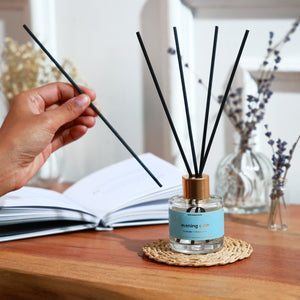
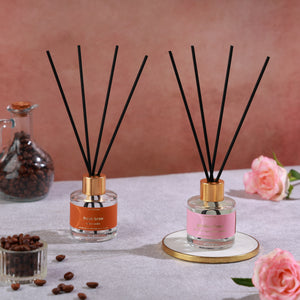
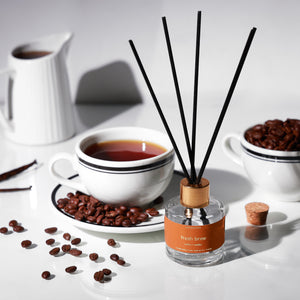

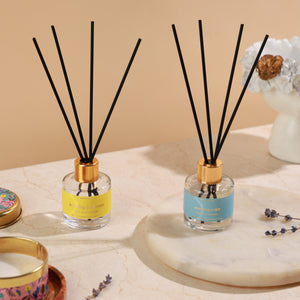
The 24-hour rule: the hour after a flip is deceptively strong and tells you nothing. The next morning is the honest reading.
Replace only if: the flip produced nothing at all within a day, and the reeds have done several months or crossed more than one refill.
The honest gap: SOSA does not sell replacement reeds separately. Refills are oil only. A new bottle brings six new fibre reeds with it.
2. Ignore the next hour entirely. There is a genuine surge in the hour or two after a flip, as the saturated end you have just exposed releases what it has been holding. It is real and it is temporary, and treating it as the new baseline is how people end up disappointed by the same bottle twice in one week.
3. Judge at twenty-four hours, and judge from the doorway. Step outside for fifteen minutes, come back through the front door, and read the first three seconds. Your nose in your armchair will not give you a usable answer; adaptation sees to that.
4. If it recovered, the reeds are fine and the cadence was the fault. Flip weekly from now on. A bottle that stalls is a bottle whose reeds have been left in one orientation too long, and no purchase corrects that habit.
5. If a full day produced nothing, ask how old the reeds are. Reeds that have run through several months, or that have carried across more than one refill, are the plausible candidates for genuine replacement. Reeds that are three weeks old are not — look at placement, reed count and immersion depth instead.
6. Understand what replacement means here. We do not sell reeds as a separate item; the refills are oil only, and you reuse your own vessel and reeds. That is an honest gap in the range rather than a policy I am proud of. In practice new reeds arrive with a new bottle, which is why our guidance is to buy a fresh bottle periodically rather than to run one set of reeds indefinitely.
Composed and handmade in small batches in Pune, and a portion of every order supports girl-child education through Nanhi Kali.
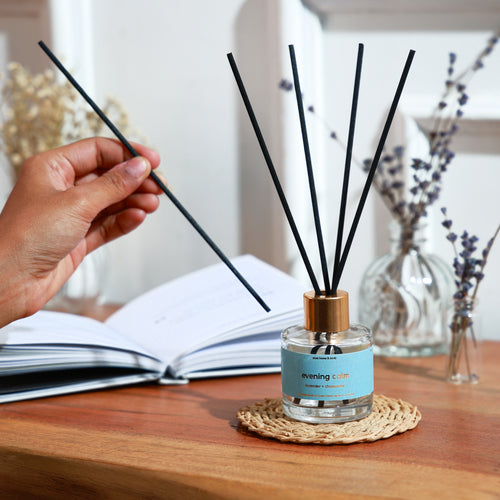
Part one — why the flip has to come before the verdict
The reason this order matters is that the two failures produce the same evidence. A saturated reed and a fouled reed both look damp, both smell of the composition when you hold them close, and both leave the room quiet. You cannot distinguish them by inspection; you can only distinguish them by their response to an intervention. Flipping is that intervention, it takes ten seconds, and it is the cheapest diagnostic in the whole category. Skipping it and buying instead is not merely wasteful — it teaches you nothing, so the same thing happens to the next bottle in six weeks' time.
 Oil refill₹2,399 · 300mlThe genuine end of a reed's life is different and slower to arrive. Household dust settles on an oily exposed surface, the heaviest fixative material builds up in the fibre channels rather than in a removable film, and the capillary path narrows until it no longer supports a useful flow. Flipping cannot help, because both ends are now compromised. This is why I say reeds are the consumable and the oil is the stable part — people habitually replace the oil and keep the reeds, when the physics runs the other way round. We use fibre rather than rattan precisely to push this point further out: rattan's natural pores clog readily in Indian humidity, which is why so many imported diffusers give up in week two of a monsoon, while fibre wicks consistently for months. Further out is not infinite, though. A set of reeds that has served through several months and more than one refill has done its work.
Part two — the twenty-four hour decision tree
This is the whole method in one table. Flip all six reeds properly, note the time, and then read the row that matches what you find the next evening. The timings here are SOSA working guidance from in-house testing and customer correspondence rather than instrumented results, but the shape of the response is consistent enough to decide by.
| Observation after the flip | When | What it means | Verdict on the reeds |
|---|---|---|---|
| Noticeable surge, then it settles ★ | 1–2 hours, then next day | Textbook. The bottle was stalled and is now delivering again | Keep them. Flip weekly from now on |
| Surge, then back to silence by morning | 24 hours | Supply recovered briefly; the room is not distributing it | Keep them — move the bottle instead |
| Nothing at one hour, clearly better next evening | 24–36 hours | Slow rewetting — common on a cold, sealed AC room | Keep them |
| Nothing at all, reeds under three months old | 24 hours | Look elsewhere: immersion depth, reed count, placement, sun | Keep them — this is not a reed problem |
| Nothing at all, reeds several months and 2+ refills old | 24 hours | Genuine fouling — channels narrowed beyond recovery | Replace, with a new bottle's set |
| Wet line still barely above the oil after a day | 24–48 hours | Under-wicking rather than stalling | Add two to four reeds first; replace only if that fails |
| The honest caveat: a flip trial cannot tell you anything useful if your own nose is the only instrument. Adaptation is at its strongest in the room you occupy most, so use the fifteen-minute doorway test or a returning household member to read the result. And run the trial on all six reeds — flipping half of them produces an intermediate outcome that answers nothing. | |||
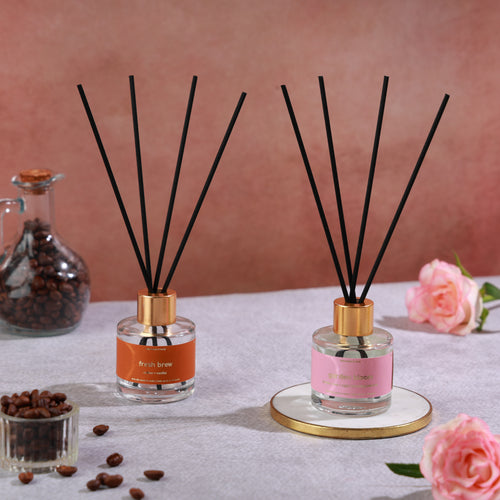 Oil refill · reeds not included₹2,399Shop →
 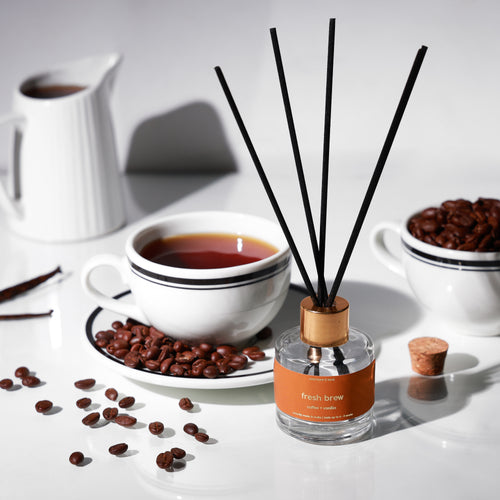 Fresh Brew · six new fibre reedsfrom ₹849Shop →
 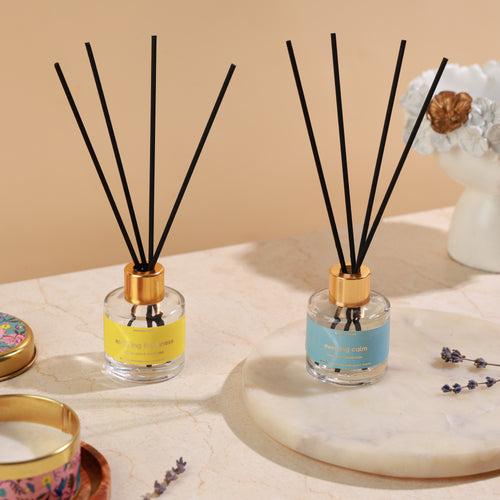 Day & Night duo · two sets of reeds₹1,498Shop →
Part three — what a genuinely spent set of reeds is like
Since I am asking you to wait a day before condemning anything, I owe you a clear description of the case where replacement really is the answer. It looks like this. The reeds have been in service for several months — usually across at least two refills, sometimes three. The exposed ends have darkened in a way that a flip does not lighten, and the fibre feels slightly stiff or gritty rather than pliant. You have flipped all six properly and a full day has passed with no change the doorway test can find. The oil level has been static for weeks in a room that is neither especially cold nor especially sealed. Taken together, that pattern is the end of a reed's working life, and no amount of patience will retrieve it. One set of reeds is not meant to run forever, and pretending otherwise is how a good refill gets blamed for a bad result.
Our guidance is to refresh reeds every few months rather than to wait for that endpoint, and I would rather state the awkward part directly: we do not sell replacement reeds as a separate item. The refills are oil only — you reuse your own glass vessel and your own reeds — and there is no reed SKU to add to the basket. That is an honest gap in the range. It exists for boring reasons about small-batch production, and I am not going to dress it up as a design choice. In practice it means new reeds arrive with a new bottle, so the sensible pattern for most households is to alternate: run a bottle, refill it once or twice on the same reeds, then buy a fresh bottle when the reeds have had enough and start the cycle again with the vessel you like best.
There is one more scenario worth naming, because it produces a confusing version of the same symptoms. If you refill with a different scent on the old reeds, you will get a muddled, indistinct result that is easy to mistake for dead fibre. The reeds retain a substantial quantity of the previous composition inside them and will keep releasing it for weeks; Kashmir lavender fighting Coorg coffee in the same six reeds reads as a fault when it is really a collision. If you are changing scent, that is exactly the moment to start with new reeds. Where the two compositions share a note the seam is far less obvious — Morning Freshness and Mountain Breeze meet on green eucalyptus, Fresh Brew and Garden Bloom meet on warmth and soft musk — but even then a clean set gives the new bottle a fair hearing.
Part four — how to actually get new reeds, and what it costs
Given that reeds are not sold on their own, here is the practical arithmetic for each situation, ordered from free upward. Note that the first three rows cost nothing at all, and that a good number of households never reach the fourth in a given season.
| Your situation | Do the reeds need replacing? | What to do instead, or as well | Cost |
|---|---|---|---|
| Bottle under six weeks old, gone quiet ★ | No — almost never | Flip all six, judge at 24 hours from the doorway | Free |
| Wet line barely above the oil | No — this is under-supply | Stand reeds deeper and upright; add two to four | Free · shortens the bottle a little |
| Reeds strong when held, room silent | No — supply is intact | Move into passing air near a doorway, waist to chest height | Free |
| Reeds several months old, flip did nothing | Yes | A fresh 50ml arrives with six new fibre reeds | From ₹749 · 6–8 weeks |
| Reeds fine, oil nearly gone | No | 300ml oil refill — pour to the neck, return reeds, flip once | ₹2,399 · roughly 8–11 months |
| Changing to a different scent | Yes — start clean | New bottle rather than refilling over the old composition | From ₹749 |
| Two rooms, and you want spare reeds in hand | Not yet, but plan for it | A duo set brings two bottles and twelve reeds | ₹1,498 · 2 × 50ml |
Versailles
The single most common repair I recommend is free, takes ten seconds, and involves no product from us at all. That is an uncomfortable position for a founder to write from, and it is also the correct one. If someone buys a new bottle because they did not know to flip the old one, I have not made a sale — I have lost a customer slowly. They will conclude the format is unreliable, and they will be right to, because nobody told them how it works.
What I would genuinely like to fix is the reed gap. Not selling replacement reeds is not a strategy; it is an artefact of making everything in small batches in Pune and not yet having solved the packaging and the shipping economics of a very light, very cheap item. Until that changes I will keep writing it down plainly on every page where it is relevant, rather than letting people assume a refill includes them and discover otherwise on their kitchen counter.
In the meantime the pattern that works is unglamorous: flip weekly, refill once or twice on the same reeds, then buy a fresh bottle when the fibre has had enough and let the vessel you like best carry on. That is roughly a year of scent for the price of one bottle and two refills, and it is what I do at home. A part of every order funds a girl's classroom through Nanhi Kali.
Frequently asked questions
- Why are my reeds not absorbing enough oil? — immersion depth and reed count, both free to correct.
- How do you know it is actually working? — the three tests to run before you spend anything.
- Why is my reed diffuser oil not going down? — the three states a static level can mean.
- Lasting too long but not smelling — the complete guide, plus why can't I smell my reed diffuser?
- Brand: the SOSA founder story.
SOSA reed diffuser range & prices (verified August 2026): alcohol-free, phthalate-free, paraben-free and IFRA-compliant compositions on a heat-stable coconut-derived (CCT) carrier, low-VOC, supplied in a refillable glass bottle with six fibre reeds; 50ml lasts 6–8 weeks and 130ml lasts 14–18 weeks. Morning Freshness (Malabar lemon · peppermint · Nilgiri eucalyptus) 50ml ₹749 · 130ml ₹1,249 · 9.0/10; Garden Bloom (British rose · night-blooming jasmine) 50ml ₹799 · 130ml ₹1,299 · 8.9/10; Evening Calm (Kashmir lavender · chamomile) 50ml ₹799 · 130ml ₹1,299 · 8.9/10; Fresh Brew (Coorg coffee · Kerala vanilla) 50ml ₹849 · 130ml ₹1,349 · 9.5/10; Mountain Breeze (Himalayan pine · sage · Indian cedar) 50ml ₹849 · 130ml ₹1,349 · 9.4/10. Reed diffuser refills are oil only — you reuse your own vessel and reeds: 300ml ₹2,399 (roughly 8–11 months) · 500ml ₹3,499 (roughly 14–18 months), about ₹7–8 per ml against ₹15–17 per ml for a 50ml bottle. Duo sets ₹1,498–₹1,598 for 2 × 50ml and ₹2,498–₹2,598 for 2 × 130ml. Strength figures are positions on SOSA’s own internal strength scale, not an industry standard. Replacement reeds are not sold as a separate SKU; SOSA guidance is to refresh reeds every few months. The reed line is separate from the water-based Hotel Collection for ultrasonic machines (15ml ₹299 · 100ml ₹999 · 300ml ₹1,799) and the two are not interchangeable. Diffusers: Boond 300ml ₹899 · Sukoon 500ml ₹1,899 · Megh 6L ₹3,499 · waterless Vaayu ₹11,999. Composed and handmade in small batches in Pune, India; tested through 45°C summer heat and 85% monsoon humidity. Free shipping above ₹499. A portion of every order supports girl-child education through Nanhi Kali. Prices subject to change — see the live product pages.