

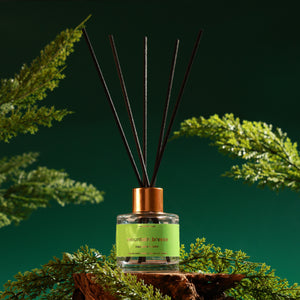

Recognition is built by repetition at a low level, not by intensity at one visit. A memorable smell is not a loud smell. Loud produces an impression on visit one and fatigue on visit three, and it is also what makes a room read as cheap.
The thing that makes it reproducible: a written specification — accord, machine, intensity setting, run window, days, mounting position and refill cadence — plus Vaayu's key-lock so the setting survives contact with staff. ₹11,999, up to 1000 m³, 400ml tank lasting about 90+ days, under 38 dB, DC 12V / 1A at 5W.
Two honest limits: SOSA publishes no exclusive or bespoke accord programme — the Hotel Collection is available to anyone, so if exclusivity matters to your brand, ask us at the contact page rather than assume it. And a signature scent cannot survive branches that smell different underneath it: if one showroom has packaging on the floor and another does not, you have two rooms, not one brand.
2. Recognition comes from sameness, and sameness is the hard part. One accord, one intensity, one run window, held constant. This sounds trivial and it is the thing showrooms most reliably fail at, because there are four separate ways for a fragrance to drift without anybody deciding to change it: a staff member turns it up, a different oil is ordered when the first runs out, a refill happens late so the room is unscented for a fortnight, or the branch manager decides a change would be nice.
3. Choose for register, not for distinctiveness. The temptation with a signature is to pick something unusual so that it is memorable. Resist it. An unusual accord invites attention, and attention spent on the air is attention not spent on the demonstration. The signature accords that work in commercial interiors are quiet, dry and slightly boring in isolation — cedar, white tea, a cool citrus edge — and they become distinctive through association with your business rather than through the material itself.
4. Set it low, and lock it. Memory does not need volume. A showroom is entered fresh by every visitor, so threshold concentration is reached easily, and the staff who cannot smell it any more are the people most likely to raise it. Vaayu's key-lock exists exactly for this: it is why a commissioned setting survives contact with staff, cleaners and customers who decide the fragrance would be better at maximum.
5. Write it down, because a second branch is where undocumented signatures die. Accord, machine, mounting position, intensity setting, run window, days, refill cadence, who holds the key. A 400ml tank runs about 90 or more days depending on intensity and scheduled hours, so somebody touches each machine roughly four times a year, and each of those occasions is a chance for the room to become a slightly different room.
Vaayu is ₹11,999, covers up to 1000 m³ of connected volume, runs under 38 dB, needs DC 12V / 1A at 5W at the mounting position, and is CE, RoHS and SGS certified. Free shipping above ₹499, and a portion of every order supports girl-child education through Nanhi Kali.

How recognition is actually built, and why it is not about being memorable
There is a version of this argument that treats scent branding as a stunt: choose something striking, make sure people notice it, and they will remember you. It works in exactly one situation, which is a single event. In a showroom that a client visits five times across a purchase cycle, striking is a liability. What you are building is not an impression, it is a match — the quiet click of arriving somewhere that smells the way it smelled last time. That click does not require the fragrance to be interesting. It requires it to be the same, and it requires the visitor to have met it enough times for the match to be available. Below are the three conditions that produce it.
 One accord₹1,799 / 300mlOn a first visit a fragrance does almost nothing commercially. It contributes to a general sense that the place is well kept, which is worth having and is not what you are paying for. The return is on visit two and after. The visitor walks in, something matches, and the room feels familiar before anybody has said a word — which in a sales conversation is a genuinely useful head start. Nothing about that mechanism rewards intensity. It rewards frequency and consistency, which is why the correct instruction to a showroom manager is boring: leave it exactly as it is. There is a second-order benefit worth naming. Because the effect works on returning visitors, it is strongest with precisely the people who matter most to an automation business — architects, designers and integrators who come back with different clients, several times a year, for years.
Vaayu₹11,999A signature that exists only in the founder's nose is not a signature, it is a habit. The moment you open a second centre, the question becomes whether a manager 800 kilometres away can produce the same room, and the answer depends entirely on what you wrote down. The same accord is necessary and nowhere near sufficient, because the same oil in a different volume, at a different intensity, with a different mounting position and a different air-conditioning layout, produces a noticeably different room. This is where reasoning in volume earns its keep: the branch with 3,000 sq ft under a four-metre ceiling is a considerably larger volume than the branch with 3,000 sq ft under a standard one, and if both are set to the same number on the dial they will not match. Establish connected volume per branch, set intensity to achieve the same perceived level rather than the same setting, then record the setting that achieved it.
One accord₹1,799 / 300mlOn a first visit a fragrance does almost nothing commercially. It contributes to a general sense that the place is well kept, which is worth having and is not what you are paying for. The return is on visit two and after. The visitor walks in, something matches, and the room feels familiar before anybody has said a word — which in a sales conversation is a genuinely useful head start. Nothing about that mechanism rewards intensity. It rewards frequency and consistency, which is why the correct instruction to a showroom manager is boring: leave it exactly as it is. There is a second-order benefit worth naming. Because the effect works on returning visitors, it is strongest with precisely the people who matter most to an automation business — architects, designers and integrators who come back with different clients, several times a year, for years.
Vaayu₹11,999A signature that exists only in the founder's nose is not a signature, it is a habit. The moment you open a second centre, the question becomes whether a manager 800 kilometres away can produce the same room, and the answer depends entirely on what you wrote down. The same accord is necessary and nowhere near sufficient, because the same oil in a different volume, at a different intensity, with a different mounting position and a different air-conditioning layout, produces a noticeably different room. This is where reasoning in volume earns its keep: the branch with 3,000 sq ft under a four-metre ceiling is a considerably larger volume than the branch with 3,000 sq ft under a standard one, and if both are set to the same number on the dial they will not match. Establish connected volume per branch, set intensity to achieve the same perceived level rather than the same setting, then record the setting that achieved it.
 Restraint₹799A signature has to be liveable for the people who work in it forty-eight hours a week, and that is a stricter constraint than being pleasant for a visitor for forty minutes. Set it too high and one of two things happens: the staff turn it down or off, which ends the signature quietly, or they stop noticing it and the room stays uncomfortable for everybody who does not work there. There is also the flattening problem. Almost any composition, pushed too far, collapses into a single sweet or sharp impression — the structure a perfumer built stops being separable and what arrives is one loud object. That is what makes an expensive oil read as cheap, and it happens at the dial rather than in the bottle. A signature accord run quietly for three years will be described by visitors as elegant; the same accord run loudly will be described as an air freshener, and it will be the same oil.
The four ways a signature quietly dies
None of them is a decision anybody remembers making, which is why they are worth listing. The first is upward drift. Olfactory receptors adapt to a constant stimulus within minutes, so by mid-morning nobody on the floor can smell the room. A well-meaning member of staff concludes the machine has failed and raises the intensity. A week later somebody else does the same. The room ends the quarter at a level no visitor enjoys and no employee can detect. The key-lock is the entire answer to this, and it is the reason I mention it on every page written for a commercial buyer.
The second is substitution. The oil runs out on a Saturday, somebody orders whatever is available, and the accord changes without a decision. The defence is a refill cadence rather than a reaction: a 400ml tank runs about 90 or more days depending on intensity and scheduled hours, so put a quarterly service date in the diary and refill every unit on that date whether or not each one strictly needs it. A synchronised cadence is much easier to hold than an accurate one, and it removes the emergency that causes substitution in the first place. The third is absence — the machine sits empty for three weeks because nobody owns the task, and a signature interrupted is a signature restarted.
The fourth is enthusiasm. Somebody senior visits, decides the scent has become boring, and changes it. It has become boring because they have been smelling it for two years, which is exactly the evidence that it is working: a signature is supposed to be invisible to the people who live in it and legible to the people who visit occasionally. If you take one governance decision from this page, take this one — put the fragrance accord in the same category as the logo. It changes when there is a brand reason, at brand scale, across every branch at once, and not because a room felt stale to somebody who works in it.
Signature scent versus rotating scent, honestly compared
There are situations where rotating is right, and I would rather name them than pretend the answer is universal. A pop-up, a seasonal retail activation and a single-event space all benefit from novelty because there is no second visit to build on. An experience centre is the opposite case.
| Aspect | One signature accord, held for years | Rotating or seasonal scents | What it means commercially |
|---|---|---|---|
| What it builds | Recognition on return visits | A pleasant first impression, repeatedly reset | One compounds; the other is re-bought each quarter |
| Who it works on | Returning clients, architects, designers, integrators | First-time walk-ins only | The first group is where an automation business lives |
| Required intensity | Low — memory needs frequency, not volume | Higher, to register in one exposure | Low is cheaper, more liveable and reads as more expensive |
| Effect on staff | Adapted within days; comfortable indefinitely | Repeated re-adaptation; more complaints | Staff comfort decides whether the machine stays switched on |
| Second branch | Reproducible from a setting sheet | Effectively impossible to keep aligned | Only one of these survives expansion |
| Refill logistics | One oil, quarterly, per unit | Multiple oils, variable timing, frequent substitution | Complexity is where signatures actually break |
| When rotating wins | It does not, in a showroom | Pop-ups, one-off events, seasonal retail activations | No second visit to build on means nothing to protect |
Cold-air nebulising · Vaayu₹11,999See it →  Ultrasonic water mist · Sukoon₹1,899See it →
 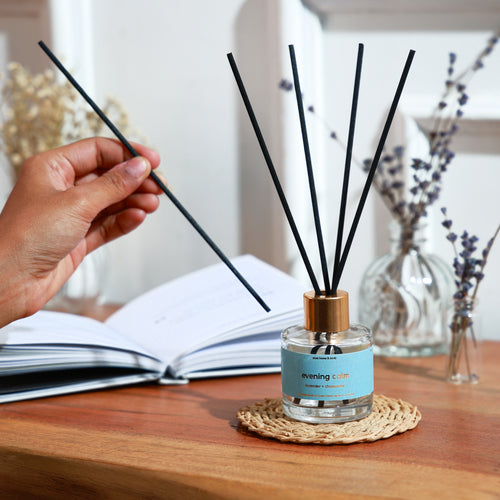 Passive capillary · reed₹799See it →
The setting sheet, and what goes on it
This is the deliverable, and it belongs in the handover file next to the rest of the commissioning records. Accord and supplier — the exact oil and size, so a reorder cannot drift; the Hotel Collection is 300ml at ₹1,799, 100ml at ₹999 and a pack of seven at ₹1,799. Machine and quantity per zone, expressed against connected volume rather than floor area — Vaayu is rated to 1000 m³, roughly 2,000 to 3,000 sq ft at a standard ceiling height, and I will not give you a machines-per-square-foot rule because there is not an honest one. Mounting position and method: freestanding, wall-mounted or into an HVAC return, with the height recorded, because the same intensity at 1.8 metres on a wall and on a shelf at desk height are not the same room.
Then the electrical and mechanical notes, which are what make this a specification rather than a preference. DC 12V / 1A, 5W at the mounting position — trivial as a load and therefore easy to omit from a drawing, and an omitted low-voltage supply behind a wall-mounted unit is a first-fix problem rather than a snag. If you are using the HVAC-return mount, note it on the mechanical drawings as an in-duct coordination item and record reachable access for refilling. Under 38 dB is the acoustic figure, which is what allows the unit to sit inside a demonstration volume rather than in a corridor. And the operational lines: run window, days, intensity setting, key-lock holder, refill date, and the name of the person who owns the quarterly service.
One line on the specification that saves the most money over three years: alcohol-free, water-free oils formulated for cold-air diffusion only. Thick undiluted essential oils are not recommended in Vaayu because they are viscous, they load the fine nozzle and over time they clog it — and this is precisely the failure that arrives when a branch manager receives a gift bottle of something natural and decides to be helpful. It is entirely preventable with one sentence in the handover and one conversation with whoever refills the machine. While we are being exact: Vaayu automates itself and does not join a control system. The complete control story is a Bluetooth app plus onboard buttons, and SOSA publishes no Wi-Fi, voice assistant, hub, Matter, KNX, RS-232, dry contact or API. The signature is held by the machine and the paperwork, not by your controller.
What to specify, in order — and the honest gap
The buying order for a business that intends to hold one accord for years, ending with what SOSA does not offer. I would rather set the expectation correctly now than have it discovered when a second branch opens.
| Specify | What it is | When it is the right answer | Price |
|---|---|---|---|
| 1. Vaayu ★ | Waterless cold-air nebuliser with recordable intensity, run windows, day selection and a key-lock | One per connected volume, identical in every branch | ₹11,999 |
| 2. Hotel Collection 300ml | One accord, ordered in the same size every quarter — White Tea Serenity and Quiet Luxury are the two nearest a technology showroom | Always. Consistency of oil is half of consistency of room | ₹1,799 |
| 3. The setting sheet | Accord, machine, mounting height, connected volume, intensity, window, days, key holder, refill date | Before the second branch, not after it | Free, and the actual asset |
| 4. Mountain Breeze reed | Passive capillary in the same dry woody register — six fibre reeds, refillable glass, 6–8 weeks on 50ml | A manager's cabin or meeting room where a machine is unnecessary | ₹849 |
| 5. Aangan | HVAC nebulising, approximately 8,000–10,000 sq ft | A flagship centre well above Vaayu's sensible ceiling | ₹25,999 |
| The honest gap: no exclusive accord, and no protocol | SOSA publishes no bespoke, exclusive or territory-restricted accord programme — the Hotel Collection is available to anyone, including a competitor two streets away. And Vaayu has no Wi-Fi, voice assistant, hub, Matter, KNX, RS-232, dry contact or API | If exclusivity matters to your brand, ask rather than assume | Ask, do not assume |
Versailles
The question I am asked is usually phrased as what should our signature scent be, and the more useful question is who is going to keep it the same. I have watched businesses spend real thought on choosing an accord and then no thought at all on the four ways it drifts, and a year later the room smells of something nobody chose, at a level nobody set, because a series of reasonable people each made a small adjustment. The choosing is the easy part. The holding is the asset.
It is worth understanding why the drift is always upward. Receptors adapt to a constant stimulus within minutes — the signal keeps arriving, the brain stops reporting it — so the people who work in your showroom are the least qualified people in the building to judge whether the fragrance is present. They will tell you, sincerely, that it has stopped working. It has not. A visitor coming in from the street is a better instrument than anybody on your payroll, and the key-lock exists so that this particular truth does not have to be re-litigated every month.
And a note on ambition, since scent branding invites it. You do not need a rare accord to have a signature. You need a quiet one, chosen for the register the room is in, run at a level nobody has to tolerate, and left alone for long enough that it starts belonging to you rather than to the bottle. Three years of an unremarkable white-tea-and-cedar accord will do more for a business than a magnificent one changed every season. Everything we compose is made in Pune, and a portion of every order supports girl-child education through Nanhi Kali.
Frequently asked questions
- What a premium experience centre should smell like — clean, dry, low and unchanging.
- The best fragrance for a luxury automation showroom — the register argument in full.
- Making the showroom feel more luxurious — the ninety per cent that is not fragrance.
- What suits a smart-living experience centre — the centre as a journey.
- Fresh, woody or hotel-like? and should it smell like a five-star hotel?
- How strong should it be? — the dose page, and why the answer is lower.
- What customers should smell on entry — the arrival moment.
- Choosing a signature scent for the brand — the selection method, step by step.
- Brand: the SOSA founder story.
SOSA Vaayu — facts verified August 2026: ₹11,999. Waterless cold-air nebulising diffuser; pressurised air shatters undiluted oil into a dry nano-mist, with no water, no dilution, no added humidity and no residue. Coverage up to 1000 m³, approximately 2,000–3,000 sq ft at standard ceiling height, measured as connected volume rather than floor area. Control: Bluetooth app plus onboard buttons, run windows of 1h / 4h / 8h / 24h, day selection, adjustable mist intensity, auto-stop and key-lock. SOSA publishes no Wi-Fi, Alexa, Google Assistant, Matter, Zigbee, Z-Wave, KNX, Crestron, Control4, RS-232, dry-contact or API integration of any kind, and Vaayu cannot be addressed by, or included in a scene on, any home-automation control system. Mounting: freestanding, wall-mounted or into an HVAC return. Power DC 12V / 1A, 5W at the mounting position. Under 38 dB. 400ml sealed, residue-free, refillable tank lasting up to about 90+ days depending on intensity and scheduled hours. CE, RoHS and SGS certified. Black and white finishes. Oils must be alcohol-free, water-free fragrance oils formulated for cold-air diffusion, such as the SOSA Hotel Collection (100ml ₹999 · 300ml ₹1,799 · pack of seven ₹1,799); thick undiluted essential oils are not recommended as they clog the fine nozzle. Above Vaayu's range: Aangan ₹25,999 (~8,000–10,000 sq ft) and Meenar ₹38,500 (12,000–18,000 sq ft). Below it, on a different mechanism: Sukoon ₹1,899 ultrasonic (270–320 sq ft) and Boond ₹899 (up to about 150 sq ft); Megh ₹3,499 has a six-litre tank and long runtime but covers only about 215 sq ft and is never a coverage upgrade. SOSA reed diffusers are alcohol-free, phthalate-free, paraben-free, IFRA-compliant and 0 ppm formaldehyde, with six fibre reeds in a refillable glass bottle on a heat-stable CCT carrier, composed in Pune. Reed oil and the water-based Hotel Collection are separate products and are not interchangeable, and there is no hotel-inspired reed diffuser. A scent machine adds fragrance; it does not remove an existing odour, clean or purify air, and SOSA makes no health or air-quality claim. SOSA publishes no dealer programme, reseller margin, trade price, territory, minimum order, lead time, installation charge, maintenance contract, or bespoke or exclusive accord programme; commercial and multi-branch enquiries are welcome at https://sosahomeandbody.com/pages/contact. Free shipping above ₹499. A portion of every order supports girl-child education through Nanhi Kali. SOSA is an independent Indian fragrance house; the Hotel Collection scents are SOSA's own interpretations inspired by the world's finest hotels, and SOSA is not affiliated with or endorsed by any hotel brand or any home-automation manufacturer. Prices subject to change — see the live product pages.