


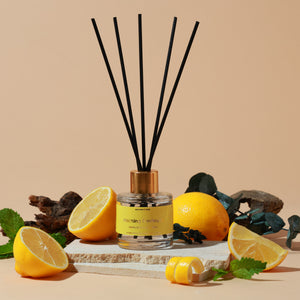

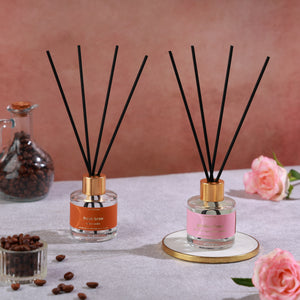
The wrong lever: adding reeds. It raises the whole curve, so the peak beside the bottle rises faster than the value at the door — you over-dose the sofa before you fix the doorway. Six reeds is full projection and there is nothing above it.
The right lever: move air. Active diffusion does not simply add more; it flattens the gradient, so the threshold value comes up without the middle of the room being overloaded. That is the whole difference.
Check one thing first: is the bottle sized for the room? A 50ml is specified for up to about 150 sq ft. In a 300 sq ft open-plan room it reads as weak while performing exactly to specification, and the fix there is the 130ml, not a machine.
The honest gap: Sukoon ₹1,899 covers a published 270–320 sq ft; Megh ₹3,499 covers about 215 and is never a coverage upgrade; Safar ₹3,999 is named and sold as a car and travel diffuser with no published room figure; and between it and Vaayu ₹11,999 there is no mid-sized waterless machine at all.
2. Understand the shape you are working against. A reed diffuser adds no air movement, so the fragrance leaves the reeds and travels only as far as the room’s own gentle convection carries it. The result is a gradient: high at the bottle, falling steeply outwards. Somebody on the sofa is in the thick of it. Somebody in the doorway is at the very edge. They then walk from the edge to the thick over about half a minute, and describe your home as smelling lovely once they have settled — which is exactly what you have observed and exactly what the physics predicts.
3. Do not try to fix the doorway with more reeds. Adding reeds scales the whole curve upward, and a curve that is low at the door and high at the bottle stays proportionally the same shape. You will over-dose the middle of the room long before you make the threshold interesting, and over-dosing flattens a composition into a single sweet or sharp impression — the thing people mean when they say a home smells like air freshener. Six reeds is full projection. There is nothing above it, and that ceiling is structural rather than a matter of trying harder.
4. Change the transport instead, because moved air flattens the gradient. This is the sentence worth keeping. An active diffuser does not just put more fragrance into the room — it distributes it, so the difference between the doorway value and the sofa value shrinks. That is precisely what “immediate impact” requires: not a bigger peak, a smaller drop. Sukoon ₹1,899 does it with ultrasonic water mist across a published 270–320 sq ft; Safar ₹3,999 does it with waterless cold-air nebulising of undiluted oil, at personal scale, and is named and sold as a car and travel diffuser.
5. But first, check the bottle is the right size for the room. A 50ml is built for up to about 150 sq ft and a 130ml above that. A 50ml in a 300 sq ft open-plan living room reads as weak while performing precisely to specification, and the honest fix there is ₹500 rather than ₹2,000. Reed count is the volume dial; bottle size is the room dial. Get both right before concluding the mechanism is the problem.
Free shipping above ₹499, and a portion of every order supports girl-child education through Nanhi Kali.

The gradient, and why a doorway sits at its thin end
Fragrance concentration in a room is not one number. It is a field — a value at every point — and with a passive source that field has a very particular shape. Molecules leave the reeds and are carried outwards by whatever gentle convection the room provides; nothing is pushing them, so the further you go from the bottle the fewer arrive per second, and the value drops away. That shape is the entire explanation for your experience, and it is also, importantly, the design rather than a fault: a reed diffuser produces a fragrant zone, not a fragranced room, and it does so silently, without power, water, charging or maintenance, for about ₹13 to ₹15 a day.
Now put a doorway on that field. A door is at the far edge of the zone by definition — you would not put your diffuser in the doorway, and if you did the air there is exchanged every time it opens, so the value collapses anyway. Then add the second variable: time. Your visitor crosses the thin end first and only reaches the thick end when they sit down. They are not smelling your home “after a while” because their nose warmed up; they are smelling it after a while because they walked from a low-concentration part of the room to a high-concentration part of it. The delay you have noticed is not a delay in perception. It is a distance being covered.
One caution before any of this becomes a purchase. You cannot measure any of it from inside the room, because receptors stop reporting a constant, unchanging stimulus within minutes and you have been sitting in your own gradient all evening. If a guest tells you the house smells lovely and you cannot detect a thing, that is the expected outcome rather than a fault — a visitor is a better instrument than you are. The only self-test worth running is to leave for fifteen minutes and walk back in, and to grade the doorway on that walk-in alone.
 Fresh Brew₹849The instinctive move is more reeds, a bigger bottle, or a deeper scent — Fresh Brew at 9.5 is the deepest thing we make, and people reach for it here. It does raise the whole field, and if your room is genuinely under-served it is the right answer. But it does not alter the shape: the peak beside the bottle climbs faster than the value at the door, so you reach “too much on the sofa” well before you reach “noticeable at the threshold”. And too much is a real failure mode, not a harmless one — at high concentration almost any composition collapses into one flat sweet or sharp note, which is what people are describing when they call something an air freshener.
 Garden Bloom₹799Sliding the bottle towards the entrance moves the peak, it does not raise it — and taken to its conclusion it puts the diffuser on the threshold, which is the worst place in a home for one. An entrance is the most turbulent air you own: the door opens, that pocket of air is replaced, and a source sitting in it is repeatedly stripped and then met at arm’s length, which reads as a burst rather than as a room. It also empties the bottle faster. The honest version of this lever is small: move it out of a dead corner and into the path air already takes, a metre or two inside the entrance, at chest height, and never into the direct blast of a split AC, which strips the lightest materials within days.
 Hotel Collection₹999An active diffuser puts fragrance into air that is being moved, so it is distributed rather than left to drift. The gradient flattens: the sofa value comes down a little relative to the peak, and the doorway value comes up a great deal. That is what a lobby feels like — not one enormous number somewhere, but a similar number everywhere, with no source to walk towards. Sukoon ₹1,899 achieves it with a wet mist of oil diluted in water. Safar ₹3,999 achieves it with pressurised air shattering undiluted oil into a dry micro-mist — the same principle hotels use, no water, no dilution, no added humidity, no white dust — and it is named and sold as a car and travel diffuser, with no published room-coverage figure, so I will not tell you what it fills.
Every mechanism, scored on the number at your threshold
The table below is the page in one place. The column that matters for your question is the third one, and note what it does not correlate with: price. The most expensive machine here has the largest coverage and would be a poor purchase for most people reading this, and one mid-priced machine in our own range covers less ground than the machine costing half as much. Coverage, runtime and price are three different axes, and this category makes it far too easy to confuse them.
| Mechanism & product | Gradient shape | Value at the threshold | Coverage | What you accept |
|---|---|---|---|---|
| Reed diffuser ₹749–₹849 · passive capillary | Steep. High at the bottle, falling with distance | Low — this is the situation you are describing | 50ml up to ~150 sq ft; 130ml above that | Nothing. Silent, unpowered, no water, no charging, ~₹13–₹15 a day, and it looks like an object |
| Boond ₹899 · ultrasonic water mist | Flatter within a small room | Moderate, in a room of the right size | Up to ~150 sq ft | Water, dilution, humidity, refilling, USB power; ~6 hours from 300ml |
| Sukoon ₹1,899 · ultrasonic water mist ★ | Genuinely flat across a normal room — air is being moved | The cheapest real answer to this question | 270–320 sq ft, published | Water, dilution, added humidity, filling. Three 15ml Hotel Collection scents included |
| Megh ₹3,499 · ultrasonic water mist | Flat, but across a smaller area than you would guess from the price | Lower than the ₹1,899 machine | ~215 sq ft — less than the Sukoon | A 6L tank and ~100 hours of runtime. A runtime and humidity machine, never a coverage upgrade |
| Safar ₹3,999 · waterless cold-air nebulising ★ | Undiluted oil as a dry micro-mist into moving air — the hotel principle | High close in; personal and small-space scenting | No published figure, and none will be invented here | Recharging, a small pump sound, a 1/2/3-hour maximum timer. Named and sold as a car and travel diffuser |
| Vaayu ₹11,999 · waterless cold-air nebulising | Flat across a very large volume | High everywhere — far more space than most readers have | 1000 m³ — roughly 2,000–3,000 sq ft | ₹11,999, and the wrong purchase for one room. It earns its price on a whole floor |
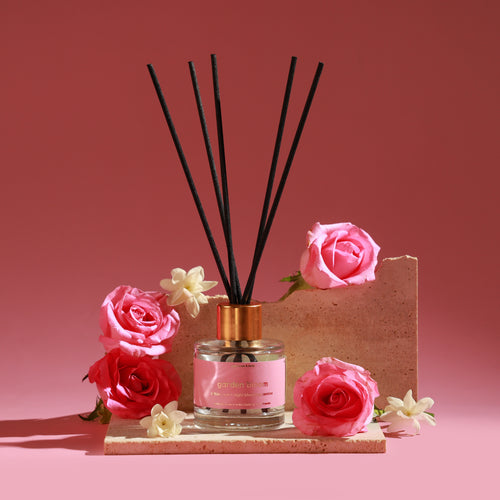 130ml for a big room · Garden Bloom₹1,299Shop → Flattens the gradient · Sukoon₹1,899Shop →
  The oils · Hotel Collection₹999Shop →
The three-point test, and the case where the room is simply too big
Before anything is bought, run this. Leave the house for fifteen minutes so your receptors reset. Come back and smell at three points: with your nose near the bottle, at about a metre, and standing in the doorway. Strong at the bottle, present at a metre, nothing at the door is the classic gradient result and it means the oil is fine, the dose is fine, and the transport is the missing part — this page’s answer applies. Weak at the bottle too means something more ordinary: the bottle is near its end, the reeds have not been flipped in a fortnight, or you have three reeds in a room that wants six. Flipping every three to five days restores projection without opening a new bottle, and it is free.
There is a third result, and it is the one people are most reluctant to accept. Sometimes the room is simply larger than the product was specified for. A 50ml is built for up to about 150 sq ft and a 130ml above that, so a 50ml in a 300 sq ft open-plan living-dining reads as weak while performing exactly to specification. That is not a weak bottle and it is not a defect; it is a sizing mismatch, and the fix costs about ₹500 rather than ₹2,000. Get the bottle size and the reed count right before concluding that you need a machine, because a meaningful share of the people who write to me about a gradient are actually describing an under-specified bottle doing its best.
If, after all that, the doorway is still flat, the mechanism is the answer and the ladder is short. Sukoon at ₹1,899 is the cheapest device in the range that genuinely moves air across a room-sized volume, and for most homes it is the right purchase; its cost is water, dilution, added humidity and a tank to fill. If water is ruled out — a humid coastal flat, or a room you simply do not want more moisture in — Safar at ₹3,999 nebulises undiluted oil into a dry mist, which is the mechanism a hotel uses and the reason undiluted reads stronger than the same oil in water: the droplet is not carrying a payload of water. It is named and sold as a car and travel diffuser, it has a 1, 2 or 3-hour auto-off rather than always-on running, it needs recharging, and SOSA has published no room-coverage figure for it. And the range’s honest limit belongs here as much as anywhere: between Safar and Vaayu at ₹11,999 — which is rated to roughly 2,000–3,000 sq ft and is the wrong purchase for one room — there is no mid-sized waterless machine in this catalogue at all.
What to change, in the order I would change it
Free first, then cheap, then mechanism. Two of these steps cost nothing and between them they resolve a good proportion of the people who ask this question, which is why they sit above the products rather than below them. The last row is the honest gap in our own range plus the one machine in it that looks like an upgrade and is not.
| Step | What it is | When it is the right answer | Price |
|---|---|---|---|
| 1. The three-point test, after fifteen minutes out ★ | Smell at the bottle, at a metre, and in the doorway. Flip the reeds if it has been more than five days. Move the bottle out of any dead corner and out of a split AC’s direct blast | Always first. It separates a transport problem from a tired bottle, and it costs nothing | ₹0 |
| 2. Size the bottle to the room | 50ml for up to about 150 sq ft, 130ml above that, six reeds rather than three in a larger space | If a 50ml is serving a living room, you are not facing a mechanism problem yet — you are under-specified, and this is the cheap fix | ₹1,249–₹1,349 |
| 3. Sukoon ★ | Ultrasonic water mist — it moves air, so the gradient flattens rather than merely rising. 270–320 sq ft published, 16–18 hours on low, three 15ml Hotel Collection scents included | The cheapest genuine answer to “nice inside, nothing at the door”. Accept water, dilution, added humidity and filling a tank | ₹1,899 |
| 4. Safar | Waterless cold-air nebulising of undiluted oil into a dry mist — the hotel principle at personal scale. 3 speeds, 1/2/3-hour auto-off, 2000 mAh Type-C, 20ml, 6.9 cm | When water is ruled out or you want the undiluted payload. Named and sold as a car and travel diffuser, no published room coverage, needs recharging | ₹3,999 |
| 5. Vaayu, only for a genuinely large space | 1000 m³, 400ml lasting about 90+ days, app windows of 1h/4h/8h/24h on chosen days, under 38 dB | A whole floor, an open-plan living-dining, a villa, a clinic, a salon or a reception. Not one room | ₹11,999 |
| The honest gap, and what not to buy | Megh ₹3,499 covers about 215 sq ft — less than the ₹1,899 Sukoon — so it is a runtime and humidity machine, never a coverage upgrade. And between Safar and Vaayu, SOSA makes no mid-sized waterless machine for one room | Said plainly, because the intuitive purchase on a gradient page is the biggest tank, and the biggest tank is not the widest reach | — |
Versailles
I would like to start by defending you, because people who ask this question often arrive slightly embarrassed, as though they had bought badly. You did not. You bought a fragrance to solve a diffusion problem, which is the most natural mistake in this entire category — every shop in the world sells you the smell and nobody sells you the transport. And your own sentence is the proof that the purchase was fine: something that is lovely once you sit down is a composition doing exactly what it was made to do.
What I would ask you to resist is the reflex to go deeper. A 9.5 in place of an 8.9 will not put a number at your doorway; it will put a bigger number beside the bottle, and the room will read as heavier rather than as more present. That is the whole trap of this question. The scale we publish, from Evening Calm at 8.9 to Fresh Brew at 9.5, is there so somebody can choose deliberately downwards for a small sealed room — not so that the top of it can be used as a fix for a spatial problem it cannot reach.
And I will keep defending the reed even on the page where it loses, because it is our own best-selling product and it is excellent at what it is for. It is silent. It needs no power, no water, no charging and no schedule. It never has to be switched on, it costs about ₹13 to ₹15 a day, and it looks like an object on a table rather than an appliance in a corner. What it cannot do is move air, and immediate impact at a threshold is an air-movement problem. Both of those things are true at once, and I would rather you heard both from me. Everything is composed in Pune, and part of every order funds a girl’s classroom through Nanhi Kali.
Frequently asked questions
- How hotels do it in seconds — threshold concentration, scheduling and consistency.
- The “wow, your home smells amazing” effect — one scent, one entry room, ventilate before.
- Guests noticing before they sit down — placement slightly inside, out of the draught.
- An arrival moment at the bedroom door — why closing a door is the cheapest tool you own.
- Reed, spray or active diffusion — the first sixty seconds versus the evening.
- A signature scent at your own door — and the honest limitation of scenting for yourself.
- Why a lobby lands and your own home does not — adaptation, in full.
- Arrival effect or background scent — two setups mostly in tension.
- Stronger fragrance or better diffusion — the family pillar.
- Brand: the SOSA founder story.
Facts verified August 2026: Passive capillary — SOSA reed diffusers, five scents, 50ml ₹749–₹849 for rooms up to ~150 sq ft lasting 6–8 weeks, 130ml ₹1,249–₹1,349 above 150 sq ft lasting 14–18 weeks, six fibre reeds included (six for full projection, three for a soft bedside level and roughly double the life), flipped every 3–5 days, about ₹13–₹15 a day, heat-stable CCT carrier rather than DPG, alcohol-free, phthalate-free, paraben-free, IFRA-compliant, 0 ppm formaldehyde, refillable glass, tested at 45°C and 85% RH, composed in Pune; strength scale Evening Calm 8.9, Garden Bloom 8.9, Morning Freshness 9.0, Mountain Breeze 9.4, Fresh Brew 9.5; duos ₹1,498–₹1,598 for 50ml × 2; refills 300ml ₹2,399 and 500ml ₹3,499, oil only and never a first purchase. Ultrasonic water mist — Boond ₹899 (300ml, up to ~150 sq ft, ~6 hours, USB, night light), Sukoon ₹1,899 (500ml, 270–320 sq ft, 16–18 hours on low, three 15ml Hotel Collection scents included), Megh ₹3,499 (6L tank, ~100 hours, ~215 sq ft — less than Sukoon, and never a coverage upgrade). Waterless cold-air nebulising — Safar ₹3,999 (20ml bottle, 2000 mAh Type-C, up to 10 hours continuous or around 30 hours intermittent per charge, 3 speeds, 1/2/3-hour auto-off, 6.9 cm, named and sold as a car and travel diffuser with bedside and hotel room among its stated uses, no published room-coverage figure) and Vaayu ₹11,999 (up to 1000 m³ or roughly 2,000–3,000 sq ft, 400ml tank lasting up to about 90+ days, Bluetooth app plus onboard buttons, 1h/4h/8h/24h run windows, choice of days, adjustable intensity, key-lock, under 38 dB, freestanding or wall/HVAC mount, 5W, CE, RoHS, SGS). Between Safar and Vaayu there is no mid-sized waterless bedroom nebuliser in the SOSA range. Hotel Collection oils are water-based and ultrasonic-only — 15ml ₹299 (a refill), 100ml ₹999, 300ml ₹1,799, pack of 7 ₹1,799 — and cannot be used in reed diffusers, nor reed oil in ultrasonic machines; there is no hotel-inspired reed diffuser. SOSA sells no room spray or home spray; every SOSA spray is a car perfume. No health, air-quality, allergy or antimicrobial claims are made, no claim is made that fragrance improves sleep, mood or concentration, and fragrance does not remove a smell: source, ventilation, then fragrance. Free shipping above ₹499. A portion of every order supports girl-child education through Nanhi Kali. SOSA is an independent Indian fragrance house; the Hotel Collection scents referenced here are SOSA’s own interpretations inspired by the world’s finest hotels, and SOSA is not affiliated with, endorsed by or a supplier to any hotel brand. Prices subject to change — see the live product pages.