

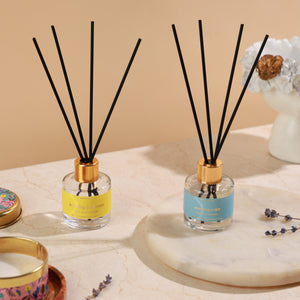

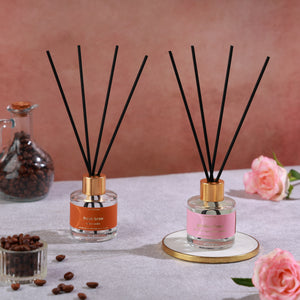

Where it holds: across two rooms. Where it fails: inside one, because coverage does not tile — two passive sources in one volume overlap rather than add.
The prices: two 130ml at ₹1,249 is ₹2,498. A Sukoon at ₹1,899 with a 15ml Hotel Collection at ₹299 is ₹2,198.
2. But coverage adds across rooms, not inside one. This is the part that makes the conversion nearly useless in practice. A coverage figure describes the size of air pocket one source can hold at equilibrium. Put two passive sources in the same pocket and you do not double the pocket; you get two origins inside a volume that neither can reach the far end of. Two bottles in one open 300 sq ft room is not 300 sq ft of coverage. The exception is shape — an L, a blind leg, a run over about twenty-two feet — where two positions genuinely serve two parts of one space.
3. The prices are closer than people expect, and the machine is the cheaper one. Two 130ml reed diffusers at ₹1,249 is ₹2,498. A Sukoon at ₹1,899 with a 15ml Hotel Collection at ₹299 is ₹2,198 — ₹300 less. And that ₹299 of fragrance goes a long way, because a Sukoon runs at three to six drops per tank. The reed bottles, by contrast, are consumables: about ₹78 a week of use each, so roughly ₹156 a week for the pair.
4. The two numbers are not the same kind of number. A reed diffuser's 150 sq ft is continuous. It has no switch, no socket, no tank and nothing to remember, so the room is held all day and all night for fourteen to eighteen weeks. The Sukoon's 270–320 sq ft applies while the machine is running. If you switch it on for two hours before guests and off at bedtime, you have bought coverage during those hours, which may be exactly what you want — or may not be, in a bedroom you want to smell nice at three in the morning.
5. And ₹1,899 is not a complete purchase. The Sukoon is hardware. It takes the water-based Hotel Collection — 15ml at ₹299, 100ml at ₹999, 300ml at ₹1,799 — and the two liquids are not interchangeable in either direction. Reed oil never goes in a Sukoon and Hotel Collection never goes in a reed bottle. There is also no hotel-inspired reed diffuser. So compare ₹2,198 against ₹2,498, not ₹1,899 against ₹2,498.
Made in India, composed by an ISIPCA Versailles-trained perfumer — and a portion of every order supports girl-child education through Nanhi Kali.
Why coverage adds up across rooms and not inside one
A coverage figure is not a radius. It is easy to picture a diffuser as a lamp throwing a circle of light, in which case two lamps would obviously light twice the floor — but that is not what is happening. Fragrance climbs the porous core of a reed by capillary action, evaporates from the exposed length, and from there the room's own air decides where it goes. There is no fan and no pump. So the rated 150 sq ft is the size of air pocket one bottle can bring to a noticeable concentration and hold there, at roughly 1,350 cubic feet under a nine-foot ceiling. It is a statement about equilibrium, not about distance.
That distinction decides everything about the conversion. Two air pockets behind two closed doors are two separate problems, and two bottles solve them independently: 150 plus 150 is genuinely 300 sq ft of scented home. One air pocket of 300 sq ft is a single problem twice the size, and putting two passive sources into it does not double the equilibrium — it gives you two origins in a volume where the fragrance still has to travel on air movement that is not there. A Sukoon is rated to 270–320 sq ft from one unit because it changes the mechanism rather than the quantity: it atomises fragrance into a cool mist and pushes it out, so the room does not have to carry it. That is why the honest answer to this question has a comma in it. Two reed diffusers equal one Sukoon in total area, and equal nothing at all in a single large room. The one exception is shape: in an L-shaped space, a blind leg, or a run over about twenty-two feet, a second bottle is buying the other limb rather than a wider circle, and there the two-bottle answer is genuinely right.
The three decisions behind the conversion
 Two roomsFrom ₹2,498Before converting anything, count doors. If your 300 sq ft is a bedroom and a living room with a door between them, two reed diffusers is right and a Sukoon cannot help you, because a machine can only be in one room at a time and needs a socket in each. If your 300 sq ft is one open living-dining with no door, the arithmetic reverses: one Sukoon does something two bottles cannot, and two bottles would largely overlap. The same 300 sq ft gives opposite answers depending on whether there is a door in the middle of it.
Sizing by space — where the conversion holds and where it does not
The same 300 sq ft appears twice in this table with two different answers, because the door between them is what the conversion actually turns on. One row is worth nothing at any coverage figure.
| Space | What it needs | How many | Cost |
|---|---|---|---|
| Two closed rooms of about 150 sq ft each ★ | The conversion holds — but a machine cannot be in two rooms, so this is bottles either way | Two bottles | from ₹2,498 |
| One open room of about 300 sq ft, no door | The conversion fails — two bottles overlap; a Sukoon with a 15ml Hotel Collection covers it from one point | One machine | ₹2,198 |
| One 300 sq ft room shaped as an L, or a run over 22–24 ft | Shape, not size — two positions genuinely serve two limbs, so two bottles is right here | Two bottles | from ₹2,498 |
| One room of about 150 sq ft where you want a switch | One reed diffuser's worth of area in machine form — the Boond at ₹899 with a 15ml Hotel Collection at ₹299 | One machine | ₹1,198 |
| One room over about 320 sq ft | Two Sukoons placed apart — not a Megh, which covers about 215 sq ft, or roughly one and a half reed diffusers | Two machines | ₹3,798 |
| A passage, or a room used less than about two hours a day | Nothing. No conversion is needed for a space nobody is standing in long enough to notice anything | None | ₹0 |
| A note on all of the above: every figure here — about 150 sq ft on six reeds, 270–320 for the Sukoon, about 215 for the Megh, about 150 for the Boond — is a steady-state number for a closed room with still air at standard ceiling height. Open doors, fans, cross-ventilation and high ceilings reduce all of them together, so the conversion between them stays roughly true even as the absolute numbers fall. | |||
One room · the unitFrom ₹749Shop → 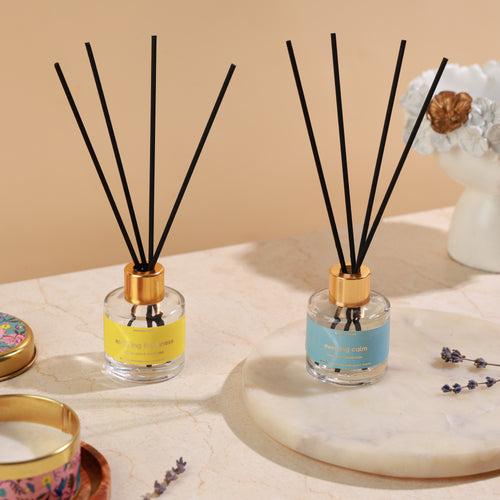 Two rooms · better value₹1,498Shop →
  Large room · a switch₹1,899Shop →
Converting properly, and what each number leaves out
Start by converting rooms rather than square feet. Walk the space with the doors as you actually keep them and write down each air pocket separately: a 160 sq ft bedroom that is shut at night is one pocket, a 300 sq ft open living-dining is one pocket, a 40 sq ft bathroom is one pocket. Then apply the figures once per pocket rather than once per home. Anything at or under about 150 sq ft is one reed diffuser and needs no machine at all. Anything between 150 and about 200 is still a bottle, on all six reeds, with better placement and a closed door — that band is where free adjustments usually win. Anything past about 200 sq ft in a single pocket is where a Sukoon starts doing something a bottle cannot. That sequence keeps the conversion from being applied to a total floor area, which is where it produces nonsense.
Then price both sides completely, because one of them is usually priced wrongly. Two 130ml reed diffusers at ₹1,249 is ₹2,498 and includes everything: glass, collar, six fibre reeds and the fragrance itself. A Sukoon at ₹1,899 includes none of the fragrance, so the working comparison is ₹1,899 plus at least a 15ml Hotel Collection at ₹299, or ₹2,198. Beyond that the running costs go in opposite directions. The reeds are consumables at about ₹78 a week of use each — ₹156 a week for two rooms — while the machine sips: three to six drops a tank means a 15ml gives many fills, and a 100ml at ₹999 or a 300ml at ₹1,799 stretches much further. Over two or three years the machine is the cheaper way to scent one large room, and the bottles remain the cheaper way to scent two small ones.
Then be careful with the conversion in the other direction, because the range does not scale the way people assume. The Boond at ₹899 covers about 150 sq ft, which is exactly one reed diffuser's worth of area in machine form — useful if you want a switch in a small room. The Megh at ₹3,499 covers about 215 sq ft, which is roughly one and a half reed diffusers, and less than the ₹1,899 Sukoon. Its six-litre tank buys runtime and humidity, not area, and is genuinely useful in a dry winter or for a room you want running all night without refilling. But if the problem is coverage, the correct answer above one Sukoon is two Sukoons at ₹3,798 placed well apart. And whichever way you go, keep the liquids separate: reed oil never goes in an ultrasonic machine, Hotel Collection never goes in a reed bottle, and there is no hotel-inspired reed diffuser.
What to buy
The conversion points at two lines of this table. Which one depends entirely on whether your area is one room or two.
| Buy | What it covers | Lasts | Price |
|---|---|---|---|
| One 50ml | A single reed diffuser — a bathroom or a small room — 150 sq ft of coverage for the least money, on two or three reeds | 6–8 weeks | from ₹749 |
| One 130ml ★ | The value size — either half of a two-room 300 sq ft — 14–18 weeks at about ₹78 a week, no socket needed | 14–18 weeks | from ₹1,249 |
| The duo | Day & Night duo — two rooms started at once at ₹1,498 — the cheapest route to the two-bottle answer | 6–8 weeks each | ₹1,498 |
| Sukoon | 500ml ultrasonic — one open room of 270–320 sq ft, where two bottles would simply overlap | Runs when you switch it on | ₹1,899 |
| 300ml refill | The running cost — keeping two reed positions going at ₹8.00 a millilitre against ₹9.60 for new bottles | Roughly 2 × 130ml fills | ₹2,399 |
Versailles
The arithmetic is two, and I want to be careful about how that gets used. Two reed diffusers cover about 300 sq ft and a Sukoon covers about 270 to 320, so on paper they meet. But a coverage figure describes one source holding one pocket of air, and pockets of air do not merge just because you own two bottles. Two bottles in one big open room is two starting points. It is not three hundred square feet.
The number that gets left out of this comparison is time. A reed diffuser holds its 150 sq ft at four in the morning without anybody doing anything. A machine holds its 270 to 320 while it is switched on. Neither is better; they answer different questions. If you want a room lifted before guests and silent at midnight, buy the machine. If you want a room that is simply always right when somebody opens the door, buy the bottle.
And do not convert your way up to the Megh. It covers about 215 sq ft — roughly a bottle and a half — for ₹3,499. Six litres is runtime, not reach. If one Sukoon is not enough, the honest answer is two Sukoons placed apart, and if two Sukoons feels like too much machine for a home, that is usually a sign the room wanted bottles and a closed door in the first place. A portion of every order funds a girl's classroom through Nanhi Kali.
Frequently asked questions
- Where the crossover actually is — six reeds is the last setting.
- Which rooms get reeds, which get a machine — always-on or switchable.
- L-shaped living rooms — the one shape that earns two bottles.
- The complete sizing and quantity guide — every home type, three builds.
- Brand: the SOSA founder story.
SOSA products & prices (verified August 2026): Hotel Collection water-based ultrasonic diffuser fragrance 15ml ₹299 · 100ml ₹999 · 300ml ₹1,799 · Pack of 7 (15ml, all fragrances) ₹1,799; refills 100ml from ₹999. Seven scents: The Ritz-Carlton-inspired (white tea · bergamot · cedar), Westin-inspired (white tea · aloe · cedar), 1 Hotels-inspired (cedarwood · vetiver · green leaves), The St. Regis-inspired (amber · violet · woods), Shangri-La-inspired (jasmine · green tea · white tea), Four Seasons-inspired (citrus · floral · sandalwood), W Hotels-inspired (citrus · pepper · amber). Diffusers: Boond 300ml ₹899 · Sukoon 500ml ₹1,899 · Megh 6L ₹3,499. Water-based, phthalate-free, composed to IFRA standards for home diffusion; 3–6 drops per tank. Made in India, Pune. The Hotel Collection scents are SOSA's own interpretations inspired by the world's finest hotels; all hotel names are trademarks of their respective owners and are used only to describe the scent style — SOSA is an independent Indian fragrance house, not affiliated with or endorsed by any hotel brand. Prices and availability subject to change — see the live product pages.