



The four changes: vent holes near the bottom and top of each door; one door left ajar; insoles pulled out overnight; a pair never put away while damp.
The rotation rule: a closed shoe worn all day needs about a day and a night in moving air to dry through. Two pairs on alternate days both smell less than one worn daily.
2. Stop putting damp shoes in. This is the single highest-value habit change and it is free. A closed shoe worn through an Indian working day is wet inside — leather, canvas and especially foam footbeds hold that moisture for far longer than people expect. Put it straight into a rack and you have added a humidifier to a box full of other people's shoes. Leave it outside the rack overnight, on the balcony in shade or by a window, and put it away in the morning.
3. Pull the insoles out and wash them. The insole is the wettest, most absorbent, most bacterially active part of a shoe and it is removable in most footwear. Taken out, both the insole and the shoe dry in a fraction of the time. Wash insoles in warm water with ordinary soap, rinse thoroughly, and dry them completely — a damp insole put back is worse than the one you removed. Where insoles are glued in, the same logic applies to loosening laces fully and opening the shoe out.
4. Rotate, so no pair is worn on consecutive days. A shoe needs roughly a full day and night in moving air before the footbed is dry through. Wear the same pair daily and it never gets that, so the moisture level and the bacterial population both climb week on week. Two pairs alternated will each smell noticeably less than one pair worn every day — not because you are wearing them less, but because each one completes a drying cycle. Alternate sandals or open footwear in wherever the day allows; open shoes barely smell at all, and the reason is entirely that they dry.
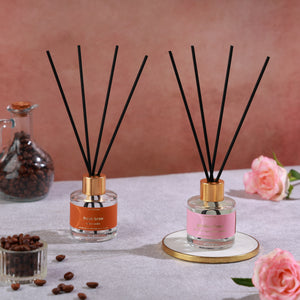
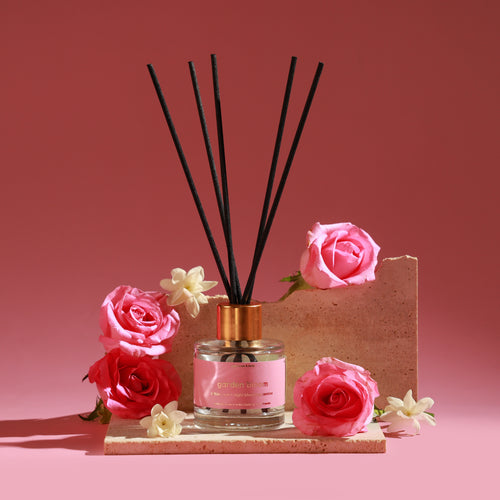
5. Then, and only then, scent the entrance. Once the rack is vented and the shoes are dry, an entrance is the highest-value place in a home to have fragrance, because a first impression is formed in a single breath. A reed diffuser from ₹749 standing on the rack is the right format: no power, no switch and nobody stands in a hall long enough to operate anything.
Made in India, composed by an ISIPCA Versailles-trained perfumer — and a portion of every order supports girl-child education through Nanhi Kali.
Why ventilating the rack does more than anything else you can do to it
Start from what the smell actually is. Feet sweat heavily; a closed shoe gives that sweat almost no route out; the interior sits warm, dark and near-saturated for eight or ten hours; and ordinary skin bacteria metabolise the components of that sweat and excrete short-chain fatty acids, which are the sour, cheesy note you can smell. Of the four conditions that process needs — warmth, darkness, food and moisture — moisture is the one you can actually remove. You cannot make a shoe cold or bright, and you cannot stop your feet sweating. You can make the shoe dry, and a dry shoe supports far less bacterial activity than a damp one. Everything about ventilating the rack follows from that single lever.
The second reason is that a closed rack is not neutral storage — it actively works against drying. Inside a shut box the moisture evaporating from six pairs of shoes has nowhere to go, so the humidity inside climbs until evaporation slows to a crawl. The shoes then stay wet, the bacteria keep working overnight, and by morning you have a box that is both damper and more concentrated than it was the night before. Give the same box a low intake and a high outlet and the physics reverses: rising warm air pulls fresh hall air through, humidity inside falls towards room level, and the shoes actually dry between wears. The rack stops being an incubator and starts being a cupboard. Nothing you buy does more than that change, and it costs the price of a drill bit.
Three ways to open the box up
 Step fourFrom ₹849The most effective permanent fix. Mark a row of four or five holes about 50mm up from the bottom edge of each door and a matching row about 50mm down from the top. Twenty to twenty-five millimetres is a good size; smaller holes clog with dust and do far less than people assume. Drill from the face side with a backing board to avoid tear-out on melamine, and fit inexpensive plastic or brass vent grilles if you want it to look deliberate. Both rows matter — a single row does almost nothing, because convection needs an inlet and an outlet to move at all.
Symptom to cause: reading the rack
Racks fail in a few specific, recognisable ways. Match the pattern before you buy anything, because three of these five rows are fixed by a habit rather than a purchase.
| What you notice | Most likely cause | How to confirm it | What actually fixes it |
|---|---|---|---|
| Rack smells strongly however often you clean the shoes ★ | No air path — humidity inside stays high so the shoes never dry between wears | Leave the doors wide open for two days and see whether the smell drops sharply | Vents low and high on each door, or one door permanently ajar |
| One or two pairs are obviously the source | Those pairs are worn daily and never complete a drying cycle | Smell inside each shoe individually rather than near the rack | Rotate on alternate days, remove and wash the insoles, dry 48 hours before returning them |
| Smell is worst at the bottom shelf | Damp rising from a mopped floor, plus the plinth sitting in water twice a day | Put a dry sheet of paper on the bottom shelf overnight and check it in the morning | Raise the unit on feet, keep the bottom shelf for dry open footwear, mop around it not under it |
| Rack smells even when almost empty | Sorption into the board and felt shelf liners — a secondary reservoir | Empty it completely, air it a day, then smell the bare interior at close range | Wash the interior, bin fabric liners, dry the board fully before reloading |
| Sharp ammonia-like or heavily sour note from one pair | A heavily loaded synthetic footbed with months of accumulated sweat | Remove the insole and smell it separately from the shoe | Replace the insole outright — it is cheap, and washing a saturated foam footbed rarely wins |
| Musty, earthy smell with staining on the wall or the rack back | Damp in the wall behind the unit — a building issue, not a shoe smell | Pull the rack away from the wall and check the plaster, skirting and floor behind it | Find the moisture source and remove the growth. Do not fragrance this. |
| If none of these fit: lift the doormat. A rubber-backed or thick coir mat that stays permanently damp is a real odour source in its own right and it lives in the same square metre as the rack. | |||
Reeds · always-on roomsFrom ₹749Shop →  Sukoon · when you want a switch₹1,899Shop →
  Hotel Collection · the scentFrom ₹299Shop →
The order of operations
First, reset what is already there. Empty the rack completely. Pull the insoles out of every closed shoe and set everything in moving air for a full day and night — balcony in shade, a windowsill, or in front of a fan. Wash the insoles in warm soapy water, rinse, and dry them right through. A handful of bicarbonate left inside a shoe overnight and vacuumed out in the morning is worth doing on the worst offenders. Wash the rack interior with a mild detergent solution, bin the felt or fabric shelf liners, and leave the unit open for a full day so the board dries. Throw out the pairs nobody has worn in two years.
Second, change the rack and the habit together, because either alone underdelivers. Drill vent rows near the bottom and top of each door, or commit to leaving one door open. Pull the unit off the wall. Then set the rule that nothing goes in on the day it was worn, and rotate two pairs of everyday shoes on alternate days. Bring the entrance into the household ventilation routine as well — when you open windows for the daily five to ten minutes of cross-draught, open the hall to the flow rather than leaving it the one dead pocket in the flat. A closed flat runs at roughly 0.2–0.5 air changes an hour and the entrance gets the least of that.
Third, add fragrance — and the top of the rack is the right shelf for it. It sits at about chest height, in the airflow of the opening front door, away from cooking oil and out of the way. A reed diffuser is the right format for an unattended hall: capillary action, no power, nothing to remember. Start with six reeds and pull one or two out if it reads as loud in the first breath — the reed count is the volume dial. For profile, dry and woody suits a threshold better than sweet: Mountain Breeze at ₹849 for 50ml is what I would choose, or Morning Freshness at ₹749 for something cooler and brighter. If the entrance opens straight into a large living room and you want the whole volume scented before guests arrive, the Sukoon at ₹1,899 running a Hotel Collection scent from ₹299 covers roughly 270–320 sq ft on a switch. Reed fragrance is oil-based and Hotel Collection is water-based; they are not interchangeable.
What to do, in order
Three free steps and a drill bit do the work here. The fourth step is the purchase, and on an entrance it is genuinely worth making — after the first three.
| Step | What to do | When | Cost |
|---|---|---|---|
| 1. Remove the source | Empty the rack, dry every pair 48 hours with insoles out, wash the insoles, wash and dry the interior, bin the liners | Before anything else | ₹0 |
| 2. Move the air | Open the entrance to the daily five-to-ten-minute cross-draught instead of leaving it a dead pocket | Daily, five to ten minutes | ₹0 |
| 3. Deal with what holds it | Vent rows top and bottom of each door, unit pulled off the wall, rotation on alternate days, nothing stored damp | Weekly to monthly | ₹0 |
| 4. Then the always-on layer ★ | A SOSA reed diffuser — a permanent hall background standing on the rack top, at chest height in the door's airflow | 50ml 6-8 weeks · 130ml 14-18 | from ₹749 |
| 5. Or the on-demand layer | Sukoon with a Hotel Collection scent — a pre-arrival scent for the whole volume when the entrance opens directly into the living room | Run it when you want it | ₹1,899 |
Versailles
The most useful thing I can tell you about shoe racks has nothing to do with fragrance: buy or make one with louvred doors, and if yours is solid, drill it. Almost every shoe cabinet sold in India is designed to look tidy rather than to work, and a solid door on a box full of damp shoes is precisely the wrong specification. Twenty minutes with a drill will do more for your entrance than anything on my website.
The habit change matters as much as the carpentry. Nothing goes in on the day it was worn. It sounds fussy and it takes about four seconds a day, and it is the difference between shoes that dry and shoes that never do. Add rotation on top and most people find the problem simply stops being a problem within a fortnight, without buying anything at all.
Then scent the hall, deliberately. I care about entrances more than any other room because that is where someone forms their impression of a home, in one breath, before they have taken their sandals off. Keep it dry and green rather than sweet, keep the volume low enough that it reads as the room rather than as a product, and use a reed so it is simply always there. A portion of every order funds a girl's classroom through Nanhi Kali.
Frequently asked questions
- Why a closed cabinet still smells — concentration, not containment.
- The full shoe odour removal routine — drying, rotation, insoles, bicarbonate.
- Why monsoon breaks all of this — wet shoes into a sealed box.
- When the entrance is tiny — no buffer, so source control only.
- Brand: the SOSA founder story.
SOSA products & prices (verified August 2026): Hotel Collection water-based ultrasonic diffuser fragrance 15ml ₹299 · 100ml ₹999 · 300ml ₹1,799 · Pack of 7 (15ml, all fragrances) ₹1,799; refills 100ml from ₹999. Seven scents: The Ritz-Carlton-inspired (white tea · bergamot · cedar), Westin-inspired (white tea · aloe · cedar), 1 Hotels-inspired (cedarwood · vetiver · green leaves), The St. Regis-inspired (amber · violet · woods), Shangri-La-inspired (jasmine · green tea · white tea), Four Seasons-inspired (citrus · floral · sandalwood), W Hotels-inspired (citrus · pepper · amber). Diffusers: Boond 300ml ₹899 · Sukoon 500ml ₹1,899 · Megh 6L ₹3,499. Water-based, phthalate-free, composed to IFRA standards for home diffusion; 3–6 drops per tank. Made in India, Pune. The Hotel Collection scents are SOSA's own interpretations inspired by the world's finest hotels; all hotel names are trademarks of their respective owners and are used only to describe the scent style — SOSA is an independent Indian fragrance house, not affiliated with or endorsed by any hotel brand. Prices and availability subject to change — see the live product pages.