

If it was stronger everywhere with the fan on: your problem was transport, not the fragrance. You have just proved your own oil is fine, and the fix is free.
If it was weaker beside the bottle and more noticeable across the room: that is redistribution, and it is the most misread result of the four. A fan cannot create fragrance; it shares out what exists. The peak drops, the far side rises, and the total is unchanged.
If it surged and then went quiet: the first minute brought down what had been accumulating in the still layer above your head. After that the room settles, and your own nose adapts to a steady stimulus within minutes.
If nothing changed: check the door, and check whether the bottle is in a dead pocket. A fan circulates the air a room already holds, so an open door turns it into an efficient way of scenting your corridor.
And the cost, said plainly: the fan shortens the bottle. Air moving over a wetted reed speeds evaporation. Run three reeds instead of six — a soft level that roughly doubles the life — and you keep most of the weeks.
What the experiment rules out: a bigger bottle bought for reach. Volume is a duration specification rather than a coverage one, and the proof sits in our own range — Megh at ₹3,499 holds six litres and covers about 215 sq ft, less than the ₹1,899 Sukoon's 270–320. A second reed diffuser is ruled out for the same reason: two passive sources make two peaks with a valley between, because neither of them moves air.
2. Which means the difference you observed is a measurement. You changed exactly one thing and held everything else — the oil, the reed count, the room, the day — constant. The size of the difference between the two states tells you how much of your room's outcome was being decided by air movement, and it is usually a great deal more than people expect. If the fan changed the room substantially, then your problem was never the fragrance, and the entire category of purchases that raise emission — more reeds, a bigger bottle, a stronger-smelling oil, a second diffuser — would have failed to fix it. That is worth knowing before you spend anything, and nobody sells it to you.
3. The most confusing result is the one where it seemed weaker. A number of people report that the corner beside the bottle became less intense once the fan was running, and conclude the fan is unhelpful. It is not; it is doing precisely what it is meant to. A point source in still air produces a high concentration at the reeds falling away to almost nothing at the far wall. Mixing lowers the peak and raises everything else. The total amount of fragrance in the room did not change, because a fan cannot make any — it was shared out. If what you loved was the intensity right beside the bottle, you will notice that reduction, and it is a genuine trade rather than a fault.
4. There is also a first-minute effect that misleads people in the opposite direction. Warm air rises, and in a still room a real share of what leaves the reeds accumulates in the layer above head height where it does nobody any good. Switching a fan on brings that layer down in a rush, which produces a noticeable surge in the first minute or two, followed by a quieter and steadier level. That is not the fan losing effectiveness. It is a stored quantity being released and then the room reaching a new equilibrium — and it is the reason a tall room feels weaker than its floor plan suggests.
5. And the last variable in the experiment is you. Receptors adapt to a constant stimulus within minutes: the signal keeps arriving and the brain stops forwarding it. So a fan-on room genuinely can seem to fade over half an hour while remaining exactly as fragranced as it was. The correction is to stop using yourself as the instrument. Leave for fifteen minutes and walk back in; better, ask somebody who does not live in the house. A visitor is a better instrument than a resident, and if guests remark on a fragrance you cannot detect, it is working for everyone but you.
Alcohol-free, phthalate-free, made in Pune. A portion of every order supports girl-child education through Nanhi Kali.
Reading your own observation, since you already have the data
Most articles about fans and diffusers tell you what to do with the switch. You have already used the switch, so the useful thing I can offer is an interpretation. There are three things a fan does to a fragranced room, and which of them dominated decides what you noticed. They are not the same effect at different strengths; they are separate mechanisms, and it is possible to experience one strongly and another not at all depending on your ceiling, your furniture and where the bottle happens to stand.
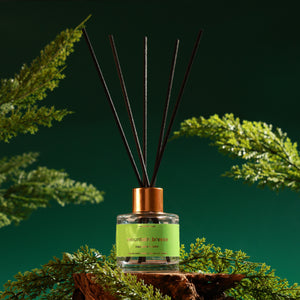
 Mountain Breeze₹849Vapour leaving a reed surface in still air spreads by molecular diffusion, which is genuinely and hopelessly slow across the scale of a room. Everything else that has ever moved your fragrance around was bulk air movement you did not control — convection off a warm wall, a draught under a door, somebody walking past. A fan converts that from chance into a setting. If your observation was that the far side of the room became noticeably scented for the first time, this is the mechanism you saw, and it is the clearest possible evidence that the bottle had been doing its job all along into a room that was not carrying the result anywhere.
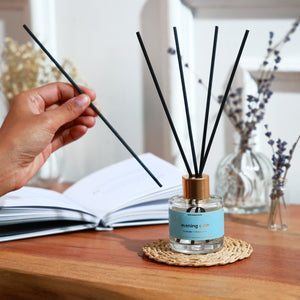
 Evening Calm₹799This is the mechanism behind the observation people most often misread as the fan making things worse. A fan makes no fragrance. It redistributes what a bottle has already produced, so the strong zone beside the reeds becomes less strong at the same moment the weak parts of the room become less weak. Evenness is bought with intensity, and the currency is the corner you liked. Whether that is an improvement depends entirely on what you were asking for. Somebody who wanted the whole room to smell of something has gained; somebody who liked burying their nose in a fragrant corner beside the sofa has lost a little, and should probably run the fan only some of the time.
 Garden Bloom₹799A room is layers rather than one uniform body of air, and warm air rises. In a still room with a decent ceiling height, a share of everything the reeds produce ends up in the stratum above head height, accumulating quietly and helping nobody. A ceiling fan's downdraught and return loop is exactly a device for exchanging air between those layers, which is why the first minute after switching on can be startling and the tenth minute is merely good. Part of what you thought had vanished was simply higher than you are. The same mechanism explains why a bottle on the floor performs so badly and why raising it to nose height, which costs nothing, changes a room.
The fan is a free diagnostic as well as a free fix
This is the part I would most like a reader to take away, because it is worth more than any product recommendation on the page. The fan switch separates emission from transport, and those are the only two quantities in this entire subject. Emission is how much leaves the bottle: reed count, bottle size, temperature, the composition itself. Transport is how far it gets: moving air, which a reed does not supply. Nearly every disappointing purchase in home fragrance happens because somebody with a transport problem buys an emission solution. More reeds, a larger bottle, a stronger-smelling oil, a second diffuser on the other side of the room — all four raise emission, all four leave transport exactly where it was, and all four disappoint in precisely the same way.
You now have a way of telling which of the two you have, and it costs nothing and takes an evening. Run the room fan-off for a couple of hours and pay attention. Run it fan-on, on low, with the door shut, for a couple of hours and pay attention again. A large difference means transport was your limiting factor, and the honest conclusion is that no change of fragrance would ever have helped you. A small difference means something else is going on — most often an open door, so the fan is efficiently distributing your fragrance into the corridor; or a bottle in a dead pocket behind a curtain or between two pieces of furniture, where no air is collecting what it emits; or a bottle standing in a running air conditioner's blast, which is the one placement to avoid outright because it strips the reeds and throws the fragrance at a single wall.
Two cautions about running the test properly, since a badly run test is worse than none. Do not judge on the first ten minutes, because of the stored-layer surge described above and because a bottle recently moved needs a few days to re-saturate its reeds. And do not use yourself as the instrument for a long observation, because adaptation will defeat you: receptors settle to a constant stimulus within minutes, so the same room genuinely reads as fading to the person sitting in it. Leave for a quarter of an hour and walk back in, and ask a visitor. Sensitivity varies between people, and you are adapted to your own home in a way nobody else is.
Five things people report, and what each one means
These are the five observations I hear, in rough order of frequency. Find yours in the first column and read across; the third column is what it is telling you about your room rather than about your bottle.
| What you noticed | The mechanism | What it tells you | What to do |
|---|---|---|---|
| Stronger across the whole room with the fan on ★ | Carriage. The reed emits, the fan carries | Your limiting factor was transport, not the fragrance. Your oil is fine and you have just proved it | Fan on low, door shut, three reeds instead of six. Spend nothing |
| Weaker beside the bottle, more noticeable further away | Sharing out. Mixing lowers the peak and raises the rest | The total is unchanged, because a fan makes no fragrance. You have traded intensity for evenness | Decide which you wanted. Run the fan only when you want the room rather than the corner |
| A surge for a minute, then quieter and steady | The layers. Accumulated vapour above head height is brought down, then the room settles | Your ceiling is doing more storing than you thought, and the bottle may be too low | Raise it to nose height on a surface. It costs nothing and it is permanent |
| Strong when you walk in, gone once you sit down | Adaptation, not the fan. Receptors settle to a constant stimulus within minutes | Nothing about the room changed. You did | Leave for fifteen minutes and return; ask a visitor. A visitor is the better instrument |
| No difference at all | Containment or a dead pocket. A fan circulates only the air the room already holds | The door is open, or the bottle is somewhere no air reaches | Shut the door; move the bottle out of the alcove or from behind the curtain, but not into the AC's blast |
| The bottle is emptying sooner | Evaporation rises with the speed of air over a wetted surface | Correct, expected, and the honest price of the improvement | Three reeds instead of six — a soft level that roughly doubles the life |
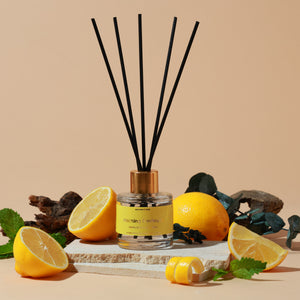
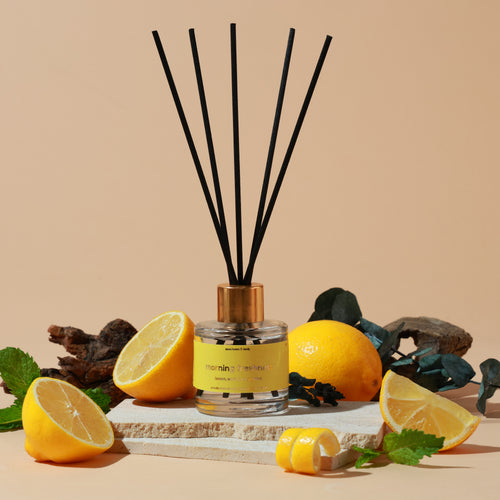
Bright · Morning Freshness₹749Shop → 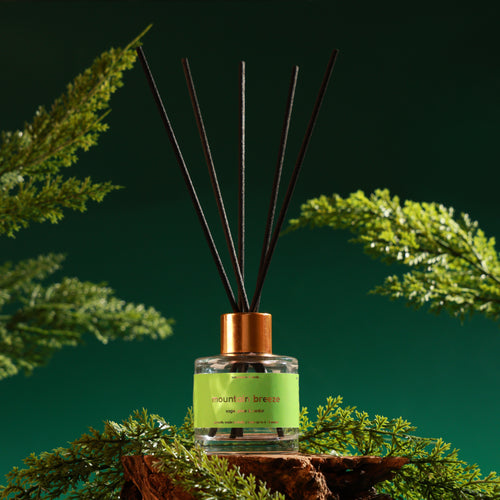 Most present at 9.4 · Mountain Breeze₹849Shop →
 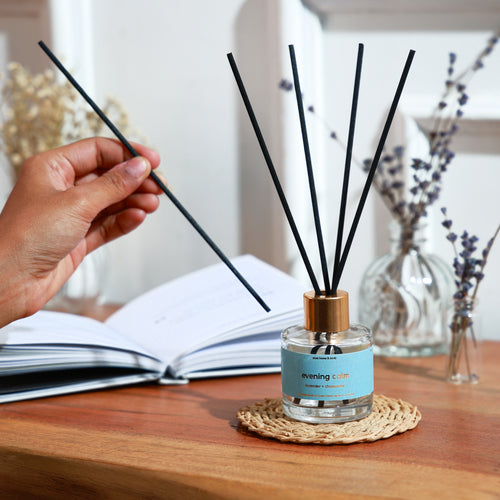 Softest at 8.9 · Evening Calm₹799Shop →
The cost in weeks, and the free counterweight
The honest half of this answer is that running a fan will shorten your bottle. Evaporation from a wetted surface rises with the speed of air passing over it, and a reed is precisely a wetted fibre surface. The 6–8 weeks a 50ml is quoted at assumes ordinary household conditions, and a room with the fan on all evening is not still air. I am not going to publish a percentage for how much shorter, because it would depend on your fan, your ceiling height, your room and your weather, and a figure invented for the sake of looking precise would be worth nothing to you. The direction is certain and the magnitude is not, and I would rather tell you that than pretend to a number.
There are two free ways to soften it. The first is the reed count, which is a volume dial almost nobody uses. Six reeds is full projection; three is a soft level and roughly doubles the life. Running three reeds with the fan on low is, in my view, the best-value arrangement available to an Indian bedroom, and the logic is neat: the fan is now doing the reaching, so the three reeds you removed were only adding output that had nowhere to go. You keep the distribution and you keep most of the weeks. The second is to run the fan during the hours that matter — the evening you are in the room, the hour before people arrive, the time before bed — rather than continuously through a working day when the room is empty. Every millilitre leaves through the reeds whether anybody is present or not, and oil evaporating into an unoccupied room is the only genuine waste in this product. That is an occupancy question rather than a product one.
And since this page has spent its length describing what a reed cannot do, here is what it does that nothing else in the range does. It is silent — no motor, no pump, no piezo plate, nothing that hums at three in the morning, which in a bedroom is not a small consideration. It needs no power at all, so on the evening the electricity goes and the fan stops, the diffuser carries on exactly as before. Nothing to fill, nothing to charge, nothing to clean, nothing to remember, and no setting to get wrong. It runs at roughly ₹13–₹15 a day. It is an object rather than an appliance, which matters when it is going to sit in view on a bedside table for two months. And it never breaks, which cannot be said of anything with a motor in it. The fan is the better half of the partnership for reach; the bottle is the half that will still be working in five years.
What the experiment tells you to buy — which may be nothing
Take the result seriously in both directions. If the fan-on room was what you wanted, you are finished and you should spend nothing, beyond perhaps a second bottle for a second room. The situation where a purchase becomes reasonable is narrower than most articles admit: it is when you want that fan-on evenness without the fan — in a room that has none, in a sealed cooled bedroom where the AC is circulating in one direction instead, or when you want fragrance at a chosen intensity on demand rather than fragrance that appears when you happen to want moving air. A reed plus a fan is an excellent arrangement with no control surface on it, and control is the thing a machine actually sells. Here is the ladder, with the gap named where it falls.
| Option | What it is | When it is right | Price |
|---|---|---|---|
| 1. Fan on low, door shut, three reeds instead of six ★ | Emission from the bottle, transport from the ceiling — the two halves assembled for nothing | First, and if your experiment went well it is the whole answer. Silent, no power, nothing to fill or charge, works in a power cut, roughly ₹13–₹15 a day, and it never breaks | ₹0 |
| 2. Raise it and move it closer | Nose height on a surface, near where you sit or sleep — not the floor, not a high shelf, not a dead corner | Always worth doing alongside the fan. Halving the bottle-to-person distance does more than any change of scent | ₹0 |
| 3. A second bottle for a second room | Morning Freshness ₹749, Evening Calm ₹799, Mountain Breeze ₹849 | When you want two rooms rather than one even room. Two bottles in one room make two peaks with a valley between, because neither moves air — genuinely right for a long or L-shaped room used at both ends, wrong for evenness in one volume | ₹749–₹849 |
| 4. Sukoon | Ultrasonic, 500ml, 270–320 sq ft, 16–18 hours on low, three 15ml Hotel Collection scents included | A room with no fan, or when you want the fan-on result on demand. Very often the correct bedroom answer and never to be skipped on the way to something dearer. The oil is diluted in water, it adds humidity, it needs filling, and in a hard-water city it can leave a fine white dust | ₹1,899 |
| Not this: a bigger tank or bottle bought for reach | Megh has a six-litre tank and about a hundred hours of runtime | Never a coverage upgrade — about 215 sq ft, less than the ₹1,899 Sukoon's 270–320. Volume is duration, not coverage, and a 130ml reed behaves the same way against a 50ml: more weeks, not more metres | ₹3,499 |
| The honest gap: no mid-sized waterless machine | Safar ₹3,999 is waterless cold diffusion of pure undiluted oil — 20ml, cordless, three speeds, a 1 / 2 / 3-hour auto-off timer — and it is named and sold as a car and travel perfume diffuser, so it is not set-and-forget and it needs recharging. Vaayu ₹11,999 is rated to 1000 m³, roughly 2,000–3,000 sq ft | Nothing sits between them as a bedroom-sized waterless machine, and I would rather say so than stretch one to fit. Vaayu is the wrong purchase for one bedroom, where most of what it can do is wasted; it earns its price on a whole floor, an open-plan living-dining, a clinic or a showroom | — |
Versailles
I like this question more than almost any other we get, because the person asking it has done something no brand asked them to do: they changed one variable and observed the result. That is a better piece of evidence about their room than anything I could tell them from Pune, and it is the reason this page is written as an interpretation rather than an instruction. You already know what happened. What you may not know is what it proves.
What it proves is the single most useful idea in home fragrance, and it is not a flattering one for our industry. Emission and transport are two different quantities, and almost everything sold as a solution to a distribution problem is a solution to an emission problem. A stronger-smelling oil, a larger bottle, extra reeds, a second diffuser: all raise how much leaves the bottle, all leave the carrying exactly as it was. Your fan changed the carrying and nothing else. If that changed your room, then the money you were about to spend would not have.
The last thing, and it matters when people go to test this properly. Do not trust your own nose over a long sitting. Receptors adapt to a steady stimulus within minutes, so the room you are sitting in fades for you and for nobody else. Leave for a quarter of an hour and come back; ask somebody who does not live there. And if you find you can smell it constantly, all evening, with no break at all, that is not a well-performing room either — it is a room dosed too strongly, and the reed count is the free correction. Our softest composition sits at 8.9 on a scale that measures perceived intensity rather than quality precisely so that somebody scenting a small closed bedroom can choose deliberately downwards. Everything is composed in Pune, and a part of every order funds a girl's classroom through Nanhi Kali.
Frequently asked questions
- Where should I place a reed diffuser? — the full placement method.
- Near a ceiling fan? — the same mechanism as an instruction, with the settings.
- Near an open window — yes, it disappears faster, and here is why.
- Weaker with the balcony door open — a much larger opening than a window.
- Does AC make it stronger or weaker? — both, and both matter.
- Directly under the AC — the one placement to avoid outright.
- Door, window, bed or centre? — the four candidates, ranked.
- Cross-ventilation — a straight line through the room, and how to place off it.
- Change the placement before you buy anything — the family pillar.
- Brand: the SOSA founder story.
SOSA facts verified August 2026: Reed diffusers are supplied in 50ml and 130ml only — 50ml suits rooms up to about 150 sq ft and lasts 6–8 weeks, 130ml suits rooms above 150 sq ft and lasts 14–18 weeks, at roughly ₹13–₹15 a day. Six reeds is full projection; three is a soft bedside level and roughly doubles the life; two or three reeds in a 50 sq ft bathroom can make a 50ml last nearly three months; flip the reeds every 3–5 days. Morning Freshness ₹749 / ₹1,249 · Evening Calm ₹799 / ₹1,299 · Garden Bloom ₹799 / ₹1,299 · Mountain Breeze ₹849 / ₹1,349 · Fresh Brew ₹849 / ₹1,349. Duos: Day & Night ₹1,498, Fresh & Grounded ₹1,548, Warmth & Bloom ₹1,598. Strength scale, perceived intensity rather than quality: Evening Calm 8.9 softest, Garden Bloom 8.9, Morning Freshness 9.0, Mountain Breeze 9.4, Fresh Brew 9.5 deepest. Morning Freshness uses a eucalyptus globulus base that slows lemon evaporation three to four times. Six fibre reeds rather than rattan, heat-stable CCT carrier rather than DPG, alcohol-free, phthalate-free, paraben-free, IFRA-compliant, 0 ppm formaldehyde, refillable glass bottle, tested at 45°C and 85% RH, composed in Pune. Refills 300ml ₹2,399 and 500ml ₹3,499, oil only and never a first purchase. Machines: Boond ₹899 (300ml, up to about 150 sq ft, ~6h, USB, night light) · Sukoon ₹1,899 (500ml, 270–320 sq ft, 16–18h on low, three 15ml Hotel Collection scents included) · Megh ₹3,499 (6L, ~100h runtime but only ~215 sq ft, never a coverage upgrade) · Safar ₹3,999, a waterless cold-diffusion device named and sold as a car and travel perfume diffuser, with a 20ml bottle, a 2000 mAh battery, three speeds and a 1 / 2 / 3-hour auto-off timer · Vaayu ₹11,999, a waterless cold-air nebuliser rated to 1000 m³, roughly 2,000–3,000 sq ft, with a 400ml tank and app control, and the wrong purchase for one bedroom. No coverage figure is published for Safar and none is quoted here. Reed oil, the water-based Hotel Collection and pure fragrance oil are not interchangeable across these mechanisms. No health, air-quality, allergy, sleep or mood claims are made anywhere on this page. Free shipping above ₹499. SOSA is an independent Indian fragrance house; the Hotel Collection is SOSA's own interpretation inspired by the world's finest hotels and SOSA is not affiliated with or endorsed by any hotel brand. Prices subject to change — see the live product pages.