

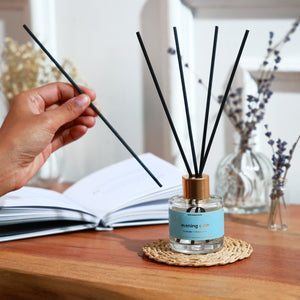

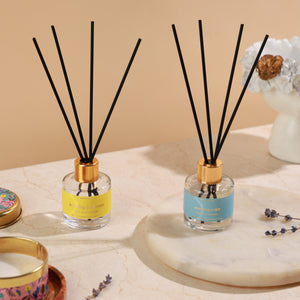

Nothing has happened to the product. Same oil, same six fibre reeds, same rate of emission. What has changed is retention: how much of what the bottle makes the room manages to keep. That is a property of the room, and you are adjusting it every time you touch that handle.
The free fixes, in order: close the balcony door for the hours you want the room to read · move the bottle away from the door and off the line between it and any other opening · get it to nose height on a surface near where you sit · shut the internal door too · ceiling fan on low, which circulates rather than exports.
The one that surprises people: if the balcony must stay open in the evening, put the bottle in the bedroom rather than the living room and close that instead. A small room you can shut will do far more with the same ₹749 than a large room open to the sky.
What not to buy: a bigger bottle. Volume is a duration specification, not a coverage one — Megh at ₹3,499 has a six-litre tank and covers about 215 sq ft, less than the ₹1,899 Sukoon's 270–320.
2. A tall opening exchanges in both directions at once, which a window cannot. Warm indoor air is lighter, so it leaves through the top of a full-height doorway while cooler outside air comes in along the floor. That gives you a continuous circulation through a single opening, with no second window needed anywhere. It is the same principle that makes a stairwell draughty, and it is the reason a balcony door feels so much more decisive than its area alone would suggest. On a breezy evening or a higher floor, where wind speed rises with height, the effect is stronger again.
3. The bottle is doing exactly what it was doing yesterday. A reed diffuser is a point source with no transport of its own — oil climbs six fibre reeds by capillary action and evaporates from their surface at a rate set by the oil, the reed count, the temperature and the humidity. Not one of those terms is affected by a door handle. What the door changes is retention: how much of the output the room keeps. Emission is unchanged, transport is unchanged, retention has collapsed, and the reader who notices it has diagnosed the room correctly.
4. So the useful question is which room you are actually trying to scent. A living room with the balcony open is not a 250 sq ft room; it is a 250 sq ft room continuously connected to the outdoors, and no passive bottle wins that. A bedroom with the door shut is a genuine, closed, modest volume, and the same ₹749 bottle performs quite differently in it. If your balcony is open every evening because that is when the air is worth having, the honest move is to stop asking the living room to be the fragrant room and let the bedroom be it instead.
5. And if the balcony room must be the fragrant one, work the free levers first. Close the door for the last stretch of the evening rather than all of it. Move the bottle to the far side of the room from the balcony, out of the line between the balcony and any internal door, at nose height on a surface near where people actually sit. Shut the internal door so the room is not also leaking into the hall. Then put the ceiling fan on low — a fan circulates the room's own air instead of exporting it, and it is the transport a reed structurally lacks. Every one of those is free.
Alcohol-free, phthalate-free, made in Pune. A portion of every order supports girl-child education through Nanhi Kali.
Three reasons a balcony door beats a window comfortably
People are often surprised that the balcony makes so much more difference than the window did, and assume something else must have changed at the same time. It has not. There are three separate reasons the balcony wins, and they stack.
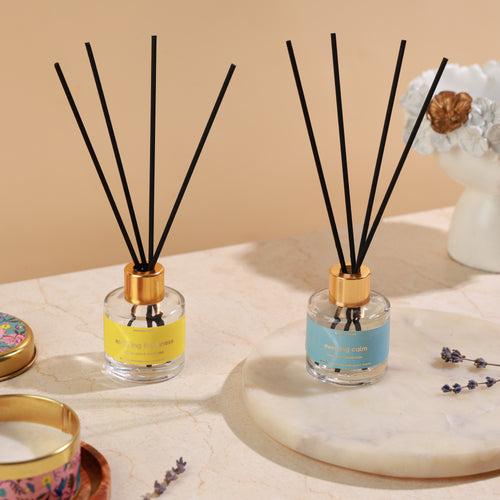
 Morning Freshness₹749A window on the latch is a slot. A window fully open is a panel. A balcony door slid or swung open is a doorway from the floor to above your head, and typically as wide as two windows side by side. Every one of those openings is exchanging your room's air with the outside; they simply do it at different rates, and the rate follows the size. This is why the balcony feels like a switch rather than a dial. There is no clever placement that works around it, because the loss is happening to the whole room rather than to one end of it. It is worth saying plainly: nothing you can buy in a bottle competes with an opening that large.
 Evening Calm₹799This is the part that explains why the difference feels disproportionate. A small window high in a wall needs a second opening somewhere to make a through-draught. A doorway from floor to lintel does not: warm indoor air, being lighter, flows out through the upper part of the opening while cooler outdoor air flows in along the floor, and the exchange sustains itself with no breeze at all. On a still evening with the balcony open you are still losing the room steadily, which is exactly the case people find hardest to believe because nothing is visibly moving. The taller the opening and the larger the temperature difference across it, the stronger this runs.
 Garden Bloom₹799Indian flats are usually planned so that the balcony sits opposite the entrance or across from a window, which is sensible for cooling and unhelpful for fragrance. Two openings on opposite sides of a room behave like a channel: air runs in a fairly direct line between them, and anything standing on that line is being ventilated rather than distributed. Most people place the diffuser on the console by the balcony, because that is where the light and the view are. That console is very often exactly on the channel. Moving the bottle off that line, to the side of the room the airflow neglects, is free and makes a visible difference even with the door still open.
The scheduling problem nobody names
Here is what makes this question genuinely awkward rather than merely technical. The hours you open the balcony are precisely the hours you want the room to smell of something. Evening, after work, the air outside finally worth having, people coming over, the doors open and the room breathing. That is when a living room is most used and most on display, and it is also the state in which it holds fragrance worst. The conflict is real and I am not going to pretend a bottle resolves it.
What resolves it is deciding what each room is for. A home with the balcony open all evening is not a fragrance environment during those hours, and it becomes one the moment it closes — that is a fact about buildings rather than about diffusers, and it applies to cooling and to noise in the same way. So either close the balcony for the last stretch of the evening and let the room build while you are still in it, or accept those as ventilated hours and put the fragrance where it will be kept: the bedroom you shut at night, the bathroom, the study with a door. A small room you can close will do more with a ₹749 bottle than a large room open to the sky will do with anything at all, and it is a much better use of the same money than escalating.
One more check before you decide the room has failed, because it costs nothing and is very often the answer. Receptors adapt to a constant stimulus within minutes: the molecules keep arriving and the brain stops forwarding the message. You live in this room, so you are the least reliable instrument in it. Leave for fifteen minutes and walk back in — with the balcony shut — and ask somebody who does not live there. Sensitivity varies between people, and if guests remark on the scent while you cannot detect it, the room is working for everybody, including you. It is the commonest thing in the world to be the last person in a house to notice its smell.
Door states, and what each one does
The arrangements people actually live in, and what each does to the room and to the bottle. The first row is what I would do if the balcony room has to be the fragrant one.
| Arrangement | What happens to the room's fragrance | What happens to the bottle | Cost to change |
|---|---|---|---|
| Balcony shut for the last hours of the evening, internal door shut, fan on low ★ | The room keeps what it makes and the fan distributes it — the best free result available | Shorter than still air because of the fan. Three reeds instead of six buys most of it back | ₹0 |
| Balcony shut, no fan | Retained but not carried — a fragrant zone with an edge to it | Full 6–8 weeks on a 50ml with six reeds | ₹0 |
| Balcony open, bottle on the far side of the room, off the channel | Reduced but not erased. The best you can do with the door open | Close to normal — the bottle itself is out of the airflow | ₹0 |
| Balcony open, bottle on the console beside it | Worst case. The output is handed straight to the opening | Shorter — moving air over the reeds speeds evaporation | ₹0. Move it tonight |
| Balcony open and internal door open | The room is a channel between two openings and is being ventilated, not scented | Shorter still | ₹0. Shut the internal door at least |
| Balcony open on a high floor or a breezy evening | Faster again — wind speed rises with height, so the air turns over more often | Shorter, for the same reason. Nothing about the diffuser differs | ₹0 |
| Same bottle moved to a bedroom that closes | Transformed, and it is the same oil and the same reeds — which is the proof the bottle was never the problem | Normal, or longer at three reeds | ₹0, and it is the move I would make |
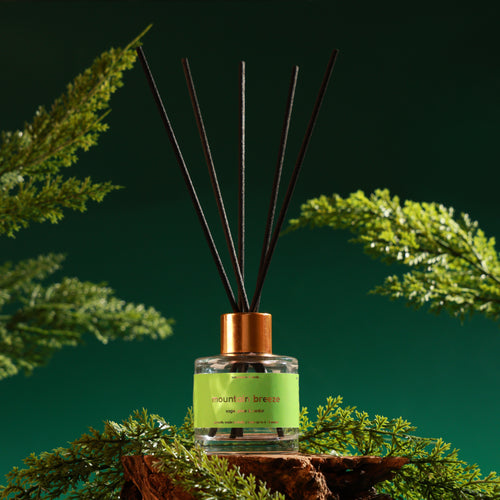
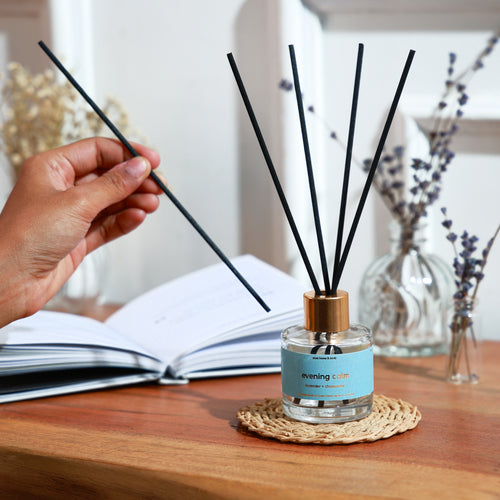 Bedroom 50ml · Evening Calm₹799Shop → Most present at 9.4 · Mountain Breeze₹849Shop →
  Moves air · Sukoon₹1,899Shop →
The free fix, in the order I would do it
First, move the bottle off the channel. Walk the line between the balcony and whatever opening faces it — an entrance, a window, a passage — and put the diffuser somewhere that line does not pass through, ideally the far side of the room from the balcony, on a surface at or slightly below nose height, near where people actually sit. This alone helps with the door still open, and it costs nothing but a change of mind about where a nice object belongs. The console by the balcony is the most photographed surface in the flat and the worst position in it.
Second, close what you can, when you can. Not the whole evening on principle — just the last stretch, or the half hour before people arrive, or the time after dinner when everyone settles. Shut the internal door as well, because a room open to the balcony at one end and the hall at the other is not a room at all for these purposes. Containment is half the equation and it costs nothing. Then give it time; a reed builds a room slowly by design, so closing up and expecting an instant result will disappoint, while closing up and going to do something else will not.
Third, put the ceiling fan on low with the balcony shut. This is the change worth making even if you make no other, because it is the only free one that addresses transport rather than adding emission. A reed emits and cannot carry; a fan carries and cannot emit; together they do the job neither does alone. Not directly under the blades at full speed, which flattens the zone and empties the bottle for no gain — low, steady, in a closed room. It does shorten bottle life, because moving air over the reeds speeds evaporation, and the free counterweight is the reed count: six is full projection, three is a soft level that roughly doubles the life. Three reeds with the fan on low, in a shut room, is the best-value arrangement in this whole subject. If that gives you the room you wanted, stop and keep your money.
If the balcony stays open
Plenty of homes are built around an open balcony and would be worse for closing it, and I am not going to advise anybody to seal a flat for the sake of a fragrance. If that is your situation, the honest position is that a passive source is fighting a continuous loss it cannot win, and the choice is between moving the fragrance to a room that closes or moving to a mechanism that produces on demand rather than accumulating slowly. Here is that ladder with its counterweights, including the gap in our own range.
| Option | What it is | When it is right | Price |
|---|---|---|---|
| 1. Scent the room that closes ★ | Move the bottle you own to a bedroom, study or bathroom, six reeds, door shut, fan on low | First, and it costs nothing. A closed 120 sq ft bedroom will do far more with a ₹749 bottle than an open living room will do with any bottle. Silent, no power, nothing to fill or charge, works in a power cut, roughly ₹13–₹15 a day, and it never breaks | ₹0 |
| 2. A 130ml for a large balcony-facing living room | Mountain Breeze 130ml ₹1,349 or Garden Bloom 130ml ₹1,299, above 150 sq ft, 14–18 weeks | Right for the room size and for the weeks — but be clear that it buys duration, not reach. It will not out-argue an open balcony | ₹1,299–₹1,349 |
| 3. Two bottles for a long or L-shaped room used at both ends | Two 50ml, one at each end, or two scents zoned deliberately | Genuinely right for a long room, two rooms that are really one volume, or different scents per zone. Not right for evenness: two passive sources make two peaks with a valley between, because neither moves air | ₹1,498–₹1,598 as a duo |
| 4. Sukoon, or Boond for a smaller room | Ultrasonic. Sukoon: 500ml, 270–320 sq ft, 16–18 hours on low, three 15ml Hotel Collection scents included. Boond: 300ml, up to about 150 sq ft, roughly six hours, USB | When you want fragrance on demand rather than accumulated over hours. Sukoon is very often the correct answer for one room and should never be skipped for something dearer. Water-diluted, adds humidity, needs filling, and in a hard-water city it can leave white mineral dust | ₹1,899 / ₹899 |
| Not this: a bigger tank bought for reach | Megh has a six-litre tank and about a hundred hours of runtime | Never a coverage upgrade — about 215 sq ft, less than the ₹1,899 Sukoon's 270–320. It is a runtime and humidity machine, and volume is duration rather than coverage | ₹3,499 |
| The honest gap: no mid-sized waterless machine | Safar ₹3,999 is waterless cold diffusion of undiluted oil, 20ml, cordless, three speeds, a 1 / 2 / 3-hour auto-off timer — and it is named and sold as a car and travel perfume diffuser, not set-and-forget. Vaayu ₹11,999 is rated to 1000 m³, roughly 2,000–3,000 sq ft | Nothing exists between them for one bedroom-sized room. Vaayu earns its price on a whole floor, an open-plan living-dining, a large home, a clinic or a showroom, and is the wrong purchase for a single bedroom | — |
Versailles
This one is close to home, because the flat I composed most of our range in has a balcony off the living room that stays open from October to March, and for the first year I quietly wondered why the living room never smelled the way the studio did. The answer was not the composition. It was that I had been treating a room with one wall open as though it were a room. Once I moved the bottle to the far side, away from the line between the balcony and the entrance, and started shutting the door for the last hour of the evening, the room did what I wanted. It cost nothing and I felt slightly foolish, which is usually the sign of a correct diagnosis.
The instinct I would talk you out of is buying upwards. When a room disappoints, the natural move is a bigger bottle, and it is the wrong axis entirely. Bottle volume is a duration specification, not a coverage specification — a 130ml lasts 14–18 weeks against 6–8 and reaches not one inch further. The clearest proof is inside our own range rather than a competitor's: Megh at ₹3,499 has a six-litre tank and a hundred hours of runtime, and covers only about 215 sq ft, which is less than the ₹1,899 Sukoon's 270–320. Bigger is a longer answer to a question you were not asking.
And I would rather you spent nothing here than spent badly. If your balcony is open because the evening air is the best thing about your home, keep it open. Put the fragrance in the bedroom, close that door, and let the living room be what it is — an outdoor-facing room in a country where that is a luxury. A reed diffuser is a quiet, undemanding object: silent, no power, nothing to fill or charge, working through a power cut, roughly ₹13–₹15 a day, and it never breaks. It is not the thing that should be fighting a balcony. Everything is composed in Pune, and a part of every order funds a girl's classroom through Nanhi Kali.
Frequently asked questions
- Where should I place a reed diffuser? — the full placement method.
- Should I put it near a ceiling fan? — yes, and it is the best free fix there is.
- Does an open window make it disappear faster? — yes, and in two separate ways.
- Does AC make it stronger or weaker? — both, and both matter.
- Directly under the AC — the one placement to avoid outright.
- Door, window, bed or centre? — the four candidates, ranked.
- Cross-ventilation — a straight line through the room, and how to place off it.
- Why it performs differently with the fan on — the mechanism behind the observation.
- Change the placement before you buy anything — the family pillar.
- Brand: the SOSA founder story.
SOSA facts verified August 2026: Reed diffusers are supplied in 50ml and 130ml only — 50ml suits rooms up to about 150 sq ft and lasts 6–8 weeks, 130ml suits rooms above 150 sq ft and lasts 14–18 weeks, at roughly ₹13–₹15 a day. Six reeds is full projection; three is a soft bedside level and roughly doubles the life; two or three reeds in a 50 sq ft bathroom can make a 50ml last nearly three months; flip the reeds every 3–5 days. Morning Freshness ₹749 / ₹1,249 · Evening Calm ₹799 / ₹1,299 · Garden Bloom ₹799 / ₹1,299 · Mountain Breeze ₹849 / ₹1,349 · Fresh Brew ₹849 / ₹1,349. Duos: Day & Night ₹1,498, Fresh & Grounded ₹1,548, Warmth & Bloom ₹1,598 as two 50ml bottles. Strength scale, perceived intensity rather than quality: Evening Calm 8.9 softest, Garden Bloom 8.9, Morning Freshness 9.0, Mountain Breeze 9.4, Fresh Brew 9.5 deepest. Six fibre reeds rather than rattan, heat-stable CCT carrier rather than DPG, alcohol-free, phthalate-free, paraben-free, IFRA-compliant, 0 ppm formaldehyde, refillable glass bottle, tested at 45°C and 85% RH, composed in Pune. Refills 300ml ₹2,399 and 500ml ₹3,499, oil only. Machines: Boond ₹899 (300ml, up to about 150 sq ft, ~6h, USB, night light) · Sukoon ₹1,899 (500ml, 270–320 sq ft, 16–18h on low, three 15ml Hotel Collection scents included) · Megh ₹3,499 (6L, ~100h runtime but only ~215 sq ft, never a coverage upgrade) · Safar ₹3,999, a waterless cold-diffusion device named and sold as a car and travel perfume diffuser, with a 20ml bottle, a 2000 mAh battery, three speeds and a 1 / 2 / 3-hour auto-off timer · Vaayu ₹11,999, a waterless cold-air nebuliser rated to 1000 m³, roughly 2,000–3,000 sq ft, with a 400ml tank and app control, and the wrong purchase for one bedroom. No coverage figure is published for Safar and none is quoted here. Reed oil, the water-based Hotel Collection and pure fragrance oil are not interchangeable across these mechanisms. No health, air-quality, allergy, sleep or mood claims are made anywhere on this page. Free shipping above ₹499. SOSA is an independent Indian fragrance house; the Hotel Collection is SOSA's own interpretation inspired by the world's finest hotels and SOSA is not affiliated with or endorsed by any hotel brand. Prices subject to change — see the live product pages.