


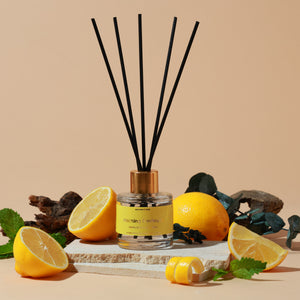
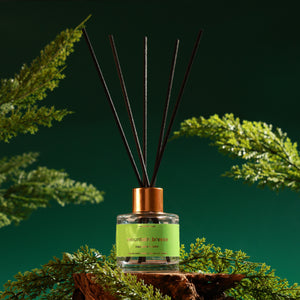
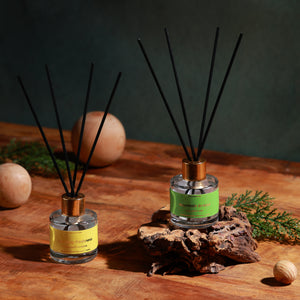
Why your reed does not do it: a reed is passive capillary evaporation. It emits vapour, not droplets, and it adds no air, so there is nothing to suspend and nothing to carry. It produces a fragrant zone around the bottle, by design.
Why an ultrasonic machine gets halfway: it genuinely moves air and covers a room, which is a real step up — but the oil is diluted in water, the mist is wet, it adds humidity, and in a hard-water city it can leave a fine white dust.
The honest gap: for one bedroom, waterless means Safar ₹3,999, which is named and sold as a car and travel diffuser and has no published room-coverage figure — or Vaayu ₹11,999, which is rated to 2,000–3,000 sq ft and is far too much machine for a bedroom. There is nothing between them.
2. The droplets are small enough to stay up. This is the property that decides everything else. Coarse droplets fall out of the air quickly and land on floors and furniture, which is what a spray does and why a sprayed room is intense for a minute and ordinary after five. Fine droplets settle slowly enough that the room’s own air currents can distribute them first. Evenness is a consequence of how long the mist stays airborne.
3. There is no water in it, and that changes what the room feels like. A waterless nebuliser throws pure oil, so nothing gets damp, the air does not gain humidity, glass does not fog and no fine white mineral dust appears on the console. It is also why the fragrance reads as crisp rather than as heavy: a wet mist carries a great deal of water per droplet and comparatively little fragrance, and your nose notices the difference as much as your skin does.
4. It is released into air that is already travelling. A hotel does not push the mist across the lobby; it hands it to the ventilation the building runs anyway, and the mist goes wherever the air was going. This is why there is no strongest point to walk towards and no findable source — which is a large part of why it reads as designed rather than as added.
5. And you arrive with a nose that has not been sitting in it all day. Receptors adapt to a constant stimulus within minutes. You are meeting the signal fresh, from outdoors, usually at the end of a journey, and that novelty is a real component of the effect. It is also the one component you cannot buy, in any range, at any price.
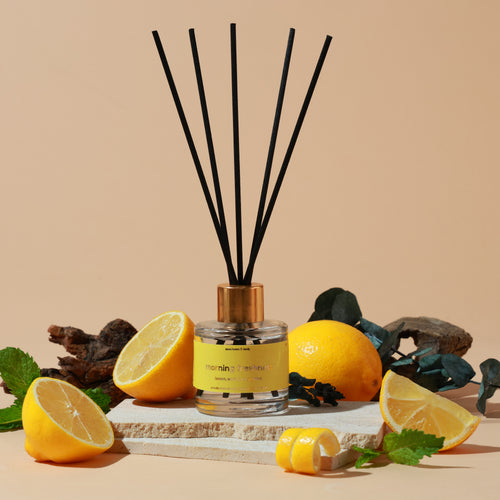
Alcohol-free, phthalate-free, IFRA-compliant, six fibre reeds in a refillable glass bottle. Free shipping above ₹499, and a portion of every order supports girl-child education through Nanhi Kali.

The three properties that turn fragrance into a cloud
People usually assume the difference between their home and a hotel is quantity — more oil, stronger oil, a bigger bottle. It is much more often a difference in the state the fragrance is in when it enters the room. These are the three properties that decide whether what leaves a diffuser hangs in the air or does not, and none of them can be improved by buying a more expensive composition.
 Hotel Collection₹999Anything released into air is in a race between its own weight and the air’s ability to hold it up. Coarse droplets lose that race in seconds and land, which is why a sprayed room smells enormous immediately and then does not — the fragrance is on the sofa, not in the air. A cold-air nebuliser atomises undiluted oil into a mist fine enough that the race takes a long time, and while it is being run the mist is being moved about. That is the whole mechanism behind the word “cloud”. It is also why no adjustment to a reed produces one: a reed releases individual molecules from a wetted surface, and individual molecules are not droplets at all.
 Sukoon₹1,899An ultrasonic droplet is mostly water with fragrance dispersed through it. A nebulised droplet is fragrance. Same oil, entirely different payload per droplet — and that, rather than any difference in the composition, is most of the perceived intensity gap between a water diffuser and a hotel machine. Dryness has consequences beyond strength: no added humidity in a room that may already be humid, no damp feel on a marble console, no fine white mineral dust in a hard-water city, and no wet patch under the machine. In a Mumbai or Chennai bedroom in August, the humidity point stops being an aesthetic one.
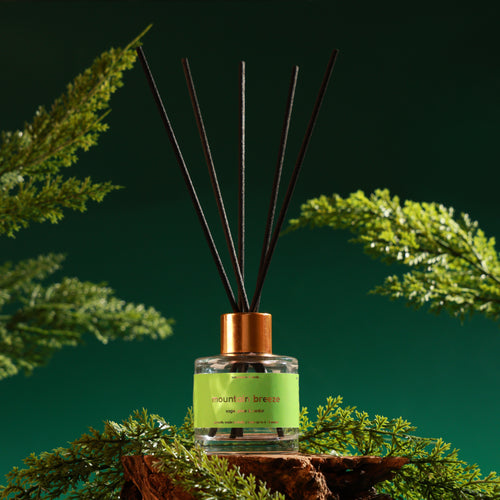
 Mountain Breeze₹849Residence time is the quiet hero of the three, because it is what converts a local release into an even room. While a mist is airborne it is being stirred by whatever the room is doing — a ventilation system, a ceiling fan, an air conditioner recirculating in a closed bedroom, or simply the convection off a warm wall. The longer it stays up, the more thoroughly it is mixed, and the smaller the difference between standing at the source and standing across the room. Short residence time gives you a strong patch and a weak room. Long residence time gives you the same level everywhere, which is what people mean by hotel-like far more often than they mean strong.
What each of the three mechanisms actually puts into your air
It is worth being literal about this, because the three formats are usually described in marketing language that hides how different they are. A reed diffuser emits vapour. Oil climbs six fibre reeds by capillary action and individual molecules leave the wetted surface at whatever rate the room’s temperature, humidity and airflow permit. There is no droplet, no plume and no cloud, and there is no energy going in. Concentration is therefore highest at the bottle and falls with distance — a fragrant zone rather than a fragranced room. That is the design and not a defect, and it is why the format is silent, needs no power, needs no filling and never has to be switched on.
An ultrasonic machine emits a wet mist. A piezo plate vibrating at high frequency throws a water-and-oil mixture off the surface as visible droplets, and because that output leaves with some velocity it moves air. Moving air is the genuine upgrade here: it is the reason a Sukoon covers 270–320 sq ft while a reed covers a corner of it. The costs are the water — dilution, humidity, and mineral dust where the water is hard — and the fact that the visible plume, being wet and comparatively coarse, comes down faster than a dry one. It is a real room-scenting device with an honest trade in it.
A cold-air nebuliser emits a dry mist of undiluted oil. No heat, no water, no dilution. Pressurised air does the atomising, the mist is fine, and it is handed to air the room or building is already moving. This is the technology hotels actually use, and in our range it is Safar at personal scale and Vaayu at 1000 m³, roughly 2,000 to 3,000 sq ft. I will say the awkward part before you find it yourself: Safar is named and sold as a car and travel diffuser, SOSA publishes no room-coverage figure for it, and Vaayu is a machine for a floor rather than for a bedroom. Between the two there is nothing, and that gap is real.
Vapour, wet mist and dry mist, line by line
The same question asked of all three mechanisms. Read the “what is in the air” column first — almost every other difference follows from it.
| Mechanism | What is in the air | Does it move air? | What you experience | In our range |
|---|---|---|---|---|
| Passive capillary — reed | Vapour only. No droplets, no cloud | No. Nothing is added | A fragrant zone around the bottle, falling away with distance. Silent, powerless, unswitchable | Reeds from ₹749 |
| Ultrasonic water mist | Visible wet droplets — oil dispersed in water | Yes, and this is the real upgrade | A covered room, plus added humidity and, in hard-water cities, white mineral dust | Boond ₹899 · Sukoon ₹1,899 · Megh ₹3,499 |
| Waterless cold-air nebulising | Dry micro-mist of undiluted oil. Nothing but fragrance | Yes, and it borrows the room’s airflow too | The suspended cloud. Even, dry, no humidity, no dust, no findable source | Safar ₹3,999 · Vaayu ₹11,999 |
| Aerosol spray (generic category) | Coarse droplets that fall out of the air quickly | Briefly, at the point of spraying | Peak and crash — enormous for a minute, ordinary after five, with fragrance on surfaces rather than in air | None — SOSA makes no room spray |
| Coverage note worth reading twice | Tank size is not coverage | — | Megh has a 6L tank and about 100 hours of runtime but covers only ~215 sq ft, less than the Sukoon at ₹1,899 | Runtime machine, not a coverage upgrade |
 Vapour · Mountain Breeze₹849Shop → Wet mist · Sukoon₹1,899Shop →
  The oils · Hotel Collection₹999Shop →
The part of the cloud that is your nose rather than the machine
I would be selling you something dishonest if I let the whole explanation sit in the hardware. A meaningful share of the arrival effect belongs to the fact that you were not there five minutes ago. Olfactory receptors adapt to a constant unchanging stimulus within minutes: the signal keeps arriving and the brain stops reporting it, because nothing has changed and nothing changing is precisely what a brain is built to ignore. This is why you can smell every friend’s house and not your own, and why the honest test of your home fragrance is not to sniff harder but to leave for a quarter of an hour and walk back in. A guest is a better instrument than you are, and asking one is free.
The corollary is worth stating because it saves people money. If you set out to reproduce the entrance sensation in your own hallway, you will succeed for visitors and for yourself on returning from outside, and you will not succeed for yourself at four in the afternoon on a working Tuesday. Nothing is wrong with the machine at that point. A diffuser you can smell continuously in your own home is usually set too strong for the room, and the fix is a lower intensity or fewer reeds rather than a bigger device. Home fragrance is designed to be noticed on arrival and at transitions, and a hotel lobby is a room composed almost entirely of arrivals.
The other half of the un-adapted advantage is novelty of composition. A hotel signature is unfamiliar to you and completely familiar to the staff, who stopped smelling it in their first week. Your own home’s scent is the one your nose knows best in the world. The practical consequence is that consistency, not variety, is what reads as luxurious — one scent held steady for a year is a signature, while four scents rotated monthly is a collection — but the price of consistency is that you personally will notice it least. That is not a failure. It is the same trade the hotel made, and the staff there cannot smell the lobby either.
What to buy for each of the three, in order — and the gap
Cheapest first, as always, because a good share of people who write to me about clouds are actually describing a still corner or a room they have adapted to. The last row is what the range does not contain, and it is the row I would want to read before spending ₹3,999.
| Do this | What it is | When it is the right answer | Price |
|---|---|---|---|
| 1. Close the door, move the bottle into the airflow, run the fan on low | Borrowing mixing and residence time from air the room already has | First. A closed bedroom with the AC recirculating is already doing half of what a hotel does | Free |
| 2. A 50ml reed diffuser | Vapour from six fibre reeds, refillable glass, 6–8 weeks, about ₹13–₹15 a day, nothing to plug in | Bathrooms, bedsides, small studies. No cloud, and a genuinely lovely fragrant zone | ₹749–₹849 |
| 3. Sukoon | Ultrasonic wet mist, 500ml, 270–320 sq ft, 16–18 hours on low, three 15ml Hotel Collection scents included | When you want the whole room covered and switchable, and can accept water, dilution and added humidity | ₹1,899 |
| 4. Vaayu | Waterless cold-air nebulising — the dry mist itself. 1000 m³, roughly 2,000–3,000 sq ft, 400ml tank lasting up to about 90+ days, app scheduling, under 38 dB | A whole floor, an open-plan living-dining, a villa, a clinic, a salon or a reception. Not one bedroom | ₹11,999 |
| Not this, for coverage | Megh ₹3,499 — a 6L tank and about 100 hours of runtime, but only ~215 sq ft | Buy it for runtime and humidity if you want those. It covers less than the ₹1,899 Sukoon and is never a coverage upgrade | ₹3,499 |
| The honest gap | SOSA has no mid-sized waterless bedroom nebuliser. Safar ₹3,999 is the same dry-mist mechanism at personal scale — 20ml bottle, 2000 mAh Type-C, 3 speeds, 1/2/3-hour auto-off — but it is named and sold as a car and travel diffuser, needs recharging, and SOSA publishes no room-coverage figure for it | Said plainly. If a dry cloud in one bedroom is the requirement, this is the rung that does not exist and you should know before you pay | ₹3,999 |
Versailles
When somebody writes to me about a fragrance cloud, they almost always apologise for the word, and they should not. It is the most technically accurate thing anyone says to us all week. They have described a suspension, and suspension is a mechanism, which means the question has an answer that is not “buy something more expensive”.
What I try to make clear is that the three formats are not three grades of the same thing. They are three different physical events. Vapour leaving a wetted stick, water droplets thrown off a vibrating plate, and undiluted oil shattered by pressurised air are as different from each other as a candle is from a lamp. Reading them as good, better and best is the error that costs people money, because it leads to buying a bigger version of the format that was never going to do it — which is exactly why I keep pointing out that our own Megh, with six litres and a hundred hours in it, covers less ground than the Sukoon at half the price.
And I would rather you knew the last part from me. If you want a dry cloud in one bedroom specifically, our range does not have the right machine for you. Safar is the correct mechanism at personal scale and it is sold as a car and travel diffuser with no published room coverage; Vaayu is a machine for a whole floor. That middle rung is empty, and pretending otherwise would get me one sale and lose me the reader. Everything is composed in Pune, and a part of every order funds a girl’s classroom through Nanhi Kali.
Frequently asked questions
- How hotels do it — the decisions behind a signature.
- What luxury hotels use — the equipment, sized honestly.
- Everywhere there, barely here — a bounded surface against a pump.
- Strong and even — the word “even”, taken seriously.
- How fragrance travels across a room — the transport page.
- Do hotels use reed diffusers? — where they genuinely appear.
- Why hotel scent feels more present — the three components of presence.
- Oil or system? — with the oil’s role properly defended.
- Recreating it at home — the whole ladder, gap included.
- Brand: the SOSA founder story.
Facts verified August 2026: SOSA reed diffusers — five scents, 50ml ₹749–₹849 suiting rooms up to ~150 sq ft and lasting 6–8 weeks, 130ml ₹1,249–₹1,349 suiting above 150 sq ft and lasting 14–18 weeks; six fibre reeds included, six for full projection and three for a soft bedside level with roughly double the life; flipped every 3–5 days; about ₹13–₹15 a day; heat-stable CCT (caprylic/capric triglyceride) carrier rather than DPG; alcohol-free, phthalate-free, paraben-free, IFRA-compliant, 0 ppm formaldehyde; refillable glass bottle; tested at 45°C and 85% RH; composed in Pune. Duos ₹1,498–₹1,598 (50ml × 2). Refills 300ml ₹2,399, 500ml ₹3,499. Ultrasonic water mist — Boond ₹899 (300ml, up to ~150 sq ft, ~6 hours, USB, night light), Sukoon ₹1,899 (500ml, 270–320 sq ft, 16–18 hours on low, three 15ml Hotel Collection scents included), Megh ₹3,499 (6L tank, ~100 hours, ~215 sq ft, less than Sukoon and never a coverage upgrade). Waterless cold-air nebulising — Safar ₹3,999 (20ml bottle, 2000 mAh Type-C, up to 10 hours continuous or around 30 hours intermittent, 3 speeds, 1/2/3-hour auto-off, 6.9 cm, named and sold as a car and travel diffuser with bedside and hotel room among its stated uses, no published room-coverage figure) and Vaayu ₹11,999 (up to 1000 m³ or roughly 2,000–3,000 sq ft, 400ml tank lasting up to about 90+ days, Bluetooth app and onboard buttons, 1h/4h/8h/24h windows, adjustable intensity, key-lock, under 38 dB, freestanding or wall/HVAC mount, 5W, CE, RoHS, SGS). Hotel Collection oils are water-based and ultrasonic-only — 15ml ₹299 (a refill), 100ml ₹999, 300ml ₹1,799 — and are not interchangeable with reed oil in either direction; there is no hotel-inspired reed diffuser. SOSA makes no room spray; every SOSA spray is a car perfume. No health, air-quality or antimicrobial claims are made, and fragrance does not remove a smell: source, ventilation, then fragrance. Free shipping above ₹499. A portion of every order supports girl-child education through Nanhi Kali. SOSA is an independent Indian fragrance house; the Hotel Collection scents referenced here are SOSA’s own interpretations inspired by the world’s finest hotels, and SOSA is not affiliated with, endorsed by or a supplier to any hotel brand. Prices subject to change — see the live product pages.