

How to rule out an actually weak bottle: the level should be visibly dropping over the weeks, the reeds should be darkened with oil well above the liquid line, the fragrance at the neck should still be rich, and it should not have turned sour or bitter. If all four hold, the bottle is fine.
What "weak" is really measuring: you judged emission — how much leaves the bottle — using evidence about transport, which is how far it gets. Only one of those is under the bottle's control, and it is not the second.
The honest gap: no reed, at any price or strength rating, projects across a room. If reach rather than richness is what you want, that is an active diffuser — most often Sukoon at ₹1,899, and rarely anything dearer.
2. You have judged one quantity using evidence about another. Emission is how much fragrance leaves the bottle, and it is set by reed count, bottle size, room temperature and the oil itself. Transport is how far that fragrance gets, and it is set almost entirely by air the room is already moving. The word weak is a verdict on emission. The observation I have to walk close is a measurement of transport. The two are not the same instrument.
3. Here is what genuinely weak would look like. The level in the bottle not dropping over several weeks. Reeds that are dry a centimetre above the oil line after two days. A neck that smells of very little when you put your nose to it. Or a fragrance that has turned sour or bitter, which is a carrier failing in heat rather than a dose being low. If none of those describes your bottle, your bottle is not weak.
4. Strength ratings do not measure reach, and I would rather you knew that from me. Our own scale runs from Evening Calm at 8.9, the softest thing we make, to Fresh Brew at 9.5, the deepest. That is perceived intensity in the air near the source. It exists so that somebody buying for a small sealed bedroom can choose deliberately downwards. A 9.5 does not travel further than an 8.9. It arrives more emphatically in the same zone.
5. Do the free things, then decide. Six reeds instead of three, half the distance, nose height, out of the draught, door shut, ceiling fan on low. If those give you the room you wanted, spend nothing. If you still want the far side of the room to smell of it, you want moved air, and Sukoon at ₹1,899 is where I would look before anything more expensive.
Alcohol-free, phthalate-free, made in Pune. A portion of every order supports girl-child education through Nanhi Kali.
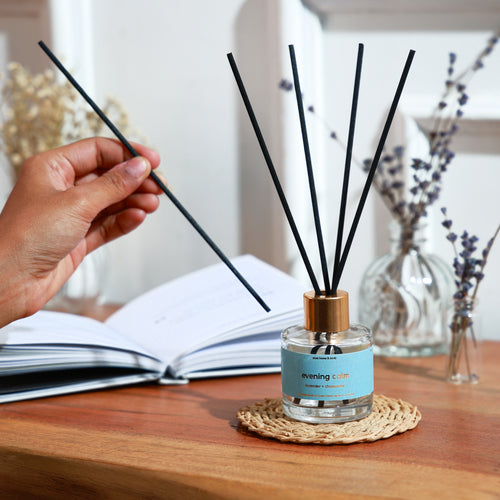
What a genuinely weak bottle actually looks like
I would like to give you a real fault test rather than reassurance alone, because reassurance you cannot check is not worth much. There are only a few ways a reed diffuser can genuinely underperform, and every one of them shows up close to the bottle, where you already have good evidence. Run these three checks before you conclude anything about the far side of the room.
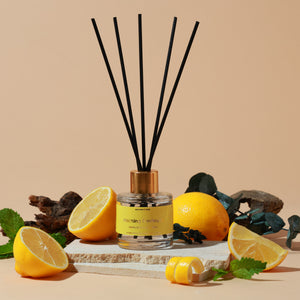
 Morning Freshness₹749A working bottle empties. Over a fortnight the level should be visibly lower, and a 50ml on six reeds should be gone in six to eight weeks. Look at the reeds themselves too: they should be darkened with oil for a good length above the liquid, which is capillary action doing its work. A bottle that has not moved in three weeks and reeds that are dry just above the oil line are the one genuinely diagnostic failure, and it is usually a wicking problem rather than a fragrance one — clogged reeds, or rattan reeds whose irregular internal channels have stopped drawing in humidity. Every SOSA bottle ships with fibre reeds for exactly that reason.
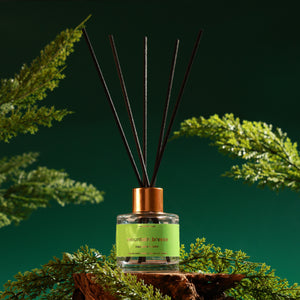
 Mountain Breeze₹849Put your nose to the neck of the bottle. The composition should be legible and rich — you should be able to find the top, the heart and the base. The failure to look for is not faintness but distortion: sour, bitter, acrid or plasticky. That is a carrier problem. A great many reed diffusers sit on DPG, which can crack above roughly 40°C, and an ordinary Indian afternoon reaches that. Every SOSA reed sits on a heat-stable CCT base, coconut-derived, tested through a 45°C heat soak and 85% monsoon humidity, which is an unglamorous decision and the entire reason the bottle behaves the same in May as in January.
 Garden Bloom₹799A 50ml is built for a room up to about 150 sq ft. Put the identical bottle in a 300 sq ft open-plan bedroom, or one with a balcony door open all evening, and it reads as weak while performing to specification, because concentration is output divided by volume and reduced further by air leaving the room. If you have ever carried the same bottle into a bathroom and found it suddenly emphatic, you have already run the control experiment — same oil, same reeds, same cadence, one third of the air and a shut door. That result is proof the product is fine and the variable is the room.
What a reed diffuser is actually specified to do
Here is a thing worth noticing: no honest reed diffuser anywhere carries a projection specification. Bottles are specified in millilitres and weeks, and rooms in square feet — a SOSA 50ml suits spaces up to about 150 sq ft and runs 6–8 weeks, a 130ml suits above that and runs 14–18 weeks. Nowhere in that specification is a distance, and the reason is that no such figure exists. How far a reed reaches depends on the volume of your room, how contained it is, how warm it is and what your air conditioning and ceiling fan are doing, none of which a manufacturer in Pune knows anything about. Any brand quoting you a reach in feet is quoting a number for a room it has never seen, and I would treat it as marketing rather than measurement.
So when you ask whether yours is weak, the honest reply is: weak against what? Against the neck of the bottle, it is not — you have just told me it smells beautiful there. Against a mental image of a hotel lobby, yes, and so is every reed diffuser ever made, including the expensive ones, because hotels do not put an object on a table and hope. They introduce fragrance into a building's moving air, which is why you can never find the diffuser in a hotel room and why there is no gradient to walk up. That is a different technology answering a different brief, and comparing your bedside bottle with it is comparing a candle to the electric light.
What the reed is specified to do, it does better than anything else in this range. It is completely silent. It needs no socket, no water, no filling and no charging. There is nothing to switch on and nothing to remember, and it carries on working during a power cut, which in a great deal of India is not a trivial property. It costs roughly ₹13–₹15 a day. It is an object rather than an appliance — it looks like something you chose rather than something you installed — and unlike every machine on this page, it never breaks. If a rich, characterful zone where you actually sit is what you want, nothing else here does it so gracefully.
Faulty, or working as designed — the checklist in one table
The complete diagnostic, with the symptom on the left and the honest reading on the right. The last row is the one that sends people looking for a stronger bottle when they should be looking at a different mechanism, and it is worth reading even if nothing else here applies to you.
| What you observe | What it means | Emission or transport | What to do |
|---|---|---|---|
| Rich at the bottle, quiet across the room | Normal. The designed behaviour of a point source | Transport | Free fixes, then decide whether you want a machine |
| Level not dropping after three weeks | A genuine wicking failure — the one real fault | Emission | Replace or unclog the reeds; check they are fibre, not rattan |
| Reeds dry above the oil line after two days | Same fault, seen earlier | Emission | Flip them; if still dry, the reeds are the problem, not the oil |
| Sour, bitter or acrid rather than faint | A carrier failing in heat, typically DPG above 40°C | Neither — a formulation fault | Move it out of direct sun; a CCT-based oil should not do this |
| Strong in week one, quieter by week three | Not fading, settling — the lightest materials leave first | Emission, expected | Flip the reeds every 3–5 days. Week three is the composition as written |
| Everyone else notices it and you do not | Adaptation. You live there; they do not | Neither — perception | Leave for fifteen minutes and walk back in. Ask a visitor |
Making the zone bigger, for nothing
Everything here is free, and a large share of the people who arrive at this page are finished after the first two items. Reed count first. Every SOSA bottle contains six fibre reeds and a lot of people use three because three looks neater on a bedside table. Six is full projection; three is a soft bedside level and roughly doubles the life of the bottle. If you have three in and you have decided the diffuser is weak, you have judged it at half volume. Put all six in, give it two days to saturate, then judge. The trade is honest and it goes both ways: six is stronger and shorter, three is gentler and longer, and in a small bathroom two or three reeds can stretch a 50ml to nearly three months.
Then distance, which is worth more than any other adjustment available to you. Halve the gap between the bottle and where you sit or sleep. A diffuser on a chest of drawers across the room and the same diffuser on the bedside table are two completely different products from where you lie, and moving it is not a defeat — it is the correct use of a point source. At very close quarters, incidentally, use three reeds rather than six, or the near field becomes too much. Then height: at or a little below nose height, on a surface, never on the floor and never on a high shelf. Then the draught: off the windowsill, out of the direct blast of a split unit, away from an open balcony door — but not buried in a still nook behind a wardrobe either. Then the door, because containment is half of this and shutting one costs nothing.
And then the item I would rank first if it did not require a sentence of explanation: put the ceiling fan on low. A fan is precisely the transport a reed does not have. The bottle keeps making fragrance and the fan finally carries it somewhere, and the result is much closer to the even room most people are imagining than any reed count can produce. The cost is that it shortens the bottle's life, because moving air across the reeds evaporates them faster. I would rather tell you that and let you choose the evening than quietly leave the advice out. It is also why a closed bedroom with the air conditioning running often smells strongest at night — recirculation distributes well, and dry moving air empties the bottle sooner. Better distribution, shorter bottle, both true at once.
If what you want is reach rather than richness
Then you have a real requirement, it is a perfectly reasonable one, and no reed on earth meets it. I would rather say that than sell you a second bottle or a stronger scent and watch you arrive at the same sentence in six weeks. Here is the whole ladder in the order I would actually work through it, including the two things in our own range I would talk most readers out of.
| Step | What it is | When it is the right answer | Price |
|---|---|---|---|
| 1. Six reeds, half the distance, fan on low ★ | Full emission, better placement, and the only free source of transport there is | First, for everyone. Many readers stop here | Free |
| 2. A 50ml reed, placed properly | Six fibre reeds, refillable glass, 6–8 weeks, silent, no power, works in a power cut | When a rich zone where you sit is genuinely the thing you want | ₹749–₹849 |
| 3. 300ml refill | Oil alone — roughly six 50ml fills for the bottle and reeds you own | Only once you have settled on a scent. Never a first purchase | ₹2,399 |
| 4. Sukoon ultrasonic ★ | 500ml, 270–320 sq ft, 16–18 hours on low, three 15ml Hotel Collection scents included | When reach across a room is the actual requirement | ₹1,899 |
| 5. Safar waterless | Named and sold as a car and travel diffuser. Undiluted oil, 20ml, cordless, three speeds, a 1 / 2 / 3-hour auto-off timer, so not set-and-forget and it needs recharging | For emphatic personal-scale projection with no water and no dilution | ₹3,999 |
| The gap, and the two I would refuse: Megh and Vaayu | Megh ₹3,499 holds six litres and runs around 100 hours yet covers only ~215 sq ft, less than the ₹1,899 Sukoon. Vaayu ₹11,999 is rated to 1000 m³, roughly 2,000–3,000 sq ft. Between Safar and Vaayu there is no mid-sized waterless bedroom nebuliser in the range | Megh is a runtime and humidity machine and never a coverage upgrade. Vaayu is the wrong purchase for one bedroom, where nine-tenths of it is wasted | ₹3,499 / ₹11,999 |

Versailles
The word weak arrives in my inbox more often than any other, and it almost never means what the sender thinks it means. What they are describing is a bottle that smells wonderful when they lean towards it and nothing at all from the doorway. That is not weakness. That is a passive device being asked, entirely reasonably, to do something active. Nobody told them the difference, so they reached for the only word available.
I find the money question underneath it more interesting. What people are really asking is whether a dearer bottle would have travelled further, and the honest answer is no — and it stays no all the way up the price list. What a higher price buys, once you cross from a bottle to a machine, is not a better smell. It is transport, control and evenness. A ₹1,000 reed and an ₹11,999 nebuliser can run related fragrances and produce completely different rooms, and the difference in the room is the machinery, not the perfumery. I would rather a customer understood that before spending than after.
So: check the level, check the neck, put all six reeds in, move the bottle to where you actually are, and give it a fan on low for half an hour. If that is the room you wanted, keep your ₹1,899. If it is not, buy the Sukoon, not the thing at three times the price, and know before you order that the fragrance in it will be a different one. Everything is composed in Pune, and a part of every order funds a girl's classroom through Nanhi Kali.
Frequently asked questions
- Why can I smell it only when I stand next to it? — the point-source explanation from the beginning.
- Amazing within two feet and nowhere else — is that normal? — yes, and here is why.
- Why doesn't the fragrance travel across the room? — molecular diffusion, and how slow it really is.
- Strong beside the bottle, weak from the bed — the distance problem, with the free answers.
- How far should it actually travel? — why no honest brand publishes a figure.
- One strong corner, the rest nothing — the smooth gradient and the edge that is not there.
- It's definitely evaporating, so why can't I smell it? — where the millilitres actually go.
- Walking past versus sitting still — two mechanisms, stacked.
- I love the fragrance — how do I get it everywhere? — the full ladder, free fixes first.
- Brand: the SOSA founder story.
SOSA products — facts verified August 2026: Reed diffusers in 50ml and 130ml only. Morning Freshness ₹749 / ₹1,249 (9.0) · Evening Calm ₹799 / ₹1,299 (8.9, softest) · Garden Bloom ₹799 / ₹1,299 (8.9) · Mountain Breeze ₹849 / ₹1,349 (9.4) · Fresh Brew ₹849 / ₹1,349 (9.5, deepest). 50ml suits rooms up to ~150 sq ft and lasts 6–8 weeks; 130ml suits above 150 sq ft and lasts 14–18 weeks; roughly ₹13–₹15 a day. Six fibre reeds in a refillable glass bottle, on a heat-stable CCT (caprylic/capric triglyceride) carrier rather than DPG, alcohol-free, phthalate-free, paraben-free, IFRA-compliant, 0 ppm formaldehyde, climate-tested at 45°C and 85% RH, composed in Pune. Duos ₹1,498–₹1,598 (50ml × 2). Refills 300ml ₹2,399 · 500ml ₹3,499, oil only. Machines: Boond ₹899 (300ml, ≤~150 sq ft, ~6h) · Sukoon ₹1,899 (500ml, 270–320 sq ft, 16–18h on low, three 15ml Hotel Collection scents included) · Megh ₹3,499 (6L, ~100h runtime, ~215 sq ft) · Safar ₹3,999, named and sold as a waterless car perfume diffuser, 20ml, 2000 mAh, up to 10 hours continuous or around 30 hours intermittent per charge, three speeds and a 1 / 2 / 3-hour auto-off timer, 6.9 cm — SOSA publishes no room coverage figure for it and none is given here · Vaayu ₹11,999 (up to 1000 m³, roughly 2,000–3,000 sq ft, 400ml, under 38 dB). Hotel Collection oils are water-based and ultrasonic-only: 15ml ₹299 · 100ml ₹999 · 300ml ₹1,799. Reed oil and Hotel Collection oil are not interchangeable in either direction and there is no hotel-inspired reed diffuser. No health, air-quality or sleep claims are made for any SOSA product; fragrance does not remove an unwanted smell, which is a matter of source, then ventilation, then fragrance. Free shipping above ₹499. A portion of every order supports girl-child education through Nanhi Kali. SOSA is an independent Indian fragrance house; the Hotel Collection scents are SOSA's own interpretations inspired by the world's finest hotels, and SOSA is not affiliated with or endorsed by any hotel brand. Prices subject to change — see the live product pages.