



Where not to: any room in the direct line between two open windows. A bottle there is being emptied outdoors and will run about ten weeks instead of sixteen.
The alternative: a Sukoon at ₹1,899 with a 15ml Hotel Collection at ₹299 — ₹2,198 — because a machine you switch on matches a home whose air is only still for part of the day.
2. Buy for the rooms that close. Almost every strongly cross-ventilated Indian home has two or three spaces that behave normally — the bedroom once the AC goes on, the bathroom with its single small window, sometimes a study. Those rooms return to 0.2–0.5 air changes an hour the moment the door and windows shut, which is exactly the condition coverage figures assume. A 130ml at ₹1,249 in the bedroom and a 50ml at ₹749 in the bath is ₹1,998 and will read properly, where the same ₹1,998 spread across the living room and the hall would read as almost nothing.
3. Buy for the hours, not just the rooms. Cross-ventilation is not a constant. Most homes like this are open from early morning until mid-morning and again in the evening, and shut overnight. That is a schedule, and it means the question "how much fragrance does this home need" has a different answer at 8am and at 11pm. A passive bottle runs continuously and cannot take advantage of the still hours specifically. A Sukoon at ₹1,899 running the water-based Hotel Collection from ₹299 can be switched on when you close up, which is the mechanism that fits this home.
4. Expect any bottle here to run short — and price it honestly. Evaporation rises with airflow and with heat. A 130ml rated at 14–18 weeks in a still room may give ten weeks in a draughty one, which turns about ₹78 a week into about ₹125. That is not a fault in the bottle; it is what airflow costs. Knowing it in advance is what stops people buying four of them and then feeling cheated when the whole set needs replacing before the season is out.
5. Move the bottle before you buy another. The single most effective free adjustment in a ventilated home is to get the source out of the flow path. Draw the line between your two facing openings — front door to balcony, window to window — and put nothing on it. An inside wall, a corner, the side of a room away from that axis: those places retain air far better, sometimes enough to make a bottle that read as nothing read perfectly well. Position is free. A second bottle is ₹1,249.
Made in India, composed by an ISIPCA Versailles-trained perfumer — and a portion of every order supports girl-child education through Nanhi Kali.
Air changes beat bottle sizes, every time
Every coverage figure in home fragrance carries a condition, and this is the home where that condition matters most. One reed diffuser on six reeds holds a room of up to about 150 sq ft closed and still — the closed and still part is not decoration. It describes an equilibrium: the bottle evaporates fragrance into the room at a steady rate, the room loses a little to leakage, and the two settle at a level you can smell. A closed room exchanges roughly 0.2 to 0.5 of its air an hour, so that equilibrium is easy to reach. Open windows on two sides and you are at three to eight air changes an hour, which means the whole volume is swapped for outside air every eight to twenty minutes. There is no equilibrium to reach. The bottle is producing into a river.
The second effect is on cost rather than performance. Evaporation from a reed diffuser rises with temperature and airflow — this is why the same bottle lasts longer in an air-conditioned bedroom than in a hot hallway — so a draught does not just carry the fragrance away, it pulls it out of the reeds faster. A 130ml rated at 14–18 weeks can come in nearer ten in a windy position, taking the running cost from about ₹78 a week to about ₹125. Put those two effects together and the arithmetic of buying more bottles for a ventilated home collapses: you would be paying a premium per week for fragrance that spends most of its short life outdoors. The rational response to high air exchange is to spend less, in fewer places, chosen because the air there is still. That is not a compromise. It is the only version of this purchase that works.
The three decisions for a ventilated home
 Two bottles₹1,998Walk through the flat and ask of each room: can this be shut, and is it ever shut? The bedroom with the AC qualifies. The bathroom qualifies — it is the least ventilated room in a ventilated house and the cheapest volume in the home to hold. A study with a door qualifies. The living room with the balcony open and the main door on the latch does not, and neither does the hall. Buy for the first list and nothing at all for the second, and you will spend roughly half what a room-by-room count would have cost you for a better result.
Sizing by space — a home where the air is moving
Sort your rooms by whether they can be closed before you read this. Two rows tell you to buy nothing, and one of them is probably your largest room.
| Space | What it needs | How many | Cost |
|---|---|---|---|
| Bedroom that closes at night, 120–150 sq ft ★ | One 130ml on four or five reeds — the room where coverage figures actually apply | One | from ₹1,249 |
| Bathroom with one small window | A 50ml on two reeds — the least ventilated room in a ventilated house, and the cheapest to hold | One | from ₹749 |
| Living room with the balcony door and the opposite window both open | Nothing while it is open. Three to eight air changes an hour beats any bottle | None | ₹0 |
| Any room in the direct line between two facing openings | Nothing. It is a wind tunnel — a bottle there is being emptied outdoors | None | ₹0 |
| The living room, for the evening hours when you shut up and have people over | A Sukoon with a 15ml Hotel Collection — a switch, not a constant | One machine | ₹2,198 |
| A reed bottle you insist on running in a draughty position | Six reeds, off the flow axis — and price it at about ₹125 a week rather than ₹78 | One | from ₹1,249 |
| A note on all of the above: all the coverage and longevity figures on this page are steady-state numbers measured in a closed, still room. A strongly cross-ventilated home is the case they least describe, and a reader who buys on the headline figure here will be disappointed. Buy for the still rooms, expect shorter bottle life everywhere else, and treat placement as the first adjustment rather than the last. | |||
One room · the unitFrom ₹749Shop → 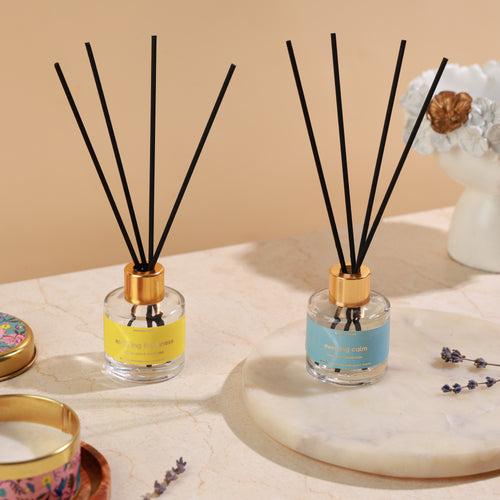 Two rooms · better value₹1,498Shop →
  Large room · a switch₹1,899Shop →
Placement, reeds and the running cost
Place first, buy second. In a home like this, position is worth more than money. Identify the two openings that create the draught and keep every bottle off the line between them — an inside wall, a corner, a side table set back from the axis. Keep them out of direct sunlight, which heats the oil and fades the fragrance, and out of the direct throw of a ceiling fan or AC vent, which does exactly what the draught does but faster. Then give it forty-eight hours, because reeds have to saturate along their full length before they throw properly, and judge it by walking in from outside rather than from inside the room, where you will have adapted within about twenty minutes and will always under-read your own home.
Use six reeds in ventilated rooms and fewer in the closed ones. Reed count is the only volume control a reed diffuser has, and the trade is real: more reeds means a stronger room and a shorter bottle. In a bedroom that shuts, four reeds is right and the bottle will run its full 14–18 weeks. In a room with air moving through it, six is the setting if you are running one there at all — but understand that you are choosing to spend faster to be heard over the airflow, and that the honest alternative is to put nothing in that room and accept that it will read of the outside, which in a well-ventilated flat is rarely a bad thing.
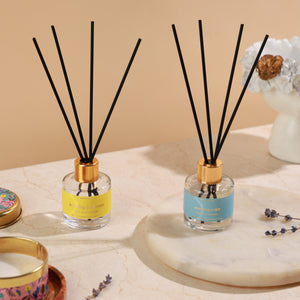
Then plan the running cost before you commit. A 130ml at ₹1,249 gives 14–18 weeks in a closed room — about ₹78 a week — and perhaps ten weeks in a windy one, about ₹125. A 50ml at ₹749 gives 6–8 weeks, about ₹105, and rather less in a draught. If your home is genuinely open most of the day, a 300ml refill at ₹2,399 is the thing that keeps this affordable, since it fills a 130ml roughly twice; and refilling is when you fit fresh reeds, because clogged fibre is the usual reason a bottle seems weak after a few months. For a bedroom that shuts, Evening Calm; for a bathroom, Morning Freshness.
What to buy
Two lines cover a ventilated home honestly, and one of them is a machine rather than a bottle. Here is what each option is for.
| Buy | What it covers | Lasts | Price |
|---|---|---|---|
| One 50ml | A single reed diffuser — the bathroom — the one room in a ventilated flat that behaves like a closed room | 6–8 weeks | from ₹749 |
| One 130ml ★ | The value size — the bedroom that shuts at night, on four reeds — about ₹78 a week when the air is still | 14–18 weeks | from ₹1,249 |
| The duo | Day & Night duo — a bedroom and a bathroom together, which are the two rooms in this home worth doing | 6–8 weeks each | ₹1,498 |
| Sukoon | 500ml ultrasonic — the living room in the evening hours, when the windows shut — a switch rather than a constant | Runs when you switch it on | ₹1,899 |
| 300ml refill | The running cost — keeping the bedroom bottle going, and the thing that makes a draughty home affordable | Roughly 2 × 130ml fills | ₹2,399 |
Versailles
People with beautiful airy flats write in expecting to be told to buy more, and I tell them to buy less. You cannot hold air that is leaving. At six air changes an hour the room is completely replaced every ten minutes, and a passive bottle producing quietly into that is not underpowered — it is in the wrong place.
What works is being selective. Almost every home like this has a bedroom that shuts at night and a bathroom with one small window, and those two rooms behave exactly the way the coverage numbers assume. Put ₹1,998 there and the home reads of something in the moments people are actually in it. Spread the same money across four open rooms and nobody will smell anything anywhere.
If what you want is the living room to read of something when you shut up in the evening and people come over, buy the Sukoon rather than more bottles. A switch is the right mechanism for a home whose air is only still for part of the day. And do try moving the bottle off the draught line first — it costs nothing and it settles a surprising number of these. A portion of every order funds a girl's classroom through Nanhi Kali.
Frequently asked questions
- When every door stays open — the doors you have, unused.
- A home with no internal doors — when the whole flat is one air space.
- When to stop adding reeds — the honest crossover point.
- The complete sizing and quantity guide — every home type, three builds.
- Brand: the SOSA founder story.
SOSA products & prices (verified August 2026): Hotel Collection water-based ultrasonic diffuser fragrance 15ml ₹299 · 100ml ₹999 · 300ml ₹1,799 · Pack of 7 (15ml, all fragrances) ₹1,799; refills 100ml from ₹999. Seven scents: The Ritz-Carlton-inspired (white tea · bergamot · cedar), Westin-inspired (white tea · aloe · cedar), 1 Hotels-inspired (cedarwood · vetiver · green leaves), The St. Regis-inspired (amber · violet · woods), Shangri-La-inspired (jasmine · green tea · white tea), Four Seasons-inspired (citrus · floral · sandalwood), W Hotels-inspired (citrus · pepper · amber). Diffusers: Boond 300ml ₹899 · Sukoon 500ml ₹1,899 · Megh 6L ₹3,499. Water-based, phthalate-free, composed to IFRA standards for home diffusion; 3–6 drops per tank. Made in India, Pune. The Hotel Collection scents are SOSA's own interpretations inspired by the world's finest hotels; all hotel names are trademarks of their respective owners and are used only to describe the scent style — SOSA is an independent Indian fragrance house, not affiliated with or endorsed by any hotel brand. Prices and availability subject to change — see the live product pages.