




Instrument two — the held reed: hold that reed a few inches from your nose. It should read clearly as the composition you bought. Thick and muted means the exposed end has silted up.
Instrument three — a fresh nose: anyone who has just walked in from outside. Ask before you tell them what it should smell of.
Why not the level: a 50ml over its 6–8 week life loses on the order of a millilitre a day, against curved glass. That is below the resolution of the eye on any single morning.
2. Take the wet-line reading. Gloves on, lift one reed, and find where the darkened oil-soaked section ends. Somewhere around the middle, having risen over the first fortnight, is healthy. Near the top with a dark, tacky reed is a stall. Barely above the oil after two weeks is undersupply.
3. Take the held-reed reading. With the same reed in your hand, hold it three or four inches from your nose. This is a concentrated sample of exactly what the room is being offered. If it reads clean and recognisably like the fragrance you bought, oil is moving and the composition is intact.
4. Take the fresh-nose reading. Ask somebody who has just come in from outside, before you tell them what they are supposed to smell. Your own nose is disqualified for this job — it stops reporting constants within minutes and adapts hardest at home, on precisely the kind of steady low background a reed diffuser is designed to produce.
5. If you live alone, substitute the hour-out test. Close the room, go out for an hour, and pay attention to the first two seconds when you come back in. That is the closest you can get to borrowing somebody else's nose.
6. Only then decide anything. Three good readings and a slow level means a slow room, not a fault. A bad wet line means a free fix. A good wet line, a good reed and no reaction from a visitor means the composition is quieter than the room needs, or the room is bigger than the format covers.
7. And stop checking the glass daily. If you want to track the level honestly, put a strip of tape on the bottle on day one and look again in a month.
Composed and handmade in small batches in Pune, and a portion of every order supports girl-child education through Nanhi Kali.
Part one — the three instruments that actually tell you something
Every measurement problem comes down to choosing an instrument that responds to the thing you care about. You care about whether fragrance is being delivered into a room. The level in the glass responds to that only weakly, slowly and with a long delay; three other readings respond to it immediately. Two of them are physical and one is social, and the social one is the most powerful of the three despite being the one people are most reluctant to use. Between them they take under a minute, cost nothing, and settle almost every question this sub-cluster of articles exists to answer.
 Mountain Breeze₹849 · 9.4/10With that same reed in your hand, bring it three or four inches from your nose. You are now sampling, at high concentration, precisely what the room is being offered — and at that distance adaptation has no chance to hide anything, because you have introduced a sudden change rather than a constant. A working reed smells clean and recognisable: you should be able to name the fragrance from it. A stalled one smells thick, dull and faintly generic, because what remains at the tip is the residue rather than the composition. This second reading is what turns the first from a hint into a diagnosis: a high wet line plus a muted reed is a stall with no ambiguity at all, and it is fixed by flipping all six, for free, this afternoon. Put the reed back the way it came, and wash your hands — reed oil marks skin, wood and stone alike, which is why the bottle belongs on a tray.
Part two — what people measure, and what it actually tells them
Before the good instruments, a short audit of the bad ones. Every row below is something I have been sent as evidence, usually with a photograph attached, and none of them supports the conclusion drawn from it.
| What people measure | What it genuinely indicates | Why it misleads | Measure this instead |
|---|---|---|---|
| The oil level, checked daily ★ | Roughly nothing over a day; something over a month | The daily change is smaller than the meniscus you are reading | The wet line, plus tape on the glass checked monthly |
| Days since you bought it | Where you should be on the curve, in theory | Our windows assume six reeds, weekly flipping, no draught — your room may differ in every one | Whether the plateau still smells the way it did in week three |
| How strong it smells to you, sitting in the room | How adapted you are, mostly | Your nose suppresses constants fastest in your own home | A visitor's first reaction, or the hour-out test |
| How it compared to day one | The size of the opening spike, which always fades | Days one to three are a spike; the plateau is the product | Week three against week seven, not day one against today |
| How dark the reeds have gone | Age and residue — useful, but only alongside the wet line | Darker compositions tint reeds faster with no fault at all | Darkness and tackiness and a muted held reed together |
| Whether the reeds feel wet to the touch | Very little — the top of a healthy reed is barely damp | A dripping reed is usually one just flipped, not a healthy one | Where the wet line sits, not how wet the tip feels |
| The honest caveat: none of the good instruments is quantitative either. They are qualitative checks that reliably separate a stall from a starved bottle from a slow room, and that is all they are for. Anyone offering you a numeric diffuser diagnostic is selling certainty that does not exist in a passive, unpowered format. Treat everything on this page as SOSA working guidance from our own testing and correspondence. | |||
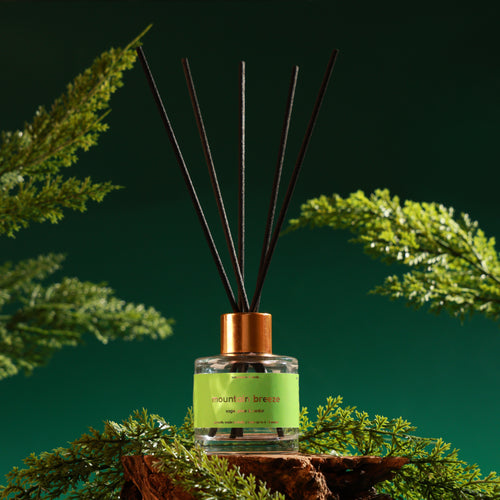 Mountain Breeze · 9.4/10from ₹849Shop →
 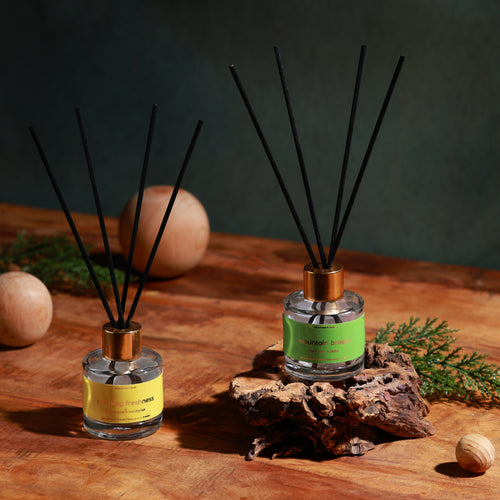 Fresh & Grounded duo₹1,548Shop →
  Oil refill · 300ml₹2,399Shop →
Part three — why the eye is the wrong sense for this job
Work the arithmetic on our own published figures and the problem becomes obvious. A 50ml rated at six to eight weeks is releasing on the order of a millilitre a day; over the course of a week that is a change you might just notice against a straight-sided glass in good light, and over the course of a morning it is nothing at all. People check daily, see no change, and conclude from an instrument with insufficient resolution that the product has failed. The 130ml is worse rather than better in this respect: the same daily loss spread across a longer fourteen-to-eighteen-week life and a taller column of oil, so weeks can pass looking identical. If you want to use the level at all, use it slowly — mark the glass with tape on the day you set it up and look again a month later. Used that way it is a genuine long-run check on throughput. Used daily it is an anxiety generator.
There is a shape problem layered on top of the resolution problem. Reed bottles narrow towards the neck, ours included, which means the same millilitre lost shows up as a different visible drop depending on where in the bottle the oil currently sits. Early on, in the wide part of the glass, the level looks stubborn; later, in the narrow section, the identical rate of loss appears to accelerate, and I get a second wave of letters asking why it has suddenly started disappearing. Nothing accelerated. The geometry changed. Any instrument whose sensitivity varies along its own scale needs to be read with that in mind, and most people quite reasonably have not thought about their diffuser as an instrument at all.
The deepest objection, though, is not about precision. It is that the level measures the wrong quantity entirely. It records what has left the glass, not what has arrived in the room, and those two come apart in both directions in ordinary homes. Put a bottle directly in the path of a split AC and it will empty weeks ahead of schedule while the room smells of very little, because fragrance is being stripped off the reeds and flushed away before it can distribute. Put the same bottle in an alcove behind a sofa and it will hold its level admirably and do nothing, because there is no air exchange to carry anything anywhere. A fast level and a slow level can both mean failure; a fast level and a slow level can both mean success. Only the reed and the room can tell you which, which is precisely why the three instruments above exist and why I would rather you spent a minute on them than ₹1,349 on a bigger bottle that measures the same wrong thing more slowly.
Part four — the three readings, and the verdict each combination gives
Take all three readings, then find your row. The combinations are not arbitrary — each one points at a different half of the machine, and only two of the seven cost money to resolve.
| Wet line | Reed held close | A visitor's reaction | Verdict and what to do | Cost |
|---|---|---|---|---|
| Mid-reed ★ | Clean and recognisable | Notices it on arrival | Working. The room is slow, not the bottle — leave it alone | Free |
| High, reed dark and tacky | Thick and muted | Notices nothing | Stalled. Flip all six and judge tomorrow evening | Free |
| Barely above the oil at week three | Faint | Notices nothing | Starved. Add or refresh reeds, top the oil to the neck | Refill ₹2,399 if you also top up |
| Mid-reed | Clean | Notices nothing | Delivery is fine but the room defeats it — airflow, size, or a quiet composition | Free first; from ₹849 if you change scent |
| Mid-reed | Clean | Notices it — but you cannot | Adaptation. Nothing is wrong. Alternate scents between rooms if it bothers you | Free · or a duo at ₹1,548 |
| Falling fast, bottle emptying early | Clean at the bottle | Notices nothing across the room | Draught or direct sun. Move it several feet clear of the vent or window | Free |
| Mid-reed, room over roughly 250–300 sq ft open | Clean | Notices it only near the bottle | Format ceiling. Two sources, or a Sukoon for scent on demand | Duo from ₹1,498 · Sukoon ₹1,899 |
Versailles
At Versailles we were taught to distrust our own noses on a schedule. You do not evaluate a composition for hours at a stretch, because by hour two you are no longer measuring the fragrance — you are measuring your own fatigue. You leave the room, you come back, and you trust the first ten seconds. Everything in this article is that discipline translated into a home, where nobody has a smelling booth and nobody wants one.
The instinct to judge a diffuser by its bottle is completely understandable. It is the only visible part, it looks quantitative, and the alternative involves either putting oil on your fingers or asking a guest a slightly awkward question. But it measures a stock, not a flow, and a passive diffuser is entirely a question of flow.
So: lift the reed, hold it up, and ask the next person who walks in. If those three say the bottle is working and the room is simply cool and quiet, believe them and leave it alone. If they say it has stalled, flip it, which is free. I would far rather you spent a minute measuring properly than ₹1,349 on a larger bottle for a problem that a Sunday-morning flip resolves. Everything is composed and handmade in small batches in Pune, and a portion of every order funds a girl's classroom through Nanhi Kali.
Frequently asked questions
- Why is my oil not going down? — the three states a static level can mean.
- Barely evaporating? — the cold, sealed, still room, and when nothing is wrong.
- Lasting long but smelling of little and reeds not absorbing enough oil.
- The complete guide to a diffuser that lasts too long, and why can't I smell my reed diffuser?
- Brand: the SOSA founder story.
SOSA reed diffuser range & prices (verified August 2026): alcohol-free, phthalate-free, paraben-free and IFRA-compliant compositions on a heat-stable coconut-derived (CCT) carrier, low-VOC, supplied in a refillable glass bottle with six fibre reeds; 50ml lasts 6–8 weeks and 130ml lasts 14–18 weeks. Morning Freshness (Malabar lemon · peppermint · Nilgiri eucalyptus) 50ml ₹749 · 130ml ₹1,249 · 9.0/10; Garden Bloom (British rose · night-blooming jasmine) 50ml ₹799 · 130ml ₹1,299 · 8.9/10; Evening Calm (Kashmir lavender · chamomile) 50ml ₹799 · 130ml ₹1,299 · 8.9/10; Fresh Brew (Coorg coffee · Kerala vanilla) 50ml ₹849 · 130ml ₹1,349 · 9.5/10; Mountain Breeze (Himalayan pine · sage · Indian cedar) 50ml ₹849 · 130ml ₹1,349 · 9.4/10. Reed diffuser refills are oil only — you reuse your own vessel and reeds: 300ml ₹2,399 (roughly 8–11 months) · 500ml ₹3,499 (roughly 14–18 months), about ₹7–8 per ml against ₹15–17 per ml for a 50ml bottle. Duo sets ₹1,498–₹1,598 for 2 × 50ml and ₹2,498–₹2,598 for 2 × 130ml. Strength figures are positions on SOSA’s own internal strength scale, not an industry standard. Replacement reeds are not sold as a separate SKU; SOSA guidance is to refresh reeds every few months. The reed line is separate from the water-based Hotel Collection for ultrasonic machines (15ml ₹299 · 100ml ₹999 · 300ml ₹1,799) and the two are not interchangeable. Diffusers: Boond 300ml ₹899 · Sukoon 500ml ₹1,899 · Megh 6L ₹3,499 · waterless Vaayu ₹11,999. Composed and handmade in small batches in Pune, India; tested through 45°C summer heat and 85% monsoon humidity. Free shipping above ₹499. A portion of every order supports girl-child education through Nanhi Kali. Prices subject to change — see the live product pages.