

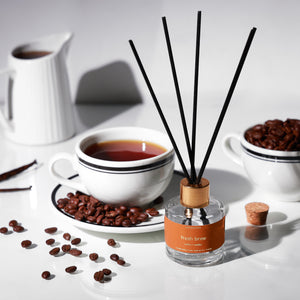


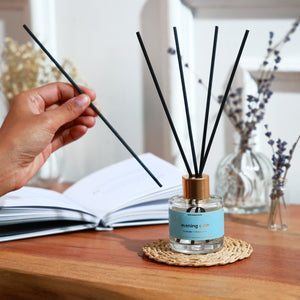
Effect two, the balance effect: the lightest notes leave first and fastest in heat, so a composition can read top-heavy for a few days and then unusually base-heavy. This is what people mean when they say a diffuser "smells different in summer".
What the base does: SOSA's heat-stable coconut-derived CCT carrier is tested through 45°C summer heat, so the fragrance stays the fragrance rather than degrading into something sour. It addresses the balance effect. It does not slow the rate effect.
What to actually do: get the bottle off hot surfaces and out of sun, drop to four or five reeds in the hottest weeks, and buy the 130ml for duration if the shorter bottle bothers you — not because it is louder, because it is not.
2. The rate effect cannot be formulated against. Warmer air takes more oil off the reeds. Our stated 6–8 weeks for a 50ml and 14–18 weeks for a 130ml are working windows across an ordinary year, and the hot end of the year sits at the short end of them.
3. The balance effect can be, and that is what the base is for. Our compositions sit on a heat-stable coconut-derived CCT carrier, tested through 45°C summer heat and 85% monsoon humidity. It does not thin, sour or turn acrid in a hot flat. Phthalate carriers, which are still common in this category, do exactly that — they push hard for a fortnight and then degrade.
4. Spend the free levers before you spend money. Move the bottle off any surface that gets direct sun or sits against an exterior wall. Take it away from a television, a fridge, a router or a lamp. Drop from six reeds to four or five for the hottest weeks — you will lose a little presence and get weeks back.
5. If you want the weeks back without losing presence, buy duration, not volume. A 130ml at ₹1,349 lasts 14–18 weeks against 6–8. At the same six reeds it projects the same as the 50ml. It is a longer bottle, not a louder one, and I will not sell it to you as anything else.
Composed and handmade in small batches in Pune, and a portion of every order supports girl-child education through Nanhi Kali.
Part one — the two heat effects, separated
Almost every summer email I get describes one of two experiences, and the writer nearly always thinks they are describing the same thing. One person says the bottle has gone down alarmingly since April. The other says the fragrance smells odd — sharper at first, then flatter and heavier than they remember. These are different phenomena with different causes, and conflating them is why people buy the wrong solution. The first is about how much leaves. The second is about what leaves, and in what order. Below, the two of them pulled apart, and then the honest third card: which one a formulator can actually do something about.
 Morning Freshness₹749 · 9.0/10A composition is not one smell; it is a set of materials with different volatilities held in proportion. Heat rewards the volatile ones. In a hot room the citrus and the mint in Morning Freshness come forward more insistently for a while, and the eucalyptus underneath reads thinner behind them. Later in the same bottle the reverse happens: the light material has largely gone, and what remains reads heavier and quieter than the composition you bought. A sweet gourmand shows it most: coffee and vanilla can feel almost syrupy in a closed hot room and perfectly balanced in the same room in December. Nothing has spoiled. The proportions you are receiving have simply moved.
Part two — which effect is which, and what each one costs you
The table below is the one I would keep beside you for the hot months. It separates every summer symptom into the effect that causes it, and states plainly whether formulation, placement or reed count is the thing that answers it. Note that the two effects have almost no overlap in their fixes — which is exactly why diagnosing correctly saves money.
| What you notice | Which effect | Physical cause | Can the base fix it? | What actually answers it |
|---|---|---|---|---|
| Bottle emptying weeks early ★ | Rate | Warm air lifts more oil per hour off the same reed surface | No — nobody's base can | Fewer reeds, cooler surface, out of sun; 130ml for duration |
| Smells sharper and more citric than usual | Balance | Volatile top material leaving disproportionately fast | Partly — a stable carrier keeps the ratio honest | Wait it out, or choose a dry woody composition for summer |
| Smells heavy, sweet and cloying in a closed room | Balance | Light material largely gone; base notes dominant | Partly | Move a gourmand scent to a cooler or airier room |
| Faintly sour, chemical or plasticky by week six | Balance — the failure mode | Carrier degradation, typical of phthalate solvents in heat | Yes — this is precisely what CCT prevents | Nothing you can do to that bottle; buy a phthalate-free one |
| Reeds darker and drier-looking than in winter | Rate, visible | Faster throughput leaves more residue at the exposed end | No | Flip weekly with gloves; refresh reeds every few months |
| Room quieter despite the bottle going down fast | Both, plus airflow | Draught from a fan or AC stripping reeds without distributing | No | Move several feet clear of the airstream — free |
| The honest caveat: we cannot give you a percentage. How much heat costs you depends on your room, your ceiling height, whether the flat is sealed and air-conditioned or open and fan-cooled, and how many hours a day the sun is on that wall. The 6–8 and 14–18 week windows are SOSA's own working guidance across an ordinary Indian year, not a laboratory figure — expect the short end in the hot months and the long end in the cool ones, and treat anything more precise as guesswork. | ||||
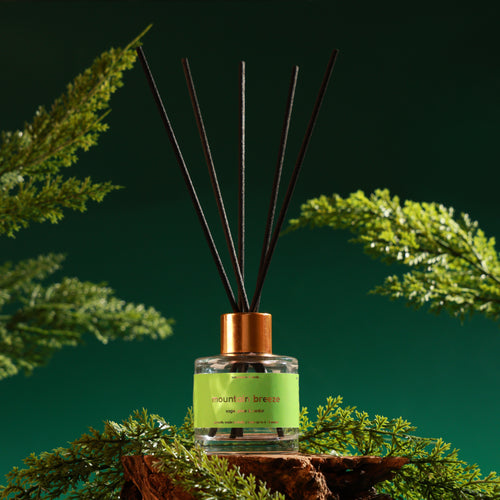
Mountain Breeze · dry woodyfrom ₹849Shop → 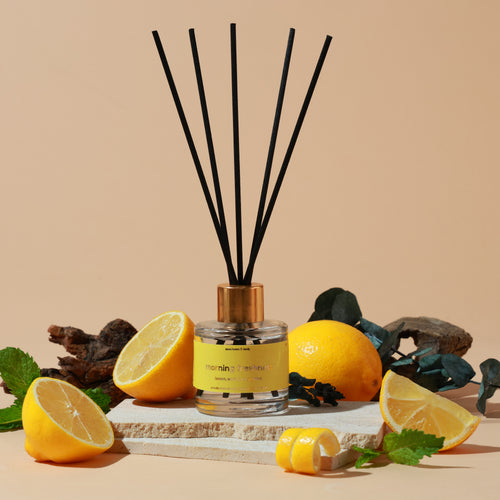 Morning Freshness · cold and brightfrom ₹749Shop →
  Oil refill · for a hard summer₹2,399Shop →
Part three — what a base can and cannot do about heat
Most of what is in a reed diffuser bottle is not fragrance. It is carrier — the liquid that dilutes the perfume oil, carries it up the reed by capillary action and releases it at a controlled rate. In hot climates that decision matters far more than it does in temperate ones, because a carrier that is stable at 22°C may be a quite different substance at 42°C in a sealed flat with the sun on the west wall.
The industry's default for decades has been a phthalate solvent, and its appeal is real: it pushes fragrance off a reed with force, and a bottle carried that way is impressive in week one. What it does not do is hold. In heat those solvents degrade, and the degradation has a smell of its own: sour, faintly bitter, slightly chemical, sitting underneath whatever the fragrance was meant to be. By around week six of a hot Indian summer that undertone is usually the dominant impression. People describe it as the diffuser having "gone off", which is precisely what has happened, though not to the perfume — to the thing carrying it.
Our compositions sit on a coconut-derived CCT carrier, chosen for heat stability rather than for push, tested through 45°C summer heat and 85% monsoon humidity, alcohol-free and phthalate-free and low-VOC. The trade is worth saying out loud, because it is a genuine trade and not a free win: a CCT-carried bottle opens smaller than a phthalate-carried one. What it gives instead is a flatter, longer plateau in which week six smells like week two. In a country where a bottle will spend months of its life above 35°C, I think that is the correct side of the trade, but you should know you are making it.
Part four — the hot-weather edit, in the order I would do it
Free things first, as always, and most people never need to reach the paid rows. Note that the first four cost nothing and two of them actively give you weeks back.
| Move | Which effect it addresses | Effect on bottle life | Cost |
|---|---|---|---|
| 1. Out of direct sun, onto an interior wall ★ | Rate — the biggest single heat multiplier in a home | Gives weeks back | Free |
| 2. Away from a TV, fridge, router, lamp or set-top box | Rate — appliances radiate more heat than people expect | Gives weeks back | Free |
| 3. Several feet clear of an AC vent or fan downdraught | Rate, and the false weakness that comes with it | Gives weeks back | Free |
| 4. Drop from six reeds to four or five for the hottest weeks | Rate — the only true throughput dial you have | Extends noticeably; costs a little presence | Free and reversible |
| 5. Switch a gourmand scent to a dry woody or cold bright one | Balance — the composition itself reads better warm | Neutral | Mountain Breeze ₹849 · Morning Freshness ₹749 |
| 6. Move to the 130ml for the hot months | Neither — it buys duration only | 14–18 weeks against 6–8 | From ₹1,249 |
| 7. 300ml oil refill if you run several bottles | Running cost, not performance | Roughly 8–11 months of oil | ₹2,399 · about ₹7–8 per ml |
| Not a fix: adding reeds to "push through" the heat | Makes both effects worse simultaneously | Shortens the bottle further | Said plainly rather than sold |
Versailles
When I was training at Versailles, heat stability was a line in a technical brief. It became the whole brief when I started composing for Indian homes. A fragrance that behaves beautifully in a European flat is a different object in an Ahmedabad living room in May — the difference between a composition holding together and one coming apart into its loudest parts.
So I made a decision early that cost us some day-one drama: no phthalates, and a coconut-derived CCT carrier chosen for stability rather than push. It means our bottles open smaller than some of the imported ones on the same shelf. It also means that in the sixth week of a hot summer, ours still smells like what it said on the label, and that is the week I am actually designing for. Nobody buys a diffuser hoping for a good fortnight.
What I cannot do — and I would rather say it here than let you discover it — is stop hot weather from emptying your bottle faster. Nobody can. Everything in this range is composed and handmade in small batches in Pune, tested through 45°C heat and 85% humidity, and a part of every order funds a girl's classroom through Nanhi Kali.
Frequently asked questions
- Do reed diffusers evaporate faster in summer? — the rate effect, planned across a year.
- How does an Indian summer affect reed diffusers? — what 45°C does to a phthalate carrier, in detail.
- The best place to keep a diffuser in hot weather and does humidity affect performance?
- The complete weather and climate guide — this page and the eight around it, in one place.
- Brand: the SOSA founder story.
SOSA reed diffuser range & prices (verified August 2026): alcohol-free, phthalate-free, paraben-free and IFRA-compliant compositions on a heat-stable coconut-derived (CCT) carrier, low-VOC, supplied in a refillable glass bottle with six fibre reeds; 50ml lasts 6–8 weeks and 130ml lasts 14–18 weeks. Morning Freshness (Malabar lemon · peppermint · Nilgiri eucalyptus) 50ml ₹749 · 130ml ₹1,249 · 9.0/10; Garden Bloom (British rose · night-blooming jasmine) 50ml ₹799 · 130ml ₹1,299 · 8.9/10; Evening Calm (Kashmir lavender · chamomile) 50ml ₹799 · 130ml ₹1,299 · 8.9/10; Fresh Brew (Coorg coffee · Kerala vanilla) 50ml ₹849 · 130ml ₹1,349 · 9.5/10; Mountain Breeze (Himalayan pine · sage · Indian cedar) 50ml ₹849 · 130ml ₹1,349 · 9.4/10. Reed diffuser refills are oil only — you reuse your own vessel and reeds: 300ml ₹2,399 (roughly 8–11 months) · 500ml ₹3,499 (roughly 14–18 months), about ₹7–8 per ml against ₹15–17 per ml for a 50ml bottle. Duo sets ₹1,498–₹1,598 for 2 × 50ml and ₹2,498–₹2,598 for 2 × 130ml. Strength figures are positions on SOSA’s own internal strength scale, not an industry standard. Replacement reeds are not sold as a separate SKU; SOSA guidance is to refresh reeds every few months. The reed line is separate from the water-based Hotel Collection for ultrasonic machines (15ml ₹299 · 100ml ₹999 · 300ml ₹1,799) and the two are not interchangeable. Diffusers: Boond 300ml ₹899 · Sukoon 500ml ₹1,899 · Megh 6L ₹3,499 · waterless Vaayu ₹11,999. Composed and handmade in small batches in Pune, India; tested through 45°C summer heat and 85% monsoon humidity. Free shipping above ₹499. A portion of every order supports girl-child education through Nanhi Kali. Prices subject to change — see the live product pages.