
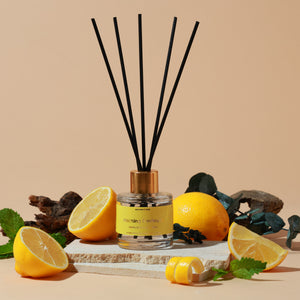
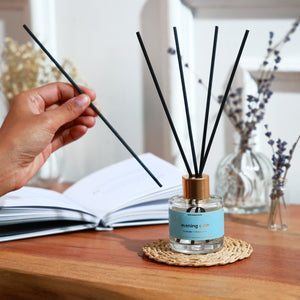

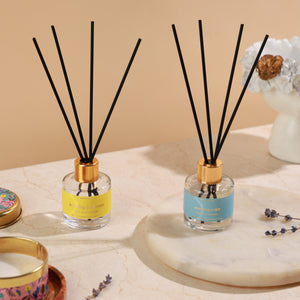

Then leave it alone for a week before you judge it, and use a visitor rather than yourself as the instrument.
Why this order works: because "a stronger reed diffuser" is not one thing. Reed count and a stronger-smelling oil raise emission, how much leaves the bottle. Distance, height, the door and the fan change transport, how far it gets. Nearly everybody arriving here has a transport problem and is about to buy an emission solution.
The two purchases I would talk you out of: a bigger bottle bought for reach — volume is duration, not coverage; Megh at ₹3,499 holds six litres and covers about 215 sq ft, less than the ₹1,899 Sukoon's 270–320. And Vaayu at ₹11,999 for one bedroom, where nine-tenths of it is wasted.
If the checklist is not enough, the honest ladder starts at Sukoon ₹1,899, not at anything dearer.
2. Separate the two quantities and the whole subject becomes obvious. Emission is how much leaves the bottle: reed count, bottle size, the composition, the temperature of the room. Transport is how far it gets: moving air, which a reed does not supply and which the room either provides or does not. You cannot fix a transport problem by increasing emission. That single sentence explains why every attempted upgrade in this category disappoints in the same way, and it is also why the free checklist works — four of its six items are transport levers, and transport is what you are short of.
3. Here is the whole checklist, in order, with nothing held back. One: set the reed count deliberately — six for full projection, three for a soft bedside level that also roughly doubles the life. Two: halve the distance between the bottle and where your head actually is; this is the strongest single lever you have. Three: put it at or slightly below nose height, on a surface, never on the floor and never on top of a wardrobe. Four: get it out of the draught but not into a dead corner, and never into a running air conditioner's blast, which is the one placement to avoid outright. Five: close the door, because containment is half the equation and costs nothing. Six: turn the ceiling fan on low, which is the best free advice in this entire subject, because a fan is the transport a reed structurally lacks.
4. Then leave it for a week and judge it properly. A bottle that has just been moved needs a few days to re-saturate its reeds, and a room needs time to settle at a new level. Judging it the same evening is unfair to it and will send you shopping for the wrong reason. When you do judge it, do not use yourself: receptors adapt to a constant stimulus within minutes, so a resident is genuinely poor at detecting a fragrance a visitor notices on the doorstep. Leave for fifteen minutes and walk back in. Ask somebody who does not live there.
5. And if the checklist is not enough, buy the right thing rather than the dearer thing. The requirement that placement genuinely cannot meet is evenness on demand — the same level at the bed, the desk and the door, whenever you want it, without waiting for a fan or a season. That is a machine, and the honest first rung is Sukoon at ₹1,899 for 270–320 sq ft, never to be skipped on the way to something dearer. What I would talk you out of is a bigger bottle bought for reach, and Vaayu at ₹11,999 for one bedroom, where most of what it can do is wasted.
Alcohol-free, phthalate-free, made in Pune. A portion of every order supports girl-child education through Nanhi Kali.
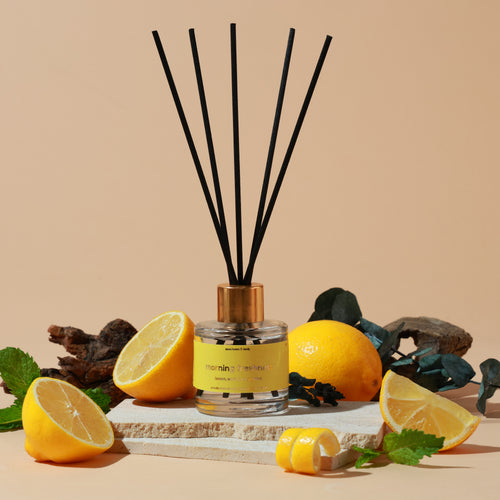
What “a stronger reed diffuser” turns out to mean
It is worth unpacking the phrase, because it hides three different requests and only one of them can be bought. People asking for a stronger reed diffuser usually mean one of: more intense near the bottle, lasting longer, or reaching further. The first two are genuine specifications you can shop for. The third is the one nearly everybody actually wants, and it is the one a reed diffuser does not have a control for. Sorting out which you mean is the difference between a purchase that works and the third disappointing bottle on the same shelf.
 Fresh Brew₹849If you want the zone around the bottle to be more present, that is available and mostly costs nothing. Use all six reeds rather than three. Flip them every three to five days rather than daily, which restores output for a few hours. And if you are buying, our strength scale is there for exactly this: Fresh Brew at 9.5 is the deepest we make and Mountain Breeze at 9.4 the next, against Evening Calm at 8.9, the softest. The scale measures perceived intensity in a room rather than quality or concentration, and it exists so somebody can choose deliberately in either direction. What it will not do is change the size of the zone.
 Evening Calm₹799A 50ml runs 6–8 weeks and a 130ml runs 14–18. That is the whole of what the larger bottle buys. Bottle volume is a duration specification, not a coverage specification, and it is the most expensive misunderstanding in home fragrance. The clearest possible proof is inside our own range, where the largest tank we sell is not the biggest room: Megh at ₹3,499 holds six litres and about a hundred hours of runtime, and covers only about 215 sq ft, less than the ₹1,899 Sukoon's 270–320. Megh is a runtime and humidity machine and it is never a coverage upgrade. If a six-litre tank does not out-reach a half-litre one, a 130ml bottle will not out-reach a 50ml either.
 Mountain Breeze₹849Once fragrance has left a reed surface it travels only by molecular diffusion, which is far too slow to cross metres of a room usefully, or by whatever bulk air movement the room happens to provide. The second does essentially all of the work, and it is not under the bottle's control at any price. That is why there is no published figure anywhere for how far a reed diffuser projects, and why I will not invent one — any brand quoting a distance in feet is quoting a number for a room it has never seen. Reach is decided by room size, containment and airflow, which is to say by your placement and your door and your fan, not by the label on the bottle.
The six free fixes, in the order I would do them
One: set the reed count deliberately. Every SOSA bottle ships with six fibre reeds, and almost nobody treats them as the volume dial they are. Six is full projection. Three is a soft, bedside level and roughly doubles the life. Two or three in a 50 sq ft bathroom can stretch a 50ml to close to three months. If your complaint is that the room is faint, use all six. If your complaint is that the bottle beside your pillow is cloying — and cloying is nearly always a description of over-dosing rather than of a composition — drop to three. Do this before anything else, because it is instant and it tells you whether you have an emission problem at all. If six reeds makes no difference to the far side of the room, you have just proved your ceiling is structural, and the remaining five fixes are the ones that matter.
Two: halve the distance. Concentration is highest at the reeds and falls away with distance, so the gap between the bottle and where your head actually is is the largest number in the whole problem and the easiest to change. Moving a diffuser from a shelf across the room to the table beside where you sit does more than any change of scent, any extra reed and any larger bottle. People resist this because it feels like giving up on the room, and it is the opposite: a point source makes a zone, and the sensible response is to put yourself in the zone. A bedside table is the correct use of the object rather than a compromise — with the caveat that at thirty or forty centimetres you want three reeds, not six.
Three: get the height right. At or slightly below nose height, on a surface. Not on the floor, where the air is stillest and lowest and the output is spent on a layer nobody breathes. Not on top of a wardrobe, where you are scenting the stratum above your head — which is also where warm air is carrying it anyway, so a high shelf compounds the problem rather than solving it. This one is free, it takes ten seconds, and it is the most commonly skipped item on the list.
Four: out of the draught, but not into a dead corner. Two placements are wrong regardless of anything else. Standing the bottle in a running air conditioner's blast is the one placement to avoid outright: a cooling vent is a narrow, fast, dry jet rather than general circulation, so it strips the reeds quickly and throws the fragrance at a single wall, producing a room that is uneven rather than faint. A windowsill or an open balcony threshold is nearly as bad for the opposite reason: air that leaves takes the fragrance with it, so the bottle is not weaker, the room is being flushed. But do not overcorrect. A dead corner, an alcove, behind a curtain or wedged between two pieces of furniture makes a bottle last an impressively long time because nothing is collecting what it emits. Out of the draught is not the same as out of the room.
Five: close the door. Containment is half the equation and it is free. This is the entire reason a bathroom makes the same bottle seem powerful while a bedroom makes it seem quiet: the bathroom is smaller, it is shut, there is no window open and no balcony, and you are never more than a metre or two from the bottle. A bedroom leaks in three directions. If your diffuser performs beautifully in one room and disappears in another, you have already run the control experiment that proves your oil is fine, and the variable was never the product.
Six: turn the ceiling fan on low. This is the best free advice in the whole of this subject and I would rather give it away than sell around it. A reed emits and cannot carry; a fan carries and cannot emit; together, in a closed room, they are the two halves of the job a machine sells in one box. Run it on low rather than full, because mixing a closed room needs only gentle circulation while evaporation keeps rising with airspeed, so extra speed buys very little evenness and a great deal of consumption. Keep the bottle beside the circulation rather than directly under the blades. And the honest cost: a fan shortens the bottle, because air moving across a wetted surface speeds evaporation. The free counterweight is to run three reeds instead of six while the fan is on — the fan is now supplying the reach those extra reeds could never have supplied.
The checklist as a table, with what each one actually changes
The same six fixes, sorted by whether they change emission or transport, so you can see why the order matters. The last two rows are the purchases I would talk you out of.
| Change | Emission or transport | What it does | Cost |
|---|---|---|---|
| 1. Reed count — six full, three soft ★ | Emission | Sets how much leaves the bottle. Three roughly doubles the life; six is full projection. Adds no range whatsoever | ₹0 |
| 2. Halve the bottle-to-person distance | Neither — it moves you into the zone | The strongest single lever available. Beats any change of scent, reed count or bottle size | ₹0 |
| 3. Nose height, on a surface | Transport | Puts the output into the layer people actually breathe. The floor is too still; a high shelf is above you | ₹0 |
| 4. Out of the draught, not in a dead corner | Transport | Never in a running AC's blast, never on a windowsill — and never in an alcove where no air collects what it emits | ₹0 |
| 5. Close the door | Transport | Containment is half the equation. It is why a bathroom makes the same bottle feel powerful | ₹0 |
| 6. Ceiling fan on low ★ | Transport | The transport a reed structurally lacks. The best free change in this subject — and it shortens the bottle, so use three reeds | ₹0 |
| Not this: a bigger bottle bought for reach | Emission, and only the duration part of it | 50ml runs 6–8 weeks, 130ml runs 14–18. Volume is duration, not coverage. Megh ₹3,499 holds six litres and covers ~215 sq ft, less than the ₹1,899 Sukoon's 270–320 | ₹500+ for nothing you asked for |
| Not this: a second reed diffuser for evenness | Emission, twice over | Two passive sources make two peaks with a valley between, because the midpoint is farthest from both and neither moves air | ₹749–₹849 misapplied |
Bright · Morning Freshness₹749Shop → 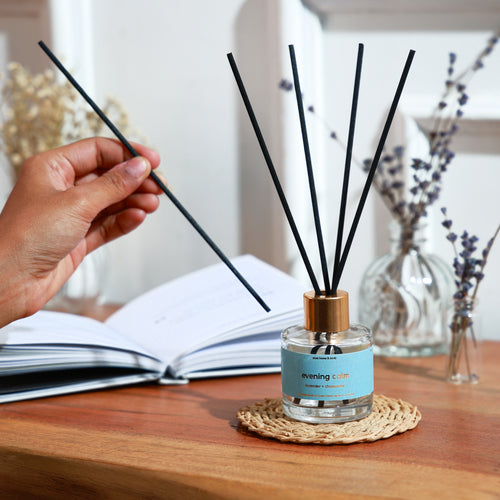 Softest at 8.9 · Evening Calm₹799Shop →
 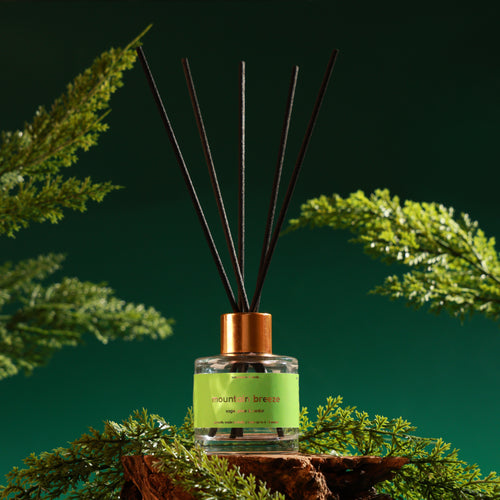 Most present at 9.4 · Mountain Breeze₹849Shop →
How to judge the week, and why you are the wrong instrument
Give it a full week and change nothing else during it. A diffuser that has just been moved needs several days for its reeds to re-saturate and for the room to settle at a new level, and if you adjust three things on three consecutive evenings you will learn nothing about any of them. This is the discipline that most often gets skipped, and skipping it is how people end up buying a machine on the evidence of one disappointing Tuesday.
Then judge it honestly, which means not judging it from your armchair. Receptors adapt to a constant stimulus within minutes: the signal keeps arriving and the brain stops reporting it. This is not a fault in you and it is not a fault in the fragrance; it is how the sense works, and it is why a person can sit in a properly scented room and truthfully say they cannot smell anything. Two corrections. Leave the room for a quarter of an hour and walk back in, because walking in means crossing the gradient from low concentration to high, and the nose reports change far better than steady state. And ask somebody who does not live in your house. A visitor is a better instrument than a resident, since sensitivity varies between people and you are adapted to your own home in a way nobody else is. If guests remark on it and you cannot detect it, it is working for everybody but you.
One more calibration, because it is the opposite failure and it is more common than people admit. If you can smell your diffuser continuously, all evening, with no break at all, it is set too strong for the room rather than performing well. Home fragrance is meant to be noticed on arrival and at transitions, not to press on you without pause. That is what the reed count is for, and it is why our softest composition sits at 8.9 on a scale that measures perceived intensity rather than quality — so that somebody scenting a small closed bedroom can choose deliberately downwards. Almost any composition at too high a dose flattens into one sweet or sharp impression, which is precisely what people mean when they call something an air freshener. Restraint costs nothing.
And while you are running the week, notice what the object is doing for you that nothing else in this category does. It is silent, with no motor, no pump and nothing that hums at three in the morning. It needs no power at all, so it works straight through a power cut when the fan has stopped and every machine in the house is dark. Nothing to fill, nothing to charge, nothing to clean, nothing to remember and no setting to get wrong; it works while you are at the office and while you are asleep, and it will still be working if you ignore it entirely for a fortnight. It runs at roughly ₹13–₹15 a day, which is a fairer way to read a ₹749 bottle than the sticker price. It is an object rather than an appliance, which matters on a surface you look at every day. And it never breaks — machines have a service life and a glass bottle with fibre reeds in it does not. Several of those are the reasons people keep a reed on the dresser long after buying a machine for the same room.
If the checklist was not enough
Some requirements survive all six fixes, and they have a recognisable shape. It is not the room is faint — that is usually solved above. It is evenness on demand: the same level at the bed, the desk and the door, at a chosen intensity, whenever you want it, without waiting for a fan to be on or a season to be right. A passive object cannot meet that by design, because it has no way of moving air and no control surface at all. Two other legitimate cases: a room with no ceiling fan and no useful circulation, and a room that genuinely cannot be closed. For all three, here is the ladder, in the order I would actually walk it, with the two things I would talk you out of kept in the table rather than hidden.
| Step | What it is | When it is right | Price |
|---|---|---|---|
| 1. The six free fixes, given a week ★ | Reed count, distance, height, out of the draught, door shut, fan on low | First, and for a large share of readers it is the whole answer. Silent, no power, nothing to fill or charge, works in a power cut, roughly ₹13–₹15 a day, and it never breaks | ₹0 |
| 2. The right bottle for the room you have | Morning Freshness ₹749, Evening Calm ₹799, Mountain Breeze ₹849 — 50ml up to ~150 sq ft and 6–8 weeks; 130ml from ₹1,249 above that and 14–18 weeks | When the room really is bigger than the bottle, or when the strength scale points you somewhere else. Buy for duration and for register, never for reach | ₹749–₹1,349 |
| 3. A second bottle, for a second zone | Two 50ml bottles — Day & Night ₹1,498, Fresh & Grounded ₹1,548 | A long or L-shaped room used at both ends, two rooms that are really one volume, different scents per zone, or a budget short of a machine. Not for evenness in one open volume | ₹1,498–₹1,598 |
| 4. Sukoon — the honest first machine | Ultrasonic, 500ml, 270–320 sq ft, 16–18 hours on low, three 15ml Hotel Collection scents included | Very often the correct bedroom answer, and never to be skipped on the way to something dearer. The counterweights: the oil is diluted in water, it adds humidity, it needs filling, and in a hard-water city it can leave a fine white mineral dust | ₹1,899 |
| 5. Safar, with the disclosure attached | Waterless cold diffusion of pure undiluted oil — 20ml, 2000 mAh, cordless, three speeds, a 1 / 2 / 3-hour auto-off timer. It is named and sold as a car and travel perfume diffuser, and SOSA's own page lists car, handbag, desk, bedside and hotel room | When you want the undiluted-oil mechanism at personal scale and are content that it is not set-and-forget: the timer runs one, two or three hours and it needs recharging. SOSA publishes no coverage figure for it, so none is quoted here | ₹3,999 |
| ⛔ Not for one bedroom: Vaayu | Waterless cold-air nebuliser, rated to 1000 m³ — roughly 2,000–3,000 sq ft — 400ml tank, app and onboard control, under 38 dB | The honest answer for a one-bedroom reader is no: in 120 sq ft most of what it can do is wasted. It earns its price on a whole floor, an open-plan living-dining, a large home, a clinic, a salon or a showroom | ₹11,999 |
| The honest gap: nothing between Safar and Vaayu | There is no mid-sized waterless bedroom nebuliser in the range. Nothing is “a Vaayu for one room” | Said plainly rather than papered over. It is the reason Sukoon at ₹1,899 matters so much on this ladder, and the reason I would not push anybody past it without a specific requirement | — |

Versailles
This is the page in this whole series I most wanted to get right, because it is the one where our interests and the reader's are most obviously in tension. Somebody arrives having decided to spend money with us, and the honest answer is a list of six things that cost nothing. I have been asked, reasonably, whether the checklist could be shortened or placed after the recommendations. It could. It is not going to be. A brand that hides its best advice because the advice is free has stopped being worth reading, and everything else we publish depends on this page being straight.
The commonest thing I see, and it is never foolish, is somebody who has been buying along the wrong axis for a long time without anyone telling them. They wanted the fragrance to reach further, so they bought a stronger-smelling oil, then more reeds, then a larger bottle, and each one arrived and became, in a few weeks, another thing they could smell only when they walked past it. That is a completely rational response to a misdiagnosis. Anybody told that a diffuser scents a room would reasonably conclude that a bigger one scents it more. The mistake was never theirs — it belongs to an industry that has been vague about the difference between how much fragrance you make and how far it gets.
And a word about what you are actually paying for when you do move up the ladder, because it explains the whole price structure. Not a better smell. A ₹800 reed and a ₹11,999 nebuliser can run related compositions and produce entirely different rooms, and what the higher price buys is transport, control and evenness — not quality. That is why a ceiling fan, which supplies the first of those three for nothing, outperforms most of what I could sell you at the same price, and why Sukoon at ₹1,899 is very often the right answer for a bedroom while Vaayu at ₹11,999 is very often the wrong one. Everything is composed in Pune by hand, and a part of every order funds a girl's classroom through Nanhi Kali.
Frequently asked questions
- Where should I place a reed diffuser? — the full placement method.
- Near a ceiling fan? — yes, and it is the best free fix in this subject.
- Near an open window — yes, it disappears faster, and here is why.
- Weaker with the balcony door open — a much larger opening than a window.
- Does AC make it stronger or weaker? — both, and both matter.
- Directly under the AC — the one placement to avoid outright.
- Door, window, bed or centre? — the four candidates, ranked.
- Cross-ventilation — a straight line through the room, and how to place off it.
- Why it performs differently with the fan on — reading the evidence you already have.
- Brand: the SOSA founder story.
SOSA facts verified August 2026: Reed diffusers are supplied in 50ml and 130ml only — 50ml suits rooms up to about 150 sq ft and lasts 6–8 weeks, 130ml suits rooms above 150 sq ft and lasts 14–18 weeks, at roughly ₹13–₹15 a day. Six reeds is full projection; three is a soft bedside level and roughly doubles the life; two or three reeds in a 50 sq ft bathroom can make a 50ml last nearly three months; flip the reeds every 3–5 days. Morning Freshness ₹749 / ₹1,249 · Evening Calm ₹799 / ₹1,299 · Garden Bloom ₹799 / ₹1,299 · Mountain Breeze ₹849 / ₹1,349 · Fresh Brew ₹849 / ₹1,349. Duos: Day & Night ₹1,498, Fresh & Grounded ₹1,548, Warmth & Bloom ₹1,598 (50ml × 2); 130ml duos ₹2,498 / ₹2,548 / ₹2,598. Strength scale, perceived intensity rather than quality: Evening Calm 8.9 softest, Garden Bloom 8.9, Morning Freshness 9.0, Mountain Breeze 9.4, Fresh Brew 9.5 deepest. Six fibre reeds rather than rattan, heat-stable CCT carrier rather than DPG, alcohol-free, phthalate-free, paraben-free, IFRA-compliant, 0 ppm formaldehyde, refillable glass bottle, tested at 45°C and 85% RH, composed in Pune. Refills 300ml ₹2,399 and 500ml ₹3,499, oil only and never a first purchase. Machines: Boond ₹899 (300ml, up to about 150 sq ft, ~6h, USB, night light) · Sukoon ₹1,899 (500ml, 270–320 sq ft, 16–18h on low, three 15ml Hotel Collection scents included) · Megh ₹3,499 (6L, ~100h runtime but only ~215 sq ft, never a coverage upgrade) · Safar ₹3,999, a waterless cold-diffusion device named and sold as a car and travel perfume diffuser, with a 20ml bottle, a 2000 mAh battery, up to 10 hours continuous or about 30 hours intermittent per charge, three speeds and a 1 / 2 / 3-hour auto-off timer · Vaayu ₹11,999, a waterless cold-air nebuliser rated to 1000 m³, roughly 2,000–3,000 sq ft, with a 400ml tank, app and onboard control and under 38 dB operation, and the wrong purchase for one bedroom. Aangan ₹25,999 and Meenar ₹38,500 are commercial machines and are not home recommendations. No coverage figure is published for Safar and none is quoted here. Reed oil, the water-based Hotel Collection and pure fragrance oil are not interchangeable across these mechanisms. No health, air-quality, allergy, sleep or mood claims are made anywhere on this page. Free shipping above ₹499. SOSA is an independent Indian fragrance house; the Hotel Collection is SOSA's own interpretation inspired by the world's finest hotels and SOSA is not affiliated with or endorsed by any hotel brand. Prices subject to change — see the live product pages.