




Musty is a specific thing: it is microbial. Fabric, paper and wood in still air above roughly 60 per cent relative humidity support slow growth, and what you are smelling is what that growth releases. It is not dust and it will not respond to more cleaning.
The bathroom is usually involved: a U-bend water seal evaporates in two to four weeks of disuse and the drain then vents into the room. A mug of water down every floor drain, basin and unused shower fixes it in minutes.
Free fixes: leave the door open when the room is not in use — the single best change and it costs nothing; twenty minutes of cross-draught weekly; a mug of water down the drain monthly; bedding aired rather than stored sealed.
2. Musty is a specific smell with a specific cause, and it is not dirt. It is microbial: fabric, paper, wood and cardboard sitting in still air above roughly 60 per cent relative humidity support slow growth, and what reaches you is what that growth gives off. This is why more cleaning does not touch it and why it is much worse from June to September.
3. Check the attached bathroom before anything else. A U-bend holds a small water seal that stops drain air entering the room, and in an unused bathroom that seal evaporates in two to four weeks. Pour a mug of water down every floor drain, the basin and the shower. It works within minutes and costs nothing.
4. Then leave the door open, which is the single best change available to you. A guest room with its door open is no longer a separate sealed volume; it becomes part of the flat and shares in every exchange the rest of the house gets. It costs nothing, it requires no memory, and it does more than any product on this website.
5. And stop storing the bedding sealed. Linen folded in a closed cupboard for six weeks arrives on the bed carrying the cupboard rather than the wash. Air it on the line or over a chair the day before somebody comes, and open both wardrobe doors during the weekly draught.
A portion of every order supports girl-child education through Nanhi Kali.

Clean and aired are different properties
The reason this question is asked with such genuine bewilderment is that it appears to break a rule everybody relies on, which is that clean rooms smell fine. That rule is not wrong so much as incomplete, because cleanliness is a property of surfaces and freshness is a property of air, and nothing you do to the first has any lasting effect on the second. You can mop a room to a standard nobody could fault and shut the door on it, and six weeks later the air in that room will have had nowhere to go for six weeks, which is the only fact that matters.
The guest room, place by place
Six places in a room nobody enters, what is happening in each while the door is shut, the free fix, and how long it takes. The first row is the door itself, because it is the cheapest and most effective item on any list in this cluster. Everything here is free; the products come afterwards and only for the rooms that have had this done first.
| Where | What is happening while the room is shut | The free fix | How long |
|---|---|---|---|
| The door ★ | It is the reason the room is a separate sealed volume rather than part of the flat | Leave it open whenever nobody is sleeping in there. The single best change available and it costs nothing | One second |
| The attached bathroom drain | The U-bend water seal evaporates in two to four weeks of disuse, and the drain then vents into the room | A mug of water down every floor drain, the basin and the shower, once a month | Two minutes, works within minutes |
| The mattress, under a fitted cover | No airflow at all to a large foam or fibre object that has absorbed months of ambient humidity | Strip it, take the cover off, and open the windows. Sunlight on it for two hours if you can manage it | An afternoon, twice a year |
| Bedding folded in the cupboard | Linen takes on the smell of wherever it is stored, and a shut cupboard in a shut room is the worst of both | Air it over a chair or on the line the day before guests arrive, rather than going cupboard to bed | A few hours |
| The wardrobe interior | A sealed box inside a sealed room, usually with paper, cardboard or old fabric in it | Open both doors during the weekly draught. Take out anything cardboard and anything you have forgotten about | Twenty minutes a week |
| Curtains and the rug | Textiles hold moisture and are the slowest thing in the room to dry, so they carry the musty note longest | Wash what is washable, and put the rug in the sun for two hours. Do not put a rug back down damp | A wash cycle |
The door, the draught, and why a reed rather than a machine
Take the free work first and do it in one go, because a guest room rewards a single thorough afternoon far more than it rewards a routine nobody will keep. Door propped open as the new default. Twenty minutes of two-sided cross-draught with the wardrobe doors open at the same time. A mug of water down every drain in the attached bathroom. The mattress stripped and its cover off for the afternoon, and the rug and the pillows outside for two hours if there is any sun. That is perhaps ninety minutes of work, most of it waiting, and it deals with the accumulated part of the problem. The ongoing part is much smaller: the open door does most of it by itself, twenty minutes of draught once a week does the rest, and the mug of water is monthly and takes two minutes. One thing to be careful about, because it is the exception to every open-the-windows instruction in this cluster: do not do the weekly draught in the middle of a downpour or on a heavy monsoon morning when the outdoor air is at 90 per cent humidity, because on those days you are importing moisture into a room you are trying to keep dry. Wait for a break in the weather, or do it in the afternoon when it is warmest, and in July and August lean harder on the open door and on keeping the wardrobe from becoming a sealed box than on the windows.
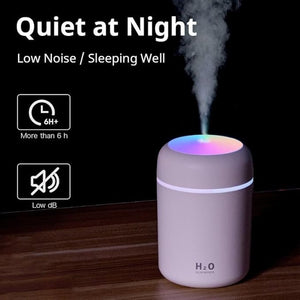
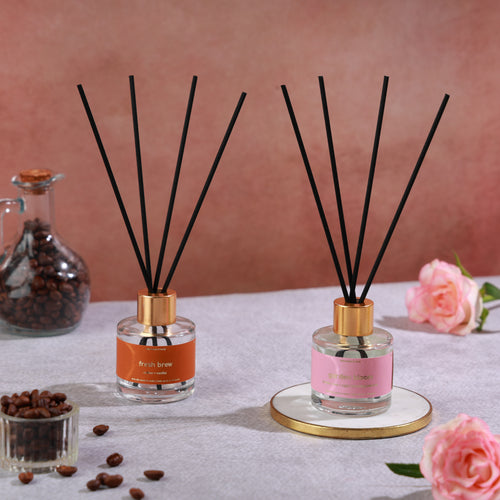
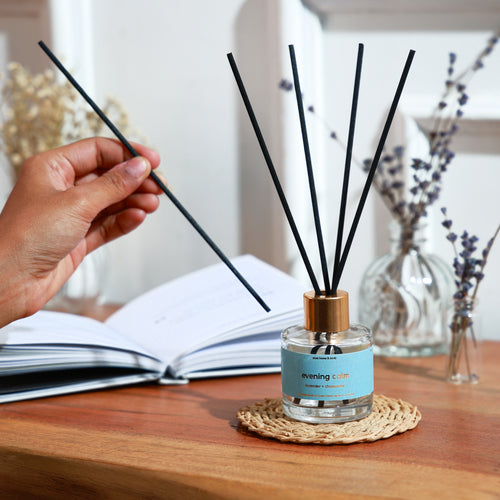
Then the product decision, which for this particular room is unusual enough to be worth stating plainly: the right answer for a guest room is a reed diffuser, and it is the one room in this group where I would actively steer somebody away from anything electric. The reasoning has nothing to do with fragrance quality and everything to do with attendance. A guest room is entered perhaps four or five times a year. A machine there has to be filled with water, switched on before somebody arrives, remembered, switched off and emptied afterwards, and if it is not emptied it stands with water in it for three months, which is its own problem. Nobody keeps that up, and a machine that is not kept up is worse than no machine. A reed diffuser asks for nothing at all: no electricity, no water, no timer, no switching on. It holds one level for months and it is already established on the day somebody walks in, rather than being started the night before. The only timing rule that matters is that a reed needs 24 to 72 hours to reach its level, so it must go in now rather than on the morning of the visit — it is the wrong buy for a deadline and the right buy for a room that should simply always be ready. On scent: Morning Freshness from ₹749 is Malabar lemon, peppermint and eucalyptus and reads as a room that has been aired, which is exactly the impression you want to give; Evening Calm from ₹799 is Himalayan lavender and chamomile for a room somebody is going to sleep in; Garden Bloom from ₹799 is British rose and night-blooming jasmine if you would rather it read as generous. 130ml from ₹1,249, duos from ₹1,498, and 300ml refills at ₹2,399 once a scent has stopped being a product and become the room.
Then the honest limits and the principle. Do not put the reed in until the room has actually been aired and the bathroom trap has been filled, because a fragrance laid over a musty room gives you two smells rather than one and the musty one wins every time. Fragrance does not remove a source: not damp, not a dry drain, not a mattress that needs a day in the air, not a wardrobe with cardboard in it. If the room is genuinely damp rather than merely closed — a wall that has darkened near the skirting, condensation on the inside of the window, bedding that feels cool and heavy to the back of the hand — then this is a repair before it is anything else, and a cool-mist machine would be the wrong purchase in any case, since an ultrasonic adds 30 to 50 millilitres of water an hour and a reed adds none. On the range: reed diffusers are a separate alcohol-free line with their own five scents, so the Hotel Collection does not go into them and reed oil does not go into a Sukoon; if you do want a machine in there for the two weeks a year the room is occupied, the Boond at ₹899 is the sensible size and it should be emptied and dried when the guests leave. And SOSA makes no room or linen spray for the home — the sprays in the range are car perfumes — which is worth saying on a page about bedding, because a linen spray is exactly what somebody about to make up a guest bed goes looking for. The principle: air the room, deal with the drain, then choose the smell.
The SOSA edit
In the order the work should be done for a room that is spotless and shut. Everything in the first four rows is free. The product row is a reed rather than a machine on purpose, and the last row prints something we do not make, because it is precisely what somebody making up a guest bed reaches for.
| Do this | What it is | Why it comes here in the order | Cost |
|---|---|---|---|
| 1. Leave the door open ★ | Open by default, shut only when somebody is sleeping in there | It stops the room being a separate sealed volume and lets it share in every exchange the flat gets. Nothing else on this list is this cheap | ₹0 |
| 2. A mug of water down every drain | Floor drain, basin and shower in the attached bathroom, once a month | The U-bend seal evaporates in two to four weeks of disuse and the drain then vents into the room. Works within minutes | ₹0 |
| 3. Twenty minutes of cross-draught weekly | Two openings on opposite or adjacent walls, with the wardrobe doors open at the same time | One window is ventilation and two is exchange. Not on a heavy monsoon morning, when outdoor air is wetter than the room | ₹0 |
| 4. Mattress, bedding and rug | Cover off and the mattress stripped for an afternoon; bedding aired the day before guests come; two hours of sun on the rug | Musty is microbial and it lives on fabric. This is the part cleaning never reaches | ₹0 |
| 5. A reed diffuser | Alcohol-free, its own five scents, no electricity and no water. 24–72 hours to establish, then months at one level | The right product for a room nobody tends. It is already at level when a guest arrives, and there is nothing to remember | from ₹749 |
| Not in the range: a linen spray | SOSA makes no room or linen spray for the home. The sprays we make are car perfumes, formulated for a car | Printed rather than implied, because a linen spray is exactly what somebody making up a guest bed goes looking for | — |
Versailles
The guest room is the room I am asked about most often in the week before somebody's parents arrive, and the message is nearly always defensive, as though a musty smell in a spotless room were an accusation. It is not. It is a room with no moving parts, and the person asking has done everything they were told to do — they have simply been told to do the wrong thing, because everybody is told that clean is the same as fresh and it is not. I have opened a great many guest room doors in Indian flats and the first ten seconds tells you everything: it is never dirt, it is almost always closure, and about half the time there is a dry drain in the bathroom next door doing a great deal of the work.
What I would like people to take from this page is the door. Leaving a guest room door open when nobody is in it is the highest-value change in this entire hundred-article cluster: it costs nothing, it asks nothing of your memory, and it converts a sealed box back into part of your home. After that, and only after that, I would put a reed diffuser in there and forget about it — from ₹749, nothing to switch on, nothing to refill, and already at its level whenever somebody arrives unannounced. That is the whole recommendation for that room, and it is deliberately the least demanding product we make rather than the most impressive one.
Everything is made and supported from Pune, and a part of every order funds girl-child education through Nanhi Kali. You get a home that smells like somewhere you chose; a girl gets a classroom. That equation has always felt right to me.
Frequently asked questions
- Why the smell comes back every time you close the room — the accumulation principle behind a shut guest room door.
- Why a study smells closed even though you sit in it all day — the same building, the opposite problem.
- Does an ultrasonic diffuser in an air-conditioned room make the air damp? — why a reed rather than a machine in a room that may be damp.
- Why your air-conditioned room smells stale, and what actually fixes it — the complete guide to this group.
- Brand: the SOSA founder story.
Facts verified August 2026: Diagnostic facts used in this guide: a closed room accumulates what it cannot exchange, so cross-ventilation needs two openings rather than one; a drain's U-bend water seal evaporates in roughly two to four weeks of disuse and then admits sewer gas, which is corrected by pouring water down the drain; microbial growth in fabric and on surfaces accelerates above about 60% relative humidity, and Indian monsoon indoor humidity commonly runs 80–95%, which is the one situation where ventilating on a wet day can import moisture rather than remove it; an air-conditioner's cold, wet evaporator coil and filter grow biofilm that is blown into the room on start-up; textiles adsorb cooking aerosol and body oils and re-release them for weeks; and olfactory adaptation makes a constant household smell undetectable to its residents within about a fortnight while visitors still perceive it. Timings: a scented candle scents a normal room in roughly 15–20 minutes, a Sukoon ultrasonic diffuser reaches a steady level in about 20 minutes from cold, and a reed diffuser needs roughly 24–72 hours. SOSA products and prices: Sukoon 500ml ₹1,899 (270–320 sq ft, 16–18h on low, 9–12h high, 30–50 ml/h, 2.4MHz cool mist, remote, steady/2H/4H timers, BPA-free, auto shut-off, includes three 15ml Hotel Collection scents of your choice); Boond 300ml ₹899; Megh 6-litre ₹3,499; waterless Vaayu ₹11,999 (up to 1000m³); Aangan ₹25,999. Hotel Collection water-based fragrance 15ml ₹299, 100ml ₹999, 300ml ₹1,799, Pack of 7 at 15ml ₹1,799; dose 3–6 drops per tank. Reed diffusers (separate alcohol-free line): Morning Freshness from ₹749, Garden Bloom and Evening Calm from ₹799, Fresh Brew and Mountain Breeze from ₹849; 130ml from ₹1,249; duos from ₹1,498; 300ml refills ₹2,399. Scented candles: Bookshop 80g ₹379, Amber Rose 130g ₹599 and 220g ₹799, Smoked Oudh 130g ₹449, ceramic jar candles ₹949, Pure Calm wax melt set ₹854. Free shipping above ₹499. SOSA does not make a room or linen spray for the home. The Hotel Collection scents are SOSA's own interpretations; SOSA is not affiliated with or endorsed by any hotel brand. Prices subject to change — see the live product pages.