




2. The smell is released slowly, which is why it lingers rather than airing out. A fabric or a carpet that has absorbed humidity doesn't dry the moment the rain stops — it releases what it took in gradually, over hours or days, as a background mustiness.
3. Enclosed, poorly ventilated corners are affected first and worst. Areas with the least air movement — behind furniture, in closed cabinets, along skirting in a corner booth — hold humidity the longest because nothing is passing through to help it dry.
4. No SOSA product is built to address damp, and none is positioned as one. This is honestly a drying-and-airing matter for facilities and ventilation professionals, not a fragrance catalogue question, and no product here should be reached for as though it were.
5. Fragrance over an unresolved damp smell produces a worse combined smell, not a fixed one. The two don't cancel — a damp note under a fragrance note is a specific, recognisable combination that reads as a room trying to cover something up, which is usually a worse impression than the plain musty smell alone.
Monsoon mustiness is the room telling you moisture has settled into its materials — the honest response is drying and airing, not a stronger scent laid over the top.
Why porous materials hold monsoon humidity
Fabric, unsealed wood, carpet fibre and paper are all porous at a scale humidity can get into easily. Through a monsoon month, ambient moisture in the air is consistently higher for longer stretches than in a dry season, and porous materials in the café are absorbing some of that moisture continuously, not just during an actual downpour. A sofa cushion or a curtain doesn't need to get visibly wet to take on enough humidity to carry a musty character — the process happens slowly, at a level well below anything that would look or feel damp to the touch.
What makes this different from a spill or a one-off wet patch is the release pattern. Water that's simply sitting on a surface evaporates and is gone within hours. Moisture that's been absorbed into a material's fibres releases far more slowly, seeping back out as humidity drops or as the room warms slightly, which is exactly why a musty smell in a monsoon-affected café tends to persist as a low background note across days and weeks rather than clearing after a single dry afternoon.
Enclosed, low-airflow spots make this worse because they remove the one thing that would otherwise help — air movement drying the material back out between humid spells. A curtain in a draughty corner and an identical curtain in a closed cabinet or a still corner behind a booth will hold moisture very differently over the same monsoon month, even in the same building, purely because of how much air actually reaches each one.
The three things that actually change through monsoon
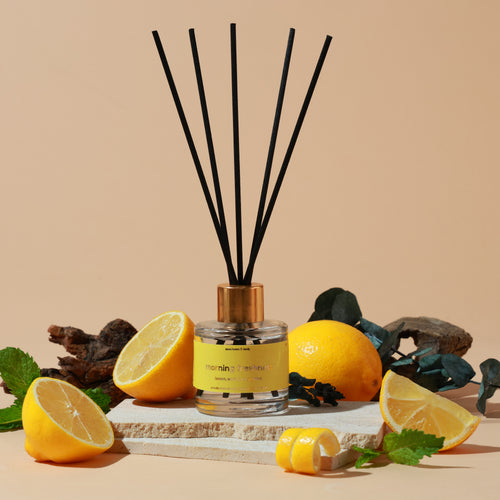
 Morning Freshness₹749There's nothing to fix about humid air arriving in the first place — it's a seasonal fact — the actual variable is how much of it gets absorbed into the café's own materials and how quickly that moisture is allowed to leave again.
Where mustiness shows up, by material and location
The pattern of where the smell is strongest points fairly directly at which materials and which corners are holding the most moisture.
| Where it's noticed | Likely material or location | What actually helps | Where fragrance fits |
| A booth or sofa area, worse than the rest of the dining room | Upholstery absorbing ambient humidity | Drying, airing and a monsoon-adjusted cleaning cadence for that seating | Not the dining room, at any point |
| Near curtains or soft window treatments | Fabric absorbing moisture from humid air near glass | Regular airing, and drying between humid spells where possible | Not fragrance |
| A closed cabinet, storage corner or area behind furniture | Enclosed, low-airflow space holding moisture the longest | Improved air movement into that specific spot | Not fragrance |
| A washroom, distinct from the dining room's pattern | Its own humidity and ventilation question | Extraction and a monsoon-adjusted cleaning check for that room specifically | A washroom fragrance decision, once dry |
| An entrance or vestibule with its own door and air volume | A separate space, worth checking on its own terms | Its own drying and ventilation review | A reed diffuser here, once genuinely dry |
| Any of the above, if fragrance has already been added on top of a still-damp material | The combination itself is the problem, not a weak fragrance choice | Remove the fragrance layer and address the damp first — no scent product resolves this from underneath |
Morning Freshness · a dry, well-aired washroom or entrance₹749Shop →  Sukoon · a larger washroom suite, checked dry₹1,899Shop →
  Vaayu · washrooms across a chain, standardised₹11,999Shop →
What to do about it, honestly
Never add fragrance to a room that still carries a damp note underneath, in any season — the combination reads as a cover-up, not an improvement, and it does nothing for the moisture actually causing the smell.
Sometimes the fix is genuinely limited to one or two spots — a booth that never gets air movement, a curtain that's due for a proper dry — and airing or cleaning just that area resolves the complaint without touching the rest of the room.
Usually, through a full monsoon season, the honest answer is a standing seasonal routine: airing and drying passes on upholstery and curtains more often than the dry-season rota calls for, confirmed ventilation into low-airflow corners, and a genuine acceptance that some background mustiness through the wettest weeks is a seasonal fact to manage, not a fragrance problem to solve.
What this costs, season by season
Almost entirely a drying-and-airing routine, not a purchase — that's the honest shape of this specific problem.
| Route | Premises | Why | What it costs |
| Increase airing and drying frequency on upholstery and curtains for the season | Any café with soft furnishings in the dining room, through the humid months | Directly reduces how much moisture stays absorbed at any given time | No purchase — a seasonal cleaning schedule change |
| Improve air movement into low-airflow corners, cabinets and behind furniture | Spots that stay musty longer than the rest of the room | Helps those specific materials dry back out between humid spells | A fan or ventilation review, unrelated to fragrance |
| Have a facilities professional review drying and ventilation options for the space | A café with persistent mustiness across a full monsoon season, not just isolated spots | Addresses the humidity mechanism directly, at the source | Assessed by a facilities professional, not a fragrance purchase |
| Confirm the washroom and entrance are genuinely dry before considering fragrance there | Any zone being considered for scent at all | Establishes the room is actually ready for fragrance, not still carrying a damp note | No purchase — an assessment |
| Reed diffuser, Morning Freshness or Mountain Breeze, once a zone is confirmed dry | A washroom or genuinely separated entrance, post-monsoon check done | The one point in this problem where a modest fragrance is honestly appropriate | ₹749–₹849 |
This is one of the questions I'm most careful about answering, because it would be easy to sell a diffuser into a musty café and let the owner believe the smell was handled. It wouldn't be — the moisture would still be sitting in the upholstery, releasing exactly the same smell underneath whatever fragrance had just been added on top of it.
The cafés that manage monsoon well are the ones that treat it as a standing seasonal routine, not a surprise each year — airing curtains and cushions more often through the wet months, checking the corners that never get air movement, and accepting that some of this is simply what monsoon does to a room full of fabric and wood.
Where I'll happily talk about fragrance is the washroom or a genuinely separate entrance, once someone has actually confirmed those spaces are dry — not as a way to skip that step, but as the modest, correctly timed addition it's always meant to be in this cluster.
Questions about café mustiness during monsoon
- Why Does My Air-Conditioned Café Develop a Closed-Room Smell? — the recirculated-air version of a similar seasonal problem.
- Why Do Sofas, Curtains and Upholstery Hold Food Smells in a Café? — the same materials, holding a different kind of smell.
- How Do Pune's Monsoon Months Affect Café Odour and Humidity? — a closer, city-specific look at the same seasonal pattern.
- Exhaust, Grease, Drains, Upholstery, HVAC, Humidity or Fragrance: What Should I Fix First if My Café Smells Bad? — the full order-of-operations this diagnosis sits inside.
- Brand: the SOSA founder story.
SOSA products & prices (verified September 2026): Reed diffusers 50ml ₹749–₹849 (to 150 sq ft, 6–8 weeks at six reeds) · 130ml ₹1,249–₹1,349 (above 150 sq ft, 14–18 weeks) · reed refill 300ml ₹2,399. Ultrasonic: Boond ₹899 (~150 sq ft) · Sukoon ₹1,899 (270–320 sq ft, ships with three 15ml Hotel Collection fragrances) · Megh ₹3,499 (6L tank, ~100 hrs runtime, ~215 sq ft — a runtime machine, not a coverage upgrade). Waterless cold-air: Safar ₹3,999 (no published coverage figure) · Vaayu ₹11,999 (up to 1000 m³, roughly 2,000–3,000 sq ft; 400ml tank lasting about 90+ days; app and onboard control, 1h/4h/8h/24h run windows, adjustable intensity, key-lock, under 38 dB, freestanding or wall/HVAC mount, 5W, CE/RoHS/SGS) · Aangan ₹25,999 (8,000–10,000 sq ft). Hotel Collection water-based fragrance 15ml ₹299 · 100ml ₹999 · 300ml ₹1,799 is for ultrasonic machines; reed oil and Hotel Collection are not interchangeable. Reed diffusers are alcohol-free, phthalate-free, paraben-free, IFRA-compliant and low VOC, handmade in small batches in Pune. Every purchase funds a girl's education through Nanhi Kali. Prices and availability subject to change — see the live product pages.