


The maintenance ledger, in real units: a reed diffuser ₹749–₹849 asks ten seconds every 3–5 days to flip six reeds, and a new bottle every 6–8 weeks. Sukoon ₹1,899 runs 16–18 hours on low per 500ml fill and covers 270–320 sq ft. Megh ₹3,499 has a 6L tank and about 100 hours of runtime — the fewest refills of any ultrasonic — but covers only about 215 sq ft, less than the cheaper Sukoon. Safar ₹3,999 needs no water at all but does need recharging, and is named and sold as a car and travel diffuser with no published room-coverage figure.
The trap: the genuinely lowest-maintenance noticeable machine in the range is Vaayu ₹11,999 — a 400ml tank lasting 90+ days on an app schedule — and it is rated to 2,000–3,000 sq ft, which makes it the wrong purchase for one room.
The honest gap: between Safar and Vaayu, SOSA has no mid-sized waterless bedroom nebuliser. That missing rung is exactly the product your question is asking for.
2. If lowest maintenance is what you actually mean, buy a reed and change what you expect from it. Passive capillary diffusion — oil climbing six fibre reeds and evaporating from their surface — asks for ten seconds every three to five days when you flip the reeds, and a new bottle every six to eight weeks on a 50ml at ₹749–₹849. No plug, no tank, no battery, no app, no schedule, no sound, about ₹13–₹15 a day. In exchange you get a fragrant zone: concentration highest at the bottle, falling with distance. In a small closed bedroom that zone can cover a surprising amount of the room. In a large or open one it will not, and no reed at any price will.
3. If noticeable is what you actually mean, the honest answer is Sukoon at ₹1,899 and the maintenance is a fill. Ultrasonic water mist vibrates a water-and-oil mixture into a visible plume, and because the plume moves air the machine both emits and delivers. 500ml, 270–320 sq ft, 16–18 hours on low, three 15ml Hotel Collection scents included. Note that 16–18 hours on low means a fill lasts more than a full day’s use, so “refilling every day” overstates it. The real costs are dilution in water, added humidity, and possible white mineral dust in a hard-water city.
4. If water is the part you object to, cold-air nebulising trades it for a battery. Safar at ₹3,999 shatters undiluted oil with pressurised air — no water, no dilution, no humidity, no dust — on a 20ml bottle and a 2000 mAh Type-C battery giving up to 10 hours continuous or around 30 intermittent, with three speeds and a 1, 2 or 3-hour auto-off timer. That is not zero maintenance; it is different maintenance, and a device you must remember to charge is arguably more demanding than one you must remember to fill. Two disclosures before you buy: it is named and sold as a car and travel diffuser, and SOSA publishes no room-coverage figure for it.
5. Check three free things first, because one of them may already have solved your problem. Move the bottle out of the draught and into the room you actually occupy. Use all six reeds rather than the three most people leave in. And leave the room for a quarter of an hour before judging it — you stop smelling a constant scent within minutes, so a room you have decided is unscented may be perfectly well scented for everybody who walks in. That last test costs nothing and settles a surprising number of these letters.
Alcohol-free, phthalate-free, paraben-free, IFRA-compliant, 0 ppm formaldehyde. Free shipping above ₹499, and a portion of every order supports girl-child education through Nanhi Kali.
Why the two requirements genuinely conflict
Start with what “noticeable across a room” actually requires, because once that is clear the conflict stops looking like a market failure and starts looking like arithmetic. To be perceived on the far side of a room, fragrance molecules have to get there in sufficient concentration, and they only travel where the air travels. That gives you two levers: emit much more, or move the air. A reed diffuser can do a little of the first — six reeds rather than three — and none of the second, because it contains nothing that moves anything. Its entire output is bounded by evaporation from a fixed area of wetted fibre at whatever rate the room happens to allow.
Now look at what “low maintenance” means physically. Maintenance is the human labour of keeping an energy supply and a consumable supply going. A reed has neither: no electricity, no water, no battery, and a consumable that lasts six to eight weeks and announces itself by the bottle being empty. It is the lowest-maintenance object in home fragrance because it is the lowest-energy one, and it is the least noticeable for exactly the same reason. Every step up in reach is a step up in energy input, and every energy input has a servicing schedule attached: a plug that must reach a socket, a tank that must be filled, a battery that must be charged.
This is why I distrust any page that answers your question with a single product. The honest shape of the answer is a curve with a trade-off along it, and where you should sit on that curve depends on something the page cannot know: whether the thing that would annoy you more is a room that is only fragrant near the console table, or a machine that wants attention on a Sunday. Both are legitimate irritations and they are not comparable. What I can do is give you the real numbers for each option so the comparison is yours to make rather than mine to assert.
 Morning Freshness₹749The lowest-maintenance improvement available is the one that costs nothing, so run it before spending. Olfactory receptors stop reporting a constant, unchanging stimulus within minutes — the molecules still arrive, the brain stops mentioning them. Leave the room for a quarter of an hour and walk back in. If it smells good on re-entry, the setup is working and you are asking a machine to solve a perception problem. Then check the two mechanical things: are all six reeds in, or did you leave three in months ago and forget; and is the bottle sitting in a dead corner or under an AC blast, either of which halves what a passive format can do.
 Sukoon₹1,899This is the place in our own range that is easiest to misread, and your question is precisely the question that leads people into it. Megh at ₹3,499 has a six-litre tank and around a hundred hours of runtime, which genuinely is the lowest refill frequency of any ultrasonic machine we sell — so for the maintenance half of your question it is a real answer. But it covers only about 215 sq ft, which is less than the ₹1,899 Sukoon’s 270–320. It is a runtime and humidity machine, never a coverage upgrade, and paying ₹1,600 more for less reach because the tank is bigger is the single most expensive mistake available on this page.
 Hotel Collection₹999I want to name this honestly because it is the shape of the whole problem. Vaayu at ₹11,999 is the only product in the range that genuinely satisfies both of your requirements at once: a 400ml tank lasting up to about ninety days, no water at all, an app that runs it on a schedule so you touch nothing for months, under 38 dB, and cold-air nebulising of undiluted oil which is the most present mechanism there is. And it is rated to 1000 m³ — roughly 2,000 to 3,000 sq ft — which means that in one bedroom nine-tenths of it is wasted. It earns its price on a whole floor, an open-plan living-dining, a large home, a villa, a clinic, a salon or a reception, or when somebody genuinely wants one machine scenting the entire flat. For one room it is the wrong purchase and I will not pretend otherwise.
The maintenance ledger, in real units
Maintenance gets discussed in adjectives when it should be discussed in minutes and litres, so here is the honest accounting for each option in a single room. A reed diffuser asks for one recurring action: flipping six fibre reeds every three to five days, which takes about ten seconds and does not require moving the bottle. Beyond that, a 50ml at ₹749–₹849 is replaced every six to eight weeks, or a 130ml at ₹1,249–₹1,349 every fourteen to eighteen, and if you want to halve even that you use three reeds instead of six, which roughly doubles the life at a softer level. There is no cleaning, no descaling, no cable, no firmware and no charging. It works during a power cut and it works while you are on holiday.
The ultrasonic machines ask for filling and a socket. Boond at ₹899 holds 300ml and runs about six hours on USB, which for evening use is a fill every couple of days and for continuous use is more; it covers up to about 150 sq ft. Sukoon at ₹1,899 holds 500ml and runs 16–18 hours on low, so a fill covers more than a full day of use — the common complaint that these machines need topping up every single day genuinely overstates it at this tank size. Megh at ₹3,499 holds six litres and runs about a hundred hours, which is the fewest refills in the range and also six litres of water to carry to the room. All three add humidity to the air by design, and in a hard-water city all three can leave a fine white mineral dust on nearby surfaces, which is a wiping job rather than a serious one.
The waterless machines remove the tank and add a different obligation. Safar at ₹3,999 has no water anywhere in the system and a 20ml bottle of undiluted oil, so there is nothing to fill in the ordinary sense — but there is a 2000 mAh battery giving up to 10 hours continuous or around 30 hours intermittent, which means a Type-C charge on a cadence set by how you use it. Whether that is more or less trouble than filling a tank is a genuine matter of temperament: a tank never goes flat at an inconvenient moment, and a battery never has to be carried to a sink. Its 1, 2 or 3-hour auto-off timer does reduce the fiddling, because it finishes without you. And the two disclosures stand: it is named and sold as a car and travel diffuser, and there is no published room-coverage figure for it, so it should be understood as personal and small-space scenting rather than a room machine.
| Option | Maintenance, in real units | How noticeable, honestly | The catch | Price |
|---|---|---|---|---|
| Reed diffuser — passive capillary ★ | Flip six reeds every 3–5 days (~10 seconds). New bottle every 6–8 weeks. No power, water, charging or cleaning | A fragrant zone, not a fragranced room — strongest at the bottle, falling with distance | Lowest maintenance and least noticeable. Cannot be switched off or up beyond six reeds | ₹749–₹849 |
| Boond — ultrasonic | 300ml fill, ~6 hours per fill, USB lead. Occasional wipe in hard water | Real but small — up to about 150 sq ft | Most frequent refilling of the three ultrasonics; adds humidity | ₹899 |
| Sukoon — ultrasonic ★ | 500ml fill, 16–18 hours on low — more than a full day’s use per fill. Mains lead, occasional wipe | Genuine room coverage, 270–320 sq ft. The best noticeable-per-effort in the range | Oil diluted in water, added humidity, possible white mineral dust | ₹1,899 |
| Megh — ultrasonic | 6L tank, ~100 hours runtime — the fewest refills of any machine here, but six litres to carry | About 215 sq ft — less than the cheaper Sukoon | Never a coverage upgrade. A runtime and humidity machine | ₹3,499 |
| Safar — cold-air nebulising | No water at all; 20ml of undiluted oil. 2000 mAh Type-C battery to recharge — 10 hours continuous or ~30 intermittent. 1/2/3-hour auto-off finishes without you | The hotel mechanism at personal scale — undiluted oil in a dry mist | Named and sold as a car and travel diffuser, with no published room-coverage figure. A battery to remember | ₹3,999 |
| Vaayu — cold-air nebulising | 400ml tank lasting 90+ days, app schedule, key-lock, under 38 dB — genuinely months of touching nothing | The most present option there is, rated to 1000 m³ ≈ 2,000–3,000 sq ft | The wrong purchase for one room — nine-tenths wasted in a bedroom | ₹11,999 |
| The honest gap: the product your question describes — hands-off, waterless, sized for one room — does not exist in this range. Between Safar at personal scale and Vaayu at 2,000–3,000 sq ft, SOSA has no mid-sized waterless bedroom nebuliser, which is why the real choice here is between accepting a smaller fragrant zone with a reed and accepting a fill with Sukoon. | ||||
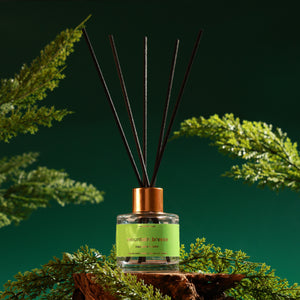
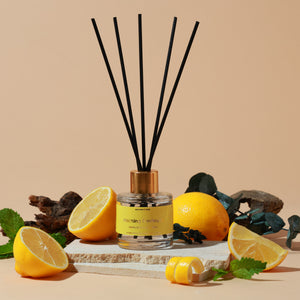
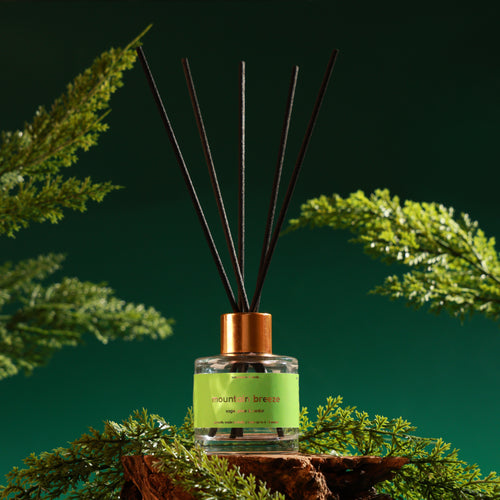
Lowest maintenance · Mountain Breeze₹849Shop →  Most noticeable per effort · Sukoon₹1,899Shop →
  The oils · Hotel Collection₹999Shop →
Deciding which requirement is actually yours
Here is the question that settles it, and it is worth answering honestly rather than aspirationally. Do you want somebody who walks in to remark on it, or do you want to notice it yourself when you sit down? Those two goals live at opposite ends of the trade-off. A guest arriving un-adapted from outside will register a well-placed reed diffuser in a small closed bedroom perfectly well — that is precisely the condition a fragrant zone performs best under. But if the requirement is that the far corner of a 300 sq ft room reads as scented at eleven at night, no passive format achieves that, and the argument is over before it starts.
The second question is about your relationship with objects, and I ask it without judgement because the answers vary enormously. Would you rather do a ten-second task twice a week forever, or a two-minute task once every day or two? Some people find the reed’s flip cadence invisible and a water tank an imposition; others find carrying a tank to the tap unremarkable and resent a fiddly consumable that has to be reordered. Neither is wrong. But the honest maintenance figures above make the comparison concrete, which is more useful than an adjective on a product page.
The third consideration is money over time rather than at the till, and it slightly favours the low-maintenance answer in a way people miss. A reed at ₹749–₹849 running six to eight weeks is about ₹13–₹15 a day, and that is the total cost — there is no electricity and no consumable beyond the oil. A machine has a purchase price and then oil on top, and the ₹299 Hotel Collection 15ml is a refill rather than a way in, so the machine route starts at ₹1,899 plus the three scents already included and continues from there. None of that makes the machine wrong; it makes the comparison honest. If you are choosing largely on cost, the reed wins on both axes and you should simply calibrate your expectation to what a fragrant zone is.
What to buy, in order — and the rung that does not exist
Two ladders rather than one, because the honest answer depends on which requirement you have decided is binding. The free steps come first in both, and the last row names the gap that your question is, in effect, asking us to fill.
| Do this | What it is | When it is the right answer | Price |
|---|---|---|---|
| 1. Run the walk-out test and put all six reeds in ★ | Leave the room for a quarter of an hour and come back before judging. Then check the reed count and move the bottle out of the draught and into the room you actually use | First, always — the lowest-maintenance improvement available costs nothing, and it settles a large share of these letters | ₹0 |
| 2. If lowest maintenance wins | A 50ml reed diffuser with all six fibre reeds — flipped every 3–5 days, replaced every 6–8 weeks, suits rooms up to about 150 sq ft. Mountain Breeze 9.4 is the deepest, Fresh Brew 9.5 the deepest of all | When you accept a fragrant zone rather than a fragranced room. No power, no water, no charging, no sound, ~₹13–₹15 a day | ₹749–₹849 |
| 3. If the room is larger than ~150 sq ft and you are staying passive | A 130ml reed at ₹1,249–₹1,349 with all six reeds, 14–18 weeks — or two 50ml bottles in two places rather than one large bottle in one, which is what a duo at ₹1,548 is for | When the room is above 150 sq ft. Two zones is a genuine strategy and often the cheaper right answer for a long room | ₹1,249–₹1,598 |
| 4. If noticeable wins ★ | Sukoon — ultrasonic water mist, 500ml, 270–320 sq ft, 16–18 hours on low, three 15ml Hotel Collection scents included. A fill lasts more than a day’s use | The best noticeable-per-effort in the range and the right answer for most bedrooms. You accept dilution, added humidity and refilling | ₹1,899 |
| 5. If water is the objection | Safar — waterless cold-air nebulising of undiluted oil, 20ml, 2000 mAh Type-C, 3 speeds, 1/2/3-hour auto-off, 6.9 cm. Named and sold as a car and travel diffuser | When no water is a hard requirement. Not zero maintenance — a battery to recharge instead of a tank to fill — and no published room-coverage figure | ₹3,999 |
| Do not buy for reach: Megh | 6L tank, ~100 hours of runtime — genuinely the fewest refills — but about 215 sq ft of coverage | Less coverage than the ₹1,899 Sukoon. Buy it only if refill frequency is the single thing you care about | ₹3,499 |
| The honest gap | The product your question describes does not exist. A hands-off, waterless, one-room machine would sit between Safar and Vaayu ₹11,999, and there is nothing there. Vaayu itself satisfies both requirements and is rated to 1000 m³ — roughly 2,000–3,000 sq ft — which makes it the wrong purchase for one bedroom | Said plainly, because it is the reason there are two answers rather than one | — |
Versailles
This is the question I find hardest to answer in a shop, because the person asking it usually wants me to say a product name and I keep wanting to ask them another question first. Low maintenance and high presence are not two features you can order together; they are the two ends of the same physical scale. The reed asks nothing of you because nothing goes into it, and it produces a zone rather than a room for exactly that reason. I would rather explain that once than sell somebody a ₹3,499 machine because the tank looked impressive.
If it helps, here is what I actually own. I keep reeds in the rooms where I want a character rather than an announcement — a bedside, a bathroom, a study — and I flip them on a Sunday with the rest of the tidying, which is genuinely the whole of the labour. Where I want a room to read as properly scented to somebody walking in, I use a machine and accept that it needs filling. Those are two different jobs and I stopped trying to make one object do both years ago.
And I will say the uncomfortable part once more, because it is the honest centre of this page. The product that would answer your question perfectly — waterless, hands-off for months, sized for one bedroom — is not in my range. Vaayu does it and is built for 2,000 to 3,000 square feet, which is absurd in a bedroom; Safar does the mechanism at personal scale and is sold as a car diffuser with no published room coverage. Between them there is nothing, and pretending otherwise would be the easiest sale on this page and the one I would regret. Everything is composed in Pune, and part of every order funds a girl’s classroom through Nanhi Kali.
Frequently asked questions
- Without burning candles — flame, attendance, and an event rather than an ambience.
- Without incense or bakhoor — combustion is a different process, and a much louder one.
- No aerosol fresheners — peak-and-crash against a held plateau.
- Without a plug-in — what the format is, and what SOSA reeds are formulated without.
- Without adding water — and why “every day” overstates it.
- Without constantly spraying — effort and repetition as the real cost.
- Without leaving a reed running all day — the reed cannot be switched off.
- No flame, no smoke, no incense — the format page, described physically.
- On when I come home, off when I leave — timers against app scheduling.
- Brand: the SOSA founder story.
Facts verified August 2026: Three diffusion mechanisms are described — passive capillary (reed diffusers), ultrasonic water mist (Boond ₹899, 300ml, up to ~150 sq ft, ~6 hours, USB, night light; Sukoon ₹1,899, 500ml, 270–320 sq ft, 16–18 hours on low, three 15ml Hotel Collection scents included; Megh ₹3,499, 6L tank, ~100 hours runtime, ~215 sq ft, which is less coverage than Sukoon and never a coverage upgrade) and waterless cold-air nebulising (Safar ₹3,999, 20ml bottle, 2000 mAh Type-C battery, up to 10 hours continuous or around 30 hours intermittent, 3 speeds, 1/2/3-hour auto-off timer, 6.9 cm, named and sold as a car and travel diffuser with car, handbag, desk, bedside and hotel room among its stated uses, no published room-coverage figure; Vaayu ₹11,999, coverage up to 1000 m³ or roughly 2,000–3,000 sq ft, 400ml refillable tank lasting up to about 90+ days, Bluetooth app and onboard buttons, 1h/4h/8h/24h run windows, choice of days, adjustable intensity, key-lock, under 38 dB, freestanding or wall/HVAC mount, 5W, CE, RoHS, SGS). SOSA reed diffusers: five scents, 50ml ₹749–₹849 lasting 6–8 weeks and suiting rooms up to ~150 sq ft, 130ml ₹1,249–₹1,349 lasting 14–18 weeks and suiting above 150 sq ft, six fibre reeds included and flipped every 3–5 days, six reeds for full projection and three for a soft bedside level with roughly double the life, about ₹13–₹15 a day, heat-stable CCT carrier rather than DPG, alcohol-free, phthalate-free, paraben-free, IFRA-compliant, 0 ppm formaldehyde, refillable glass bottle, climate-tested at 45°C and 85% RH, composed in Pune. Duos are two 50ml bottles at ₹1,498–₹1,598; 130ml duos ₹2,498–₹2,598; refills 300ml ₹2,399 and 500ml ₹3,499, oil only and never a first purchase. SOSA strength scale: Evening Calm 8.9, Garden Bloom 8.9, Morning Freshness 9.0, Mountain Breeze 9.4, Fresh Brew 9.5. Hotel Collection fragrance oils are water-based and ultrasonic-only at 15ml ₹299 (a refill), 100ml ₹999, 300ml ₹1,799 and a pack of seven at ₹1,799; they cannot be used in reed diffusers and reed oil cannot be used in ultrasonic machines, so no hotel-inspired reed diffuser exists. Between Safar and Vaayu, SOSA has no mid-sized waterless bedroom nebuliser. Fragrance does not remove a smell — source, then ventilation, then fragrance. Free shipping above ₹499. A portion of every order supports girl-child education through Nanhi Kali. SOSA is an independent Indian fragrance house; the Hotel Collection scents referenced here are SOSA’s own interpretations inspired by the world’s finest hotels, and SOSA is not affiliated with, endorsed by or a supplier to any hotel brand. Prices subject to change — see the live product pages.