
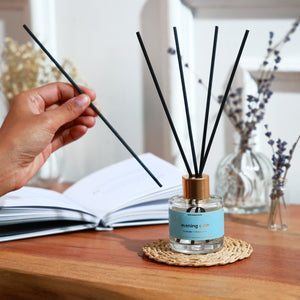



Why your room is different: a running air conditioner recirculates air inside a closed volume. That is bulk air movement, and bulk air movement is precisely the job a reed cannot do for itself. Your AC is quietly supplying the missing half of the mechanism, free.
What to do first, at zero cost: use three reeds rather than six, keep the bottle out of the direct airflow of the split unit, and take the reading after fifteen minutes out of the room. Three reeds roughly doubles the life of the bottle as well.
If you do buy a machine: buy it for control, not for reach, and run it on its lowest setting. Sukoon ₹1,899 covers 270–320 sq ft and runs 16–18 hours on low — in a sealed bedroom that is deliberately over-specified, which is fine, because the low setting is the point.
The thing not worth buying here: Vaayu at ₹11,999. It is rated to 1000 m³, roughly 2,000–3,000 sq ft. In a closed bedroom nine-tenths of it is wasted. And between Safar ₹3,999 — which is named and sold as a car and travel diffuser and has no published room-coverage figure — and Vaayu, SOSA has no mid-sized waterless bedroom nebuliser at all.
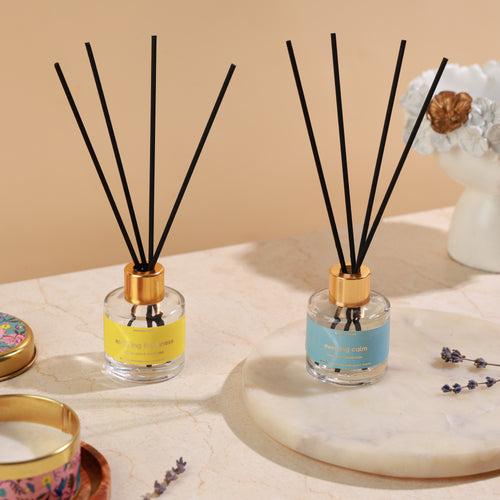
2. Go to three reeds before you go anywhere else. Every SOSA bottle ships with six fibre reeds and the count is the volume dial: six is full projection, three is a soft bedside level and roughly doubles the life of the bottle. In a small sealed room six is usually too many. If your complaint has ever been that the room is “a lot” in the first hour and unnoticeable by bedtime, that is not fading — that is an over-dosed room and an adapted nose in the same evening.
3. Move the bottle out of the split unit’s direct blast, but leave it in the room’s circulation. Directly under the vent the lightest, brightest materials are stripped within days and you are left living with the base of the composition. A metre or two to the side — on the bedside table, on a dresser, anywhere the recirculating air passes without hitting it head-on — gives you the distribution without the stripping.
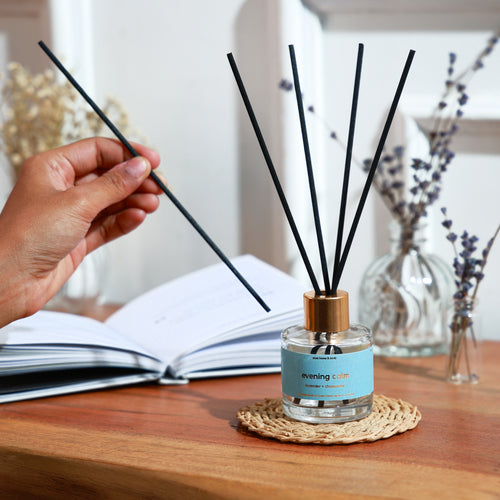
4. Choose the scent downward rather than upward. The SOSA strength scale measures perceived intensity in the room, not quality: Evening Calm 8.9 is the softest thing we make, Garden Bloom 8.9, Morning Freshness 9.0, Mountain Breeze 9.4 and Fresh Brew 9.5 the deepest. The scale exists so that somebody buying for a small sealed bedroom can choose deliberately downwards, which is a decision almost nobody makes and almost everybody in your situation should.
5. Only then ask whether you want a machine — and ask it about control, not about strength. A reed cannot be switched off. If what you want is fragrance during the hours you are in the room and nothing the rest of the time, that is a real requirement a reed structurally cannot meet, and it is the one honest reason to spend more in a room like yours. It is not a reach requirement, and buying reach you do not need is how people end up with a room that smells like a shop.
Alcohol-free, phthalate-free, paraben-free, IFRA-compliant, 0 ppm formaldehyde. Free shipping above ₹499, and a portion of every order supports girl-child education through Nanhi Kali.
Why a sealed, air-conditioned room is the easy case — three reasons, and they compound
Concentration in any room is a balance between two terms: how fast fragrance enters the air, and how fast the air carrying it leaves. Almost every complaint in this cluster is really a complaint about the second term being large — open windows, a balcony on a high floor, a doorway that opens all evening. Your second term is unusually small, and the effect of that is larger than people expect. On top of it, the machine you already own for temperature happens to solve the transport problem a reed diffuser is famously bad at. Here are the three conditions, in the order they matter.
 Morning Freshness₹749A Gurgaon high-rise bedroom with the windows shut and the AC on is close to the best-sealed domestic space in urban India. Air that leaves a room takes the fragrance with it, so a home ventilating continuously is simply not a home-fragrance environment during those hours — it becomes one the moment it closes. Yours is closed for most of the hours you care about. That means a modest emission rate has time to accumulate into a genuinely perceptible concentration, which is the whole reason a hotel room is easier to scent than a hotel lobby: a small closed volume reaches a noticeable level far faster than a large open one, at a fraction of the output.
 Sukoon₹1,899This is the card that changes the recommendation. Getting scent into a room is two jobs — emission, which a reed does well, and transport, which a reed does not do at all. In a still room, transport is left to slow convection and molecular spreading, and the result is the famous fragrant corner. A running air conditioner recirculates the room’s air continuously, and that is bulk air movement. It flattens the gradient, carries the fragrance to the bed rather than leaving it on the dresser, and does for nothing what an ultrasonic or cold-air machine is sold to do. It is also why a bedroom so often smells strongest at night. The trade-off is real and small: conditioned air is drier, drier air evaporates faster, and the bottle empties sooner. Better distribution and a shorter life, in the same room.
 Evening Calm₹799The third condition is duration, and it is the one people forget to count. A hotel gets its effect partly by running a machine at consistent intensity for hours on end into a controlled volume. You are doing the same thing with a passive source and a closed door, just more slowly — and you have all night. This is why the honest recommendation in a sealed bedroom is a low, steady output rather than a strong one: the room will get there regardless, and it will keep going after it gets there. The failure you should actually plan against is arriving at bedtime in a room that has been quietly concentrating since seven.
The over-dosing problem, and why it reads as “cheap” rather than as “strong”
Here is the part I most want you to take away, because it is counter-intuitive and it is the difference between a room that reads as a hotel and a room that reads as a taxi. Almost any composition, at too high a concentration, flattens into a single sweet or sharp impression. The nose stops resolving the separate materials and files the whole thing under one crude heading — which is precisely what people mean when they say something smells like air freshener. The same oil at a lower dose reads as layered and expensive, because there is room for the lemon and the eucalyptus, or the lavender and the chamomile, to be heard as two things rather than one. Restraint costs nothing and it is the single most reliable way to make a fragrance read as luxurious.
A closed AC bedroom is the environment most likely to push you across that line without your noticing, for the simple reason that the concentration keeps climbing while your ability to perceive it does not. Olfactory receptors adapt to a constant, unchanging stimulus within minutes. The molecules keep arriving; the brain stops reporting them because nothing has changed. So you sit in a room that is objectively getting stronger and subjectively getting quieter, and the natural response — add reeds, buy a deeper scent, look for a machine — makes the room worse for everybody who walks into it un-adapted while doing nothing at all for you. This is the most common way this problem gets worse rather than better, and it costs money to do.
The test is free and takes fifteen minutes. Leave the room, shut the door behind you, do something else for a quarter of an hour, and walk back in paying attention to the first three seconds. That is your actual reading. Better still, ask somebody arriving from outside where in the room they first notice it. A visitor is a better instrument than you are, and if they tell you it is lovely from the doorway while you can barely detect it, you do not have a diffusion problem at all. You have a working diffuser and an adapted nose, and no purchase in the world fixes that.
| Mechanism | How it works | In your room | What it costs you | Price |
|---|---|---|---|---|
| Passive capillary — the reed diffuser ★ | Oil climbs six fibre reeds and evaporates from their surface. No power, no air moved | Its weakness — no transport — is covered by your AC. Its strength, a steady low output into a closed volume, is exactly what this room wants. Use three reeds | Cannot be switched off. Drier conditioned air shortens the bottle | ₹749–₹849 / 50ml |
| Ultrasonic water mist — Boond, Sukoon, Megh | A piezo plate shatters a water-and-oil mixture into a visible wet mist | Over-specified and therefore controllable. Sukoon covers 270–320 sq ft and runs 16–18 hours on low; in a sealed bedroom the low setting is the only setting you need | Mains power, refilling, oil diluted in water, added humidity, possible white mineral dust in hard-water areas | ₹899 / ₹1,899 / ₹3,499 |
| Waterless cold-air nebulising — Safar, Vaayu | Pressurised air shatters undiluted oil into a dry micro-mist. No water, no dilution, no added humidity | The mechanism hotels actually use. Safar gives you 3 speeds and a 1/2/3-hour auto-off, which is genuine control; Vaayu at 1000 m³ is absurd for one bedroom | Charging or power, a visible device, money. Safar is named and sold as a car and travel diffuser with no published room coverage | ₹3,999 / ₹11,999 |
| The honest gap: between Safar at personal scale and Vaayu at 2,000–3,000 sq ft, SOSA has no mid-sized waterless bedroom nebuliser. In your particular room that gap matters less than it does anywhere else in this family, because a sealed AC bedroom does not need much delivered to it — but it is the reason there is no single automatic upgrade to point you at. | ||||
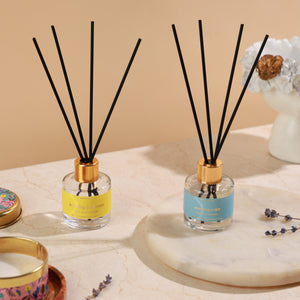
Softest · Evening Calm₹799Shop → 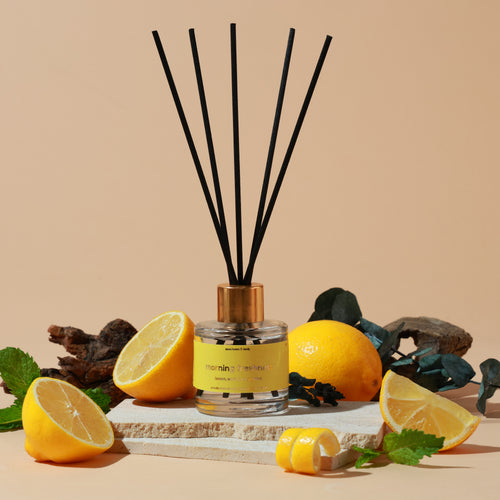 Bright · Morning Freshness₹749Shop →
  If you want control · Sukoon₹1,899Shop →
When a machine is still the right purchase in a room like this
I have spent most of this page telling you to spend less, so let me be equally clear about the case where spending more is genuinely correct. It is control, and control is a real feature rather than a luxury. A reed diffuser cannot be switched off. It runs while you are at work, it runs while you are away for the weekend, and the only real waste in a reed diffuser is oil evaporating into a room with nobody in it. If your objection to your current setup is not “I cannot smell it” but “I want it on when I am in here and off when I am not”, then you have identified something a passive mechanism structurally cannot do, and no adjustment on this page will give it to you.
The two honest answers are different in kind. Sukoon at ₹1,899 is ultrasonic water mist — a piezo plate turning a water-and-oil mixture into a visible wet mist. It covers 270–320 sq ft, runs 16–18 hours on low, comes with three 15ml Hotel Collection scents, and is on-demand. The honest caveats are that the oil is diluted in water, the output adds humidity to the room, it needs filling, and in hard-water areas it can leave a fine white mineral dust on nearby surfaces. In a sealed bedroom, run it on low and expect to use it in windows rather than continuously.
Safar at ₹3,999 is the other kind: waterless cold-air nebulising, in which pressurised air shatters undiluted oil into a dry mist with no water, no dilution, no added humidity and no white dust. That is the same physical principle a luxury hotel uses, at personal scale. It holds 20ml, runs on a 2000 mAh Type-C battery for up to 10 hours continuous or around 30 intermittent, has three speeds and a 1, 2 or 3-hour auto-off timer, and is 6.9 cm across. You should know before you buy it that it is named and sold as a car perfume diffuser — SOSA’s own product page lists car, handbag, desk, bedside and hotel room among its intended places, so a bedside recommendation is legitimate, but nobody should discover the word “car” after paying. SOSA has published no room-coverage figure for it, so treat it as personal and small-space scenting rather than as a room machine. And it is not set-and-forget: the timer maxes at three hours and the battery needs recharging.
What to buy, in order — and the rung that does not exist
Ordered by cost, because in your room the first two rows resolve the question for most people and both of them are free or nearly so. The last row is the gap in our own range, said plainly, because you deserve to know where the ladder stops before you start climbing it.
| Do this | What it is | When it is the right answer | Price |
|---|---|---|---|
| 1. Take three reeds out ★ | Six fibre reeds is full projection; three is a soft bedside level and roughly doubles the bottle’s life. Keep it out of the split unit’s direct blast | First, always, and especially if the room has ever felt like “a lot”. Costs nothing and saves money | ₹0 |
| 2. Choose downwards, not upwards | Evening Calm at 8.9 on the SOSA strength scale is the softest composition in the range; Morning Freshness at 9.0 is the bright option | When the room is small and sealed and you want it to read as layered rather than loud. 50ml suits up to about 150 sq ft | ₹749–₹849 |
| 3. Buy control, not reach | Sukoon — ultrasonic water mist, 500ml, 270–320 sq ft, 16–18 hours on low, three 15ml Hotel Collection scents included. Run it on low | When you want it on demand rather than always. You accept dilution in water, added humidity and refilling | ₹1,899 |
| 4. Control with no water at all | Safar — waterless cold-air nebulising of undiluted oil, 20ml, 2000 mAh Type-C, up to 10 hours continuous or ~30 intermittent, 3 speeds, 1/2/3-hour auto-off, 6.9 cm. Named and sold as a car and travel diffuser, with bedside and hotel room among its stated uses | When water is the deal-breaker and you want the hotel mechanism at personal scale. No published room-coverage figure — treat it as personal scenting | ₹3,999 |
| Not for this room: Megh | 6L tank, around 100 hours of runtime, about 215 sq ft of coverage | Less coverage than the ₹1,899 Sukoon. A runtime and humidity machine, never a coverage upgrade — and a sealed bedroom needs neither | ₹3,499 |
| The honest gap | No mid-sized waterless bedroom nebuliser exists at SOSA. Nothing sits between Safar and Vaayu ₹11,999, which is rated to 1000 m³ — roughly 2,000–3,000 sq ft — and is the wrong purchase for one bedroom | Said plainly. In a closed AC bedroom you are the reader least penalised by this gap, because you need the least delivered | — |
Versailles
Of all the letters I get from Indian cities, the ones from sealed high-rise bedrooms are the ones where I most often end up talking somebody out of a purchase. The message usually reads as a strength complaint — I want a strong luxury-hotel fragrance in my room — and the room described in the same paragraph is 120 or 150 sq ft with the windows shut and the AC on for ten hours. That room does not need strength. It needs restraint and a shut door, and it already has the shut door.
I understand why the instinct runs the other way. You have been in a hotel where the fragrance was unmistakable and even, you have come home and found your own room quieter, and the obvious conclusion is that you need more of something. But the hotel effect you are remembering has three parts, and only one of them is the oil: concentration, evenness, and the fact that you arrived un-adapted. Your bedroom gives you the first two more cheaply than any hotel can. What it cannot give you is the third, because you live there.
So my honest advice is the least commercial thing on this page. Take three reeds out of the bottle. Move it out of the vent’s path. Walk out for fifteen minutes and walk back in before you decide anything. If you still want to spend money after that, spend it on control rather than on power — on being able to switch the thing off when you leave the room, which is the one thing a reed genuinely cannot do and the one thing I will never pretend otherwise about. Everything is composed in Pune, and part of every order funds a girl’s classroom through Nanhi Kali.
Frequently asked questions
- Mumbai, without a humidifier — when “no water” is the binding constraint.
- A small Mumbai apartment — where small volume is an advantage rather than a limit.
- Pune with the windows open all day — the exact opposite of your room, and the reason yours is easy.
- A Pune 2BHK on the way home — scheduling rather than strength.
- A Bengaluru work-from-home bedroom — ten occupied hours change everything.
- Delhi without candles or incense — what is left when both formats are ruled out.
- Humid Chennai, passive or active — why saturated coastal air changes the answer.
- A Hyderabad open-plan flat — the one city page where the large machine is right.
- A humid Kolkata flat where the reed feels weak — airflow and drying before mechanism.
- Brand: the SOSA founder story.
Facts verified August 2026: Three diffusion mechanisms are described — passive capillary (reed diffusers), ultrasonic water mist (Boond ₹899, 300ml, up to ~150 sq ft, ~6 hours, USB, night light; Sukoon ₹1,899, 500ml, 270–320 sq ft, 16–18 hours on low, three 15ml Hotel Collection scents included; Megh ₹3,499, 6L tank, ~100 hours runtime, ~215 sq ft, which is less coverage than Sukoon and never a coverage upgrade) and waterless cold-air nebulising (Safar ₹3,999, 20ml bottle, 2000 mAh Type-C battery, up to 10 hours continuous or around 30 hours intermittent, 3 speeds, 1/2/3-hour auto-off timer, 6.9 cm, named and sold as a car and travel diffuser with car, handbag, desk, bedside and hotel room among its stated uses, no published room-coverage figure; Vaayu ₹11,999, coverage up to 1000 m³ or roughly 2,000–3,000 sq ft, 400ml refillable tank lasting up to about 90+ days, Bluetooth app and onboard buttons, 1h/4h/8h/24h run windows, adjustable intensity, key-lock, under 38 dB, freestanding or wall/HVAC mount, 5W, CE, RoHS, SGS). SOSA reed diffusers: five scents, 50ml ₹749–₹849 lasting 6–8 weeks and suiting rooms up to ~150 sq ft, 130ml ₹1,249–₹1,349 lasting 14–18 weeks and suiting above 150 sq ft, six fibre reeds included and flipped every 3–5 days, six reeds for full projection and three for a soft bedside level, about ₹13–₹15 a day, heat-stable CCT carrier rather than DPG, alcohol-free, phthalate-free, paraben-free, IFRA-compliant, 0 ppm formaldehyde, refillable glass bottle, climate-tested at 45°C and 85% RH, composed in Pune. Duos are two 50ml bottles at ₹1,498–₹1,598; 130ml duos ₹2,498–₹2,598; refills 300ml ₹2,399 and 500ml ₹3,499, oil only and never a first purchase. SOSA strength scale: Evening Calm 8.9, Garden Bloom 8.9, Morning Freshness 9.0, Mountain Breeze 9.4, Fresh Brew 9.5. Hotel Collection fragrance oils are water-based and ultrasonic-only at 15ml ₹299 (a refill), 100ml ₹999, 300ml ₹1,799 and a pack of seven at ₹1,799; they cannot be used in reed diffusers and reed oil cannot be used in ultrasonic machines, so no hotel-inspired reed diffuser exists. No health, air-quality, allergy or antimicrobial claims are made, and fragrance does not remove a smell — source, then ventilation, then fragrance. Free shipping above ₹499. A portion of every order supports girl-child education through Nanhi Kali. SOSA is an independent Indian fragrance house; the Hotel Collection scents referenced here are SOSA’s own interpretations inspired by the world’s finest hotels, and SOSA is not affiliated with, endorsed by or a supplier to any hotel brand. Prices subject to change — see the live product pages.