

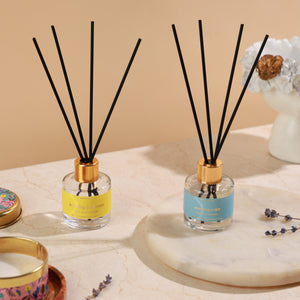



Where: the first at the inside corner — the elbow — not at the end of the long leg. The second in the middle of the short leg.
What it costs: ₹2,098 for a 130ml and a 50ml of Garden Bloom, or ₹1,998 for the same pairing in the ₹749 and ₹1,249 blends. Both bottles must hold the same scent.
2. But move the first bottle before you buy the second. This is the step that saves people money and it costs nothing. The inside corner of an L is the only spot with a line to both legs. A diffuser at the far end of the long leg is charging a rectangle and leaving the return untouched, and the owner concludes the bottle is weak when it is simply in the wrong place. Move it to the elbow, put all six reeds in, and live with it for two full days before deciding anything.
3. Then apply the eight-foot rule to the short leg. Stand where the first bottle is and look into the return. If it is under about six feet deep it is an alcove — the air there is continuous with the main leg and it will read of the same thing. If it runs eight feet or more, or if it bends far enough that you cannot see the end wall, it is a genuine second pocket. That is the case where a second bottle buys area, which is exactly what a second bottle usually fails to do in a plain rectangular room.
4. Same scent in both bottles, without exception. There is no door between the legs of an L, so two blends do not divide the room into two moods. They overlap across the elbow, which is the busiest part of the space, and neither one reads as itself there. Buy two bottles of one blend — a 130ml and a 50ml is the usual pairing. If you want a second scent in your home, put it behind a door.
5. Sizes should follow use, not symmetry. The long leg holds the seating and is occupied for hours; the short leg is often dining, a study corner or a reading chair used for shorter stretches. Put the 130ml at the elbow, where it is doing most of the work and where 14–18 weeks at about ₹78 a week earns its price, and a 50ml at ₹749–₹799 in the return. Two 130ml is not wrong, it is simply ₹500 more for a leg that does not need the duration.
Made in India, composed by an ISIPCA Versailles-trained perfumer — and a portion of every order supports girl-child education through Nanhi Kali.

Why a corner behaves like a wall, and a second bottle finally earns its keep
Almost everywhere else in this cluster we argue against the second bottle. In a plain rectangular room a second diffuser gives you a second point of origin inside air that one source already reaches — it does not widen the circle, it just empties two bottles at once. The L is the exception, and it is worth understanding why. A reed diffuser is passive. Fragrance climbs the fibre by capillary action, evaporates from the exposed tip, and from there the room's own gentle movement carries it. That movement travels along open paths. It does not reliably turn a ninety-degree corner into a leg that has its own walls, its own window and often its own furniture blocking the throat of the opening.
So an L is best understood as one air space with a restriction in the middle of it. The elbow is a throat: air passes through it, but slowly, and everything downstream of it gets a diluted version of whatever the source is producing. That is why placement fixes so many of these rooms. At the inside corner, a single bottle sits in the throat itself and both legs are downstream of it, which is the most efficient position available. At the end of the long leg, the same bottle has the whole main space to charge before anything reaches the return at all. The second reason the L needs care is simple arithmetic: these rooms are large. A 340 sq ft L at a nine-foot ceiling is about 3,060 cubic feet against the roughly 1,350 that one bottle is rated to hold, so even perfect placement leaves you short. Shape tells you where the bottles go; area tells you how many. You need both answers, and most people only ask the second one.
The three decisions for an L-shaped room
 One bottle, moved₹0 to tryFind the inside corner of the L — the point where the two legs meet on the short side of the room — and put the diffuser on the nearest surface to it, at roughly table height. That is the only position with a line into both legs. Give it all six reeds and forty-eight hours, then judge it by walking in from outside rather than from the sofa. A meaningful share of L-shaped rooms are fixed at this step, and the fix costs nothing but the walk across the room.
Sizing by space — Ls, returns and alcoves
Measure the depth of your return before you read this table. Two rows here tell you to buy nothing at all, and one of them is the row most people were about to spend on.
| Space | What it needs | How many | Cost |
|---|---|---|---|
| L of 300–350 sq ft, return 8–12 ft deep ★ | One 130ml at the elbow and one 50ml in the return, same blend — the case in this article | Two | ₹1,998 or ₹2,098 |
| L under about 200 sq ft with a shallow return | One 130ml at the inside corner on six reeds — the shape is doing nothing the placement cannot fix | One | from ₹1,249 |
| An alcove under about 6 ft deep off the main leg | Nothing. It is a recess, not a leg — the air in it is already charged | None | ₹0 |
| A short leg used only as the route to the balcony | Nothing. Transit space, and it sits in the flow path where a bottle would empty fastest | None | ₹0 |
| L where the long leg alone runs past about 22 ft | Two sources in the long leg plus one in the return — length and shape are both against you | Three | from ₹2,747 |
| L-shaped living-dining over about 450 sq ft | Past passive range — a Sukoon in the main leg and one bottle in the return | One machine, one bottle | ₹2,648 |
| A note on all of the above: the 150 sq ft figure assumes a closed, still room at standard ceiling height, and an L-shaped living room usually has a balcony door in it. Where the air is being exchanged three to eight times an hour, moving the sources out of the flow path does more than adding another one. | |||
One room · the unitFrom ₹749Shop → 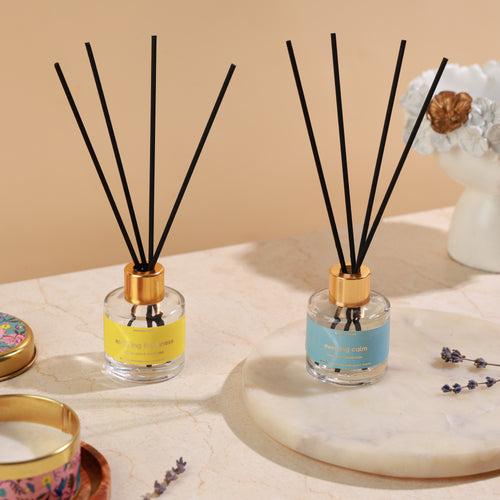 Two rooms · better value₹1,498Shop →
  Large room · a switch₹1,899Shop →
The elbow, the reeds and the scent rule
Start with the move, not the purchase. Put the bottle you own at the inside corner of the L, on a console or side table at about table height, and give it all six reeds. Reed count is the only volume control a diffuser has, and an L-shaped living room is a large, moving space where six is genuinely the right setting rather than an excessive one. Then wait two full days, because reeds have to saturate along their whole length before they throw properly and a first-day verdict tells you nothing. Judge it by walking in from the corridor with a fresh nose — never from the sofa, where you have been adapted to the room for the last hour and will always under-read it.
If the return is still flat, place the second bottle where the leg is used, not where it ends. The instinct is to put it against the far wall to "reach" the corner. The better position is beside whatever the leg is for — the dining table, the study desk, the reading chair — because that is where the air is disturbed by people and where the scent is actually going to be met. Keep both bottles out of three places: direct sunlight, which heats the oil and fades the fragrance; the direct throw of an AC vent or fan, which halves the bottle life and drives everything against one wall; and bare polished wood, since reed oil marks a finish permanently if a bottle is knocked. A tray under each solves the third for nothing.
Then buy one blend twice, and refill rather than rebuy. The pairing that suits most L-shaped rooms is a 130ml at the elbow and a 50ml in the return — ₹1,998 in Morning Freshness or ₹2,098 in Garden Bloom. When the larger one runs low, a 300ml refill at ₹2,399 fills a 130ml roughly twice, so one refill carries the elbow bottle through most of a year, and refilling is the natural moment to fit fresh reeds — clogged fibre is the usual reason a bottle that started well seems tired after three or four months.
What to buy
An L needs two lines from this table, and they should hold the same blend. The rest is here so you can see what the other options are for.
| Buy | What it covers | Lasts | Price |
|---|---|---|---|
| One 50ml | A single reed diffuser — the short leg of an L — a smaller, less occupied space that does not need 18 weeks of duration | 6–8 weeks | from ₹749 |
| One 130ml ★ | The value size — the elbow, where it does most of the work — 14–18 weeks at about ₹78 a week | 14–18 weeks | from ₹1,249 |
| The duo | Day & Night duo — two rooms behind two doors, not the two legs of one L, where a single blend is the rule | 6–8 weeks each | ₹1,498 |
| Sukoon | 500ml ultrasonic — an L-shaped living-dining past about 450 sq ft, where passive diffusion has run out of range | Runs when you switch it on | ₹1,899 |
| 300ml refill | The running cost — keeping the elbow bottle going for most of a year without buying the glass twice | Roughly 2 × 130ml fills | ₹2,399 |
Versailles
The L is the shape I am happiest recommending a second bottle for, because here it genuinely buys something. Everywhere else, a second diffuser in one room gives you two starting points inside air the first one already held. Round a corner it is different — there is a part of the room the first bottle cannot reach at all.
That said, I still want you to try the free thing first. Nine times out of ten the bottle is sitting at the end of the long leg, next to the sofa, as far from the return as it could possibly be. Move it to the inside corner. Put all six reeds in. Wait two days and judge it on the way in from outside, not from where you have been sitting. A good number of people never need the second bottle after that.
And whatever you do, do not buy two different scents for the two legs. They meet at the elbow, which is precisely where everyone walks, and the result is neither of the two things you paid for. One blend, two bottles, and nothing at all in the six-foot alcove. A portion of every order funds a girl's classroom through Nanhi Kali.
Frequently asked questions
- An open-plan living-dining-kitchen — why you count length, not area.
- Rooms with high ceilings — coverage is cubic, quoted in square.
- The passage between two bedrooms — the strongest case for buying nothing.
- The complete sizing and quantity guide — every home type, three builds.
- Brand: the SOSA founder story.
SOSA products & prices (verified August 2026): Hotel Collection water-based ultrasonic diffuser fragrance 15ml ₹299 · 100ml ₹999 · 300ml ₹1,799 · Pack of 7 (15ml, all fragrances) ₹1,799; refills 100ml from ₹999. Seven scents: The Ritz-Carlton-inspired (white tea · bergamot · cedar), Westin-inspired (white tea · aloe · cedar), 1 Hotels-inspired (cedarwood · vetiver · green leaves), The St. Regis-inspired (amber · violet · woods), Shangri-La-inspired (jasmine · green tea · white tea), Four Seasons-inspired (citrus · floral · sandalwood), W Hotels-inspired (citrus · pepper · amber). Diffusers: Boond 300ml ₹899 · Sukoon 500ml ₹1,899 · Megh 6L ₹3,499. Water-based, phthalate-free, composed to IFRA standards for home diffusion; 3–6 drops per tank. Made in India, Pune. The Hotel Collection scents are SOSA's own interpretations inspired by the world's finest hotels; all hotel names are trademarks of their respective owners and are used only to describe the scent style — SOSA is an independent Indian fragrance house, not affiliated with or endorsed by any hotel brand. Prices and availability subject to change — see the live product pages.