




Inside, ranked: fix the air first; then a desiccant, which removes the cause; then cedar blocks, which are mild and re-sanded rather than replaced; then a light lavender or herb sachet; then unscented tissue and fresh shelf lining.
The rule that governs all of it: anything with a strong oil base migrates into fabric, and the finer and more natural the fibre the more it takes and the longer it holds it.
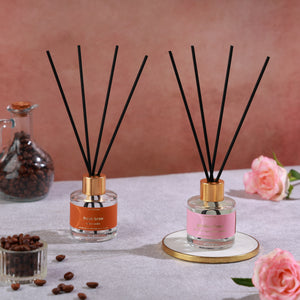
Outside: a reed on the dresser from ₹749, or a diffuser in the bedroom from ₹899.
2. Put the scent in the room instead, eighteen inches away. A bedroom exchanges its air continuously and dilutes what you add; a wardrobe does neither. The same bottle that behaves beautifully on a dresser saturates a cupboard and lands on every garment in it.
3. Do the free things first, because they are the ones that work. Both doors open for an hour on a dry day each week, a hand's width of visible gap along the rail, nothing damp put away, and the old lining paper thrown out and replaced.
4. Then, if you still want something in there, use the mild and self-limiting ones. A desiccant removes the cause; aromatic cedar blocks are dry, faint and restored with fine sandpaper rather than replaced; a dried lavender sachet is light and stays near the shelf it sits on; unscented tissue and fresh lining paper are subtraction rather than addition.
5. And never anything with a strong oil base — a reed, an open bottle, a perfumed sachet, cotton wool with scent on it. Oil-based fragrance in a sealed box migrates into fabric, and the finer and more natural the fibre the more of it it takes and the longer it holds on.
A portion of every order supports girl-child education through Nanhi Kali.

Nothing inside, something outside
It is worth being precise about what people mean when they say they want a wardrobe to smell good, because the answer changes completely depending on the reply. Almost nobody, pressed, actually wants their shirts to carry a scent. What they want is the experience of opening the doors and not being met by something flat and shut-in — and, separately, they want the corner of the bedroom the cupboard stands in to feel looked after. Those are two different wishes with two different solutions, and the reason so many wardrobe fragrance experiments end badly is that a single product gets asked to do both.
The five things worth putting in a cupboard
Ranked honestly, which means the free ones are at the top and nothing SOSA sells appears anywhere in the list. The column that decides the ranking is transfer risk — how much of it ends up on your clothes rather than in the cupboard's air. The last two rows are what not to put in there, and one of them is a product I would be delighted to sell you for a different location.
| Option | What it actually does | Transfer risk | Lifespan and upkeep | Cost |
|---|---|---|---|---|
| 1. Air, space and dryness ★ | Removes the cause rather than masking it: exchanged air, gaps on the rail, nothing damp put away, old lining paper binned | None | An hour a week with the doors open, and ten minutes of tidying the rail | ₹0 |
| 2. A desiccant | Silica gel in a breathable pouch, or a calcium-chloride absorber tub. It lowers the humidity, which is what actually stops a cupboard smelling musty | None | Silica recharges in two hours of sun and lasts years; a chloride tub is replaced when the crystals have collapsed into liquid | ₹100–₹400 |
| 3. Aromatic cedar blocks | A dry, faint, resinous note from oils held inside the wood, plus a mild deterrent effect on some insects. Traditional, and mild for good reason | Low — the oils are bound in a solid and released only from the exposed surface | Years. When it stops smelling of anything, take fine sandpaper to the face of the block rather than buying another | ₹200–₹600 |
| 4. A dried lavender or herb sachet | A very small quantity of volatile material held in plant tissue, released slowly. Light enough that fabric barely registers it | Low, provided it is genuinely dried herb rather than a cloth bag soaked in fragrance oil | A year or so. Squeeze it to refresh; replace when squeezing does nothing | ₹100–₹300 |
| 5. Unscented tissue and fresh lining | Subtraction rather than addition: acid-free tissue between folded knits, and a new sheet of plain paper on each shelf | None | Replace the lining annually. The old sheet is often the most saturated object in the whole unit | ₹50–₹200 |
| Not this: a reed diffuser inside | Undiluted oil, open to the air, in a box with no exchange. It saturates and lands on every garment, and the bottle is a spill risk over fabric | The highest available | — | — |
| Not this either: perfume on cotton wool, or a scented sachet | The same problem in a cheaper form. A cloth bag soaked in fragrance oil is an open oil source sitting between your shirts | Very high | — | — |

The transfer rule, and where the bottle goes
Start with what to do this week, because the free part is not a preamble to the recommendation — it is most of it. Open both wardrobe doors fully for an hour on a dry day, with the bedroom window open and a fan pointed into the opening for twenty minutes of that hour, and repeat it weekly. Then thin the rail until there is a hand's width of visible gap; a cupboard packed solid has no internal air movement at all, and garments pressed against each other exchange nothing with anything. Then take the lining paper out and look at it honestly, because if it has been down for more than a couple of years it has been quietly collecting and re-releasing everything that has happened in that cupboard, and a new sheet is a hundred rupees. Then adopt the one rule that prevents relapse: nothing goes in unless it is dry and cold to the back of the hand — not warm off an airer, not damp at the seams, not shoes worn that day, not a gym bag, not a coat that has been out in rain. In a monsoon month, do the airing during the driest hours rather than into a wet afternoon, since at 85% relative humidity you are importing water into a wooden box and swapping a stale smell for a musty one. If a musty note survives all of that, the problem is humidity rather than airflow, and the correct purchase is a desiccant rather than a fragrance — silica gel that recharges in two hours of sun, or a calcium-chloride absorber tub. SOSA makes neither, and I would rather point you at a hardware shop than at my own shelf.
Then, if you still want something in there, the two mild options and how to use them properly. Cedar is the traditional answer and it is traditional for a sound reason: the aromatic oils sit inside the timber and are released only from the cut surface, so the output is low, dry and self-limiting rather than saturating. Two or three blocks per cupboard is plenty, and the important part is what you do when they stop smelling of anything after eight or ten months. Do not buy more. Take a piece of fine sandpaper, give each face a rub until the surface is bright again, and the block is restored — the oils were never at the surface, they were in the wood, and you have simply opened a fresh layer. A set of blocks handled that way lasts years. The second is a dried lavender or herb sachet, and the distinction that matters is between a genuinely dried herb and a cloth bag that has been soaked in fragrance oil, which is sold alongside it and looks identical. The first holds a small amount of volatile material bound in plant tissue and releases it at a rate cotton barely registers. The second is an open oil source between your shirts and belongs in the previous paragraph's list of things not to do. Squeeze a real sachet between your fingers to wake it up; when squeezing produces nothing, it is finished. Put either of them on a shelf rather than hanging among the garments, and keep both well away from anything fine that you cannot wash. And for folded knits, unscented acid-free tissue does more good than anything scented: it keeps the layers apart, it lets air through, and it is neutral by design.
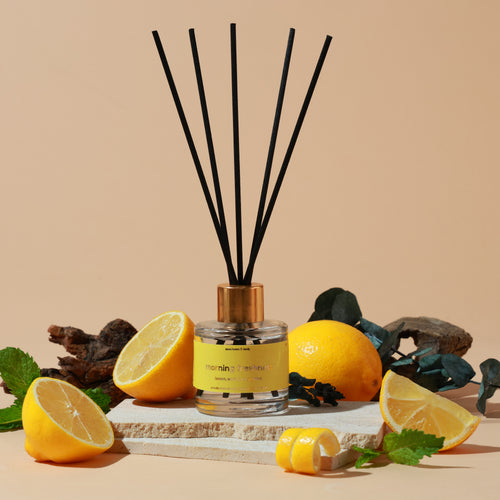
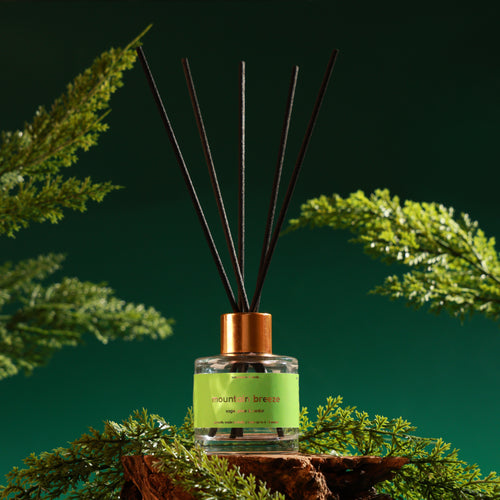
Then the part this page has been heading towards, which is where the scent you actually want goes. On the dresser, the chest of drawers, the shelf or the windowsill beside the wardrobe, at waist height or above. A bedroom is twenty-five or thirty cubic metres of air with a door, a window and people moving through it, which is the volume every room fragrance in existence is composed against, and it dilutes and exchanges continuously — so a product behaves there the way its maker intended and reaches nothing you are going to wear. For this particular corner I would use an alcohol-free reed diffuser, because it needs no socket, no switching on and no routine, and it holds one level for months rather than producing a peak and a fade. Mountain Breeze at ₹849 — Himalayan pine, sage and cedar — is the natural choice if the cedar idea appealed to you, and it is the same register done at the right scale in the right place. Morning Freshness at ₹749 is Malabar lemon, peppermint and eucalyptus and reads as air and laundry rather than as perfume, which suits a getting-dressed corner at half past seven. Evening Calm at ₹799 is lavender and chamomile and belongs on the far side of the room rather than beside the doors. All of them are alcohol-free, take 24 to 72 hours to establish before they are worth judging, and come with 130ml from ₹1,249 and 300ml refills at ₹2,399. If you would rather scent the whole bedroom on a schedule, a Boond at ₹899 or a Sukoon at ₹1,899 runs the water-based Hotel Collection at three to six drops per tank and reaches a steady level in about twenty minutes, with three 15ml scents of your choice included with the Sukoon — keeping the machine at waist height or above, out of the path of a fan or an air-conditioning vent, and well clear of open wardrobe doors, because a cool mist falls rather than rises and hanging cotton takes whatever reaches it. In a damp monsoon month, leave the machine off and use a reed or a candle, since a cool-mist diffuser adds 30 to 50 millilitres of water an hour to a room you may be trying to dry. And expect to stop noticing whatever you choose within a fortnight, which is ordinary adaptation rather than a fault in the product; the answer is one honest guest rather than more drops, and it is certainly not moving the bottle inside the cupboard where you would notice it again.
The SOSA edit
In the order I would actually do it, with the free steps first and four products SOSA does not make sitting above the one it does. The ranking is by transfer risk, because that is the variable this entire page turns on.
| Do | What it is | Why it is in this position | Cost |
|---|---|---|---|
| 1. Air it, thin it, keep it dry ★ | Both doors open for an hour weekly with a fan into the opening; a hand's width of gap on the rail; nothing damp put away | It is the only step that produces the state people are actually describing when they say a cupboard smells good, and it is free | ₹0 |
| 2. Bin the old lining paper | Years-old shelf paper or newspaper thrown out and replaced with fresh plain lining | Paper absorbs steadily and releases steadily. The oldest sheet in a cupboard is frequently its single strongest source | ₹50–₹200 |
| 3. A desiccant, if it is musty rather than stale | Silica gel recharged in the sun, or a calcium-chloride absorber tub. SOSA makes neither | Musty is a humidity problem, and humidity is solved by removing water rather than by adding a smell | ₹100–₹400 |
| 4. Cedar blocks, re-sanded not replaced | Two or three aromatic cedar blocks on a shelf; fine sandpaper across the faces once a year when they go quiet | The oils are bound in the timber and released from the surface only, which is why the output is dry, low and safe around fabric | ₹200–₹600 |
| 5. A dried lavender or herb sachet | Genuine dried herb, squeezed to refresh — not a cloth bag soaked in fragrance oil, which is a different product entirely | Volatile material bound in plant tissue transfers at a rate cotton barely registers. The oil-soaked version does not | ₹100–₹300 |
| 6. A reed on the dresser beside it ★ | Mountain Breeze at ₹849, Morning Freshness at ₹749 or Evening Calm at ₹799, at waist height or above, outside the doors | This is where a chosen scent belongs. The room exchanges and dilutes; the cupboard only accumulates and hands it back on your collar | from ₹749 |
| 7. Boond or Sukoon for the whole room | 300ml, or 500ml for 270–320 sq ft with steady/2H/4H timers and three 15ml scents included, at three to six drops per tank | If you would rather scent the bedroom on a schedule. Keep it clear of open wardrobe doors — cool mist falls rather than rises | ₹899 / ₹1,899 |
| Never inside: anything with an open oil base | No reed, no uncapped bottle, no perfume on cotton wool, no fragrance-soaked sachet among the clothes | A sealed box has no exchange, so the concentration climbs to a level no room reaches, and fine natural fibres hold it longest | — |
Versailles
The thing I would most like a reader to take from this page is a change of target rather than a purchase. Stop trying to make the wardrobe smell of something. Aim for nothing, and put the something in the room. Every cupboard I have ever admired — in a hotel, in a shop, in somebody's beautifully run house — smelled of nothing whatsoever, and the reason it felt luxurious was the absence: cool, dry, uncrowded air with a faint suggestion of clean cotton and no story of its own. That is produced by an hour of open doors a week and some space on the rail, and it cannot be bought.
Where I part company with a lot of the category is the sachet aisle. A cloth bag soaked in fragrance oil, sitting between folded jumpers in a box with no air exchange, is the most reliable way I know to end up with a cashmere you cannot wear to work. Dried lavender is fine. Cedar is fine, and I would rather you sanded your blocks once a year than bought new ones. Everything with an open oil base belongs outside the doors, which is exactly where my own products belong: Mountain Breeze on the dresser at ₹849 if you liked the cedar idea, Morning Freshness at ₹749 if you would rather the corner read as clean air. Eighteen inches makes the whole difference, and it is a free eighteen inches.
Everything is made and supported from Pune, and a part of every order funds girl-child education through Nanhi Kali. You get a home that smells like somewhere you chose; a girl gets a classroom. That equation has always felt right to me.
Frequently asked questions
- Should you put a reed diffuser inside your wardrobe — the same question answered from the other side.
- Why your wardrobe smells of naphthalene — what to use instead of mothballs, and why.
- Why the area around your wardrobe smells stale — the airflow half of the free fix.
- Why your wardrobe smells stale, and how to fix it properly — the complete guide for this group.
- Brand: the SOSA founder story.
Facts verified August 2026: Diagnostic facts used in this guide: a closed room accumulates what it cannot exchange, so cross-ventilation needs two openings rather than one; a drain's U-bend water seal evaporates in roughly two to four weeks of disuse and then admits sewer gas, which is corrected by pouring water down the drain; microbial growth in fabric and on surfaces accelerates above about 60% relative humidity, and Indian monsoon indoor humidity commonly runs 80–95%, which is the one situation where ventilating on a wet day can import moisture rather than remove it; an air-conditioner's cold, wet evaporator coil and filter grow biofilm that is blown into the room on start-up; textiles adsorb cooking aerosol and body oils and re-release them for weeks; and olfactory adaptation makes a constant household smell undetectable to its residents within about a fortnight while visitors still perceive it. Timings: a scented candle scents a normal room in roughly 15–20 minutes, a Sukoon ultrasonic diffuser reaches a steady level in about 20 minutes from cold, and a reed diffuser needs roughly 24–72 hours. SOSA products and prices: Sukoon 500ml ₹1,899 (270–320 sq ft, 16–18h on low, 9–12h high, 30–50 ml/h, 2.4MHz cool mist, remote, steady/2H/4H timers, BPA-free, auto shut-off, includes three 15ml Hotel Collection scents of your choice); Boond 300ml ₹899; Megh 6-litre ₹3,499; waterless Vaayu ₹11,999 (up to 1000m³); Aangan ₹25,999. Hotel Collection water-based fragrance 15ml ₹299, 100ml ₹999, 300ml ₹1,799, Pack of 7 at 15ml ₹1,799; dose 3–6 drops per tank. Reed diffusers (separate alcohol-free line): Morning Freshness from ₹749, Garden Bloom and Evening Calm from ₹799, Fresh Brew and Mountain Breeze from ₹849; 130ml from ₹1,249; duos from ₹1,498; 300ml refills ₹2,399. Scented candles: Bookshop 80g ₹379, Amber Rose 130g ₹599 and 220g ₹799, Smoked Oudh 130g ₹449, ceramic jar candles ₹949, Pure Calm wax melt set ₹854. Free shipping above ₹499. SOSA does not make a room or linen spray for the home. The Hotel Collection scents are SOSA's own interpretations; SOSA is not affiliated with or endorsed by any hotel brand. Prices subject to change — see the live product pages.